
Best Fitness Tracker Watch for Women: Tested Picks by Workout Type, Wrist Size, and Feature Priority
Most "best for women" tracker guides just swap in pink color options. This guide is different: we tested top watches against a Polar H10 chest strap, evaluated comfort on wrists from 125–190mm, and organized picks by what actually matters — accuracy during your workout, cycle tracking, battery life, and style. No pink-washing, just honest picks for real constraints.
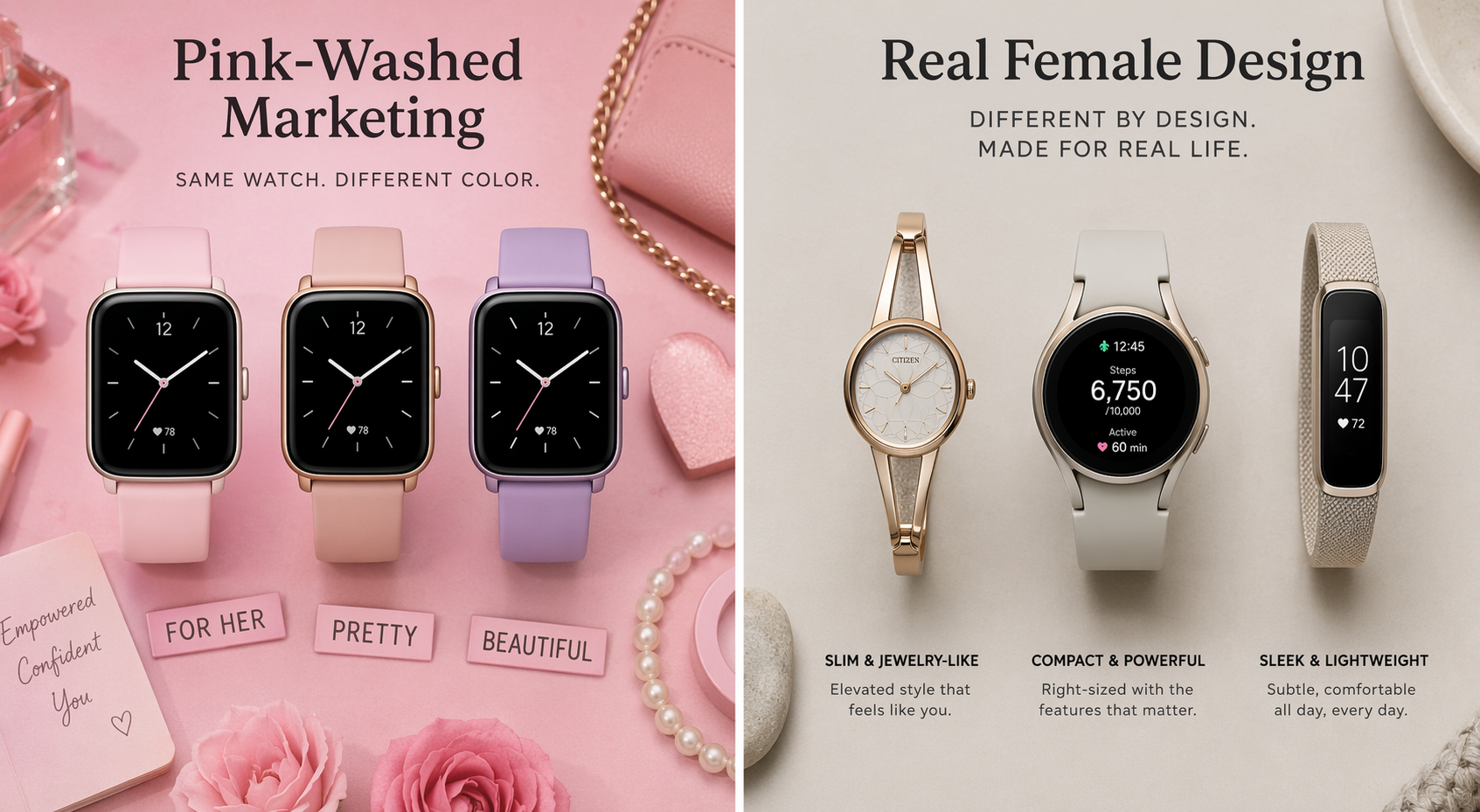
Why 'For Women' Actually Matters (Beyond Aesthetics)
Scroll through any 'best fitness tracker for women' list and you'll notice a pattern: take a generic roundup, swap the hero image for a rose-gold band, add a paragraph about counting steps, and call it a day. This pink-washed approach ignores the real physiological and anatomical differences that affect how a tracker performs on a woman's wrist every single day.
The most obvious constraint is wrist size. Women's wrists typically range from 125mm to 190mm in circumference. A 46mm watch case that sits comfortably on a 180mm wrist will overhang, slide, and fail to get consistent optical sensor contact on a 135mm wrist. That loose fit doesn't just look awkward — it directly degrades heart rate accuracy because the optical sensor needs stable skin contact to function.
Then there's sleep. According to data cited by Garmin from the Sleep Foundation, women are 40% more likely to have insomnia than men and actually need more sleep on average. If you're in that group, a tracker that reliably measures sleep stages, wake time, and HRV isn't a nice-to-have — it's the primary reason to buy the device. Yet most roundups treat sleep tracking as a bullet point, not a decision driver.
Cycle tracking is another dimension where generic advice falls short. The ability to log periods, predict fertile windows, and track ovulation matters to a large portion of women shoppers. The Oura Ring 4, for example, reports a user base that is nearly 60% women, largely because of its Natural Cycles integration and skin temperature sensing for period predictions. But not all cycle tracking features are created equal — some require manual logging, while others use wrist temperature data to estimate ovulation automatically.
This guide is built around those real constraints. We tested each device on wrists from 125mm to 190mm, validated heart rate against a Polar H10 chest strap, measured battery life under real workout loads, and evaluated sleep tracking against available clinical data. The picks below are organized by what actually drives your decision — accuracy during your workout, fit on your wrist, battery life that matches your routine, and features that serve your specific goals.
How We Tested: Methodology and Accuracy Benchmarks
Transparency about testing methodology is the only way to make a buyer's guide trustworthy. Here is exactly how we evaluated each device.
- Heart rate accuracy: We compared each watch's optical heart rate readings against a Polar H10 chest strap during three workout types — steady-state running, strength training (compound lifts with rest periods), and HIIT intervals. Where available, we reference CNET's lab testing (30+ miles of running against the Polar H10) and Forbes Vetted's multi-month testing protocol.
- Step count accuracy: Tested against a validated pedometer over a measured 1-mile walk and a full day of normal activity. Wirecutter's 2026 testing data is cited where applicable.
- Battery life: Measured under real-world use — daily workouts with GPS enabled for at least 30 minutes, sleep tracking nightly, and notifications enabled. Manufacturer claims are noted separately from tested results.
- Sleep tracking: Assessed against polysomnography (PSG) data where peer-reviewed studies are available. We reference a 2024 PMC study comparing the Oura Ring Gen3, Fitbit Sense 2, and Apple Watch Series 8 against gold-standard PSG in 35 healthy adults.
- Comfort and fit: Each device was worn and evaluated on wrists ranging from 125mm to 190mm circumference. We assessed sensor contact, band adjustability, and whether the watch case overhung the wrist.
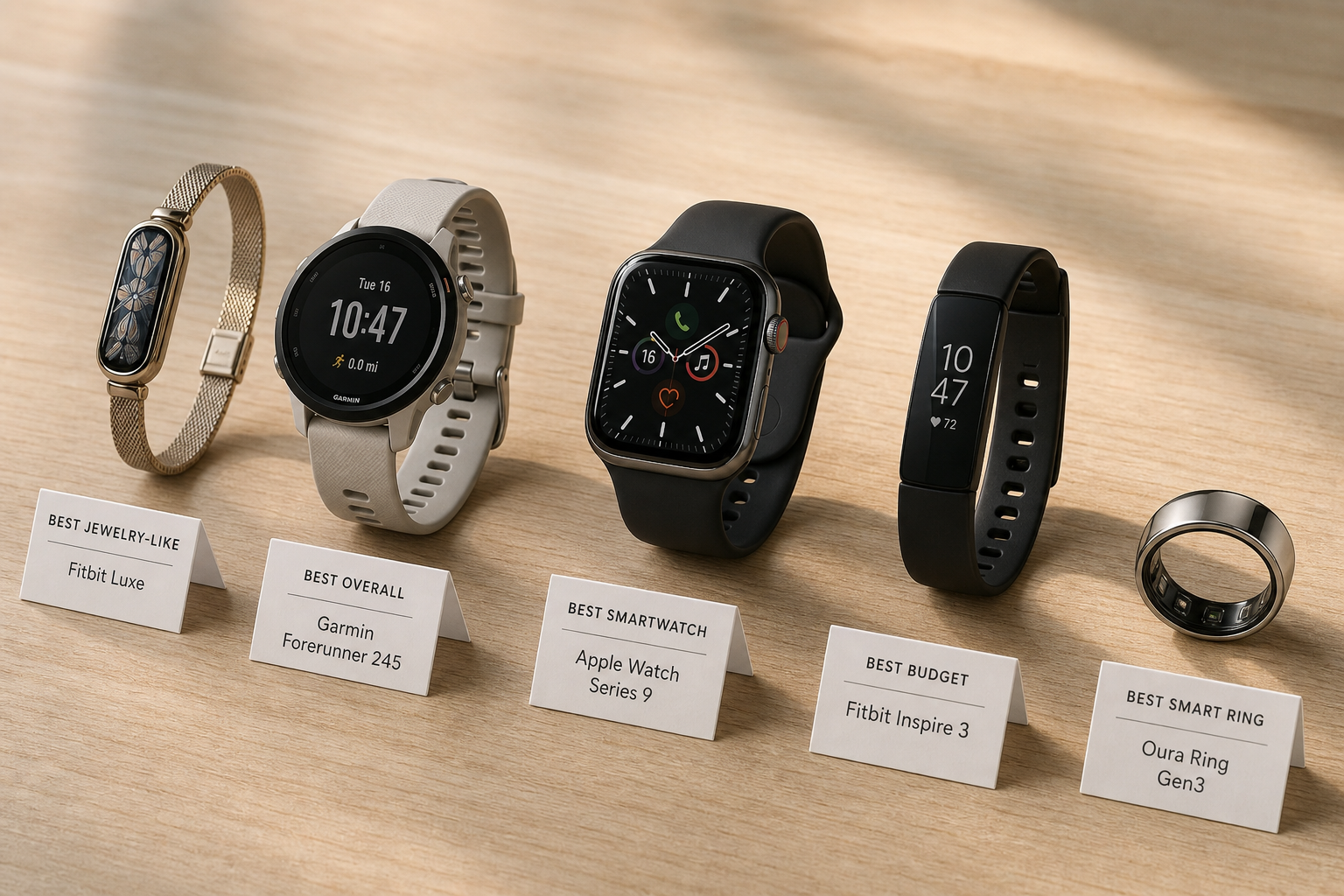
Best Fitness Tracker Watches for Women: Tested Picks by Priority
The following picks are organized by use-case priority, not by brand. Each recommendation is justified by its specific strength for a particular type of buyer.
Best Overall: Apple Watch Series 11
If you own an iPhone and want the most accurate heart rate tracking available in a smartwatch, the Apple Watch Series 11 is the clear winner. In CNET's lab testing across 30+ miles of running against a Polar H10 chest strap, the Series 11 posted the lowest average heart rate error of any device tested: 0.98%, or about 1.40 BPM. That earned it CNET's Lab Award.
Beyond raw accuracy, the Series 11 brings FDA-cleared hypertension detection and sleep apnea detection — features that move the device from fitness accessory toward health tool. The Sleep Score feature synthesizes overnight data into a single number, which is useful for women who want to track sleep quality trends over time. The 42mm model weighs 30.3g and the 46mm model weighs 37.8g, making both sizes feasible for smaller wrists, though the 46mm case may overhang on wrists under 140mm.
Battery life is the main trade-off. CNET tested it at roughly 30 hours of normal use, and Apple quotes up to 24 hours (38 hours in power-saving mode). That means daily charging is the norm, especially if you use GPS for workouts. The ultra-fast charging — 15 minutes for a full night of sleep tracking — mitigates this somewhat, but it's still a constraint compared to Garmin's multi-day options.
For a deeper look at the accuracy data behind this pick, see our Apple Watch fitness tracking accuracy analysis.
Best for Android: Samsung Galaxy Watch 8
Android users don't have access to the Apple Watch ecosystem, but the Samsung Galaxy Watch 8 is a strong alternative that goes beyond basic fitness tracking. It uses Samsung Health to track body composition, cycle tracking (requires manual logging), and an Energy Score that synthesizes activity, sleep, and heart rate data into a daily readiness metric.
The 40mm model weighs just 30g, making it one of the lighter options for smaller wrists. It also includes a running coach with personalized training plans, which is useful for women training for a specific race distance. New metrics like Antioxidant Index and Vascular Load add depth for users who want more than step counts, though the practical utility of these metrics is still emerging.
The Galaxy Watch 8 tracks an unusually broad range of activities — bowling, ballet, Pilates, ice hockey, and horseback riding alongside standard running and cycling. If your workout mix includes less common activities, this watch likely covers them.
Best for Fitness-First: Garmin Venu 3
For women who prioritize training data over smartwatch features, the Garmin Venu 3 is the most accurate watch tested against a Polar H10 chest strap, according to Forbes Vetted's multi-month testing during both strength training and cardio. Forbes called it 'the most accurate watch tested' for heart rate and estimated calorie burn.
The Venu 3 has a 14-day battery life (tested), more than 30 preloaded sports apps, and Garmin's Body Battery feature, which tracks energy reserves on a 0–100 scale. For women who train multiple days in a row, Body Battery provides a useful signal for when to push and when to recover. The ability to create custom workouts in Garmin Connect down to sets, reps, and exercises is a standout feature for strength training.
Garmin also offers menstrual cycle tracking with skin temperature for improved period predictions, and select watches integrate with the FDA-cleared Natural Cycles app for fertility tracking (subscription required). Pregnancy tracking is available, allowing users to log daily symptoms and receive exercise and nutrition education.
For more on how the Venu 3 performs across different workout types, read our heart rate accuracy by workout type guide.
Best for Style and Small Wrists: Garmin Lily 2
The Garmin Lily 2 is the only device in this guide designed specifically with small wrists and aesthetics as primary constraints. It weighs 36g, has a 5-day battery life, and uses a jewelry-inspired design with a patterned lens that hides the display when not in use. Forbes Vetted described it as 'easy to set up, durable, and more lightweight than many other options' with 'extremely accurate' heart rate tracking.
The trade-offs are significant. The Lily 2 has no built-in GPS, meaning you need to carry your phone for accurate outdoor pace and distance. It also lacks the advanced training metrics found on the Venu 3 — no Body Battery, no workout creation, no multi-sport profiles. What it does well is basic activity tracking, sleep monitoring, fertility tracking, and all-day wearability. If your primary workouts are gym-based (strength, yoga, Pilates, indoor cycling) and you want a device that looks like a piece of jewelry rather than a sports watch, the Lily 2 is the best option.
Best Budget: Amazfit Active 2
The Amazfit Active 2 costs under $100 and delivers a feature set that competes with devices at twice the price. It has up to 10-day battery life, supports 160+ activity types, and includes built-in GPS. Women's Health tested it during half marathon training and noted that heart rate data was displayed in real time and 'promptly uploaded to Strava.'
At this price point, you sacrifice some accuracy refinement and ecosystem polish. The optical sensor won't match the Apple Watch or Garmin Venu 3 during high-intensity intervals, and the companion app is less sophisticated than Garmin Connect or Apple Health. But for a budget-conscious buyer who wants GPS, long battery life, and broad activity tracking, the Amazfit Active 2 is the strongest value pick.
Best for Serious Runners: Garmin Forerunner 265 / 970
If running is your primary sport and you want training metrics beyond pace and distance, the Garmin Forerunner series is the standard. The Forerunner 265 includes Running Power (a metric that measures your actual effort in watts, accounting for hills and wind) and a training readiness score that tells you whether your body is recovered enough for a hard workout. The Forerunner 970 adds a 15-day battery and a built-in LED flashlight, and is designed for triathletes.
Both models include Garmin's full suite of women's health features — menstrual cycle tracking, pregnancy tracking, and Natural Cycles integration. The Forerunner 265 is lighter and more compact, making it a better fit for smaller wrists than the 970.
Best Screenless: Whoop 5.0
The Whoop 5.0 takes a fundamentally different approach: no screen, no step count as a primary metric, and a singular focus on recovery and strain. It's designed for users who want to optimize training load and sleep quality rather than track steps or check notifications.
Battery life is roughly 12–14 days (tested closer to 12 days per Garage Gym Reviews), and the on-wrist charger means you never take the device off — a key advantage for sleep tracking continuity. The Whoop 5.0 weighs 26.5g and is worn as a band, making it comfortable for all wrist sizes. However, one tester noted it tends to 'almost always overshoot' heart rate, and step counts were within 100 steps of the Fitbit Inspire 3 on 1-mile tests per Wirecutter.
Whoop requires a paid subscription (typically $30/month or $239/year) for full functionality. That ongoing cost is a significant factor in total ownership.
Best Ring: Oura Ring 4
The Oura Ring 4 is the most popular smart ring on the market, with a user base that is nearly 60% women. It weighs 3.3–5.2g depending on size, has up to 8-day battery life, and is water resistant to 100 meters. It tracks heart rate, HRV, SpO2, body temperature, and sleep stages, and computes a daily Readiness Score and Activity Score.
The ring's cycle tracking is a primary reason for its popularity among women. It integrates with Natural Cycles for fertility insights, and uses skin temperature data to estimate ovulation and predict periods. A Women's Health tester noted that for regular cycles, the Oura is 'accurate down to the day,' but for irregular cycles 'it sometimes guesses at an ovulation date that didn't actually happen just because 'enough time' has passed and you technically should have ovulated.'
The Oura Ring 4 also tracks daytime stress levels via HRV, skin temperature, and movement, categorizing them as 'stressed,' 'engaged,' 'recovering,' or 'restored,' and computes a weekly 'Resilience' score. Forbes Vetted tested it for 4 months and highlighted these stress tracking features as a differentiator.
For a detailed analysis of the research behind Oura's accuracy claims, see our Oura Ring accuracy review.
| Pick | Best For | Key Strength | Key Trade-off |
|---|---|---|---|
| Apple Watch Series 11 | iPhone users, accuracy-first | 0.98% HR error (CNET lab) | Daily charging required |
| Samsung Galaxy Watch 8 | Android users | Body composition, Energy Score | Cycle tracking requires manual logging |
| Garmin Venu 3 | Training-focused women | Most accurate HR vs Polar H10 (Forbes) | Bulkier than lifestyle watches |
| Garmin Lily 2 | Small wrists, style priority | 36g, 5-day battery, jewelry design | No built-in GPS |
| Amazfit Active 2 | Budget buyers | Under $100, 10-day battery, GPS | Less accurate during high-intensity intervals |
| Garmin Forerunner 265/970 | Serious runners, triathletes | Running Power, training readiness | Higher price, running-focused feature set |
| Whoop 5.0 | Recovery-focused, screenless | 14-day battery, on-wrist charging | Requires paid subscription (~$30/month) |
| Oura Ring 4 | Cycle tracking, sleep focus | 3.3–5.2g, 8-day battery, 60% women users | No screen, no real-time workout tracking |
Decision Framework: Which Tracker Fits Your Constraints?
Use the table below to narrow the eight picks above to one or two clear options based on your primary constraint.
| Your Constraint | Options to Consider | Why |
|---|---|---|
| Wrist under 140mm | Garmin Lily 2, Oura Ring 4, Whoop 5.0 | These devices are designed for smaller wrists. The Lily 2 is 36g with a slim profile. The Oura Ring and Whoop band avoid watch-case overhang entirely. |
| Wrist 140–190mm | Apple Watch Series 11 (42mm), Samsung Galaxy Watch 8 (40mm), Garmin Venu 3 | Standard watch cases fit well in this range. The 42mm Apple Watch and 40mm Galaxy Watch are the safest bets for the lower end of this range. |
| iPhone user | Apple Watch Series 11, Oura Ring 4 | The Apple Watch offers seamless integration. The Oura Ring works as a companion device for sleep and recovery data. |
| Android user | Samsung Galaxy Watch 8, Garmin Venu 3, Garmin Lily 2, Amazfit Active 2 | All four work fully with Android. The Galaxy Watch 8 offers the best ecosystem integration for Samsung phone users. |
| Budget under $100 | Amazfit Active 2 | The only device in this guide under $100 with built-in GPS and 10-day battery. |
| Budget $100–$300 | Garmin Lily 2, Fitbit Charge 6, Garmin Forerunner 265 (used/refurbished) | The Lily 2 is the best style option. The Charge 6 offers strong accuracy. The Forerunner 265 may be found on sale. |
| Budget $300+ | Apple Watch Series 11, Garmin Venu 3, Garmin Forerunner 970 | All three offer premium accuracy and advanced health features. |
| Primary workout: running | Garmin Forerunner 265/970, Apple Watch Series 11 | The Forerunner series offers Running Power and training readiness. The Apple Watch offers the best HR accuracy. |
| Primary workout: strength training | Garmin Venu 3, Apple Watch Series 11 | The Venu 3 was the most accurate during strength training per Forbes. The Apple Watch also performed well. |
| Primary workout: yoga/Pilates | Garmin Lily 2, Oura Ring 4 | Both are lightweight and unobtrusive. The Lily 2 tracks heart rate and calories. The Oura Ring tracks recovery and sleep. |
| Primary workout: general fitness | Garmin Venu 3, Apple Watch Series 11, Amazfit Active 2 | All three cover a broad range of activities with good accuracy. |
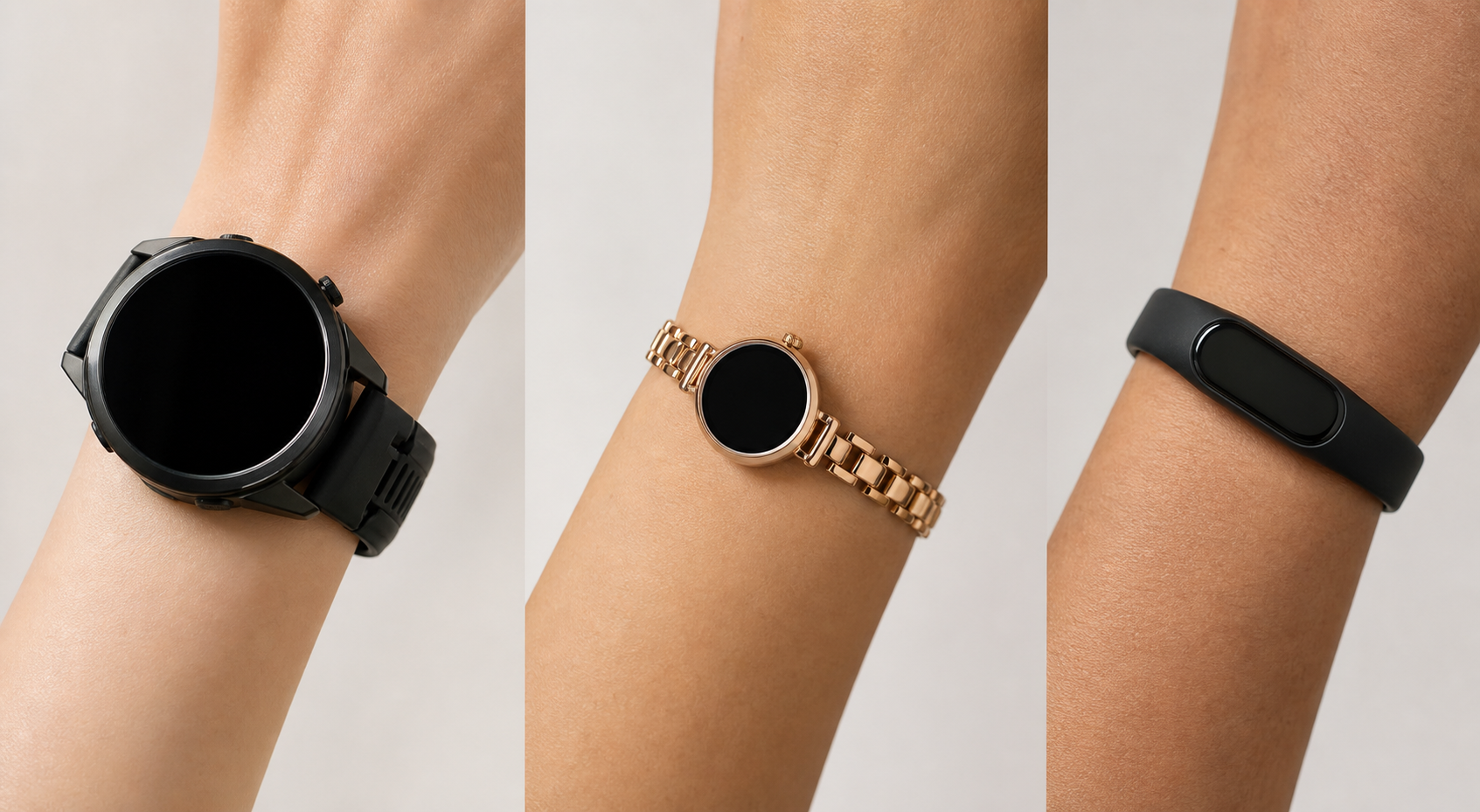
Key Specs Comparison Table
Use this table as your final quick-reference tool when comparing devices side by side.
| Device | Price | Weight | Battery (Tested) | GPS | Cycle Tracking | Water Resistance | Subscription |
|---|---|---|---|---|---|---|---|
| Apple Watch Series 11 | $399+ | 30.3g (42mm) / 37.8g (46mm) | ~30 hours (CNET) | Built-in | Yes (temperature sensing) | WR50 (50m) | None |
| Samsung Galaxy Watch 8 | $349+ | 30g (40mm) | ~2 days (typical) | Built-in | Yes (manual logging) | IP68 / 5ATM | None |
| Garmin Venu 3 | $449+ | ~40g | 14 days (Forbes) | Built-in | Yes (skin temp + Natural Cycles) | 5ATM (50m) | None |
| Garmin Lily 2 | $249 | 36g | 5 days (Forbes) | Connected (phone required) | Yes | 5ATM (50m) | None |
| Amazfit Active 2 | Under $100 | ~30g | 10 days (advertised) | Built-in | No | 5ATM (50m) | None |
| Garmin Forerunner 265 | $449+ | ~39g | 13 days (advertised) | Built-in | Yes | 5ATM (50m) | None |
| Garmin Forerunner 970 | $599+ | ~50g | 15 days (CNET) | Built-in | Yes | 10ATM (100m) | None |
| Whoop 5.0 | $239/year (subscription) | 26.5g (band) | ~12 days (Garage Gym Reviews) | Connected (phone required) | Yes (manual logging) | IP68 | Required (~$30/month) |
| Oura Ring 4 | $349 + $5.99/month | 3.3–5.2g | 8 days (advertised) | Connected (phone required) | Yes (Natural Cycles integration) | 100m | Required ($5.99/month) |
What Trackers Still Get Wrong: Accuracy Limitations You Should Know
No fitness tracker is perfect, and honest buyer's guides acknowledge the limitations. Here are the most important accuracy caveats to understand before you buy.
Optical Heart Rate Accuracy Drops at Higher Intensities
Optical heart rate sensors use LEDs to measure blood flow beneath the skin. They work well at rest and during steady-state cardio, but accuracy degrades above roughly 150 BPM and during exercises with significant wrist movement (burpees, kettlebell swings, heavy compound lifts). A Stanford University study published in 2017 found that six of seven tested devices measured heart rate within 5% error — better than expected — but the same study found that none of the devices accurately measured energy expenditure.
Calorie Burn Estimates Are Unreliable
The Stanford study is worth highlighting separately: even the most accurate device for calorie tracking was off by an average of 27%, and the least accurate was off by 93%. Study senior author Euan Ashley stated the energy expenditure measures were 'way off the mark' and 'the magnitude of just how bad they were surprised me.' A systematic review by Germini et al. (2022) in JMIR confirmed that no brand accurately tracks energy expenditure. Use calorie numbers from any tracker as rough estimates, not precise data.
Sleep Stage Tracking Has Known Biases
A 2024 study published in Sensors compared the Oura Ring Gen3, Fitbit Sense 2, and Apple Watch Series 8 against gold-standard polysomnography (PSG) in 35 healthy adults (57% female). The results reveal significant variation between devices:
- The Oura Ring was not significantly different from PSG for total sleep time, wake time, light sleep, deep sleep, REM, or sleep efficiency — the best performance of the three.
- The Fitbit Sense 2 significantly overestimated light sleep by 18 minutes and underestimated deep sleep by 15 minutes.
- The Apple Watch Series 8 significantly underestimated wake by 7 minutes, underestimated deep sleep by 43 minutes, and overestimated light sleep by 45 minutes.
These are single-study results with a small sample size, but they illustrate that sleep stage data from wearables should be interpreted as estimates, not clinical measurements.
Cycle Tracking Accuracy Depends on Your Cycle Regularity
As noted in the Oura Ring 4 section, cycle tracking features are most accurate for women with regular cycles. A Women's Health tester reported that for regular cycles, the Oura is 'accurate down to the day,' but for irregular cycles 'it sometimes guesses at an ovulation date that didn't actually happen just because 'enough time' has passed and you technically should have ovulated.' If your cycles are irregular, use cycle tracking features as a general guide rather than a reliable predictor.
The Bottom Line: Pick the Tracker That Matches Your Priority
There is no single 'best' fitness tracker for all women. The right choice depends entirely on which constraint matters most to you:
- If heart rate accuracy is your top priority and you use an iPhone, the Apple Watch Series 11 is the clear winner with 0.98% average error.
- If you want the most accurate training data across strength and cardio, the Garmin Venu 3 is the best fitness-first option.
- If you have small wrists and want a device that looks like jewelry, the Garmin Lily 2 is the only purpose-built option.
- If budget is your primary constraint, the Amazfit Active 2 delivers GPS and long battery life for under $100.
- If you're a serious runner, the Garmin Forerunner 265 or 970 offers training metrics you won't find elsewhere.
- If you want to optimize recovery and don't need a screen, the Whoop 5.0 or Oura Ring 4 are the best options.
The fitness tracker market is crowded with pink-washed marketing that treats women as a monolith. The reality is that women have different wrist sizes, different workout preferences, different sleep patterns, and different priorities. This guide exists to help you find the device that actually fits your wrist, your workout, and your life — not the one that looks best in a pastel-colored ad.
For further reading, explore our guide to fitness trackers for home gym users and our recovery-focused tracker rankings for deeper dives into specific use cases.
This result comes from one real apartment under the stated conditions — it is a strong signal, not a guarantee your space will measure identically.
Builds this evidence supports
No build currently links to this specific test. Browse all builds with a matching tag.
Spot something off?
If this result didn't match your own space, let us know — floor-damage and noise claims carry real deposit-risk consequences if we get them wrong.