
How Accurate Is Your Smart Watch? A Practical Guide to Understanding Smart Watch Fitness Data
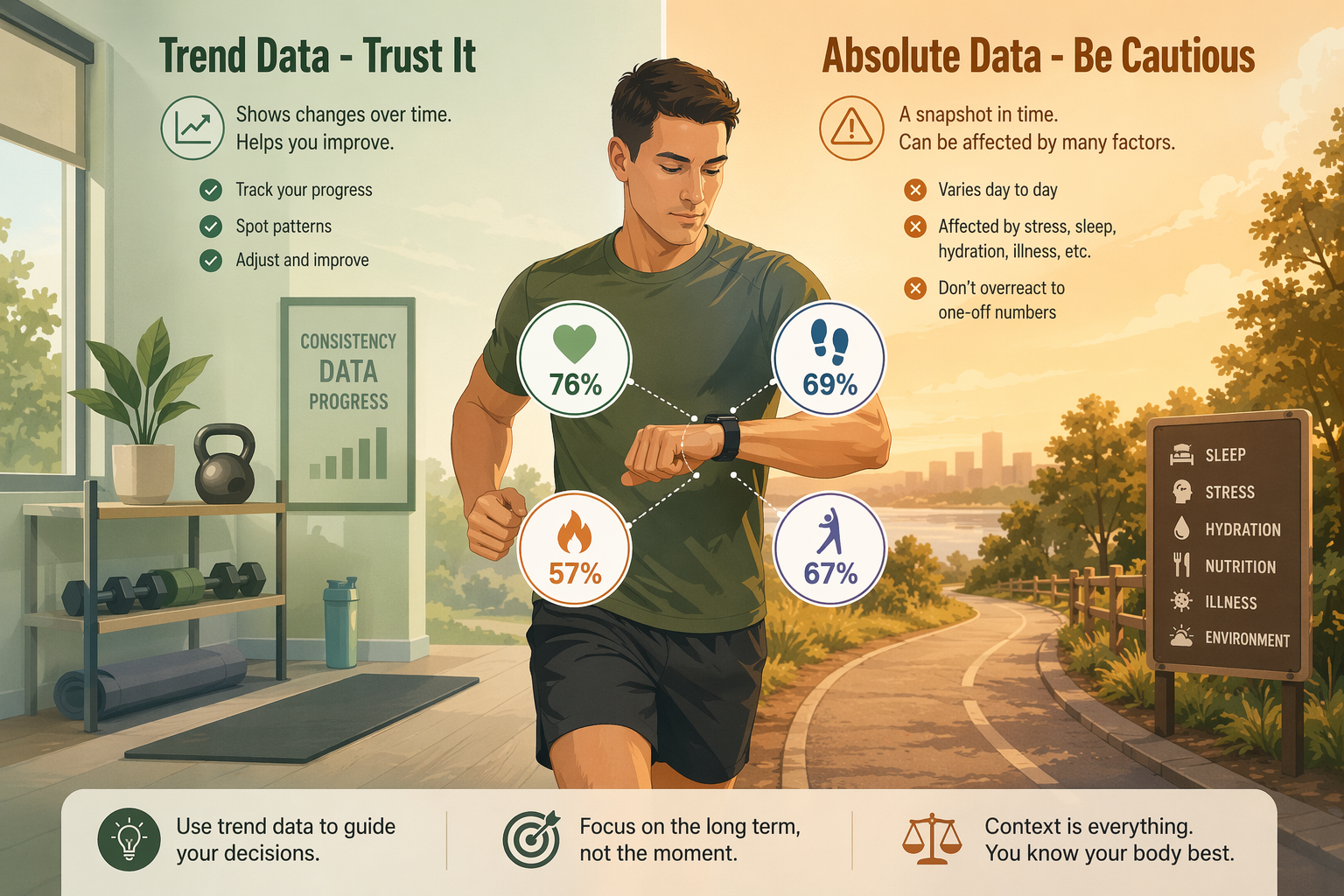
Smart watches are only about 67% accurate across key fitness metrics, but that doesn't make the data useless. This guide breaks down which metrics you can trust, which brands lead in accuracy, and how to use imperfect data as a trend tool rather than a measurement tool.
The Smart Watch Accuracy Debate: What the Science Actually Says
If you have ever finished a hard workout, glanced at your wrist, and wondered whether the number staring back at you is real or a polite fiction, you are not alone. The gap between what a smart watch reports and what is actually happening in your body is larger than most users realize — and it varies wildly depending on which metric you are looking at.
This is not an argument to throw your device in a drawer. The counterintuitive truth is that even imperfect data can be genuinely useful — if you know which numbers to trust, which to ignore, and how to interpret the rest as trends rather than measurements. The goal of this guide is to give you that framework, grounded in the best available research, so you can stop second-guessing your watch and start using it for what it does best: keeping you moving in the right direction over time.
The 67% Reality: What a Meta-Analysis of 45 Studies Found
In 2025, researchers at WellnessPulse aggregated data from 45 peer-reviewed scientific studies — representing 168 individual data points — to calculate a single number that the wearable industry rarely talks about: the average overall accuracy of consumer fitness trackers across heart rate, step count, and calorie expenditure. The result was 67.40%.
That number is sobering only until you break it down by metric. Accuracy is not uniform across the board. Some measurements are reasonably reliable; others are essentially guesses dressed up in a clean interface.
| Metric | Average Accuracy | Reliability Rating |
|---|---|---|
| Heart rate | 76.35% | Moderate — useful for trends |
| Step count | 68.75% | Moderate — good for daily trends |
| Calorie expenditure | 56.63% | Poor — treat as an estimate only |
| Overall (all metrics) | 67.40% | Useful with caveats |
The hierarchy that emerges is consistent across nearly every study in the analysis: heart rate is the metric manufacturers have optimized hardest, step count is moderately reliable but prone to miscounts during non-walking activities, and calorie burn is the weakest link by a wide margin. Understanding this hierarchy is the first step toward using your watch intelligently.
Brand-by-Brand Accuracy: Apple, Garmin, Fitbit, and Beyond
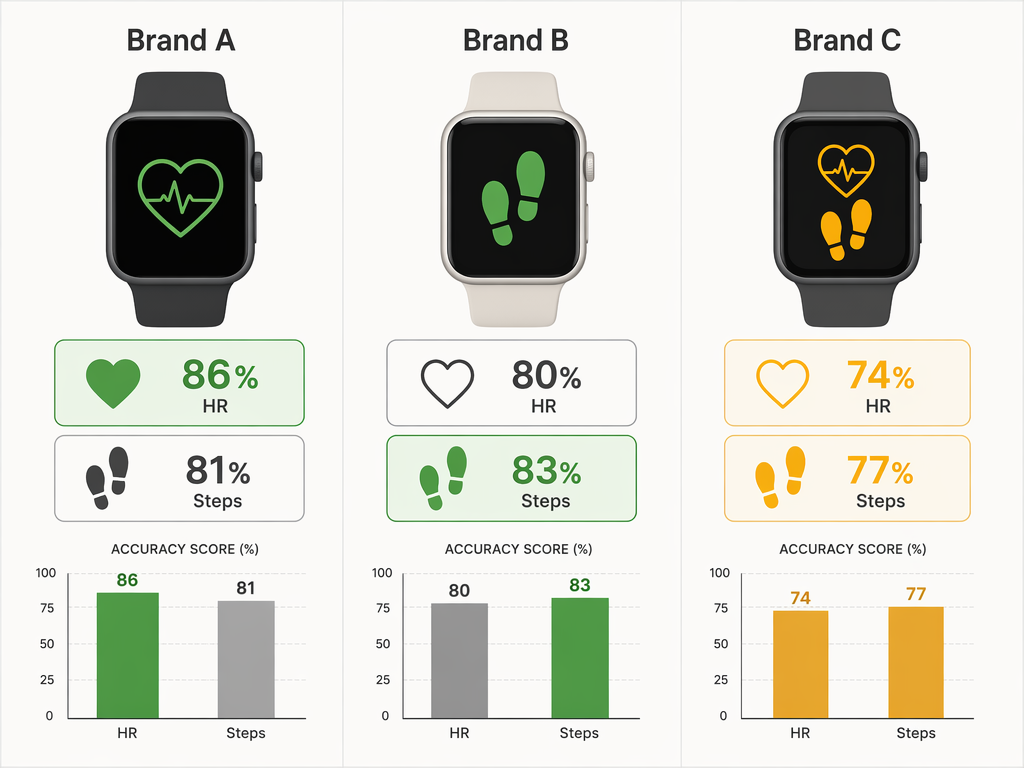
Not all watches are created equal, and the meta-analysis data makes the differences clear. When you look at brand-level performance, a distinct leader emerges for each metric — and the gaps are large enough to matter for anyone who trains with specific data goals.
| Brand | Heart Rate Accuracy | Step Count Accuracy | Calorie Accuracy |
|---|---|---|---|
| Apple Watch | 86.31% | 81.07% | 71.02% |
| Garmin | Not specified in meta-analysis | 82.58% | Not specified in meta-analysis |
| Fitbit | 73.56% | 77.29% | Not specified in meta-analysis |
| Jawbone | Not specified in meta-analysis | 57.91% | Not specified in meta-analysis |
| Polar | Not specified in meta-analysis | 53.21% | Not specified in meta-analysis |
These aggregate numbers are reinforced by real-world testing. In April 2026, CNET ran a 30-mile test comparing five smartwatches against a Polar H10 chest strap — the gold standard for consumer heart rate monitoring. The Apple Watch Series 11 posted an average error of just 1.4 beats per minute (less than 1% deviation), earning CNET's Labs Award for most accurate heart rate tracking. The Garmin Venu 4 recorded a 3.89% error rate (5.5 bpm average), though it sampled data every second versus every five seconds on the Apple Watch, giving it an edge for capturing rapid changes during interval work.
For distance and step count, the field is much tighter. CNET found that all five watches tested were within a tenth of a mile of actual distance over 30 miles, and step count deviations were under 11 steps per watch — less than 0.5% error. This suggests that the hardware for basic motion tracking has matured to the point where brand choice matters less for step and distance accuracy than it does for heart rate and calories.
Why Your Smart Watch Gets It Wrong: Factors That Degrade Accuracy
Even the best optical sensor has fundamental limitations that no amount of algorithm tuning can fully eliminate. Understanding these factors helps explain why your watch might nail your resting heart rate but completely miss your peak during a sprint interval.
- Wrist movement artifacts. Optical heart rate sensors work by shining light through the skin and measuring blood volume changes. When your wrist is in motion — swinging during a run, flexing during a push-up — the sensor shifts relative to the skin, introducing noise that the algorithm has to filter out. This is why wrist-based HR is least accurate during activities with high wrist articulation.
- Skin tone variations. Multiple peer-reviewed studies have documented that optical sensors perform differently across skin tones. Darker skin absorbs more light, which can reduce the signal-to-noise ratio for the photoplethysmography (PPG) sensor. The WellnessPulse analysis specifically cites study PMC9662769 on this point. Some manufacturers have improved their multi-wavelength LED arrays in recent years, but the gap has not been eliminated.
- Exercise intensity and heart rate lag. During rapid heart rate rises — the first 30–60 seconds of a hard interval, for example — optical sensors consistently lag behind the true rate. CNET's testing found that above 160 bpm, some watches missed the peak heart rate entirely. The sensor is measuring what your heart was doing a few seconds ago, not what it is doing right now.
- Arm position during weight training. When you grip a barbell, dumbbell, or pull-up bar, the muscles and tendons in your forearm tense and shift, changing the optical path between the sensor and the blood vessels. This is why many users see their watch report a heart rate of 80 bpm during a heavy set of deadlifts when their actual rate is closer to 150.
- Improper strap fit. As Consumer Reports notes, a strap that is too loose lets in ambient light and allows the sensor to shift; a strap that is too tight restricts blood flow and distorts the reading. The ideal fit is snug enough that the sensor does not move during activity but not so tight that it leaves deep indentations.
What to Trust vs. What to Ignore: A Metric-by-Metric Guide
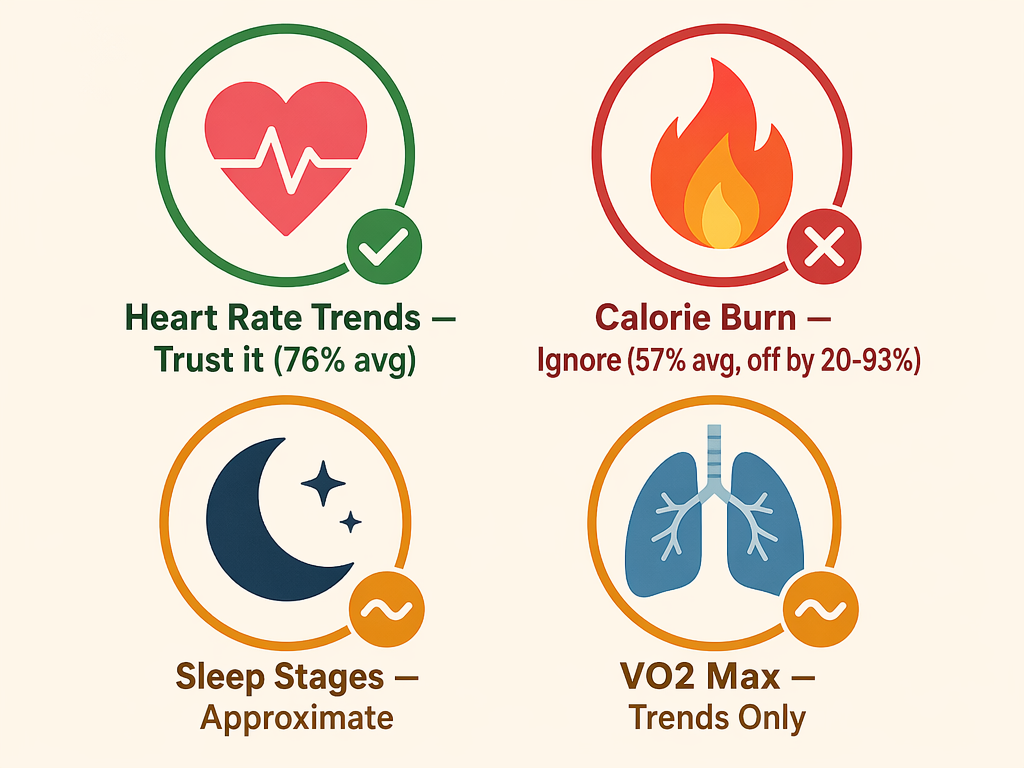
Not all data from your wrist deserves equal attention. Some metrics are reliable enough to inform decisions; others are best treated as entertainment. Here is the practical breakdown.
| Metric | What to Do | Why |
|---|---|---|
| Heart rate (trends) | Trust for trends; verify peaks with chest strap | 76% average accuracy; Apple Watch within 1% of chest strap in CNET testing; optical lag at high intensity |
| Step count | Trust for daily trends; ignore for non-walking activity | 69% average accuracy; all major brands within 0.5% error in distance testing |
| Calorie burn | Ignore entirely | 57% average accuracy; off by 20–93% per PubMed systematic review; MAPE >30% for all brands |
| Sleep stages (light, deep, REM) | Treat as approximate; focus on total sleep time | No large-scale accuracy data available; stage classification algorithms vary widely by brand |
| VO2 max estimate | Useful for trend tracking over months; ignore single readings | Estimates improve with consistent GPS running data; single readings are noisy |
The calorie number deserves special emphasis because it is the metric most likely to mislead users into poor decisions — eating back "earned" calories, choosing a workout based on burn estimates, or feeling discouraged when the number seems low. A 2022 systematic review published in PubMed (Germini et al.) found that mean absolute percentage error for energy expenditure exceeded 30% for every brand tested. That means a workout that actually burned 400 calories could be reported anywhere from 280 to 520 calories — or worse. The 20–93% range cited in the WellnessPulse analysis comes from the same body of literature.
How to Use Imperfect Data Intelligently
The most important concept in wearable data interpretation is internal consistency. As Wareable's editor Conor Allison puts it: "The secret that most brands won't tell you is that the app is more important than the hardware." A tracker that is consistently wrong by the same margin — say, it always undercounts your steps by 5% — is still useful for tracking trends because the error is stable. You can compare this week to last week and know whether you are moving more or less, even if the absolute number is off.
A cheap tracker is useless if its app is a confusing mess. Internal consistency matters more than absolute accuracy — a tracker consistently wrong by the same margin is still useful for trend tracking.
Here is how to put that principle into practice:
- Focus on direction, not magnitude. Ask "Am I averaging more steps this month than last month?" rather than "Did I hit exactly 10,000 steps today?" The trend direction is far more reliable than any single day's number.
- Use week-over-week comparisons. Daily fluctuations from hydration, sleep quality, and sensor placement noise are high. A seven-day rolling average smooths out most of that noise and gives you a signal worth acting on.
- Supplement for critical sessions. If you do structured heart rate zone training, use a chest strap for those workouts. Your smart watch is fine for casual runs and daily steps, but interval sessions and threshold work deserve better hardware.
- Ignore the calorie number. This bears repeating. No consumer wearable measures calorie expenditure accurately. Do not let it influence your eating, your workout choices, or your mood.
- Wear it consistently. The best device is the one you will actually wear every day. A less accurate tracker worn daily gives you better trend data than a more accurate tracker that sits in a drawer because it is uncomfortable or has poor battery life.
The evidence that even imperfect data drives positive behavior change is strong. A 2022 study published in The Lancet found that fitness tracker users walked up to 40 more minutes per day and lost an average of 1 kg over five months compared to non-users. The data does not need to be perfect to be effective — it just needs to be consistent enough to keep you engaged and aware.
The Hidden Risks of Over-Reliance on Your Smart Watch
While the benefits of wearable data are real, there is a darker side to the constant stream of numbers. Over-reliance on smart watch data carries three distinct risks that are worth naming explicitly.
- Health anxiety from obsessive tracking. An article in the American Heart Association journal has documented the risk of health anxiety arising from constant self-monitoring. When every heart rate spike, every low step count day, and every "unproductive" readiness score becomes a source of worry, the tool meant to improve health starts to undermine it. If you find yourself checking your watch more than you check how you actually feel, it is time to step back.
- False reassurance from inaccurate readings. The flip side of anxiety is false confidence. A watch that reports a low heart rate during a hard effort might lead you to push harder than is safe. A sleep score that says you had "great" sleep when you actually woke up feeling exhausted can mask real recovery issues. The data is a guide, not a verdict.
- The deflated step count effect. A 2023 experiment cited in the WellnessPulse analysis found that when participants were shown artificially deflated step counts, they reduced their physical activity and their blood pressure increased. Seeing a lower number than expected can be demotivating — it signals failure even when you are moving plenty. This is a design problem with how the data is presented, not a problem with your effort.
Practical Recommendations for Home Fitness Users
After reviewing the research, the testing data, and the real-world experiences of thousands of users, the practical takeaways for home fitness are straightforward.
- Use your smart watch for trend tracking and motivation, not clinical measurements. The 67% overall accuracy figure is not a reason to stop wearing your device — it is a reason to adjust your expectations. Your watch is a coach, not a diagnostic tool.
- Supplement with a chest strap if you do structured heart rate training. For zone-based runs, threshold intervals, or any workout where heart rate precision matters, a chest strap is a worthwhile investment. It removes the optical sensor limitations entirely.
- Ignore calorie burn numbers completely. This is the single most actionable recommendation in this article. The data is not accurate enough for any decision — not for eating, not for workout selection, not for comparing one activity to another. Treat it as a rough relative indicator at best.
- Focus on consistency over absolute accuracy. A watch that is consistently off by the same margin is still useful. Compare this week to last week, this month to last month. The direction of change is what matters.
- Wear the device that fits your life. The most accurate sensor in the world is useless if the device is uncomfortable, has poor battery life, or lives in a drawer. As Wareable notes, the app experience and daily wearability matter more than marginal hardware differences.
If you are in the market for a new device and want to choose based on accuracy for the metrics that matter most to you, our decision-matrix buying guide breaks down the trade-offs by user type. And if recovery metrics — sleep, HRV, readiness — are your primary concern, our recovery tracker ranking evaluates which devices do the best job at the metrics that matter for rest and adaptation.
This result comes from one real apartment under the stated conditions — it is a strong signal, not a guarantee your space will measure identically.
Builds this evidence supports
No build currently links to this specific test. Browse all builds with a matching tag.
Spot something off?
If this result didn't match your own space, let us know — floor-damage and noise claims carry real deposit-risk consequences if we get them wrong.