
Screenless Fitness Tracker Buyer's Guide 2026: Best Options by Budget and Use Case
The screenless fitness tracker market has been reshaped by the $99 Fitbit Air. This guide compares the top bands, rings, and hybrids across price, subscription cost, accuracy, and battery life to help you choose the right device for your budget and training goals.
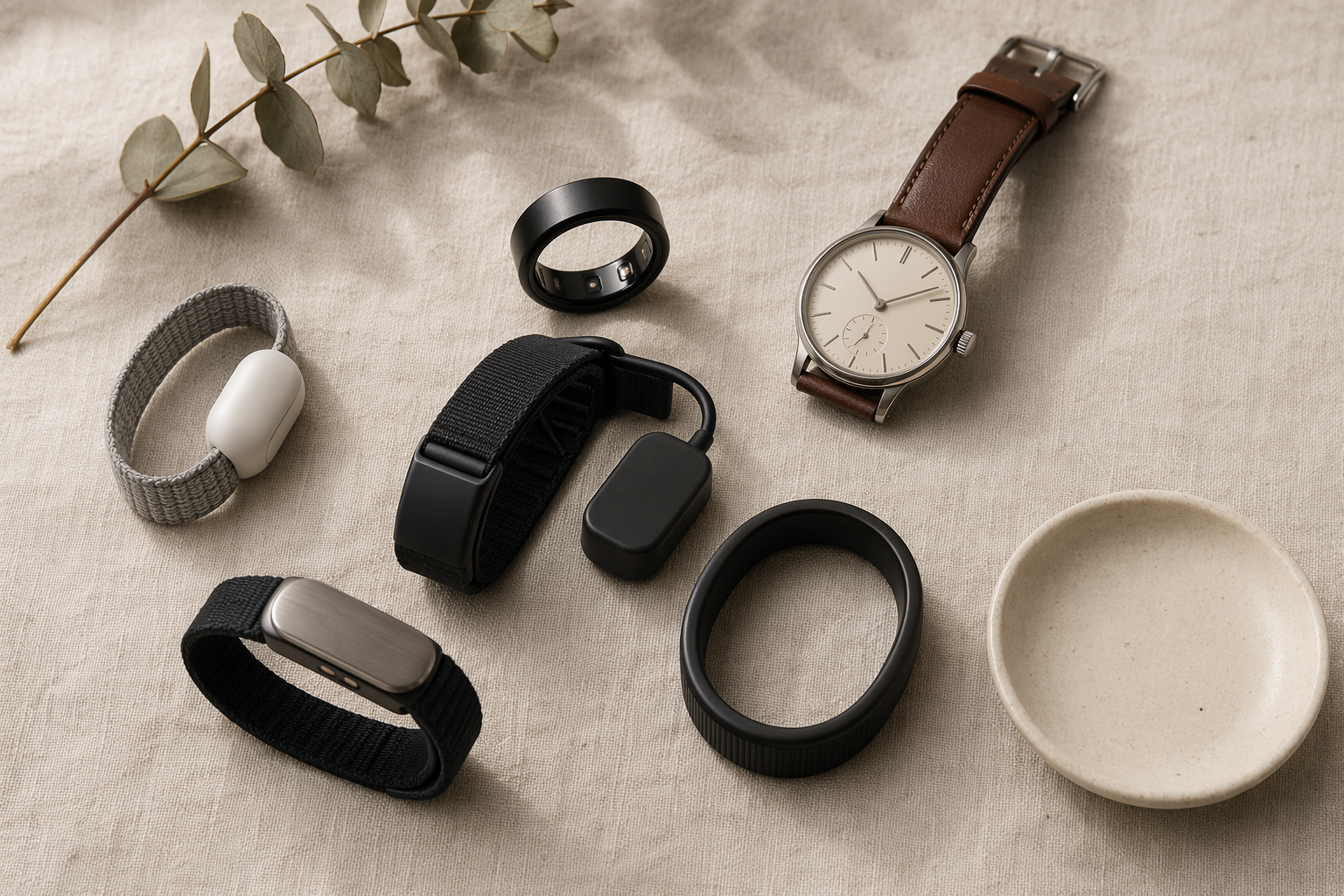
What Is a Screenless Fitness Tracker and Why Now?
A screenless fitness tracker is a wearable device that captures health and activity data — heart rate, sleep stages, HRV, steps, training load — without a visual display. Instead of a touchscreen or watch face, these devices communicate through haptic vibrations, a single LED indicator, or a companion smartphone app. The form factor is deliberately minimal: a slim band, a pod clipped to a strap, or a ring worn on a finger.
The category has existed for years — Whoop launched its first strap in 2015 — but 2026 marks a turning point. Three cultural and market forces have converged to push screenless trackers from a niche athlete tool to a mainstream purchase consideration.
- Digital detox and JOMO (Joy of Missing Out): A growing number of people want to reduce screen time without abandoning data-driven health tracking. Wearing a device with no notifications, no email previews, and no app grid removes the constant pull to check a wrist display.
- Analog watch stacking: Enthusiasts who wear mechanical or traditional watches are pairing them with a screenless band or ring on the other wrist. This lets them keep their preferred timepiece while still capturing sleep, HRV, and activity data.
- The Fitbit Air disruption: In May 2026, Fitbit released the Air — a $99 screenless pod with no mandatory subscription. That single launch reset buyer expectations for what a capable, subscription-free tracker should cost and forced every competitor to justify its pricing model.
Battery life is another structural advantage. Screenless trackers typically last 7 to 14 days on a single charge, compared to 1 to 2 days for most smartwatches. For anyone who wants 24/7 wear — including sleep tracking — that difference eliminates the daily charging ritual that causes many smartwatch owners to stop wearing their device at night.
The 2026 Screenless Tracker Landscape by Form Factor
Screenless trackers fall into three broad form factors. Each has strengths and weaknesses that matter depending on how you train, sleep, and live.
Screenless Bands
Bands are the most established form factor. They wrap around the wrist (or, in some cases, the upper arm) and use optical sensors on the underside to capture heart rate, SpO2, and skin temperature.
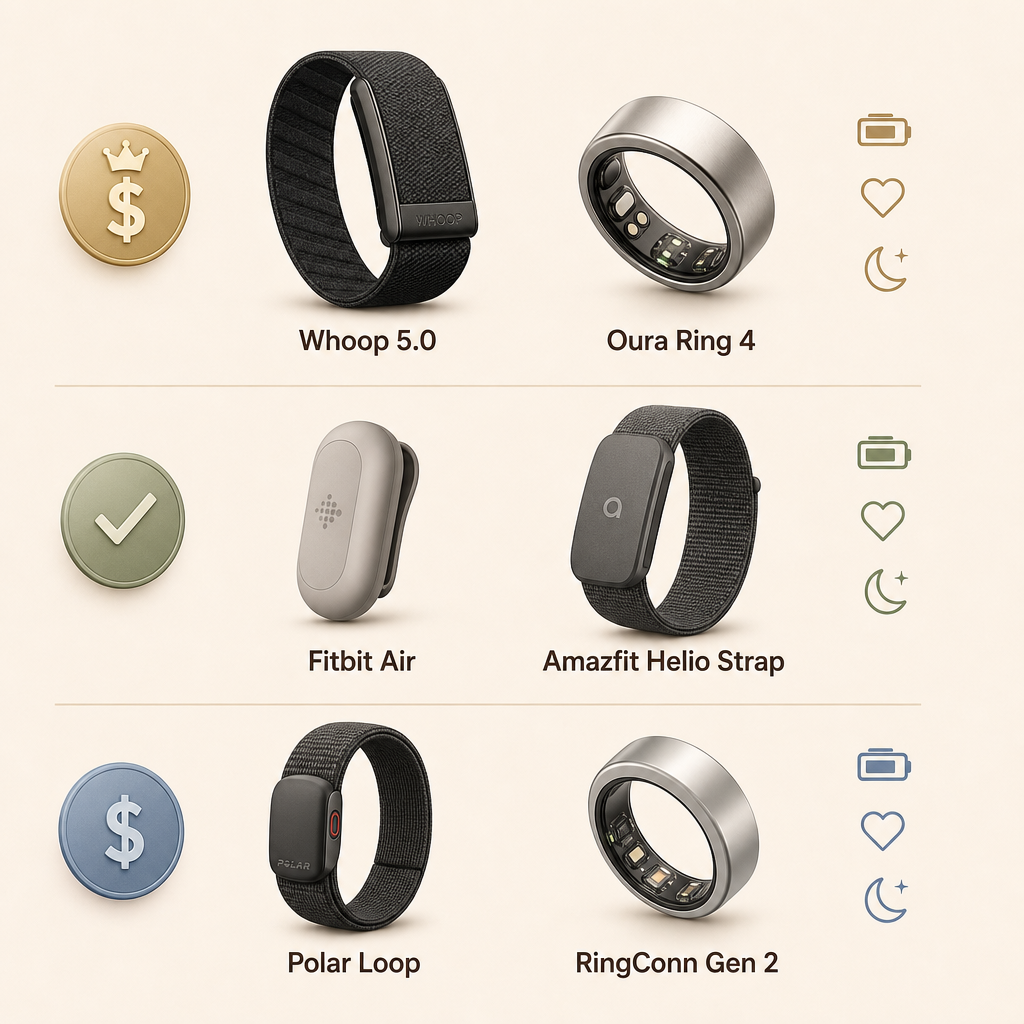
- Fitbit Air ($99): A two-part design — a small sensor pod that snaps into a fabric or silicone band. It weighs 12g with the band, has no buttons or screen, and uses haptic feedback for alerts. Sensors include optical heart rate, red and infrared SpO2, accelerometer, gyroscope, and skin temperature. It is water resistant to 50 meters and has FDA-certified background AFib detection.
- Whoop 5.0 (subscription-only, $239/year Peak membership): The device itself is included with the subscription. It lasts roughly 14 days per charge and ships with a wireless rechargeable battery pack that lets you charge while wearing it — a practical solution for continuous wear.
- Amazfit Helio Strap ($99, no subscription): A 20g band with a 10-day battery life. It tracks 27 workout activities. A key differentiator: when worn on the optional upper-arm strap, its optical heart rate sensor approaches chest-strap accuracy — within 1–2 BPM in DC Rainmaker testing.
- Polar Loop ($199.99, no subscription): A dedicated fitness band with reliable sleep tracking that has been shown to be consistent with the Oura Ring 4. Its HR accuracy during high-intensity intervals is less reliable than the Helio Strap's bicep-worn mode.
Smart Rings
Rings are the fastest-growing form factor in the screenless category. They excel at passive 24/7 tracking — especially sleep, HRV, and temperature — because they are unobtrusive and easy to forget you are wearing.
- Oura Ring 4 ($349–$499 plus $69.99/year membership): The most well-known smart ring. It tracks sleep stages, HRV, body temperature, and readiness. The subscription unlocks detailed trend analysis and personalized recommendations.
- RingConn Gen 2 ($299, no subscription): A strong Oura alternative with up to 12 days of battery life and a built-in sleep apnea tracker. No ongoing subscription is required for full functionality.
- Ultrahuman Ring Air ($349, no subscription): Competes directly with Oura on sleep and recovery metrics but does not charge a monthly fee.
Hybrids and Clip-Ons
A smaller category that includes hybrid watches (Withings, Garmin Lily) which have a traditional watch face but limited or no digital screen, and clip-on or pendant trackers that attach to clothing. These are less common in 2026 and appeal mostly to users who want the absolute minimum wrist presence.
For a deeper comparison of the ring form factor specifically, see our Fitness Tracker Rings in 2026: A Buying Guide for Home Gym Enthusiasts.
Screenless Fitness Tracker Comparison Table
The table below compares the six most relevant screenless trackers in 2026 across the dimensions that matter most during purchase evaluation: upfront price, subscription cost, battery life, heart rate accuracy, sleep tracking quality, waterproofing, GPS capability, and weight.
| Device | Price | Subscription | Battery Life | HR Accuracy Notes | Sleep Tracking | Waterproof | GPS | Weight |
|---|---|---|---|---|---|---|---|---|
| Fitbit Air | $99 | Optional ($9.99/mo or $99/yr) | ~7 days | Wrist-based; mixed vs. Whoop in testing | Yes (nap detection from 20 min) | 50m | No (relies on phone) | 12g (with band) |
| Whoop 5.0 | Included with subscription | $239/yr (Peak) | ~14 days | Wrist-based; better auto-detection (45+ activities) | Yes | Water resistant | No (relies on phone) | ~15g (band only) |
| Oura Ring 4 | $349–$499 | $69.99/yr | ~8 days | Weaker during exercise; good at rest | Excellent (sleep stages, HRV, temp) | 100m | No | ~4–6g |
| Amazfit Helio Strap | $99 | None | ~10 days | Bicep-worn: within 1–2 BPM of chest strap | Yes | Splash resistant | No | 20g |
| Polar Loop | $199.99 | None | ~7 days | Struggles with high-intensity intervals | Yes (consistent with Oura Ring 4) | 30m | No | ~25g |
| RingConn Gen 2 | $299 | None | ~12 days | Weaker during exercise; good at rest | Yes (sleep apnea tracker included) | 100m | No | ~3–5g |
Total Cost of Ownership: Subscription vs. One-Time Cost
The upfront price tag tells only part of the story. Subscription costs can multiply the total investment several times over the life of a device. The table below projects the total cost of ownership for each tracker over 1 year, 2 years, and 5 years, assuming the device lasts through that period without replacement.
| Device | Year 1 | Year 2 | Year 5 | Subscription Required? |
|---|---|---|---|---|
| Fitbit Air (free tier) | $99 | $99 | $99 | No |
| Fitbit Air (with Premium) | $198 | $297 | $594 | Optional |
| Whoop 5.0 (Peak) | $239 | $478 | $1,195 | Yes |
| Oura Ring 4 (Horizon) | $419–$569 | $489–$639 | $699–$849 | Yes |
| Amazfit Helio Strap | $99 | $99 | $99 | No |
| Polar Loop | $199.99 | $199.99 | $199.99 | No |
| RingConn Gen 2 | $299 | $299 | $299 | No |
The math is stark. Over three years, a Fitbit Air on the free tier costs $99 total. A Whoop 5.0 with Peak membership costs $717. An Oura Ring 4 Horizon with membership costs roughly $560 to $650. The Amazfit Helio Strap and Polar Loop remain at their one-time purchase price with no recurring fees.
How to Choose: Three Decision Frameworks
Rather than a single "best" recommendation, the right screenless tracker depends on your budget, your primary training focus, and your form factor preference. Use the framework below that matches your situation.
1. Choose by Budget
- Under $100: Fitbit Air ($99) or Amazfit Helio Strap ($99). Both have no mandatory subscription. The Fitbit Air offers broader sensor suite (SpO2, skin temp, AFib detection) and a more polished app ecosystem. The Helio Strap has better workout HR accuracy when worn on the bicep.
- $100–$300: Polar Loop ($199.99) or RingConn Gen 2 ($299). The Polar Loop is a solid band for sleep and daily activity tracking. The RingConn Gen 2 is the best smart ring option under $300 with no subscription and a sleep apnea tracker.
- $300+: Oura Ring 4 ($349–$499 plus subscription) or Whoop 5.0 ($239/year). These are premium options with deeper analytics, community features, and more sophisticated readiness and strain algorithms. You pay a premium for the data depth and the ecosystem.
2. Choose by Primary Need
- Sleep and recovery tracking: Oura Ring 4 or RingConn Gen 2. Rings excel at passive overnight monitoring. Oura has the most mature sleep staging and HRV analysis. RingConn adds sleep apnea detection without a subscription.
- Training and heart rate accuracy: Amazfit Helio Strap (bicep-worn) or Whoop 5.0. The Helio Strap's bicep mode approaches chest-strap accuracy. Whoop has superior automatic workout detection (45+ activity types) and a strain/recovery framework built around training load.
- All-day activity and general wellness: Fitbit Air. It tracks steps, daily activity, sleep, readiness, and has FDA-certified AFib detection. The optional Premium subscription adds the AI-powered Google Health Coach for personalized fitness plans.
For a deeper look at recovery-focused tracking, see our guide to Best Fitness Trackers for Recovery in 2026: Ranked by Sleep, HRV, and Readiness Accuracy.
3. Choose by Form Factor
- Band (wrist or bicep): Best for active users who want workout tracking, HR accuracy, and the ability to charge while wearing (Whoop). Bands are more durable for gym use than rings.
- Ring: Best for users who prioritize sleep tracking, want the least obtrusive form factor, and do not need workout HR accuracy. Rings are also the best choice for analog watch stackers.
- Hybrid: Best for users who want a traditional watch aesthetic with basic activity tracking and do not need advanced sleep or recovery metrics.
If you are still deciding between a screenless tracker and a full smartwatch, our Screenless Fitness Tracker vs. Smartwatch: Which Is Right for Your Home Fitness Setup? comparison covers the trade-offs in detail.
For a broader, multi-category comparison that includes screen-based trackers and watches, see our Best Fitness Tracker 2026: A Decision-Matrix Guide by User Type.
Who Should Skip Screenless Trackers Entirely
Screenless trackers are not the right choice for everyone. Here are the profiles where a smartwatch or a traditional fitness watch is a better fit.
- You need on-wrist GPS for outdoor runs without carrying a phone. None of the screenless trackers in this guide have built-in GPS. If you run, cycle, or hike and want pace, distance, and route mapping without a phone in your pocket, you need a Garmin, Apple Watch, or similar GPS-enabled watch.
- You rely on music control, contactless payments, or notifications on your wrist. Screenless trackers deliberately strip these features. If you use your wearable to skip tracks, pay for coffee, or glance at messages without pulling out your phone, a smartwatch is the better tool.
- You find app-dependent data review frustrating. Screenless trackers require you to open a phone app to see your data. There is no glanceable display. If you want to check your heart rate, steps, or workout summary by looking at your wrist, a screen-based device is more convenient.
- You want the most accurate heart rate data possible during structured training. While bicep-worn optical sensors (Amazfit Helio Strap) approach chest-strap accuracy, no optical sensor matches a chest strap for precision during high-intensity intervals, weightlifting, or activities with rapid heart rate changes.
If any of these apply, our Screenless Fitness Tracker vs. Smartwatch guide walks through the full decision process.
This result comes from one real apartment under the stated conditions — it is a strong signal, not a guarantee your space will measure identically.
Builds this evidence supports
No build currently links to this specific test. Browse all builds with a matching tag.
Spot something off?
If this result didn't match your own space, let us know — floor-damage and noise claims carry real deposit-risk consequences if we get them wrong.