Fitness Tracker vs. Smartwatch for Health Monitoring: A Decision Framework for Home Fitness Buyers
Choosing between a dedicated fitness tracker and a full smartwatch for health monitoring? This guide compares battery life, sensor accuracy, form factor comfort, subscription costs, and platform compatibility to help you decide based on your specific needs and home fitness goals.
The Blurring Lines Between Fitness Trackers and Smartwatches
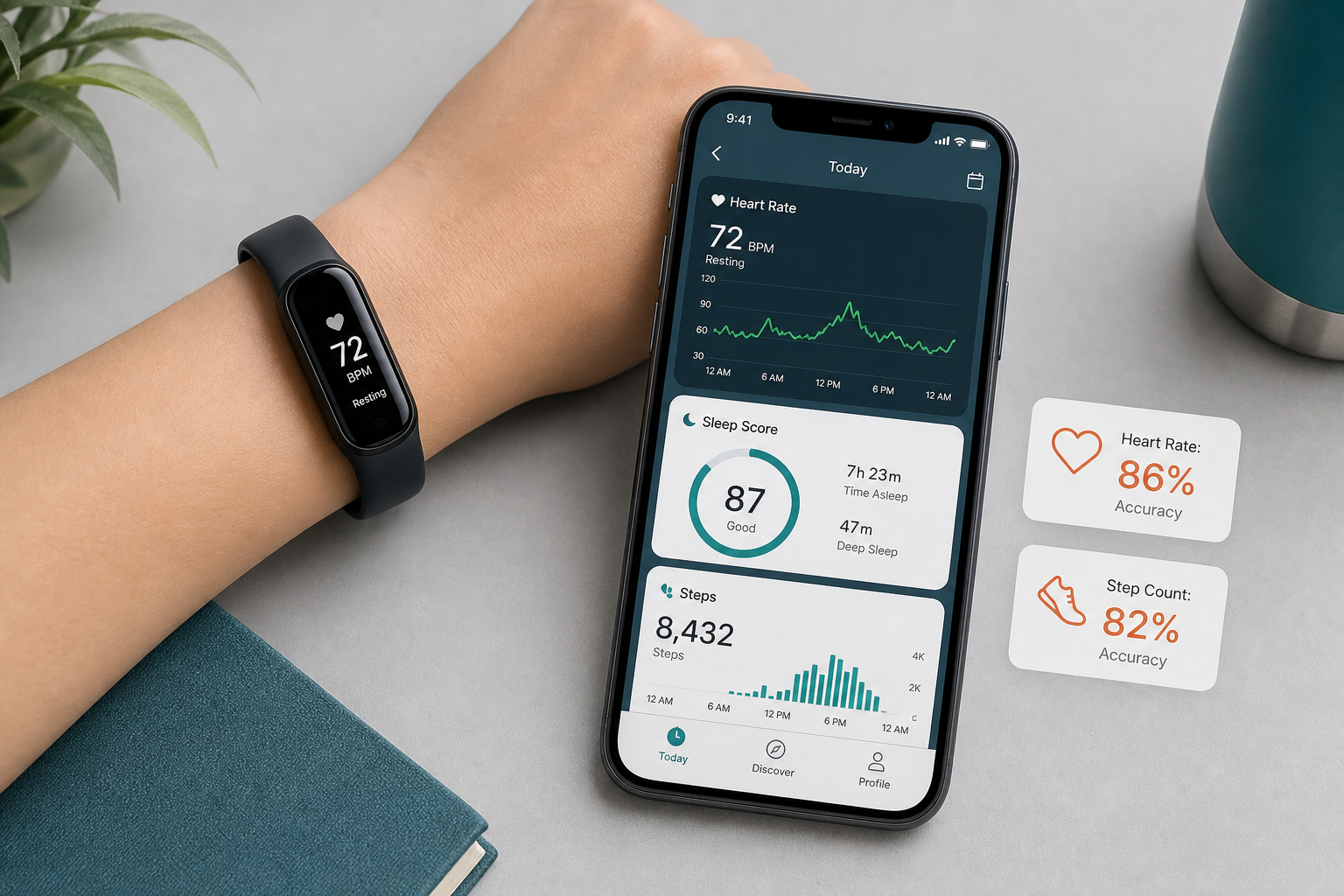
Walk into any electronics store or scroll through a single page of wearable reviews, and the distinction between a fitness tracker and a smartwatch looks increasingly academic. The Fitbit Charge 6, a device that started life as a pure activity band, now packs Google Maps, contactless payments, and YouTube Music controls. The Apple Watch Series 11, a full-featured smartwatch, tracks sleep stages, blood oxygen, and can run an ECG on demand. The Garmin Forerunner 265, built for runners, includes smart notifications and music storage alongside its training metrics.
This convergence is good for the market but confusing for buyers. If you are shopping for a device to monitor your health during home workouts and daily life, the question is no longer simply "tracker or watch?" It is: which set of trade-offs aligns with your actual priorities? The answer depends on five factors that remain stubbornly different between the two categories: battery life, form factor comfort, sensor accuracy for specific metrics, subscription costs, and platform ecosystem lock-in.
This guide is designed for home fitness buyers in purchase-evaluation mode. It does not rank every device on the market — our Fitness Tracker Accuracy Report 2026 already does that. Instead, it provides a structured decision framework organized around the constraints that matter most when choosing between a dedicated health tracker and a multi-purpose smartwatch.
Battery Life: The Biggest Practical Difference
Battery life is the single most consequential difference between fitness trackers and smartwatches for health monitoring. It directly determines whether a device can be worn 24 hours a day, seven days a week without interruption — and uninterrupted wear is what makes continuous health metrics like resting heart rate trends, overnight HRV, and sleep stage analysis meaningful.
The gap is wide. Dedicated fitness trackers routinely deliver five to fourteen days of battery life. Wirecutter's testing found the Fitbit Inspire 3 offers up to 10 days of battery life, with a tested result of 8.5 days in 2025. PCMag reports the Fitbit Charge 6 lasts one week, the Garmin Venu Sq 2 reaches 8 days, and the Whoop 5.0 approaches two weeks. Smartwatches, by contrast, measure their battery life in hours. The Apple Watch SE 3 lasts 46 hours according to PCMag's testing. The Samsung Galaxy Watch 8 manages 26 hours. Even the most efficient full-color smartwatches rarely exceed two days of mixed use.
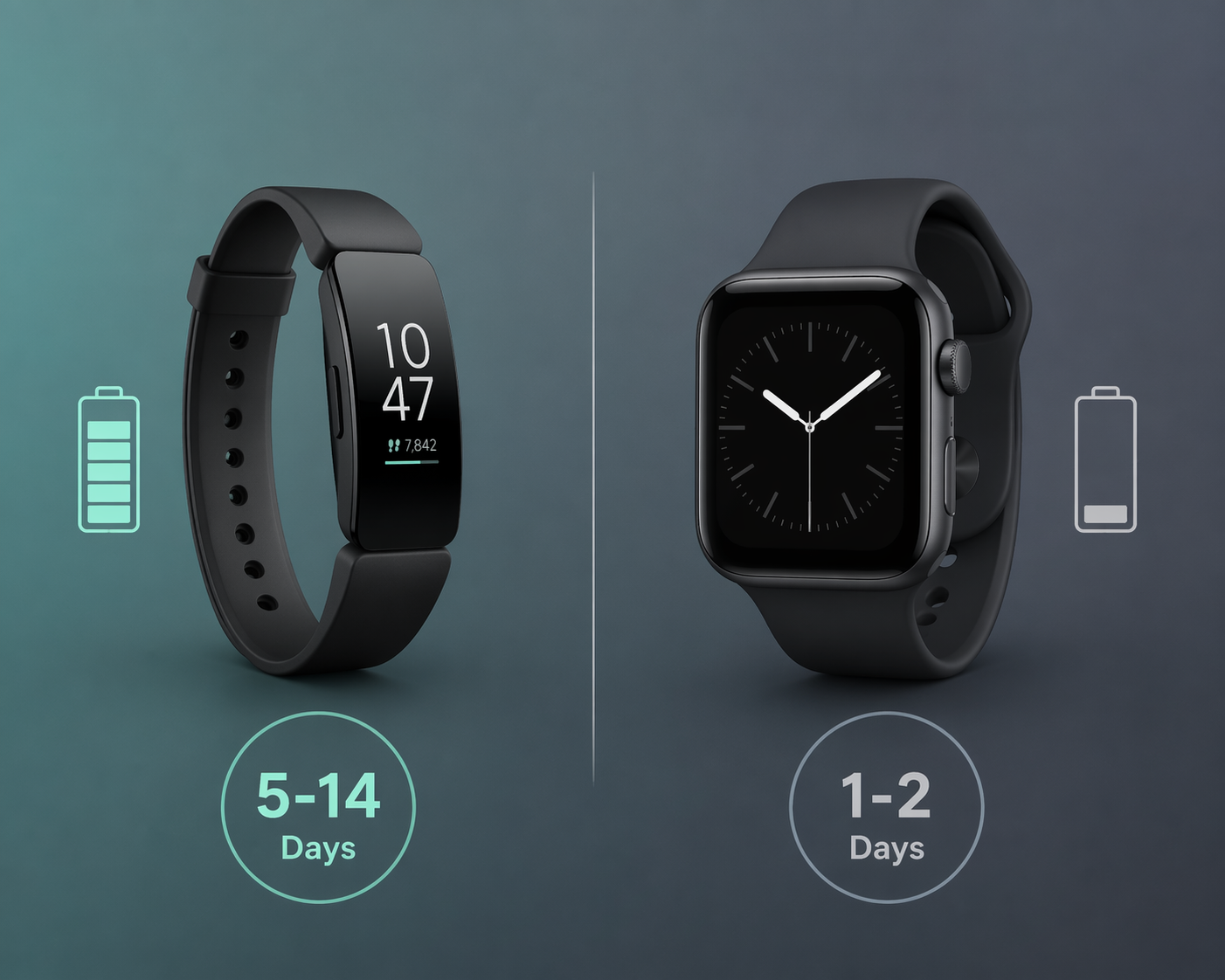
What does this mean for health monitoring? A smartwatch user who charges nightly loses sleep tracking data for the charging window. A user who charges every other night loses an entire night of sleep data every two days. Over a month, that is roughly 15 nights of missing or partial sleep data — enough to make weekly trend reports unreliable. A fitness tracker user who charges once a week loses at most one night of data per month.
| Device | Category | Tested Battery Life | Charging Frequency for 24/7 Wear |
|---|---|---|---|
| Whoop 5.0 | Screenless tracker | ~14 days | Every 2 weeks |
| Fitbit Inspire 3 | Band tracker | 8.5 days | Weekly |
| Garmin Venu Sq 2 | Hybrid watch | 8 days | Weekly |
| Fitbit Charge 6 | Band tracker | 7 days (5 with GPS) | Weekly |
| Fitbit Air | Screenless tracker | 8.5 days | Weekly |
| Apple Watch SE 3 | Smartwatch | 46 hours | Every 1.5 days |
| Apple Watch Series 11 | Smartwatch | 43 hours | Every 1.5 days |
| Samsung Galaxy Watch 8 | Smartwatch | 26 hours | Daily |
Form Factor Comfort: Band, Watch, or Ring?
Battery life and form factor are linked. A device that needs daily charging is harder to wear continuously, but the physical design of the device also determines whether you want to wear it to bed, during a sweaty workout, or under a dress shirt.
The wearable market now offers four distinct form factors, each with different comfort profiles for 24/7 health monitoring:
- Band-style trackers (Fitbit Inspire 3, Charge 6): Lightweight, slim, and unobtrusive. The narrow band and small display make them easy to wear during sleep and during most workouts. The trade-off is a small or no screen for glancing at data.
- Smartwatches (Apple Watch, Samsung Galaxy Watch): Heavier and bulkier due to the larger screen, battery, and sensors. The weight and wrist real estate can make sleep tracking uncomfortable for some users, especially side sleepers. The trade-off is a rich display for notifications, maps, and on-wrist data review.
- Screenless trackers (Whoop 5.0, Fitbit Air): The lightest wrist-worn option. Without a display, the device is smaller, lighter, and has fewer parts to fail. The Fitbit Air costs $99.99 and offers 8.5 days of battery life. The trade-off: you must check your phone for all data, which can reduce engagement.
- Smart rings (Oura Ring 4): The most discreet option. Rings are worn on the finger, which some users find more comfortable for sleep than any wrist device. The trade-off is limited workout tracking accuracy — our Smart Ring Workout Accuracy Tested found that rings struggle with exercises involving gripping or rapid hand movement.
For sleep tracking specifically, form factor comfort is not a nice-to-have — it is a prerequisite. If a device is uncomfortable enough that you take it off before bed, its sleep tracking features are useless. Wirecutter interviewed Aric Prather, a sleep researcher at UCSF, who stated that most wearables accurately estimate total sleep time and fragmentation but are less reliable for sleep architecture like deep sleep minutes. The caveat: this accuracy depends on the device being worn consistently through the night.
Sensor Accuracy: Which Measures What Best?
The assumption that smartwatches are universally more accurate than fitness trackers does not hold up under scrutiny. Accuracy varies by metric, and the device category that wins for heart rate is not the same category that wins for step count or sleep tracking.
A WellnessPulse meta-analysis of 45 scientific studies provides the most comprehensive brand-level accuracy comparison available. The analysis found that overall fitness tracker accuracy averages 67.40% across heart rate, step count, and energy expenditure — a reminder that no consumer wearable is a medical-grade device. But the breakdown by metric reveals meaningful differences:
| Metric | Most Accurate Brand | Accuracy Rate | Runner-Up | Accuracy Rate |
|---|---|---|---|---|
| Heart Rate | Apple Watch | 86.31% | Fitbit | 73.56% |
| Step Count | Garmin | 82.58% | Apple Watch | 81.07% |
| Energy Expenditure | Apple Watch | 71.02% | Fitbit | 48.05% (Garmin) |
The pattern is clear: smartwatches (Apple Watch) lead for heart rate and calorie estimation, while dedicated fitness trackers (Garmin, Fitbit) are competitive or better for step counting. For sleep tracking, the advantage shifts back to trackers — not because their sensors are inherently better, but because their longer battery life and lighter form factor enable the consistent overnight wear that sleep tracking requires.
A PubMed systematic review of 65 articles adds an important caveat: for energy expenditure, the mean absolute percentage error (MAPE) was greater than 30% for all brands. No consumer wearable — tracker or smartwatch — can reliably tell you how many calories you burned during a workout. The same review found that the Apple Watch had a MAPE under 10% for heart rate in two studies, while the Fitbit Charge/Charge HR had a MAPE under 25% for step counts across 20 studies.
For the tracker-vs-smartwatch decision, the practical takeaway is this: if your primary health monitoring goal is heart rate variability trends or resting heart rate, a smartwatch (particularly Apple Watch) gives you the best sensor. If your primary goal is step count consistency or sleep tracking continuity, a dedicated fitness tracker is the better choice. For a deeper metric-by-metric breakdown, see our Fitness Tracker Accuracy Report 2026.
Subscription Costs and Total Cost of Ownership
The sticker price of a wearable is only half the story. Several of the most popular health-focused devices require ongoing subscriptions to unlock their full feature sets, and these costs can exceed the device price within the first year of ownership.
The subscription landscape breaks into three tiers:
- Mandatory subscription: Whoop requires a membership to function at all. Wirecutter reports three tiers at $199, $239, and $359 annually. There is no one-time purchase option.
- Optional premium subscription: Fitbit Premium ($80/year) and Oura ($70/year) unlock deeper analytics, personalized insights, and coaching features. The devices work without the subscription, but many of the health tracking features that differentiate them from basic step counters are behind the paywall.
- No subscription required: Apple Watch, Garmin, and Samsung Health provide their core health tracking features — heart rate, sleep stages, activity tracking — without any ongoing fee. Some advanced features (Fitness+ for Apple, training plans for Garmin) may have separate costs, but the health monitoring data is free.
A two-year total cost of ownership comparison reveals how dramatically subscriptions change the value equation:
| Device | Upfront Cost | Annual Subscription | 2-Year Total Cost |
|---|---|---|---|
| Apple Watch SE 3 | $219 | $0 | $219 |
| Fitbit Inspire 3 | ~$80 | $0 (or $80 Premium) | $80–$240 |
| Fitbit Charge 6 | $99.95 | $0 (or $80 Premium) | $99.95–$259.95 |
| Garmin Venu Sq 2 | ~$250 | $0 | $250 |
| Whoop 5.0 (mid-tier) | $0 (device included) | $239 | $478 |
| Oura Ring 4 | ~$299 | $70 | $439 |
| Garmin Forerunner 265 | $449 | $0 | $449 |
The Apple Watch SE 3, at $219, costs less than the Whoop 5.0 after one year of mid-tier membership ($239). But that comparison misses the point: the Whoop tracks 24/7 without daily charging, provides a screenless form factor that many find more comfortable for sleep, and delivers recovery-focused analytics that Apple Health does not match. The right choice depends on whether the subscription cost is buying features you actually value.
Platform Compatibility and Ecosystem Lock-In
Your phone's operating system may be the single most restrictive factor in your wearable choice. The platform compatibility landscape is straightforward but unforgiving:
| Device | iOS Compatibility | Android Compatibility | Notes |
|---|---|---|---|
| Apple Watch | Full | None | Requires iPhone for setup and operation |
| Samsung Galaxy Watch | Limited | Full | Some features require Samsung phone |
| Fitbit (all models) | Full | Full | Now uses Google Health app on Android |
| Garmin (all models) | Full | Full | Garmin Connect app on both platforms |
| Whoop | Full | Full | Cross-platform via Whoop app |
| Oura Ring | Full | Full | Cross-platform via Oura app |
For iPhone users, the Apple Watch offers the deepest integration — seamless Health app sync, Apple Fitness+ compatibility, and tight integration with iOS notifications and apps. PCMag notes that Fitbit trackers now use the Google Health app on Android but still work with iOS, while the Apple Watch remains iOS-only and the Samsung Galaxy Watch is Android-only.
For Android users, the smartwatch options with strong health tracking are more limited. The Samsung Galaxy Watch 8 is the primary Android-native smartwatch, but its 26-hour battery life and Samsung-exclusive features (like the BioActive sensor's full capabilities) may require a Samsung phone. Garmin watches offer a middle ground: cross-platform compatibility, excellent battery life, and robust health tracking, but with a less polished smartwatch experience than the Galaxy Watch.
Ecosystem lock-in matters beyond the initial purchase. If you invest in an Apple Watch and build two years of health data in Apple Health, switching to a Garmin or Fitbit means losing that data continuity. Some platforms offer data export, but the trend graphs, baseline calculations, and personalized insights do not transfer. For a detailed look at Apple Watch accuracy, see our Apple Watch Fitness Tracking Accuracy analysis.
Decision Matrix: Which Device Type Fits Your Profile?
The following matrix maps common user profiles to the device type that best matches their priorities. No single device is right for everyone — the goal is to match your primary health monitoring goal with the device category that excels at it.
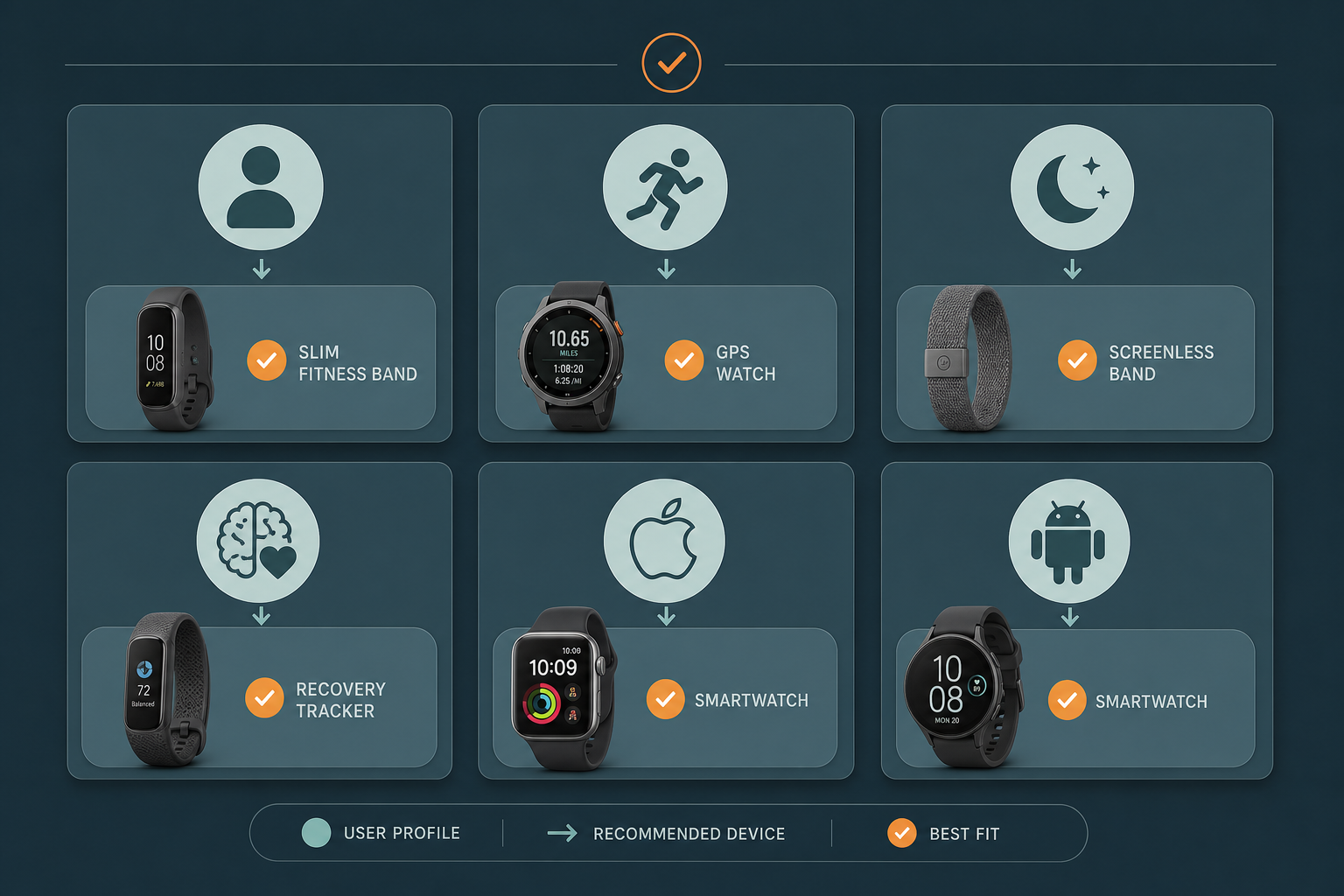
| Your Profile | Primary Priority | Recommended Device Type | Why |
|---|---|---|---|
| Budget-conscious beginner | Low cost, basic activity tracking | Band-style tracker (Fitbit Inspire 3, Charge 6) | Under $100, good battery life, cross-platform, no subscription required for basics |
| Runner or cyclist | GPS accuracy, training metrics | GPS running watch (Garmin Forerunner 265) | Best-in-class GPS, training load analysis, multi-day battery, no subscription |
| Sleep-focused tracker | Overnight HR, sleep stages, consistency | Screenless band or smart ring (Whoop, Oura, Fitbit Air) | Most comfortable for 24/7 wear, longest battery life, sleep-optimized analytics |
| Stress and recovery focused | HRV, readiness score, strain management | Recovery-focused tracker (Whoop, Oura) | Dedicated recovery metrics, readiness scoring, subscription covers ongoing analysis |
| Apple ecosystem user | Seamless iPhone integration, app ecosystem | Smartwatch (Apple Watch SE 3 or Series 11) | Deepest iOS integration, best heart rate sensor, ECG, fall detection, no subscription |
| Android user wanting smartwatch | Smart features with good health tracking | Smartwatch (Samsung Galaxy Watch 8) or Garmin | Galaxy Watch for smart features, Garmin for battery life and cross-platform health tracking |
For readers who want to factor in their primary exercise type — yoga, Pilates, HIIT, bodyweight strength, or recovery — our guide Which Fitness Tracker Works Best for Your Home Workout Type? provides workout-specific recommendations.
Making Your Choice: Key Takeaways
The decision between a fitness tracker and a smartwatch for health monitoring comes down to a single question: do you prioritize continuous passive monitoring or on-demand advanced features?
- Choose a dedicated fitness tracker (band, screenless band, or ring) if: you want uninterrupted sleep and recovery data, you prioritize battery life measured in days or weeks, you are comfortable checking your phone for detailed metrics, and you want the lightest, most comfortable form factor for 24/7 wear.
- Choose a smartwatch if: you want the best heart rate sensor accuracy, you need on-wrist features like ECG, fall detection, and notifications, you are already in the Apple or Samsung ecosystem, and you are willing to charge daily or every other day.
- Consider a hybrid (Garmin Forerunner 265, Fitbit Charge 6) if: you want the middle ground — multi-day battery life with smartwatch features like payments and music, or a GPS running watch that also handles daily health tracking.
The five key differentiators — battery life, form factor comfort, sensor accuracy by metric, subscription costs, and platform lock-in — form a complete decision framework. Use them to evaluate any device, and you will make a choice that serves your health monitoring goals for years, not months.
This result comes from one real apartment under the stated conditions — it is a strong signal, not a guarantee your space will measure identically.
Builds this evidence supports
No build currently links to this specific test. Browse all builds with a matching tag.
Spot something off?
If this result didn't match your own space, let us know — floor-damage and noise claims carry real deposit-risk consequences if we get them wrong.