
Best Workout Tracker 2026: Fitness Band vs Smartwatch vs App for Every Training Style
Choosing the best workout tracker in 2026 depends on your training style, not just your budget. This guide compares fitness bands, GPS smartwatches, and workout-logging apps across strength training, running, hybrid workouts, swimming, and general wellness — with a decision matrix to help you find the right form factor for your routine.
The Three-Way Split: Apps vs Bands vs Watches
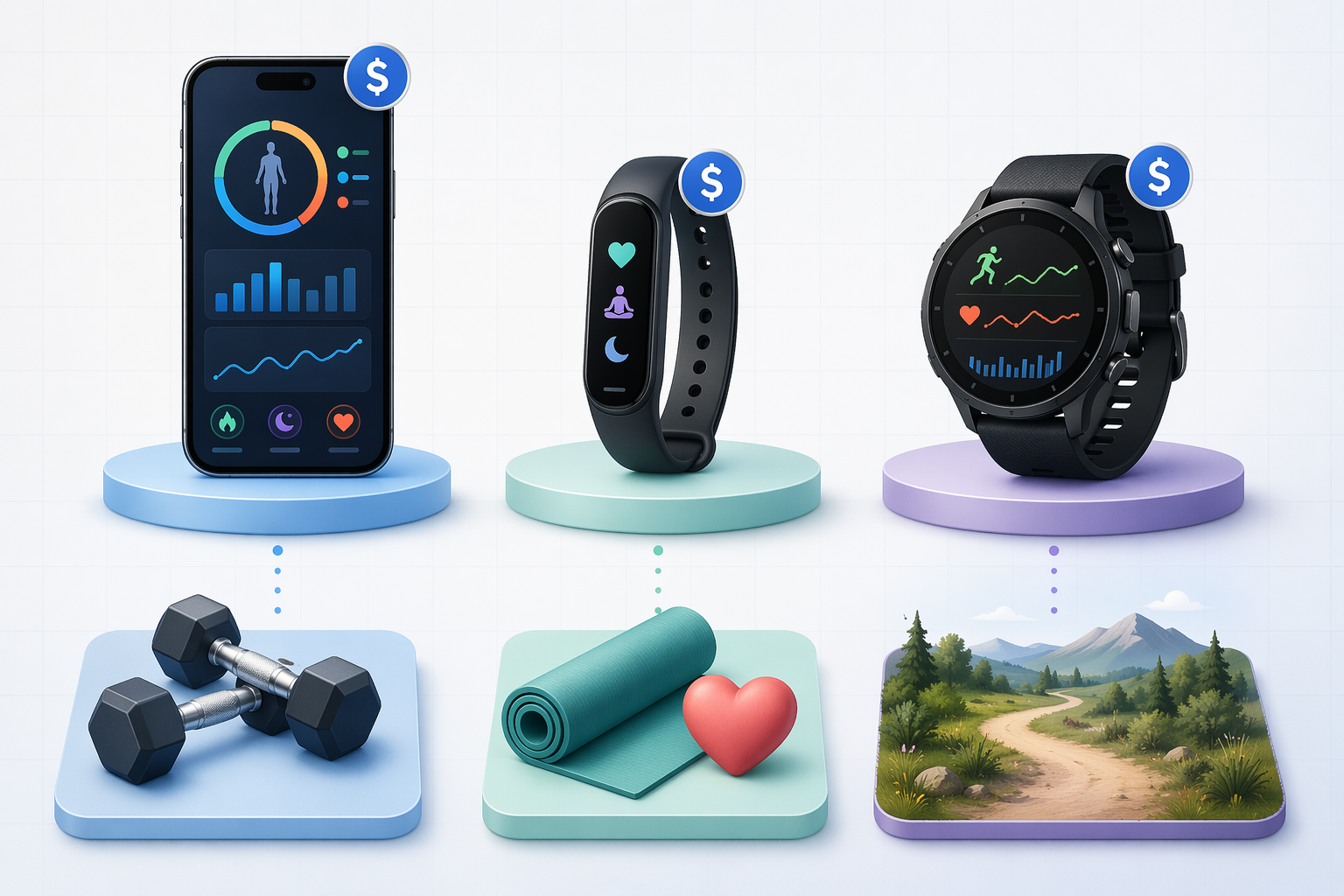
If you search for "best workout tracker" in 2026, you will find recommendations for everything from a $50 wristband to a $750 GPS watch to a phone app that costs nothing to download. The problem is that most of those guides treat the choice as a simple question of budget or brand loyalty. In practice, the device that works for a marathon runner will frustrate a strength lifter, and the app a CrossFit athlete relies on will feel incomplete to a swimmer.
The three form factors — phone-based workout-logging apps, dedicated fitness bands, and GPS smartwatches — each have strengths that map directly to specific training styles. A growing fourth category, the smart ring (exemplified by the Oura Ring 4), adds a screenless option for users who prioritize recovery and sleep data over real-time workout metrics. Understanding which form factor fits your primary workout type is the first step toward a purchase you will not regret six months later.
This guide is not a general roundup of every tracker on the market — that article already exists for readers who want a budget-and-OS comparison. Instead, it is organized around a single question: what kind of training do you actually do? The answer determines whether you should buy a watch, a band, a ring, or just download an app.
Training-Style Decision Matrix: Which Form Factor Fits Your Workout?
The table below maps five common training styles to the optimal form factor. The reasoning behind each match is explained in the sections that follow.
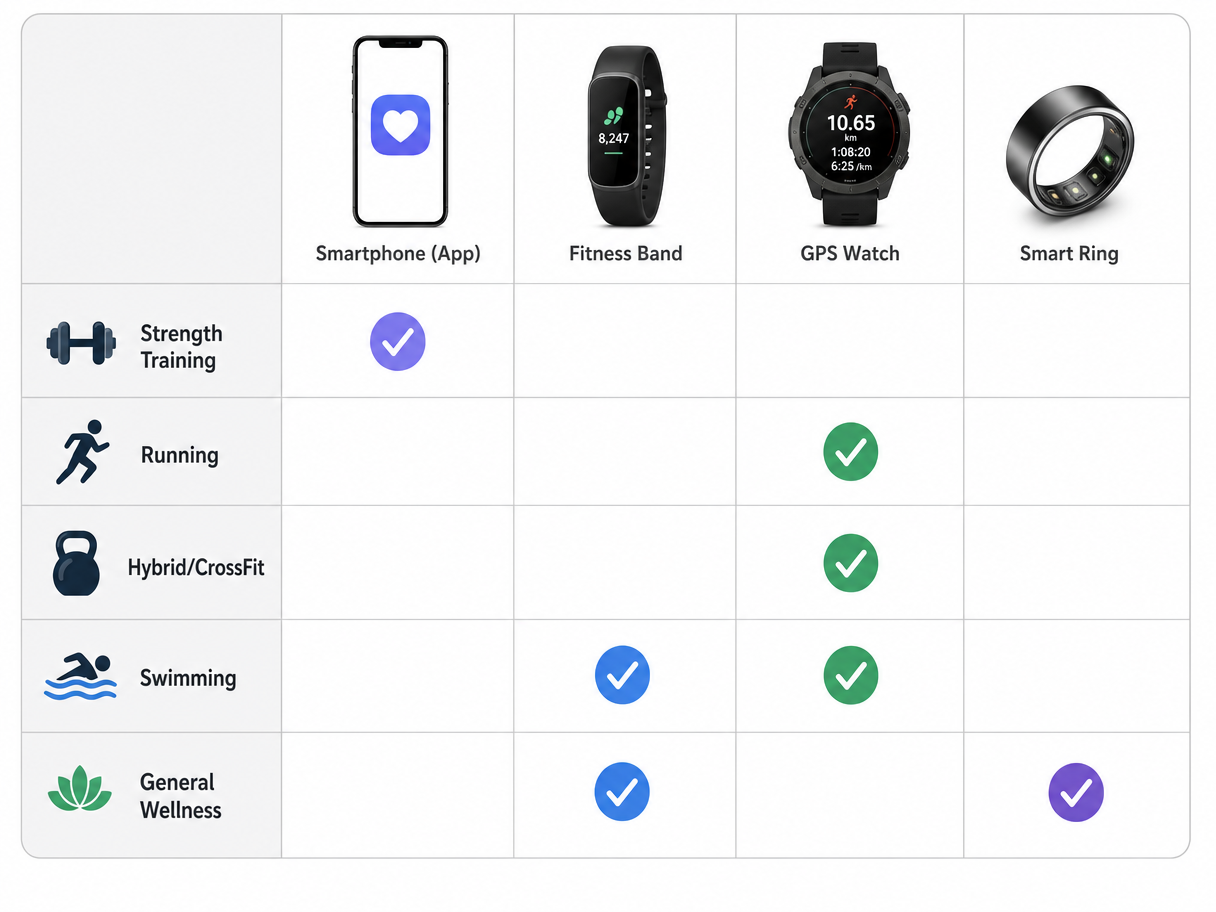
| Training Style | Best Form Factor | Why This Match Works |
|---|---|---|
| Strength Training | Workout-logging app + HR band | Rep logging, rest timers, and progressive overload tracking are app strengths; an HR band adds heart rate data without a bulky watch interfering with wrist flexion during lifts. |
| Running (Road & Trail) | GPS smartwatch | Multi-band GNSS accuracy, pace zones, VO2 max estimates, and route mapping are native to watches like the Garmin Forerunner series. Budget bands with built-in GPS (e.g., Fitbit Charge 6) are a compromise. |
| Hybrid / CrossFit | GPS smartwatch | Needs both activity tracking (HR, calories) and structured workout logging. A watch with multi-sport modes and rep counting (e.g., Garmin Venu 4) covers both. |
| Swimming | Waterproof GPS watch | Pool swim tracking requires stroke detection and lap counting. Most bands are water-resistant but lack swim-specific metrics. Watches like the Apple Watch Ultra 2 offer dive functionality to 40m. |
| General Wellness | Fitness band or smart ring | Step counting, sleep tracking, and activity reminders do not require GPS or advanced logging. Bands like the Fitbit Inspire 3 and rings like the Oura Ring 4 provide these with minimal friction. |
For strength training, the case for an app-plus-band combination is strong. Dedicated workout-logging apps like Strong (rated 4.7/5 by LoadMuscle) and Hevy (rated 4.6/5) allow you to log sets, reps, and weight, set rest timers, and track progressive overload over weeks and months — features that most smartwatches handle poorly or not at all. Fitbod (rated 4.5/5) goes further by using adaptive AI to adjust workouts based on muscle recovery, though it requires a ~$15/month subscription after a trial period. Pair any of these with an accurate heart rate band, and you get the utility of a full logging platform plus reliable HR data without the wrist bulk that can interfere with barbell work or kettlebell swings.
For runners, the priority shifts to GPS accuracy and battery life. The Garmin Forerunner 970 ($749.99) uses dual-band multi-GNSS and the Elevate Gen 5 heart rate sensor, with adaptive training plans and full-color mapping — a serious tool for distance runners. At a lower price point, the Garmin Forerunner 265 ($450) offers personalized daily workouts and a 15-day battery life, earning it "best overall" from The Independent's UESCA-certified running coach. Budget-conscious runners should note that the Fitbit Charge 6 ($130–$160) has built-in GPS, but multiple sources — including Wareable and Android Authority — describe its GPS as unreliable, making it a compromise for serious runners.
Hybrid athletes who combine strength, cardio, and conditioning in a single session need a watch that can handle multiple activity types without manual switching. The Garmin Venu 4 ($549.99) includes dual-band GNSS, the Elevate V5 HR sensor, Body Battery, Recovery Time, and Sleep Alignment — a complete package for varied training. Forbes' testing noted that the previous-generation Venu 3 was the only watch that accurately identified exercises like barbell squats and sumo-stance deadlifts using its rep-counting feature, a capability that carries forward to the Venu 4.
Swimmers need water resistance that goes beyond splash-proof ratings. The Apple Watch Ultra 2 (street price ~$409) includes a dive computer function rated to 40 meters and IP6X dust protection, making it the most capable option for open-water and pool swimming. Most fitness bands are water-resistant to 50 meters for surface swimming but lack the stroke detection and lap-counting algorithms that swimmers rely on.
For general wellness — daily step goals, sleep tracking, activity reminders, and casual heart rate monitoring — a simple band or ring is often the better choice. The Fitbit Inspire 3 ($99.95) had the best step-count accuracy Wirecutter has ever tested, with just 0.32% error over two days, and an 8.5-day real-world battery life. The Oura Ring 4 ($349 + $70/year subscription) tracks 50+ health metrics and provides daytime stress categorization (stressed, engaged, recovering, restored) and a Resilience score based on two weeks of data — useful for users who want recovery insights without wearing a wrist device.
Deep Dive: Top Picks by Form Factor with Accuracy Data
Accuracy claims in the fitness tracker space are notoriously inconsistent because testing methodologies vary widely. Some sources use lab-grade ECG chest straps as a gold standard; others rely on correlation coefficients from meta-analyses. The table below consolidates the most reliable accuracy data available from the sources cited in this guide, with clear methodology notes.
| Device | Heart Rate Accuracy | Step Count Accuracy | Methodology Source |
|---|---|---|---|
| Apple Watch Series 11 | 0.98% avg. error (~1.40 BPM) | Not tested in source | CNET lab test vs. Polar H10 chest strap over 30 miles of running |
| Apple Watch (meta-analysis) | 86.31% correlation | Not specified | WellnessPulse meta-analysis of 45 studies (correlation coefficients, not direct error) |
| Garmin (meta-analysis) | 67.73% correlation | 82.58% correlation | WellnessPulse meta-analysis of 45 studies (correlation coefficients) |
| Fitbit (meta-analysis) | 73.56% correlation | 77.29% correlation | WellnessPulse meta-analysis of 45 studies (correlation coefficients) |
| Fitbit Inspire 3 | 1 BPM resting HR error | 0.32% error over 2 days | Wirecutter real-world testing |
Beyond accuracy, each form factor has standout devices worth calling out individually.
Best GPS Smartwatch: Garmin Forerunner 970
At $749.99, the Forerunner 970 is the most capable running watch Garmin has produced. It combines the Elevate Gen 5 heart rate sensor with dual-band multi-GNSS for accurate tracking even in urban canyons or dense tree cover. The 15-day battery life (CNET-tested) means you can train through a marathon block without weekly charging. Adaptive training plans adjust based on your recovery status and performance trends, and full-color mapping with turn-by-turn navigation makes it a genuine alternative to a handheld GPS for trail runners.
Best Fitness Band: Fitbit Charge 6
CNET selects the Charge 6 as the best overall fitness tracker, citing 40+ exercise modes, built-in GPS, sleep and stress scores, and SmartTrack auto-recording. At a street price of $130–$160, it undercuts most smartwatches while covering the majority of tracking needs for general fitness and structured workouts. The caveat, noted by both Wareable and Android Authority, is that the built-in GPS is unreliable — if you run outdoors regularly, you may find the distance and pace data inconsistent. For gym-based training and daily wellness, however, the Charge 6 remains the most well-rounded band available.
Best Budget Band: Xiaomi Smart Band 10
At approximately $50 ($49.90 confirmed by Android Authority, ~$52.99 by Wareable), the Xiaomi Smart Band 10 delivers what Wareable calls "unbeatable value" — providing roughly 90% of the features of a premium band for 30% of the price. It includes a bright AMOLED display, 150+ workout modes, VO2 max estimation, training load and recovery time metrics, and a 21-day battery life with the always-on display turned off. The trade-off is that it lacks built-in GPS (it uses connected GPS from your phone) and the companion app is less polished than Fitbit's or Garmin's. For budget-conscious users whose primary training style is general wellness or gym-based strength, it is the clear value pick.
Best Workout-Logging Apps: Strong, Hevy, and Fitbod
For strength training, the app ecosystem has matured to the point where a dedicated logging app often outperforms a smartwatch for in-workout utility. LoadMuscle's April 2026 testing of 11 apps highlights three standouts:
- Strong (4.7/5): Best for fast workout logging with strong Apple Watch integration and a ~$5/month premium tier. The interface is minimalist and optimized for quick entry between sets.
- Hevy (4.6/5): The most generous free tier among the top-rated apps, with social features for sharing workouts and following other lifters' programs.
- Fitbod (4.5/5): Uses adaptive AI to adjust workouts based on muscle recovery, but requires a ~$15/month subscription after a trial period. Best for users who want algorithm-generated programming rather than manual logging.
The LoadMuscle guide notes that for strength training, a dedicated workout-logging app paired with an accurate HR band can deliver better utility than a smartwatch alone — a conclusion that aligns with the training-style-first framework of this article.
Budget Breakdown: From $50 Bands to $750 Premium Watches
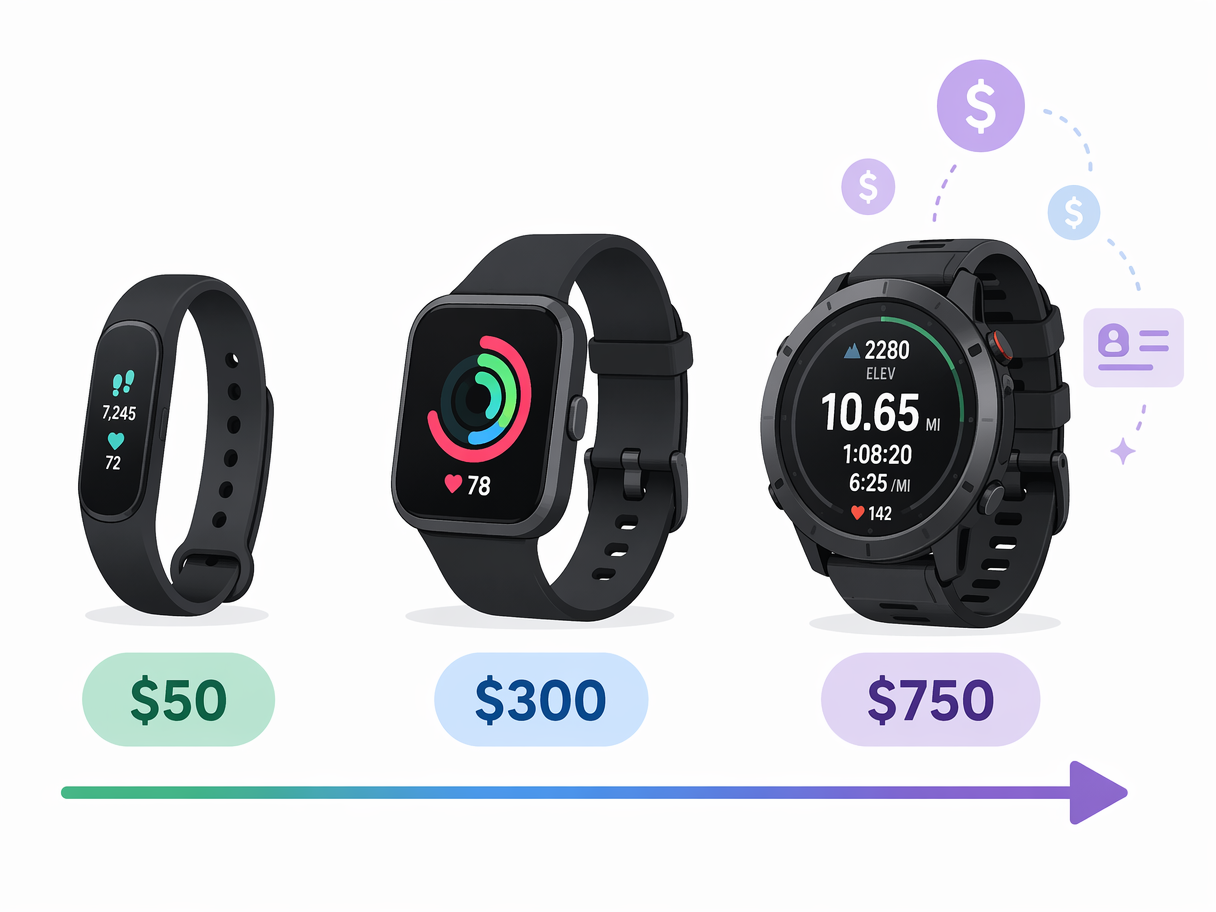
Price is the second filter after training style. The table below shows real street prices for the devices discussed in this guide, organized by form factor and price tier.
| Device | Form Factor | Street Price | Key Trade-Off |
|---|---|---|---|
| Xiaomi Smart Band 10 | Band | ~$50 | No built-in GPS; less polished app |
| Amazfit Bip 6 | Band/Watch hybrid | $79 | Good battery life but limited third-party app support |
| Samsung Galaxy Fit3 | Band | $46.90 | Android-only; accurate HR but basic feature set |
| Fitbit Inspire 3 | Band | $99.95 | Best step accuracy tested; no built-in GPS |
| Fitbit Charge 6 | Band | $130–$160 | Best overall band; unreliable built-in GPS |
| Amazfit Active 2 | Band/Watch hybrid | $64.99 | Good value for US buyers; limited advanced metrics |
| Apple Watch SE 3 | Smartwatch | $249 | Best Apple ecosystem entry; 46-hour battery |
| Garmin Forerunner 265 | GPS Watch | $450 | Best overall running watch per The Independent; 15-day battery |
| Garmin Venu 4 | GPS Watch | $549.99 | Multi-band GPS, Body Battery, rep counting; $50–$150 more than Venu 3 |
| Garmin Forerunner 970 | GPS Watch | $749.99 | Premium running features; adaptive training plans |
| Apple Watch Series 11 | Smartwatch | $399 | Best HR accuracy tested; 24-hour battery claim |
| Apple Watch Ultra 2 | Smartwatch | ~$409 (street) | Dive computer to 40m; IP6X dust protection |
The $50–$100 band tier has improved dramatically. The Xiaomi Smart Band 10 and Fitbit Inspire 3 both deliver core wellness tracking — steps, sleep, heart rate — with battery lives measured in days or weeks rather than hours. The jump to $250–$400 buys you a full smartwatch with GPS, app ecosystems, and longer feature lists, but the accuracy gains are incremental for most users. The $450–$750 tier is where specialized training tools live: the Garmin Forerunner 265 and 970 are built for runners who need adaptive training plans and multi-band GPS, not for casual step-counters.
Hidden Costs: Subscription Fees and Total Cost of Ownership
The purchase price is only the beginning. Several popular devices require ongoing subscriptions to unlock their full feature sets, and those fees can add up to more than the device itself over a typical 2–3 year ownership period.
| Device | Upfront Cost | Annual Subscription | 3-Year Total Cost |
|---|---|---|---|
| Whoop 5.0 | $0 (device included with membership) | $199–$359/year | $597–$1,077 |
| Oura Ring 4 | $349 | $70/year | $559 |
| Fitbit Charge 6 + Premium | $130–$160 | $80/year (optional) | $370–$400 (with Premium) |
| Garmin Venu 4 | $549.99 | $0 (Body Battery, sleep score, stress tracking included) | $549.99 |
| Apple Watch Series 11 | $399 | $0 (Fitness+ is separate, optional) | $399 |
| Xiaomi Smart Band 10 | ~$50 | $0 | $50 |
The Whoop 5.0 is the most extreme example: the device itself is free, but the membership costs $199–$359 per year depending on the commitment length. PCMag explicitly excluded Whoop from its best-of list due to the high annual cost. Over three years, a Whoop membership costs more than a Garmin Forerunner 970 — without a display, without GPS, and without the ability to track workouts independently of your phone.
The Oura Ring 4 requires a $70/year subscription after the first month, adding $210 over three years to the $349 upfront cost. Fitbit Premium ($80/year) is optional but unlocks deeper sleep analysis, stress management scores, and guided programs — features that many users find essential after the first few months.
Garmin stands out for including its most valuable software features — Body Battery, sleep score, stress tracking, and Training Readiness — at no additional cost. The Garmin Venu 4 and Forerunner 970 both include these metrics out of the box. Apple does not require a subscription for core health tracking, though Apple Fitness+ is a separate $9.99/month service for guided workouts.
Decision Flowchart: How to Choose Your Workout Tracker
Use the steps below to narrow your options based on your primary training style, budget, and subscription tolerance.
- Identify your primary training style. If you strength train 3+ days per week, start with the app-plus-band path. If you run or cycle as your main activity, go straight to GPS watches. If you do a mix of activities with no single dominant style, consider a multi-sport watch like the Garmin Venu 4.
- Set your hard budget cap. Include the first 2–3 years of any required subscription in your calculation. If your cap is under $100, look at bands (Xiaomi Smart Band 10, Fitbit Inspire 3). If $100–$300, consider the Fitbit Charge 6 or Apple Watch SE 3. If $300–$550, the Garmin Venu 4 or Forerunner 265. Above $550, the Forerunner 970 or Apple Watch Ultra 2.
- Decide your subscription tolerance. If you refuse to pay monthly fees, eliminate Whoop and Oura from consideration. Garmin and Apple offer the best premium features without ongoing costs.
- Check phone compatibility. Apple Watches require an iPhone. Samsung Galaxy Watches work best with Samsung phones. Garmin, Fitbit, and Xiaomi devices are platform-agnostic.
- Consider the form factor you will actually wear. A feature-packed watch is useless if you take it off because it is too bulky for sleep tracking or uncomfortable during wrist-intensive lifts. If you dislike wearing anything on your wrist, the Oura Ring 4 or a phone-based app may be the better long-term choice.
The best workout tracker in 2026 is not the one with the most sensors, the longest battery life, or the lowest price. It is the one that fits your training style so naturally that you forget you are wearing it — and that gives you the data you actually use, not the data the manufacturer wants you to see.
For readers who want to explore specific angles further: our home gym tracker guide covers strength training and cardio machine tracking in more depth. The heart rate accuracy article explains how optical HR sensors perform differently during lifting versus steady-state cardio. And our best free workout apps guide is a good next stop if you decided the app-only path is right for you.
This result comes from one real apartment under the stated conditions — it is a strong signal, not a guarantee your space will measure identically.
Builds this evidence supports
No build currently links to this specific test. Browse all builds with a matching tag.
Spot something off?
If this result didn't match your own space, let us know — floor-damage and noise claims carry real deposit-risk consequences if we get them wrong.