
The Problem With Adding Weight Only
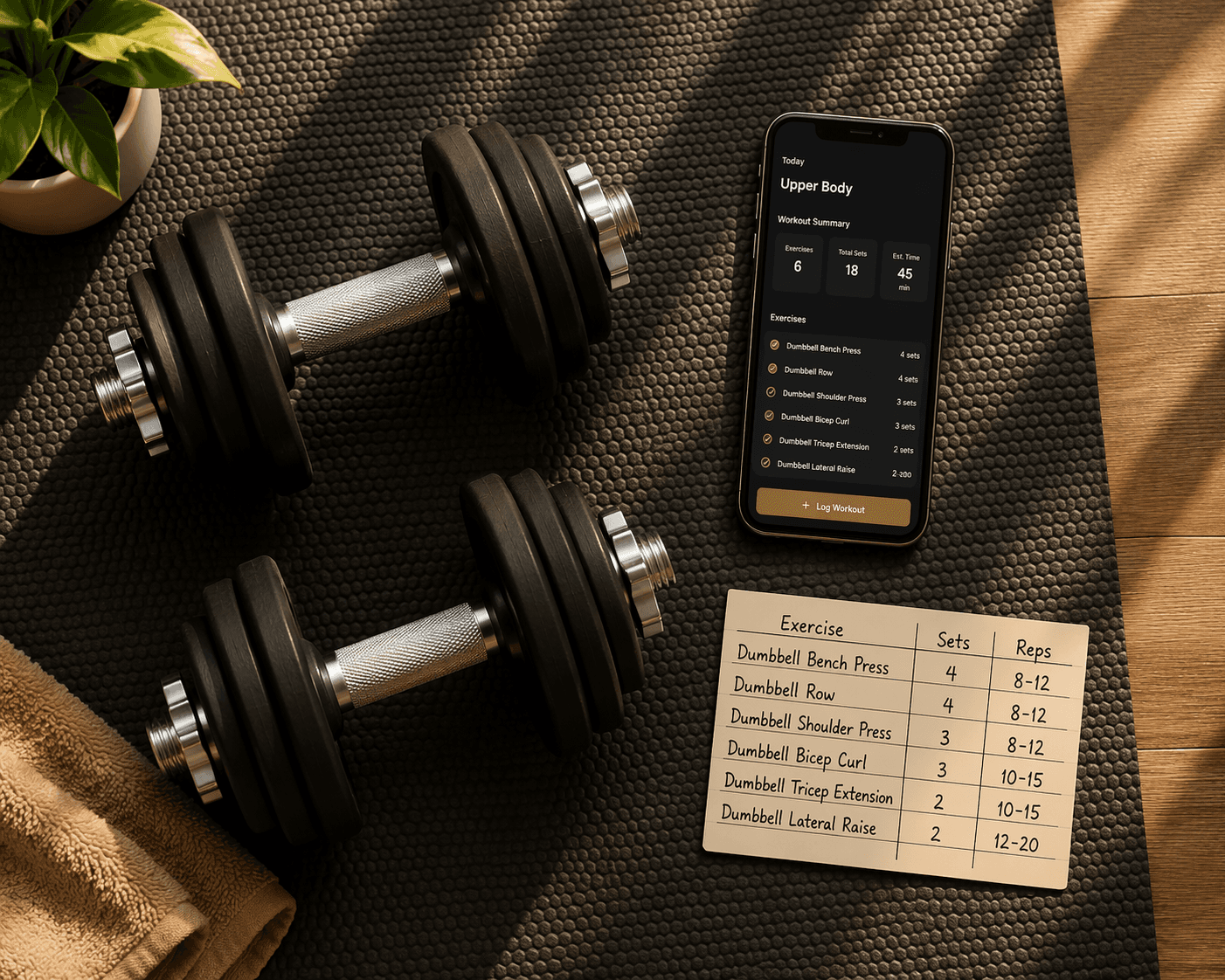
Most people think progressive overload means one thing: put more weight on the bar. With dumbbells, that assumption hits a wall fast. Your adjustable dumbbells jump in 5‑lb increments — sometimes 10. Your heaviest pair tops out at 80 or 100 lbs total. There is no spotter to help on the last rep. And unlike a barbell, you cannot just load another 2.5‑lb plate.
The result? You finish a workout, hit all your reps, and next week you try 5 lbs heavier. The set grinds down at rep six. You back off. A few weeks later you are stuck at the same weight, wondering if you’ve already outgrown your home setup. You haven’t. The problem is not the dumbbells — it is that you have only one progression tool in your kit.
Five Ways to Keep Progressing With the Same Dumbbells
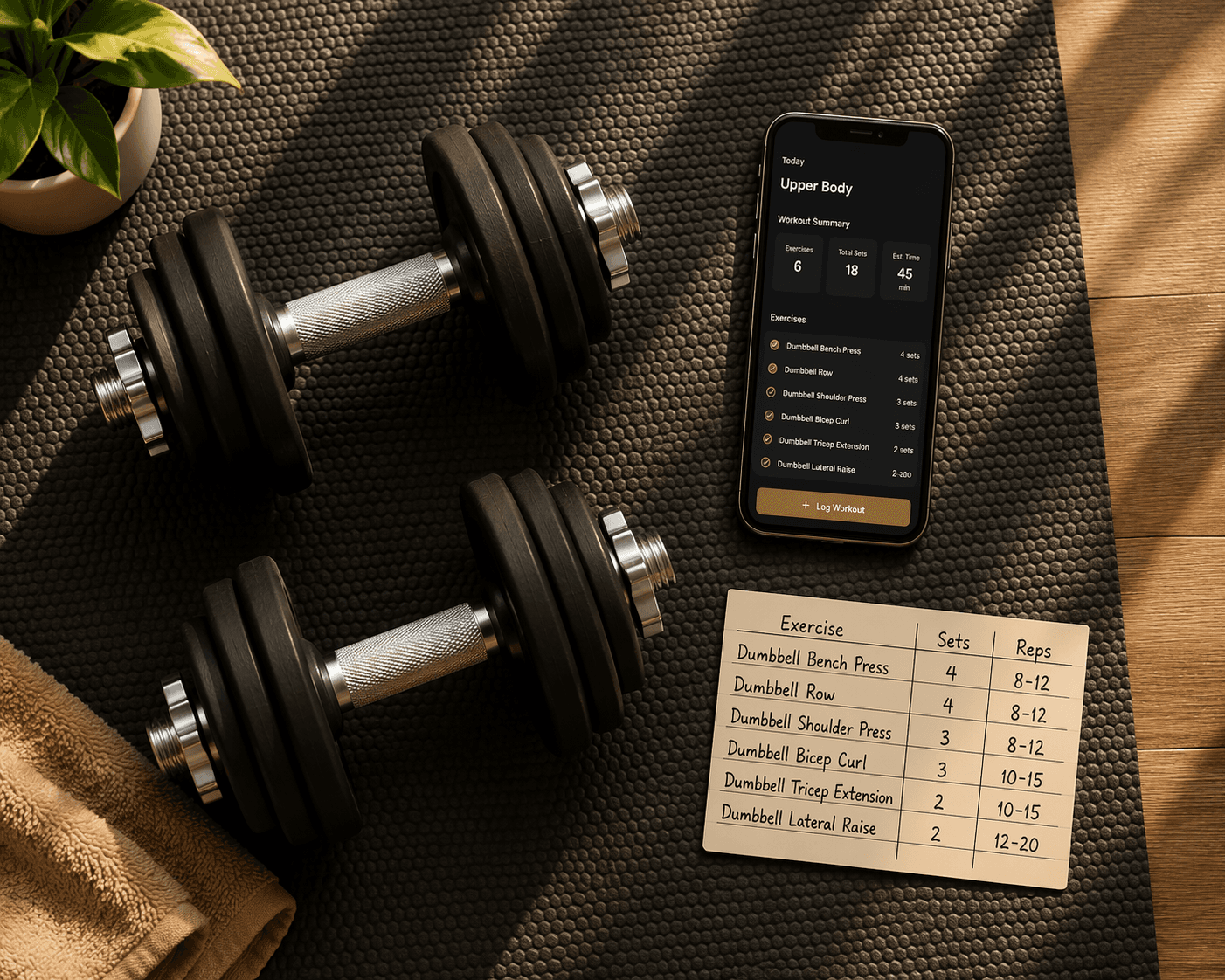
Progressive overload for a home dumbbell lifter is not a single lever. It is a system with five methods, each designed for a specific plateau. When one stops working, you rotate to the next. Together they can keep you progressing for months with the same pair of dumbbells.
- Rep progression — solid foundation, best for the first 6–10 weeks.
- Volume-first — add sets when the next weight jump is too big.
- Tempo and rest manipulation — change the clock, not the weight.
- Pre-exhaust — fatigue the muscle so the compound lift needs less weight.
- Exercise substitution — swap to a harder variation when everything else stalls.
Below I walk through each method with concrete examples. At the end, I show how they fit together in an 8‑week full body dumbbell plan.
Method 1: Add Reps Before Adding Weight
You already know you can add reps before you add weight. The difference between stalling and progressing is having a system for it. The two models below come from a practical template at Bony to Beastly. They work because they give you a precise rule for when to move up.
Conservative model: use the same weight until every set hits the target rep count. Example: 50 lbs x 10, 10, 9 → week 2: 50 x 10, 10, 10 → week 3: 55 x 10, 8, 7 → week 4: 55 x 10, 10, 9, and so on.
Aggressive model: push each set hard, aiming for decreasing reps. Example: 50 lbs x 12, 10, 8 → week 2: 50 x 13, 11, 10 → week 3: 55 x 10, 8, 7.
Either model can sustain progress for 6–10 weeks before you need another method. I prefer the conservative version for beginners — it keeps form clean. The aggressive version works better when you are comfortable with near‑failure reps.
This article covers the full system. If you want a detailed week‑by‑week tracking template, see the companion guide: How to Progress on a Full Body Dumbbell Routine. That article gives you a ready‑made log for rep goals; this one explains why and when to switch methods.
Method 2: Add Sets Before You Add Weight
When 50 lbs suddenly feels impossible and 45 lbs is too easy, the jump is too large. Do not force the heavier weight. Add a set first.
Here is the rule: if you are doing 3 sets of 10–12, go to 4 sets for 2–3 weeks, then 5 sets. The extra volume builds work capacity. After 3–4 weeks of 5 sets, deload: drop back to 3 sets with the heavier weight. Most of the time, the heavier weight now feels manageable.
This works because total volume (sets x reps x weight) is the primary driver of hypertrophy. Adding a set increases total volume without needing a heavier dumbbell. It is a bridge method, not a permanent strategy — use it for 3–4 weeks, then return to rep progression at the new weight.
Method 3: Change the Clock, Not the Weight
Rest intervals are one of the most underused levers. Research consistently shows that resting 3–5 minutes between sets produces greater increases in absolute strength, while short rest intervals of 30–60 seconds are most effective for muscular hypertrophy. You can use these as intentional progressors without adding a single pound.
| Goal | Rest Interval | Effect |
|---|---|---|
| Hypertrophy | 30–60 sec | Increased metabolic stress, higher growth hormone response |
| Strength | 3–5 min | Full ATP replenishment, allows heavier sets |
| General conditioning | 60–90 sec | Balanced between fatigue and recovery |
To use rest as a progression tool: pick a goal, set a timer, and stick to the rest interval. If you normally rest 90 seconds, shrink it to 45 for a month — the same weight will feel harder, driving adaptation. Then go back to 90 and the weight feels lighter.
Tempo manipulation works similarly. Slow the eccentric (lowering phase) to 3–4 seconds. You increase time under tension without changing the load. I am not going to give you a precise percentage — the exact figure varies by rep speed and exercise. The principle is: a slower eccentric makes the set harder. Use it when adding weight is not an option.
Method 4: Pre-Exhaust – Fatigue the Muscle First
A 2025 study from Built With Science compared pre-exhaust (an isolation set to failure followed immediately by a compound exercise) to traditional straight sets. The results: gains were nearly identical when an extra set was added to the straight‑set group. The study is not peer‑reviewed, and the sample size is unknown, but the finding matches what many experienced lifters have observed anecdotally. I've tried it myself — it buys you a few more weeks, but don't rely on it as a long-term strategy.
Here is the practical application: if your dumbbell bench press is stuck at 50 lbs and you cannot get 3x10, do one set of dumbbell flies to failure first, then go to bench press with the same weight. The pre‑fatigued chest will reach failure earlier, and you will be handling the same absolute load with less force output from the muscle. Over weeks, your bench press capacity will rise — and eventually you will be able to hit 55 lbs.
Method 5: Swap the Exercise for a Harder Variation
When you have exhausted rep progression, volume, rest changes, and pre‑exhaust — and the weight still feels maxed — swap the exercise for a harder variation. A different movement pattern creates a new overload stimulus even with the same dumbbell weight.
- Floor press → incline press (greater range of motion, more shoulder recruitment)
- Goblet squat → Bulgarian split squat (single‑leg loading nearly doubles the effective weight per leg)
- Dumbbell row → renegade row (adds core stability demand)
- Standing shoulder press → Arnold press (rotational component increases time under tension)
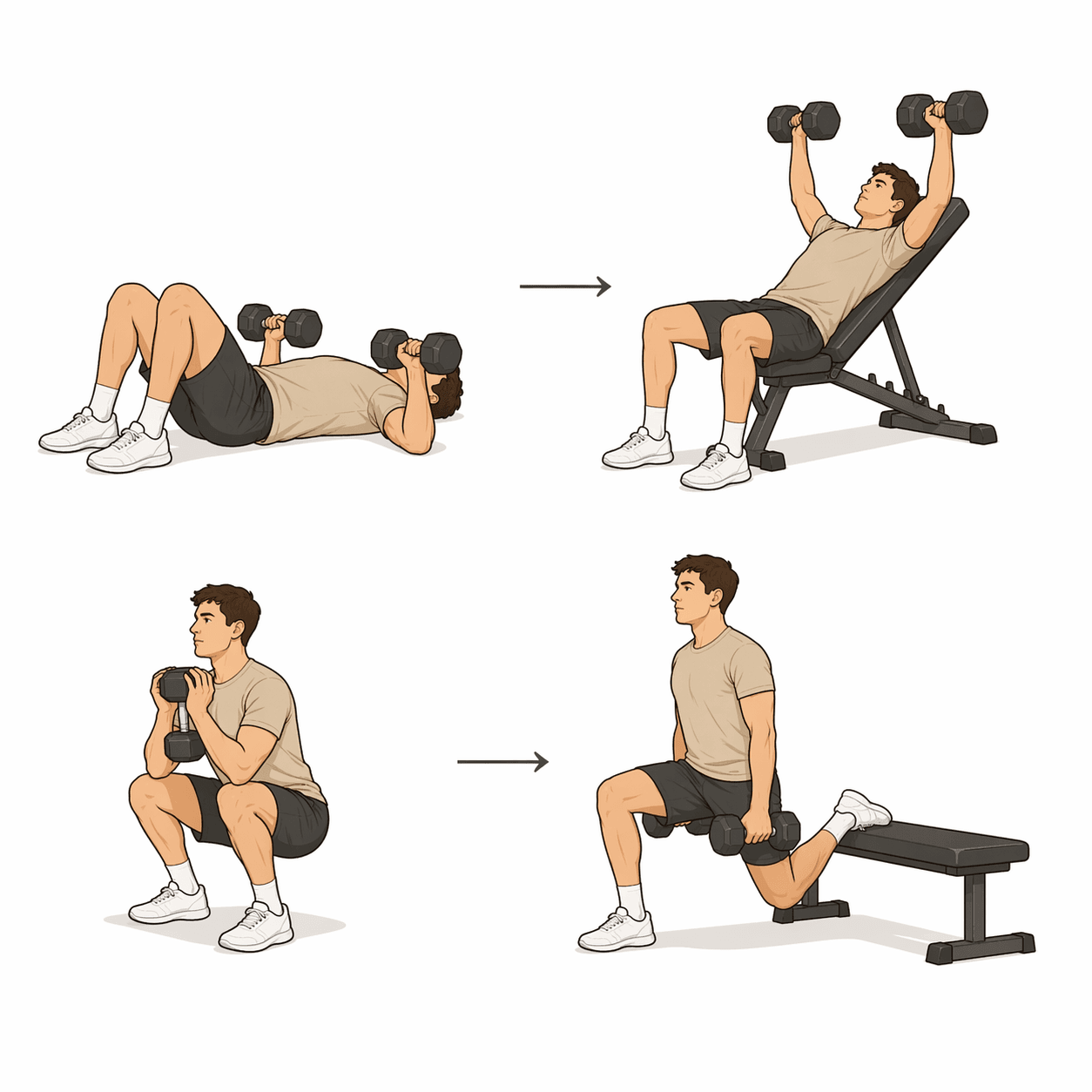
The progression criteria: only swap when you can do 3–4 sets of 10–12 controlled reps on the current exercise with every other method exhausted. Then use the substitute for 3–4 weeks before trying to return to the original movement.
The 8-Week Plan: Putting the System Together
Below is a sample 3‑day full body dumbbell routine that cycles through the five methods. Research shows that training each muscle group twice per week or more is more ideal for building muscle and strength than once per week. A full‑body protocol also burned nearly three times as much fat mass as a split‑body protocol over four weeks (Biology of Sport, 2016). I use a 3‑day split (e.g., Monday, Wednesday, Friday) with at least one rest day between sessions.
| Week | Progression Focus | Example Adjustment |
|---|---|---|
| 1–3 | Rep progression (conservative) | Same weight, push to 10,10,10 before adding weight |
| 4–5 | Volume-first | Increase sets from 3 to 4 or 5 on main lifts |
| 6 | Tempo/rest manipulation | Lower eccentric to 3‑4 sec or shorten rest to 45 sec |
| 7 | Pre-exhaust | Add isolation set before compound (e.g., flies before bench) |
| 8 | Exercise substitution | Swap one lift for harder variation |
Base routine (weeks 1–3 use this template, apply progression method each week):
- Goblet squat – 3x10
- Dumbbell bench press – 3x10
- Bent‑over row – 3x10
- Standing shoulder press – 3x10
- Dumbbell Romanian deadlift – 3x12
- Plank or dumbbell farmer carry – 3x 30 sec
To track your workouts, I recommend using a strength training app. The guide Best Strength Training Apps for Progressive Overload compares free and paid options that log sets, reps, and weight so you can see progression over time.
When You've Maxed Out Your Heaviest Dumbbell
Even with all five methods, there may come a day when your heaviest dumbbell feels easy. You are hitting 3x12 with perfect form on every exercise, and all progression levers are exhausted.
- Pre-exhaust (already covered) — use it to continue making progress with the same weight for a few more weeks.
- Unilateral loading — a single‑arm dumbbell row or single‑leg squat effectively doubles the load on that side.
- Exercise substitution to even harder variations — e.g., archer push‑ups after dumbbell bench press.
- If none of these revive progress, it is time for heavier dumbbells. Buying an additional pair (e.g., 70–80 lbs) or upgrading to a set that goes to 100+ lbs is a legitimate next step.
The point is: you should not need heavier dumbbells for six months if you use this system. And when you finally do, the new ceiling will again be pushable through the same five methods. That is the whole playbook.
Comments
Join the discussion with an anonymous comment.