Best Strength Training Apps for Progressive Overload: Which Apps Actually Make You Stronger Over Time
Most strength apps are just digital logbooks. This guide evaluates which apps genuinely implement progressive overload through AI, periodization, and auto-regulation — so intermediate to advanced lifters can choose an app that programs intelligently, not just logs workouts.
Why Progressive Overload Separates Real Strength Apps from Simple Loggers
If you have been training for more than six months, you already know the principle: to get stronger, you must consistently expose your muscles to a stimulus they have not yet adapted to. That is progressive overload in its simplest form. The question is not whether it works — it is whether the app you are using actually implements it in a way that drives continued adaptation.
Most strength apps are passive digital logbooks. They let you record sets, reps, and weights, but they do not tell you what to do next. That distinction matters. Research published in the Journal of Strength and Conditioning Research found that lifters using systematic tracking combined with intelligent progression recommendations achieved 23% better strength gains over 12 weeks compared to those using basic logging alone. That is not a marginal difference — it is the gap between spinning your wheels and making measurable progress.
A 2022 meta-analysis by Plotkin et al. in Sports Medicine confirmed that both load progression (adding weight) and rep progression (adding reps at the same weight) produce reliable muscular adaptations. The implication for app design is clear: an app does not need to be complicated to be effective, but it must have a deliberate progression mechanism. Apps that simply record your workout and leave next session's plan to your memory or intuition are leaving that 23% on the table.
This guide evaluates strength training apps through a single lens: how does this app implement progressive overload? We are not comparing feature counts, interface prettiness, or social features. We are asking whether the app can take an intermediate or advanced lifter and continue driving strength gains over months and years. If you want a broader framework for choosing a tracker, our workout tracker app decision framework covers the full picture. Here, we are going deep on the one variable that actually determines whether you get stronger.
How the Top Apps Handle Progressive Overload: A Side-by-Side Comparison
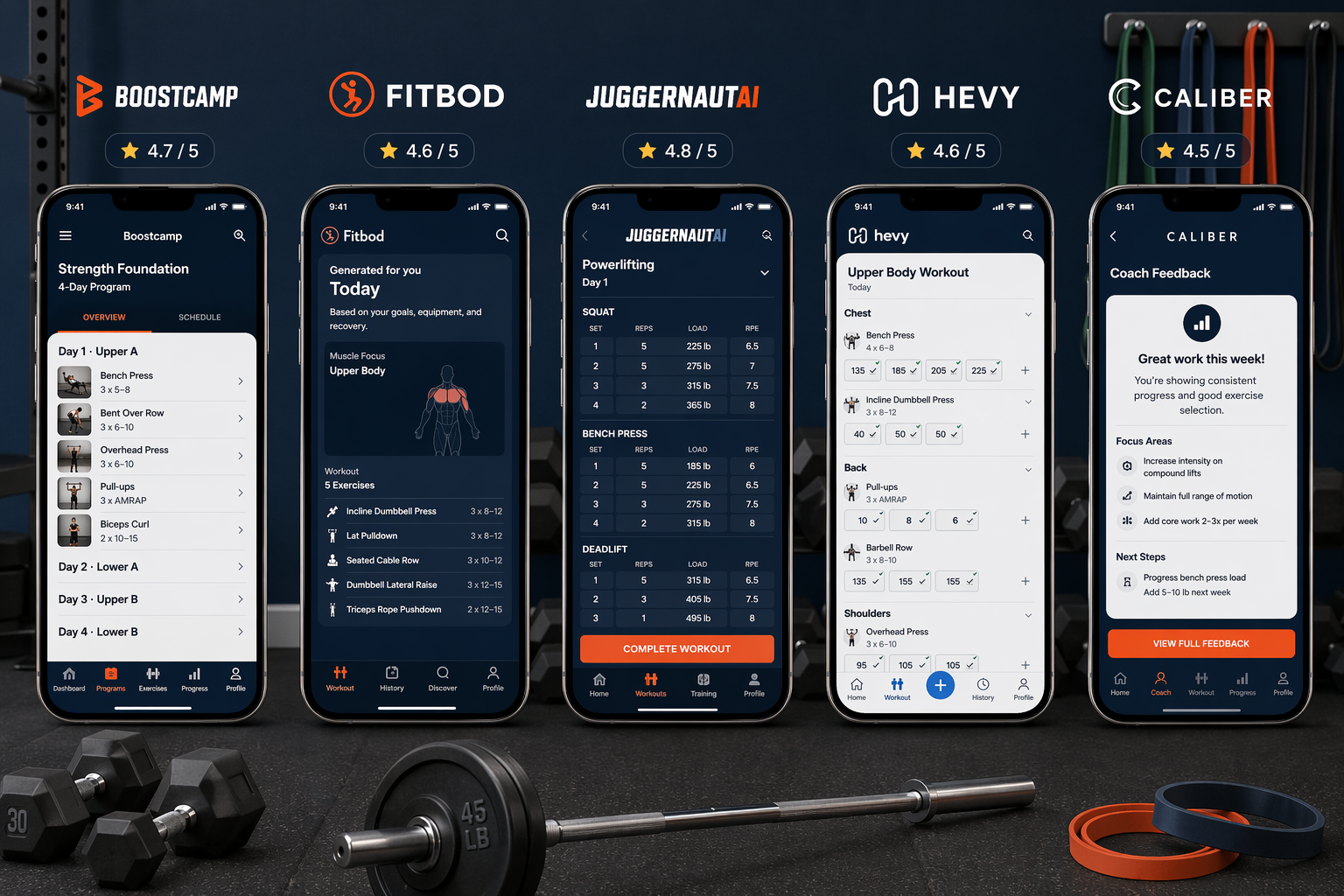
The table below summarizes the primary progressive overload method, GGR progressive overload score, pricing, and best training style fit for each app. Scores are drawn from Garage Gym Reviews' testing methodology, which evaluates how effectively each app manages load increases, volume management, and deloads over time.
| App | Progressive Overload Method | GGR Score | Pricing | Best Training Style Fit |
|---|---|---|---|---|
| JuggernautAI | Daily adaptive AI with auto-regulation | 5/5 | $34/mo (avg.) | Powerlifting, intermediate to advanced |
| JEFIT | 4 AI engines (Strength, Movement Balance, Stimulus Volume, NSPI) | 3/5 (GGR); 4.8 iOS / 4.45 Android | $12.99/mo or $69.99/yr | Bodybuilding, general strength |
| Fitbod | AI analyzes every set, adjusts future workouts | 3/5 | $12.99/mo (est.) | General strength, variety seekers |
| Boostcamp | Periodized programs from elite coaches | 5/5 | Free + premium tiers | Lifters wanting proven coach-designed programs |
| StrongLifts 5x5 | Linear progression (add 5 lb per session) | 3.5/5 | Free + paid tiers | Beginners, early intermediates |
| Hevy | None — tracker only, no long-term programming | 1/5 | Free + paid tiers | Lifters who only need a logbook |
| Nike Training Club | Does not track progressive overload or build structured programs | 3/5 | Free + premium | General fitness, not strength-focused |
| Edge | Personalized programming with 24/7 human coaches | 5/5 | Premium (newer entrant) | Hybrid: AI + human coaching |
| Future | Human coaching with personalized programming | 5/5 | $199/mo | Lifters wanting dedicated human coach |
This result comes from one real apartment under the stated conditions — it is a strong signal, not a guarantee your space will measure identically.
Builds this evidence supports
8-Week Compact Home Gym Strength Program: Build Muscle with Adjustable Dumbbells, Bands, and a Cable Tower
If you own a compact home gym setup—adjustable dumbbells, resistance bands, and a cable tower—this eight-week strength program shows how to program each resistance type for progressive overload without unlimited weight stacks.
Spot something off?
If this result didn't match your own space, let us know — floor-damage and noise claims carry real deposit-risk consequences if we get them wrong.