
Best Strength Training Apps for Beginners, Intermediates, and Advanced Lifters (2026)
Not all strength training apps are created equal. This guide breaks down the best apps for your experience level — from guided beginner programs to adaptive AI periodization for advanced lifters — so you can pick the right tool for where you are in your training journey.
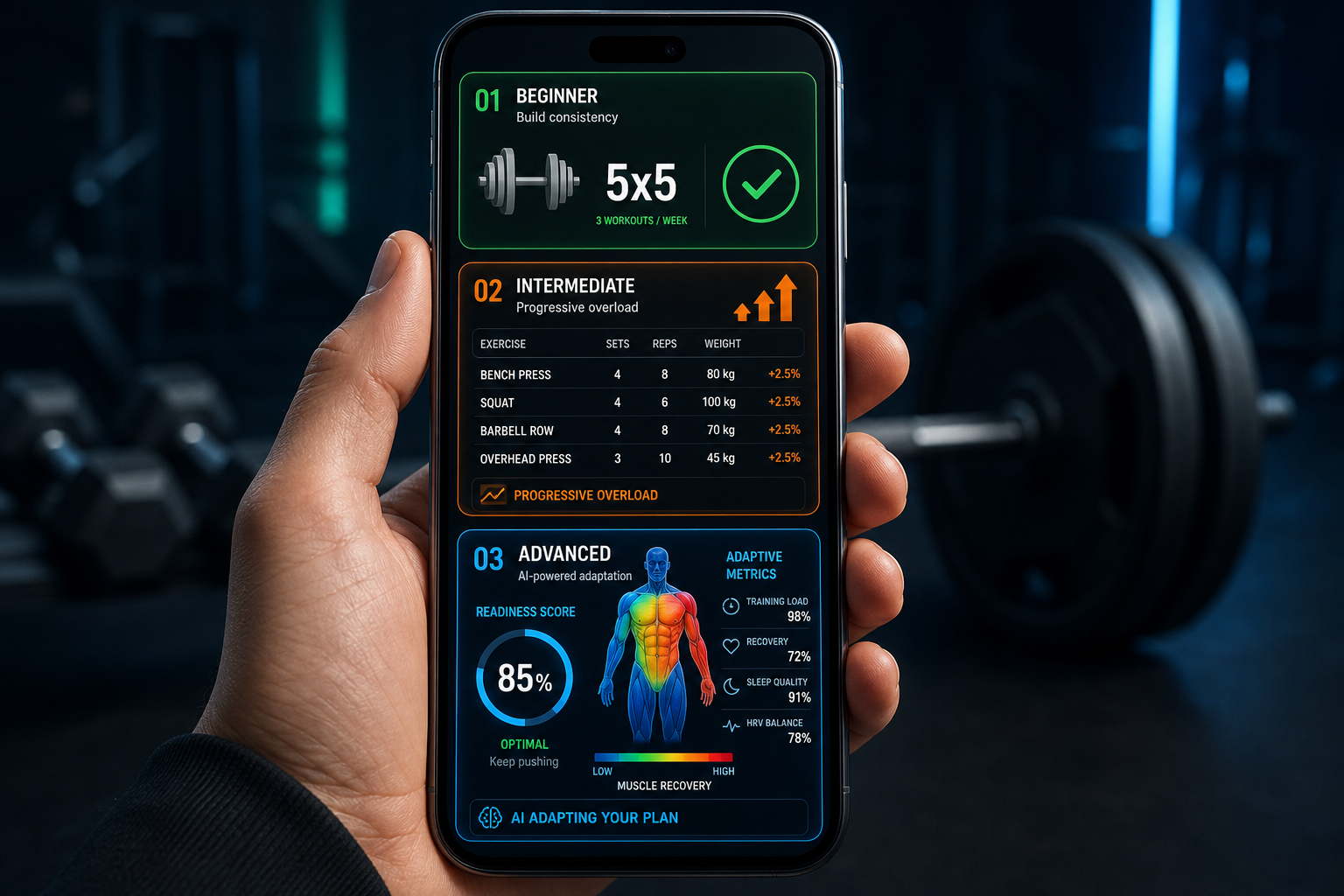
Why Your Experience Level Should Drive Your App Choice
Most strength training app roundups organize recommendations by use case — "best for strength," "best for beginners," "best for powerlifting." That approach misses a critical filter: your experience level. A beginner who downloads an app designed for an advanced lifter will face a wall of RPE scales, percentage-based programming, and auto-regulation metrics they don't yet need. An intermediate lifter stuck with a beginner app will outgrow its linear progression within months and have no way to customize their own program.
The strength training app market has bifurcated into three distinct tiers that map directly to your training stage:
- Beginner tier: Apps that provide guided programming, automatic progression, and form education — you don't need to know what to do, the app tells you.
- Intermediate tier: Apps that assume you know your program and just need fast logging, progress tracking, and routine customization — you bring the plan, the app handles the data.
- Advanced tier: Apps that use AI and auto-regulation to adjust periodization based on your daily readiness, recovery, and performance — the app adapts to you, not the other way around.
Picking an app from the wrong tier is like buying a race car when you're still learning to drive stick. This guide breaks down which apps belong in each tier, what features matter at your level, and — most importantly — when it's time to move up.
Beginner Tier: Guided Programs That Do the Thinking for You
If you're new to strength training, your biggest challenge isn't choosing the right exercise variation — it's showing up consistently and following a program that actually works. Beginner-tier apps remove all decision-making. They give you a structured program, tell you exactly what weight to lift, and handle progression automatically.
What to look for in a beginner app:
- Automatic progression — the app tells you when to add weight, not you
- Form guidance — video demos or detailed exercise descriptions
- Minimal customization — too many options overwhelm new lifters
- A proven program template — linear progression, full-body splits, or simple upper/lower
StrongLifts 5x5 — $0 (free + premium)
StrongLifts 5x5 is the simplest effective strength program available for absolute beginners. You perform five sets of five reps on three compound lifts per workout, alternating between workout A and workout B. The app handles all progression — it tells you when to add 5 pounds, when to deload, and when to repeat a weight. There are zero programming decisions to make.
The trade-off is shelf life. Linear progression works for roughly 3 to 6 months before you stall. After that, the program's simplicity becomes a limitation — there's no way to customize exercises, adjust volume, or switch to an intermediate split. But for those first months of training, it's hard to beat.
Muscle Booster — ~$15/month
Muscle Booster takes a more guided approach than StrongLifts. It generates personalized workout plans based on your goals, equipment, and experience level, and includes form videos for every exercise. Garage Gym Reviews rated it 4 out of 5 overall, with perfect 5 out of 5 scores for progressive overload, accountability, and ease of use. It's a strong pick if you want more variety than a single program template.
The downside: Muscle Booster costs $14.99 per month with no free trial, making it one of the pricier options in this tier. If budget is a concern, the free options below may serve you just as well.
Caliber Strength Training — free tier available
Caliber offers a free-forever tier that includes over 500 exercises with video demonstrations, ad-free tracking, and progress logging. It's a solid middle ground for beginners who want structure without paying. The free version doesn't include personalized programming — you'll need to follow one of their pre-built routines or build your own — but the exercise library and form cues make it a safe starting point.
For beginners who want coaching, Caliber offers group coaching at $19 per month and 1:1 coaching starting at $200 per month. Most new lifters will do fine with the free tier and a structured routine.
Intermediate Tier: Fast Tracking and Customization for Lifters Who Know Their Program
Once you've been training consistently for 6 to 12 months, you no longer need an app to design your program. You know which split works for you, which exercises target your weak points, and roughly how much weight to add each week. What you need is a tool that logs your workouts quickly, shows your progress over time, and lets you customize routines without friction.
What to look for in an intermediate app:
- Fast logging — tap through sets in seconds, not minutes
- Routine customization — create your own exercises, supersets, and rest timers
- Progress graphs and 1RM calculations — see your strength trends over weeks and months
- A generous free tier — most intermediate needs are met without paying
Hevy — free tier (Pro from $9.99/month)
Hevy has become the default recommendation for intermediate lifters, and for good reason. Its free tier covers unlimited workout logging, progress charts, 1RM calculations, routine templates, and social features. The interface is clean and fast — you can log an entire workout in under a minute once your routine is set up.
For most intermediate lifters, the free tier is genuinely sufficient. The Pro version ($9.99 per month or $23.99 per year) adds a Trainer feature for creating custom programs for others, but the core logging and tracking experience is identical. If you're an intermediate lifter who just wants to track your own workouts, Hevy's free tier is likely all you'll ever need.
Strong — Pro from $4.99/month
Strong has long been a favorite among powerlifters and bodybuilders who value speed above all else. Its logging interface is widely considered the fastest on the market — you can start a workout, log sets, and finish before most apps have finished loading your routine. The Pro version starts at $4.99 per month, making it one of the cheapest paid options in this tier.
The trade-off: Strong's free tier is more limited than Hevy's. You can only save a limited number of routines, and some features like progress graphs are locked behind the paywall. If you're willing to pay $5 per month for the fastest logging experience, Strong is the pick. If you want a robust free tier, Hevy wins.
Boostcamp — free (PRO at $14.99/month)
Boostcamp sits between the intermediate and advanced tiers. Its free version gives you access to over 1,000 workout plans created by coaches and competitive lifters — including popular programs like nSuns, GZCL, and 5/3/1. If you're an intermediate lifter who wants to follow a proven program without designing it yourself, Boostcamp's free library is unmatched.
The PRO version ($14.99 per month or $39.99 per year) unlocks advanced analytics, custom program creation, and additional features. But for most intermediates, the free version with its 1,000+ programs is more than enough.
| App | Free Tier Quality | Pro Price | Best For |
|---|---|---|---|
| Hevy | Excellent — unlimited logging, graphs, 1RM | $9.99/mo or $23.99/yr | Lifters who want a robust free tier |
| Strong | Limited — fewer routines, no graphs | $4.99/mo or $69.99/yr | Lifters who prioritize logging speed |
| Boostcamp | Excellent — 1,000+ free programs | $14.99/mo or $39.99/yr | Lifters who want coach-designed programs |
Advanced Tier: AI Periodization and Auto-Regulation for Serious Lifters
At the advanced level, you've been training for years. You know your 1RM on every main lift. You track RPE. You understand periodization. The problem is that manual programming becomes increasingly complex — calculating weekly percentages, adjusting for fatigue, and deciding when to push and when to pull back. Advanced-tier apps use AI and auto-regulation to handle this complexity for you.
What to look for in an advanced app:
- AI-driven periodization — the app adjusts your program based on your performance, not a fixed template
- Auto-regulation — daily readiness scoring that accounts for sleep, soreness, nutrition, and motivation
- Percentage-based training — the app calculates your working weights from your actual 1RM
- RPE logging and recovery tracking — the app uses your feedback to adjust future sessions
JuggernautAI — $35/month
JuggernautAI is the most sophisticated option in this tier. Every day, it asks you about your sleep quality, soreness levels, nutrition, and motivation. Based on your responses, it auto-adjusts your training loads for that day's session. If you're well-rested and recovered, it pushes the intensity. If you're fatigued, it pulls back — preventing unnecessary grind sessions that accumulate fatigue without productive stimulus.
Garage Gym Reviews gave JuggernautAI a 4 out of 5 overall rating, with a perfect 5 out of 5 for progressive overload. It offers a 14-day free trial, which is enough time to evaluate whether the AI's adjustments match your training philosophy. At $35 per month, it's the most expensive app on this list, but for advanced lifters who want truly adaptive programming, there's nothing else like it.
Fitbod — ~$15/month
Fitbod uses AI that analyzes every set you log and adjusts future workouts based on your performance and recovery. Its database of over 900 exercises includes muscle recovery heat maps that show which muscle groups are still recovering, so the app avoids overtraining them. It's particularly strong for lifters who train with varied equipment — the AI adapts to whatever you have available, whether that's a full gym, dumbbells, or resistance bands.
Fitbod is priced around $15 per month (with a 3-workout free trial). It's less expensive than JuggernautAI but also less specialized — it works well for general strength and hypertrophy but lacks the percentage-based periodization that powerlifters need.
Jefit Elite — $12.99/month
Jefit has been a staple in the strength training community for over a decade, and its Elite tier ($12.99 per month or $69.99 per year) brings AI-powered recommendations to its massive exercise library. The Progressive Overload System uses AI to recommend weights and reps for each set based on your logged history. Its NSPI (North Star Progress Index) consolidates your strength gains across all lifts into a single score, making it easy to see whether you're actually getting stronger.
Jefit's blog cites research published in the Journal of Strength and Conditioning Research finding that lifters who use systematic tracking combined with intelligent progression recommendations achieve 23% better strength gains over 12 weeks compared to those using basic logging alone. While this figure comes from Jefit's own reporting and should be interpreted with that context in mind, it underscores the value of moving beyond simple set-and-rep logging.
| App | Price | Key Advanced Feature | Best For |
|---|---|---|---|
| JuggernautAI | $35/mo | Daily readiness scoring + auto-adjusted loads | Powerlifters and serious strength athletes |
| Fitbod | ~$15/mo | Muscle recovery heat maps + adaptive AI | General strength and hypertrophy with varied equipment |
| Jefit Elite | $12.99/mo | AI weight/reps recommendations + NSPI score | Lifters who want data-driven progression tracking |
Decision Matrix: Which App Fits Your Level?
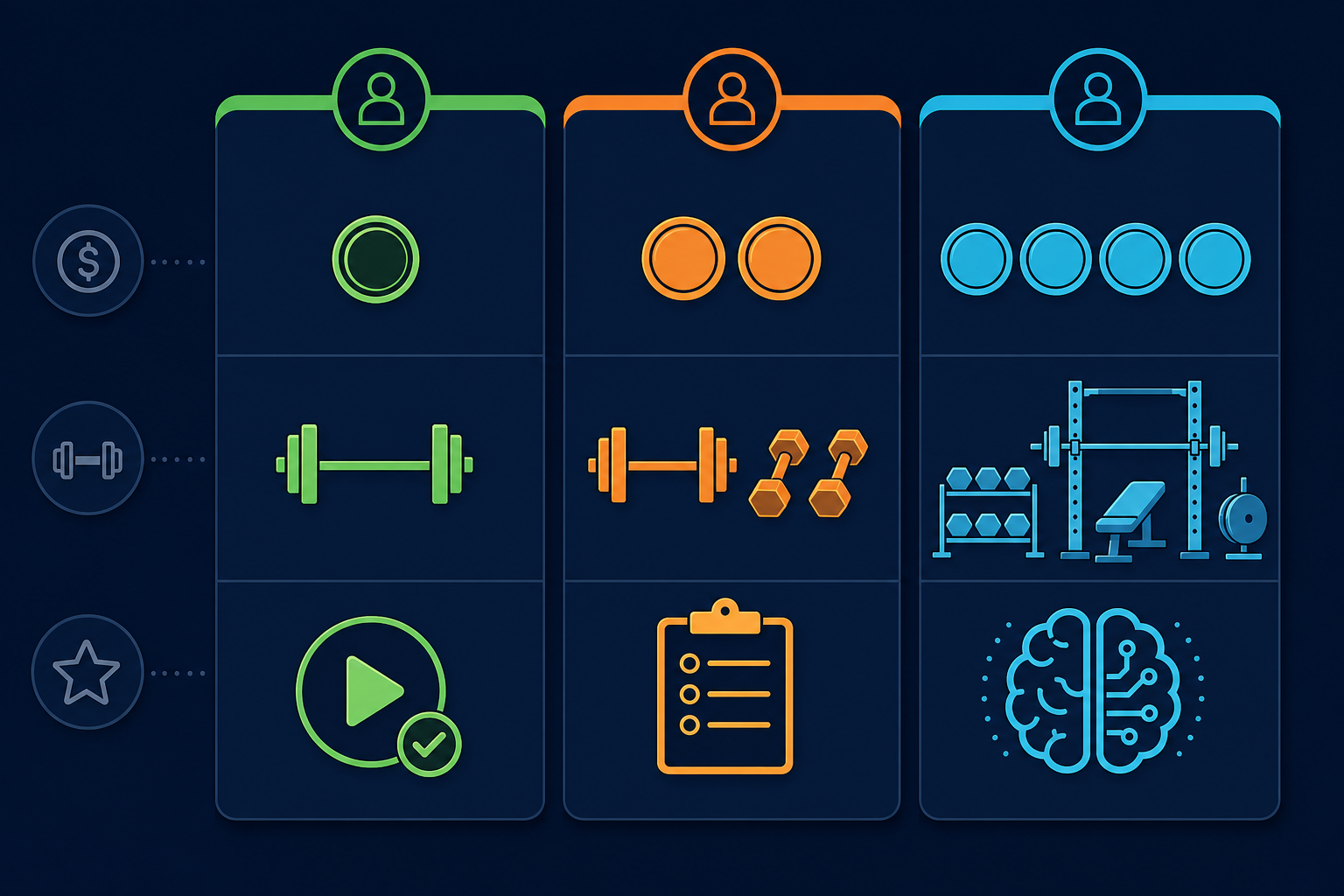
| App | Tier | Price | Equipment Needed | Key Strength Feature |
|---|---|---|---|---|
| StrongLifts 5x5 | Beginner | $0 (free + premium) | Barbell, rack, bench | Automatic linear progression |
| Muscle Booster | Beginner | ~$15/mo | Any (adjusts to equipment) | Personalized plans + form videos |
| Caliber | Beginner | Free (coaching from $19/mo) | Any (500+ exercises) | Ad-free free tier with video demos |
| Hevy | Intermediate | Free (Pro $9.99/mo) | Any | Generous free tier with full tracking |
| Strong | Intermediate | Pro from $4.99/mo | Any | Fastest logging interface |
| Boostcamp | Intermediate | Free (PRO $14.99/mo) | Any | 1,000+ free coach-designed programs |
| JuggernautAI | Advanced | $35/mo | Barbell-focused | Daily readiness auto-regulation |
| Fitbod | Advanced | ~$15/mo | Any (900+ exercises) | Muscle recovery heat maps + AI |
| Jefit Elite | Advanced | $12.99/mo | Any | AI weight/reps + NSPI progress score |
When to Graduate to the Next Tier
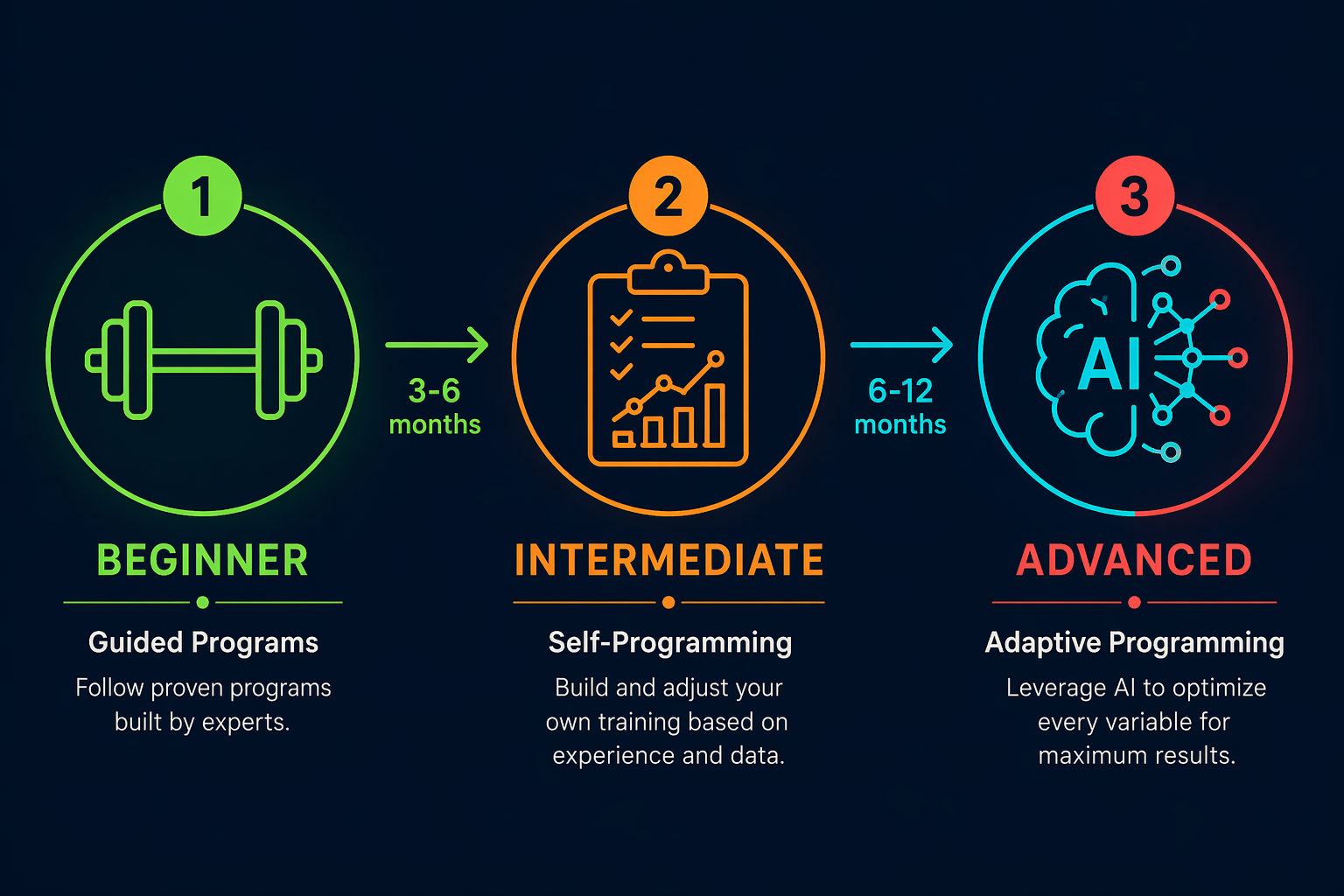
Knowing when to switch apps is as important as picking the right one in the first place. Here are the concrete signals that it's time to move up.
Beginner → Intermediate
- Your linear progression has stalled for 2-3 weeks in a row — you're failing the same weight on the same exercise
- You find yourself wanting to customize exercises or add accessory work that the beginner app doesn't support
- You know your 1RM on your main lifts and want to start using percentages
- You're manually calculating your next week's weights because the app's auto-progression no longer matches your needs
This typically happens after 3 to 6 months of consistent training. When you reach this point, switch to an intermediate tracker like Hevy or Strong, where you can build your own program and track progress on your terms.
Intermediate → Advanced
- You're tracking RPE on every working set and want the app to use that data to adjust your program
- You're running periodized programs (block periodization, DUP, or conjugate) and want AI to handle the math
- You notice that your training quality varies significantly based on sleep, stress, and recovery — and you want an app that accounts for that
- You've been training consistently for 12+ months and feel like your progress has plateaued despite following a solid program
This transition usually happens after 12 to 24 months of consistent training. At this stage, an app like JuggernautAI or Fitbod can break through plateaus by adjusting your training based on real-time readiness data — something no manual program can do.
The right strength training app isn't the one with the most features or the best reviews — it's the one that matches where you are right now. Start with a beginner app that builds the habit and handles the programming. Move to an intermediate tracker when you know what you're doing and just need fast logging. Graduate to an advanced AI app when your training demands adaptive periodization that no manual program can match. Your app should grow with you, not hold you back.
This result comes from one real apartment under the stated conditions — it is a strong signal, not a guarantee your space will measure identically.
Builds this evidence supports
Garage Gym Equipment Tier System: What to Buy First, Second, and Third Based on Your Training Goals
A practical guide for beginners and intermediate home gym builders that uses a community-backed tier system (must-have, should-have, nice-to-have, avoid) to help you buy equipment in the right order—so every purchase serves a real training need and nothing is wasted.
Backyard Gym Equipment: How to Build an Outdoor Workout Space on Any Budget
This guide helps beginners and budget-conscious home fitness enthusiasts build a functional outdoor gym. It covers three budget tiers (under $500, $500–$2,000, and $2,000–$5,000) and reveals the hidden costs of weatherproofing, flooring, and storage that often derail budgets.
Compact Home Gym Buyer's Guide: 8 Questions to Answer Before Buying a Single Piece of Gear
Most compact home gym purchases fail not because of bad products, but because buyers skip the constraint-framing step. This guide helps complete beginners with limited space ask the right questions about noise, space, training style, budget, and growth plans before evaluating any gear.
Spot something off?
If this result didn't match your own space, let us know — floor-damage and noise claims carry real deposit-risk consequences if we get them wrong.