
Why a Generic 'Best App' List Fails Women at Different Life Stages
Open any major roundup from CNET, Forbes, or Good Housekeeping and you will find a list of the same half-dozen apps ranked by general features: instructor quality, workout variety, price. What you will not find is any acknowledgment that a 28-year-old training through her first trimester and a 52-year-old managing perimenopausal joint stiffness have fundamentally different physiological needs. A single ranked list cannot serve both readers, yet that is exactly what the mainstream fitness media continues to publish.
This gap is not a minor oversight. Prenatal programming must account for pelvic floor safety and diastasis recti risk. Perimenopause-stage training should prioritize bone density and metabolic health. A strength-focused woman in her thirties needs progressive overload mechanics, not a generic HIIT class. When a roundup ignores these distinctions, it forces the reader to reverse-engineer the decision herself — reading each app description and trying to guess whether it fits her stage of life.
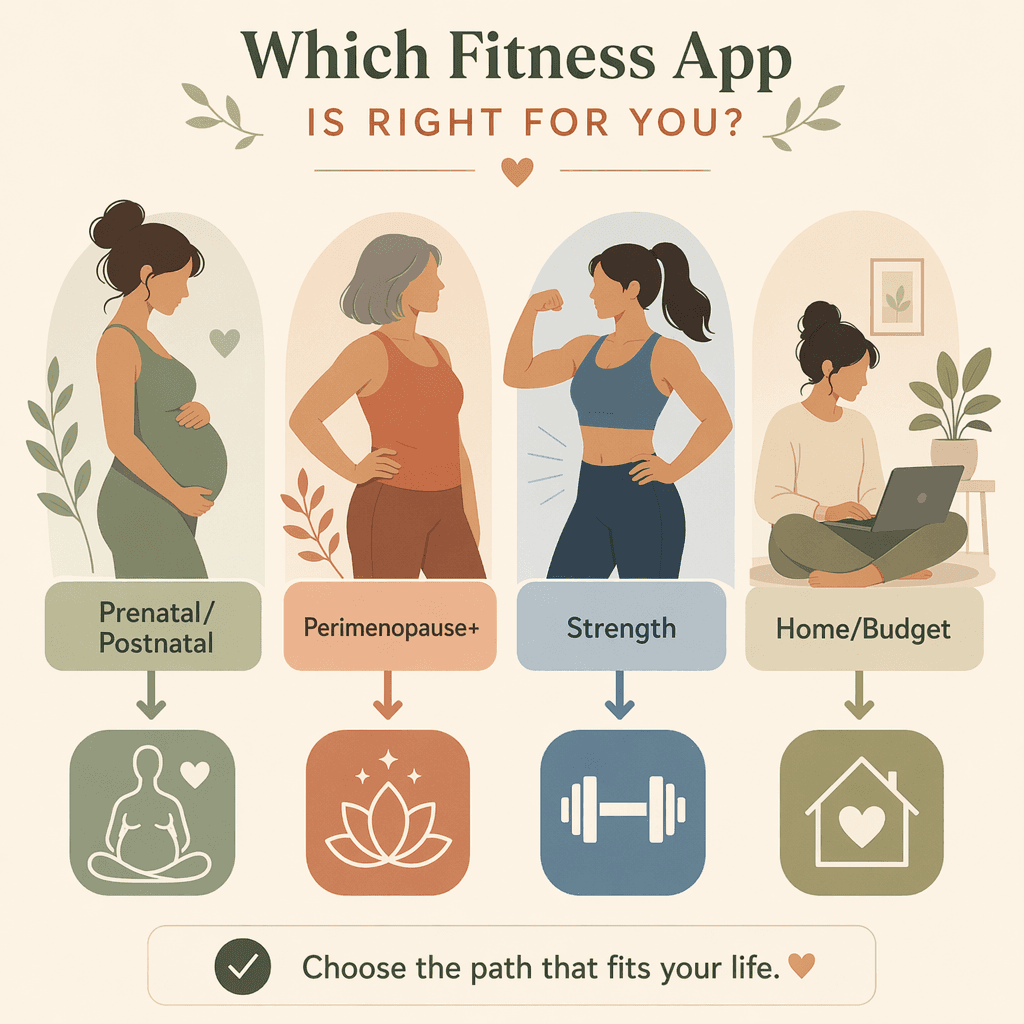
The following comparison is organized around the constraints that actually matter: life stage, primary goal, budget, and equipment access. Each section names a clear winner for that profile, explains why general-purpose apps fall short, and provides the pricing data you need to make a decision.
Decision Framework: Match Your Life Stage, Goal, Budget, and Equipment
Before you scroll through app descriptions, take 30 seconds to identify your profile. The table below maps the four decision axes that determine which app will actually serve you. Every app reviewed in this article is matched to one or more of these profiles.
| Profile | Life Stage | Primary Goal | Budget Range | Equipment |
|---|---|---|---|---|
| Prenatal / Postpartum | Pregnancy through 12 months postpartum | Pelvic floor strength, birth prep, safe core recovery | $0 – $30/mo | None to minimal |
| Perimenopause & 50+ | Ages 40–60+ | Bone density, joint mobility, metabolic health | $15 – $33/mo | None to light weights |
| General Strength | Ages 25–50 | Progressive overload, muscle building, hypertrophy | $0 – $20/mo | Dumbbells, barbell, or gym access |
| Budget-Conscious | Any | Consistent workouts without subscription lock-in | $0 | None to minimal |
| Cycle-Synced Training | Menstruating women, any age | Phase-adjusted intensity and nutrition | $0 – $15/mo | None to moderate |
If you fall into multiple profiles — for example, you are postpartum and on a tight budget — read the relevant sections and cross-reference the comparison table at the end. The bottom-line recommendations section consolidates everything into a single pick per profile.
Pregnancy & Postpartum: Apps That Support Your Changing Body
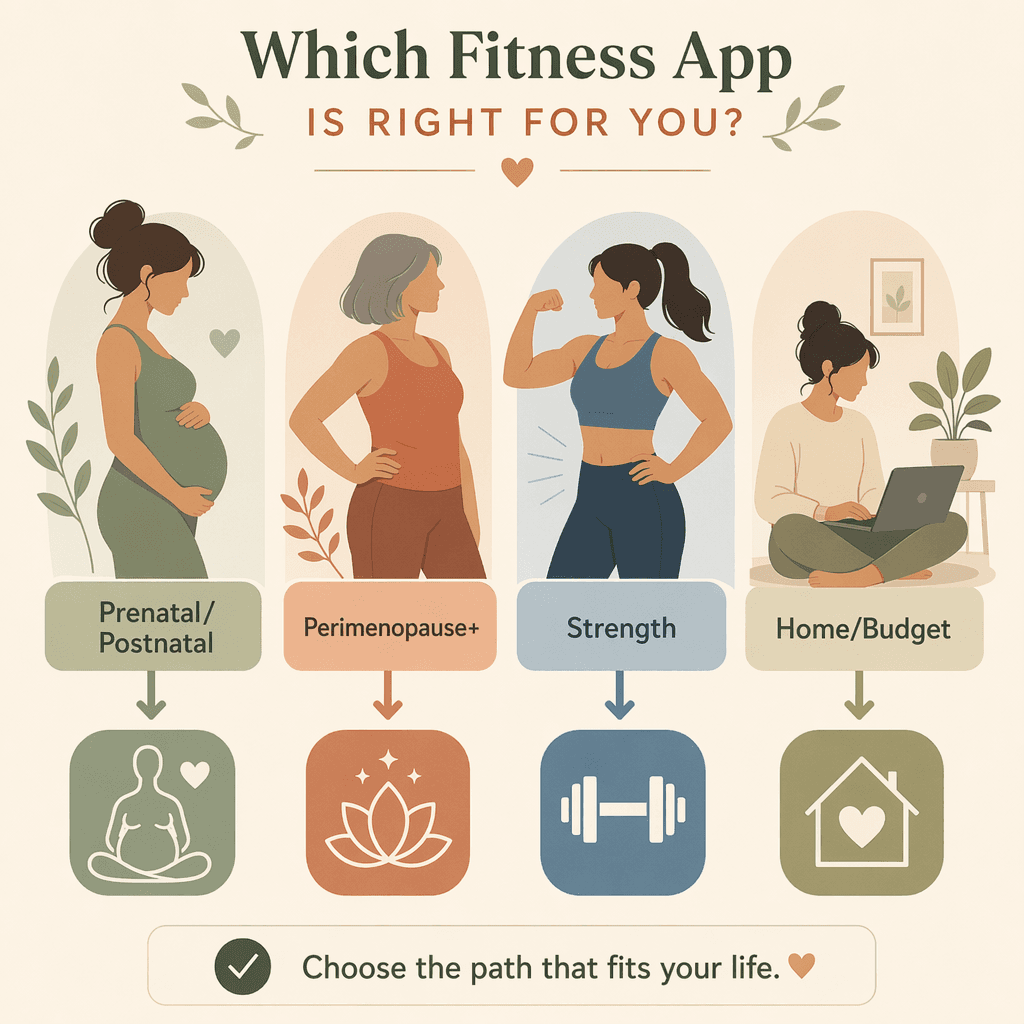
Prenatal and postpartum fitness is not a niche — it is a distinct medical category. General apps like Peloton or Nike Training Club offer modifications at best, but they do not build their programming around pelvic floor safety, diastasis recti precautions, or the progressive return to load-bearing exercise after birth. For this stage, you need an app that was designed from the ground up for pregnancy and postpartum recovery.
Bloom Method — Best Overall for Prenatal & Postpartum
Bloom Method is our top pick for this profile. It costs $29.99 per month with a 7-day free trial and focuses specifically on pelvic floor strength, core integrity, and birth preparation. Unlike general apps that treat pregnancy as a temporary modification of a standard workout, Bloom Method structures its entire library around the physiological changes of each trimester and the postpartum recovery window.
The app earned a GGR Score of 4.5 from expert testers at Garage Gym Reviews, who evaluated it across pricing, ease of use, equipment demands, and accountability. The 7-day trial gives you enough time to assess whether the programming matches your specific stage.
Sweat Post-Pregnancy — Strong Alternative with Broader Variety
The Sweat app, founded by Kayla Itsines, includes a dedicated post-pregnancy program alongside its main workout library. Sweat costs $25 per month or $135 per year and offers zero-equipment options, making it accessible for home use. The app has over 1 million monthly users and more than 50 workout programs, but its post-pregnancy content is one program among many, not the app's sole focus. If you want a broader workout library that happens to include postpartum programming, Sweat is a solid choice. If you want a specialist, stick with Bloom Method.
| App | Monthly Price | Annual Price | Free Trial | Focus Area |
|---|---|---|---|---|
| Bloom Method | $29.99 | Not listed | 7 days | Pelvic floor, birth prep, postpartum recovery |
| Sweat (Post-Pregnancy) | $25 | $135 | 7 days (typical) | Post-pregnancy program within broader library |
Perimenopause & 50+: Strength, Bone Density, and Metabolic Health
Women in perimenopause and menopause face a set of training priorities that most fitness apps simply do not address: maintaining bone mineral density, preserving lean muscle mass during hormonal shifts, supporting joint mobility, and managing metabolic changes. Despite this being a massive demographic, the majority of 'best apps for women' lists skip it entirely. Two apps have emerged to fill this gap.
Over Fifty Fitness — Built Specifically for Women Over 50
Over Fifty Fitness was founded by award-winning trainer PJ Wren and is designed exclusively for women over 50. The app contains over 1,550 on-demand workouts and 60+ specialized programs that focus on bone density, metabolic health, and joint mobility. According to the brand's website, it has been trusted by more than 10,000 women over 50 and holds over 400 five-star Google reviews.
Pricing is $32.99 per month or $167.99 per year (which works out to roughly $14 per month when billed annually). A 14-day free trial is available. The app is accessible on iOS, Android, Roku, Amazon Fire, Apple TV, and Samsung TV, which matters for women who prefer to follow workouts on a larger screen.
WeGLOW — Cycle-Synced Training for Perimenopause
WeGLOW positions itself as a female-first fitness app with cycle-synced training features that adjust workout intensity based on menstrual cycle phase — a particularly relevant feature for perimenopausal women whose cycles may be irregular but who still benefit from phase-aware programming. The app offers over 2,500 workouts, 400+ on-demand live-style classes, and 700+ recipes. It claims a 4.9 out of 5 average app rating and states that '98% of women that use our fitness app and stick to their plan see results in 8 weeks.'
| App | Monthly Price | Annual Price | Free Trial | Key Focus |
|---|---|---|---|---|
| Over Fifty Fitness | $32.99 | $167.99 ($14/mo) | 14 days | Bone density, joint mobility, metabolic health |
| WeGLOW | Not specified | Not specified | Not specified | Cycle-synced training, strength, Pilates, yoga |
General Strength & Hypertrophy: Progressive Overload for Real Results
For women whose primary goal is building muscle and getting stronger, the app needs to support progressive overload — the systematic increase of weight, reps, or volume over time. Many general fitness apps treat strength as one workout type among many, not as a structured training methodology. The apps below are built around strength programming, not around class variety.
Caliber — Best Free Strength Foundation
Caliber's free version includes a library of over 500 exercises, ad-free usage, and strength and body metrics tracking. It earned a GGR Score of 4.6 from expert testers at Garage Gym Reviews, making it their top overall pick for women. The Pro version costs $19 per month and adds personalized programming and coaching. For women who want a serious strength foundation without an immediate subscription, Caliber's free tier is the strongest starting point.
Stronger By The Day — Science-Based Programming for Serious Lifters
Created by powerlifting coach Meg Gallagher, Stronger By The Day uses science-backed programming designed for women who want to lift heavy and track progress. It costs $15 per month with a 7-day free trial, or $100 per year. CNET recommends it specifically for women serious about strength training. The programming follows a periodized structure, which means you are not repeating the same workouts — you are following a planned progression across weeks and months.
EvolveYou and Fitbod — Alternatives for Different Training Styles
EvolveYou (formerly Tone and Sculpt) costs $22.99 per month or $119 per year and was named best overall for women by CNET. It offers structured strength programs with a focus on muscle definition. Fitbod costs $15.99 per month or $95.99 per year and uses AI to adapt workouts based on your logged performance and available equipment. Fitbod is a strong choice if you want an app that adjusts automatically rather than following a fixed program.
| App | Monthly Price | Annual Price | Free Trial | Best For |
|---|---|---|---|---|
| Caliber (Free) | $0 | $0 | Forever free tier | Strength foundation, tracking, ad-free |
| Caliber (Pro) | $19 | Not listed | Included in free tier | Personalized coaching |
| Stronger By The Day | $15 | $100 | 7 days | Periodized strength programming |
| EvolveYou | $22.99 | $119 | Not specified | Structured strength and definition |
| Fitbod | $15.99 | $95.99 | Not specified | AI-adaptive strength training |
For a deeper dive into progressive overload programming and how these apps handle periodization, see our dedicated strength training apps guide and our muscle-building apps comparison.
Budget Picks: Free and Low-Cost Apps That Deliver
Not everyone wants a recurring subscription. The apps below offer genuinely useful free tiers — not just 7-day trials — that can sustain a workout routine indefinitely. These are the best options if your budget is $0.
Nike Training Club — Completely Free, 300+ Workouts
Nike Training Club has been completely free since 2020 and offers over 300 workouts across strength, HIIT, yoga, and mobility. Forbes Health rated it 5.0, and Good Housekeeping named it best for beginners. There is no paid tier, no subscription upsell, and no feature gating. For a free app, the production quality and workout variety are exceptional. The trade-off is that you do not get personalized programming or progressive overload tracking — it is a library of individual workouts, not a structured training plan.
FitOn — Free Tier with Live Classes and Modifications
FitOn's free version gives you access to all workout videos with on-screen modifications, making it a strong choice for beginners. The free tier is comprehensive enough for consistent use. The Pro version costs $199.99 per year or $79.99 for six months and adds personalized meal plans and advanced tracking. FitOn also includes pre- and postnatal workouts in its library, which is rare for a free-tier app.
Hevy — Free Workout Logging with Social Features
Hevy is a strength logging app with a generous free version that includes workout tracking and social community features. It is not a guided workout app — you bring your own program and use Hevy to log sets, reps, and weights. If you already know how to structure your own strength training and just need a clean logging tool, Hevy's free tier is one of the best available. A premium version unlocks additional analytics and custom routines.
| App | Free Tier Quality | Paid Version | Best For |
|---|---|---|---|
| Nike Training Club | Full library, no paywall | None (fully free) | Guided workouts, variety, beginners |
| FitOn | All videos, modifications shown | $199.99/yr or $79.99/6mo | Live classes, beginners, prenatal |
| Hevy | Full logging, social features | Premium for extra analytics | Self-directed strength logging |
For a more detailed breakdown of free apps organized by goal, see our free workout apps guide. If you are completely new to strength training and need an app that teaches you the basics, our beginner strength training apps guide is a better starting point.
Cycle-Synced Training: The Emerging Category for 2026
Cycle-synced training — adjusting workout intensity, type, and nutrition recommendations based on the phases of the menstrual cycle — has moved from a niche concept to a recognized training methodology in 2026. The underlying research suggests that aligning training load with hormonal fluctuations (higher intensity during the follicular phase, lower intensity and more recovery during the luteal phase) may improve performance, reduce injury risk, and support better recovery.
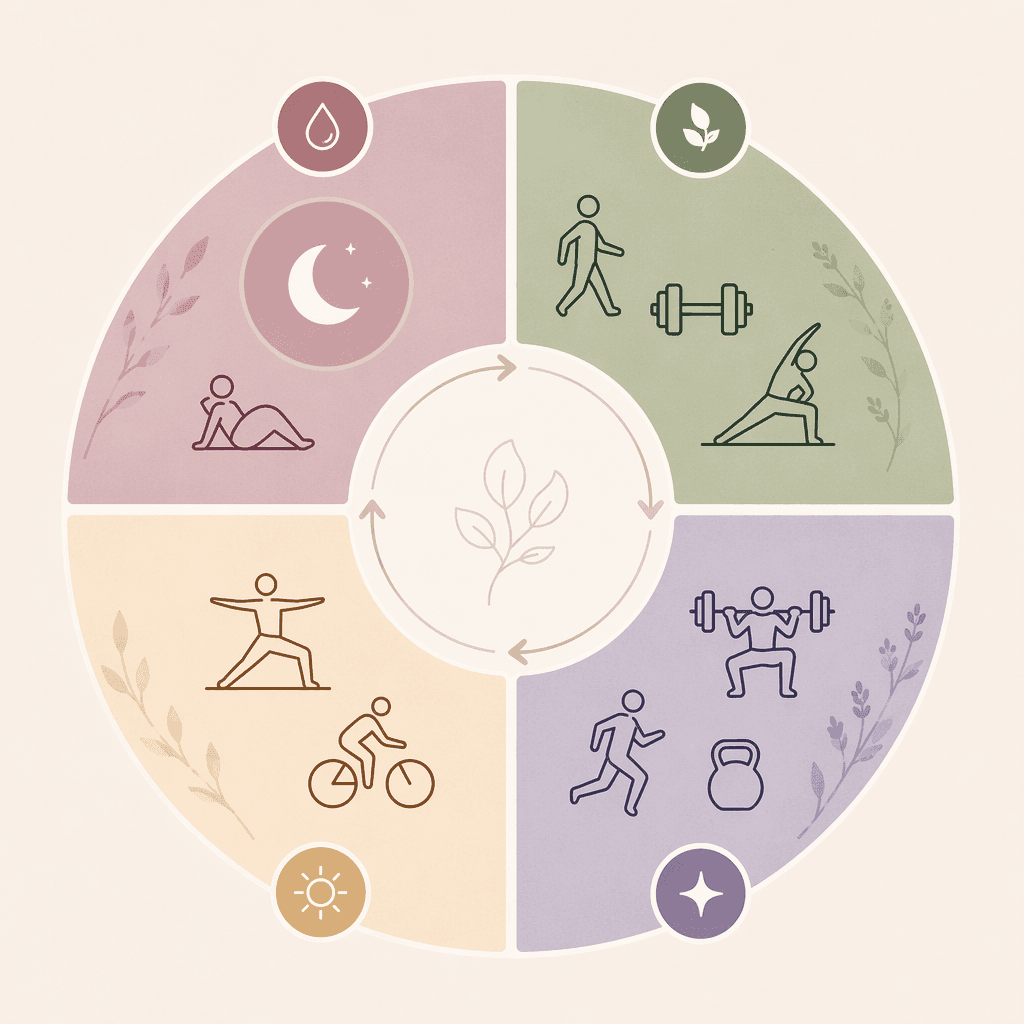
Several apps now offer cycle-synced features as a core differentiator:
- Wild.AI — Named a breakout trend for 2026 by FitKit UK, Wild.AI coaches women based on their menstrual cycle phase, adjusting both training intensity and nutrition recommendations. It is free with a subscription option for advanced features.
- WeGLOW — As noted in the perimenopause section, WeGLOW includes cycle-synced training across its 2,500+ workout library, making it one of the most comprehensive apps in this category.
- FitrWoman — An app specifically focused on cycle-aware training and nutrition, though its full feature set and pricing were not available in the sources reviewed for this article.
If you are interested in cycle-synced training, start with Wild.AI's free tier to test whether the approach fits your lifestyle before committing to a paid subscription. The research backing is promising, but individual responses to phase-based training vary significantly.
Comparison Table: Pricing, Trial Length, Equipment, and Best-Fit Stage
The table below consolidates every app featured in this article across the decision dimensions that matter most: cost, trial access, equipment requirements, and the specific life stage or goal each app serves best. Use this as your final reference before making a choice.
| App | Pricing Model | Monthly Cost | Annual Cost | Free Trial | Equipment Needed | Platform | Best-Fit Profile |
|---|---|---|---|---|---|---|---|
| Bloom Method | Paid subscription | $29.99 | Not listed | 7 days | None to minimal | iOS, Android | Prenatal & postpartum |
| Sweat | Paid subscription | $25 | $135 | 7 days (typical) | None to minimal | iOS, Android | Post-pregnancy, general fitness |
| Over Fifty Fitness | Paid subscription | $32.99 | $167.99 ($14/mo) | 14 days | None to light weights | iOS, Android, Roku, Fire TV, Apple TV, Samsung TV | Women over 50 |
| WeGLOW | Paid subscription | Verify | Verify | Verify | None to moderate | iOS, Android | Cycle-synced, perimenopause |
| Caliber (Free) | Free | $0 | $0 | Forever | Dumbbells, gym access | iOS, Android | Strength foundation |
| Caliber (Pro) | Paid subscription | $19 | Not listed | Included in free | Dumbbells, gym access | iOS, Android | Personalized strength coaching |
| Stronger By The Day | Paid subscription | $15 | $100 | 7 days | Dumbbells, barbell, gym | iOS, Android | Serious strength training |
| EvolveYou | Paid subscription | $22.99 | $119 | Not specified | Dumbbells, resistance bands | iOS, Android | Structured strength & definition |
| Fitbod | Paid subscription | $15.99 | $95.99 | Not specified | Dumbbells, gym access | iOS, Android | AI-adaptive strength training |
| Nike Training Club | Free | $0 | $0 | N/A | None to minimal | iOS, Android | Budget, beginners, variety |
| FitOn | Freemium | $0 (free tier) | $199.99 (Pro) | N/A (free tier) | None to minimal | iOS, Android | Budget, beginners, prenatal |
| Hevy | Freemium | $0 (free tier) | Verify (premium) | N/A (free tier) | Dumbbells, gym access | iOS, Android | Self-directed strength logging |
| Wild.AI | Freemium | $0 (free tier) | Verify (subscription) | N/A (free tier) | None to moderate | iOS, Android | Cycle-synced training |
Bottom-Line Recommendations by Profile
If you read only one section, read this one. Below is a single best pick for each reader profile, with a brief justification. These are not the only good options — the comparison table above gives you alternatives — but they are the strongest match for each specific situation.
- Prenatal / Postpartum: Bloom Method ($29.99/mo, 7-day trial). No other app in this comparison builds its entire programming around pelvic floor safety, birth preparation, and postpartum recovery. General apps offer modifications; Bloom Method offers a complete framework.
- Perimenopause & 50+: Over Fifty Fitness ($32.99/mo or $167.99/yr, 14-day trial). With over 1,550 workouts focused on bone density, joint mobility, and metabolic health, it is the only app in this comparison built exclusively for this demographic. The 14-day trial gives you ample time to evaluate.
- General Strength & Hypertrophy: Stronger By The Day ($15/mo, 7-day trial). Science-backed periodized programming at a lower price than most strength apps. If you want to lift heavy and follow a structured progression, this is the clearest choice. For a free starting point, use Caliber's free tier.
- Budget-Conscious: Nike Training Club (free). Completely free, no subscription, no ads, over 300 workouts. It will not give you personalized programming, but it is the best free guided workout library available.
- Cycle-Synced Training: Wild.AI (free tier available). The breakout trend for 2026, with a free tier that lets you test phase-based training before committing. Verify current pricing and features on the app store.
If you are still unsure which profile fits you, revisit the decision framework at the top of this article. Identify your life stage, primary goal, budget, and equipment access, then match those four inputs to the recommendation above. For a broader orientation to workout apps by life stage, including profiles not covered in this deep-dive comparison, see our full life-stage guide. For home fitness setup considerations — small spaces, no equipment, or home gyms — our home fitness apps guide covers the best apps for your specific space and equipment constraints.
Comments
Join the discussion with an anonymous comment.