
How to Program Leg Day at Home for Strength, Hypertrophy, or Endurance
A science-backed guide for intermediate home exercisers on how to structure leg day programming for three distinct goals — strength, hypertrophy, and endurance — using only home equipment. Covers rep ranges, rest periods, exercise sequencing, sample weekly splits, and progressive overload methods without a barbell.
If you already know how to squat, lunge, and hinge, the next question isn't which exercises to do — it's how to structure them for a specific outcome. Most home leg workout content stops at exercise lists. This guide covers the programming layer: how to manipulate reps, sets, rest, and sequencing to target strength, hypertrophy, or endurance using only the equipment you already own.
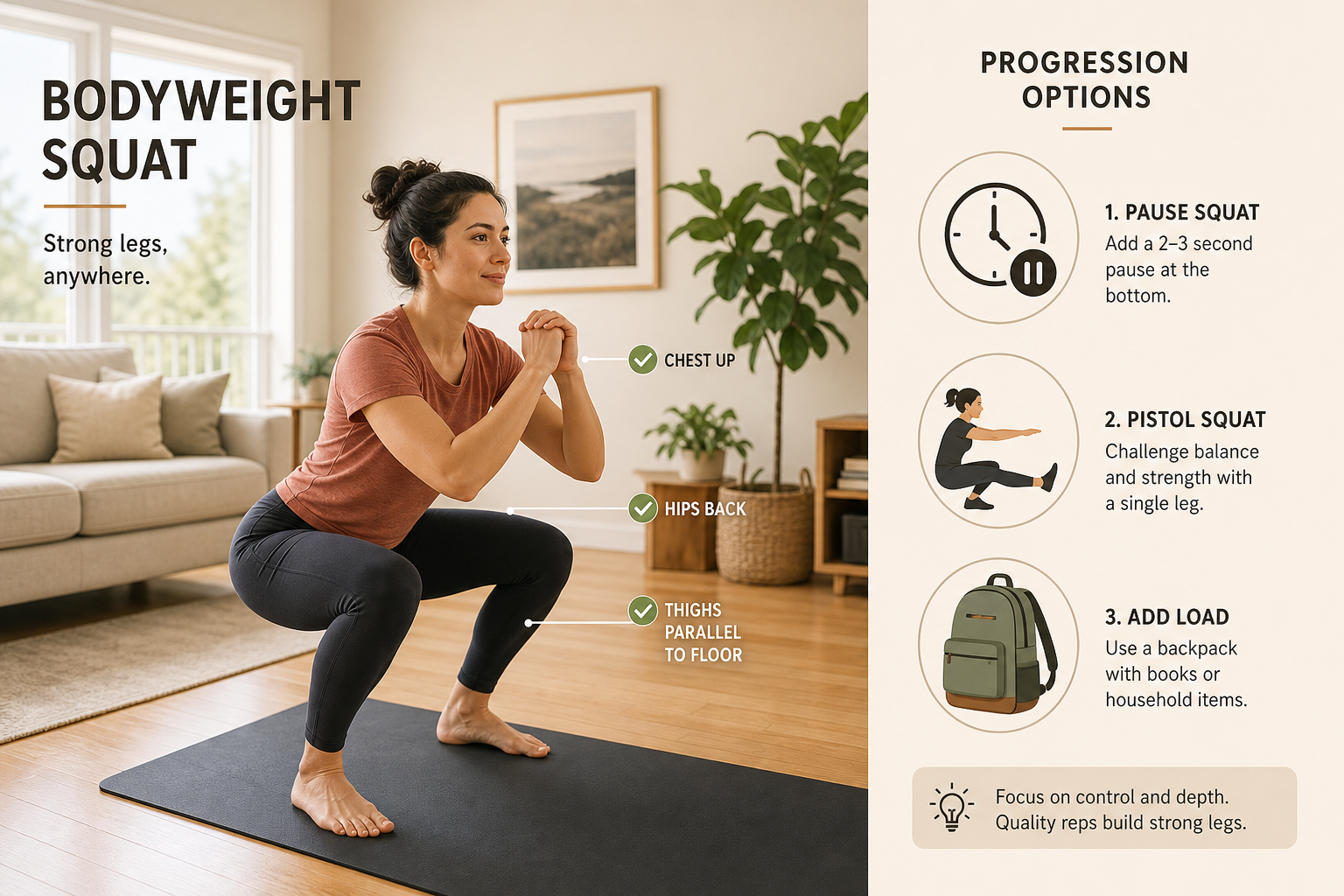
Why Leg Day Programming Matters More Than Exercise Selection
A well-chosen list of exercises is only half the equation. The same squat can build strength, muscle size, or endurance depending entirely on how you program it — the load, the rep range, the rest interval, and where you place it in the session. Without deliberate programming, even the best exercise selection produces mediocre results.
The existing Leg Workouts at Home: Three Complete Programs by Training Goal covers strength, conditioning, and mobility outcomes. This guide adds the missing pieces: hypertrophy and endurance programming, plus the science-backed rep ranges, rest periods, and sequencing protocols that turn a routine into a targeted program.
The Three Leg Day Goals: Strength, Hypertrophy, and Endurance
Each goal shifts three core variables: rep range, rest period, and load selection. The table below summarizes the standard protocols adapted for home training.
| Variable | Strength | Hypertrophy | Endurance |
|---|---|---|---|
| Reps per set | 5–8 | 8–12 | 15–20+ |
| Sets per exercise | 3–5 | 3–5 | 2–3 |
| Rest between sets | 2–5 minutes | 60–90 seconds | 30–60 seconds or circuit |
| Load | Heavy (household objects, bands) | Moderate (dumbbells, bands) | Light to bodyweight |
| Primary adaptation | Neural drive, bone density | Muscle cross-sectional area | Metabolic stress, fatigue resistance |
These are starting points, not rigid rules. A strength-focused lifter may occasionally dip into the 8–12 rep range for accessory work, and an endurance session can include brief strength blocks. The key is knowing which variable you are prioritizing and why.
The Universal Exercise Sequence: Explosive → Compound → Isolation
Regardless of your goal, the order of exercises should follow a consistent logic: explosive or power-based movements first, then compound lifts, then isolation exercises. This sequencing, backed by the NSCA and cited by [P]rehab, ensures you perform the most neurologically demanding work when your nervous system is fresh, reducing injury risk and maximizing performance on the movements that drive the most adaptation.
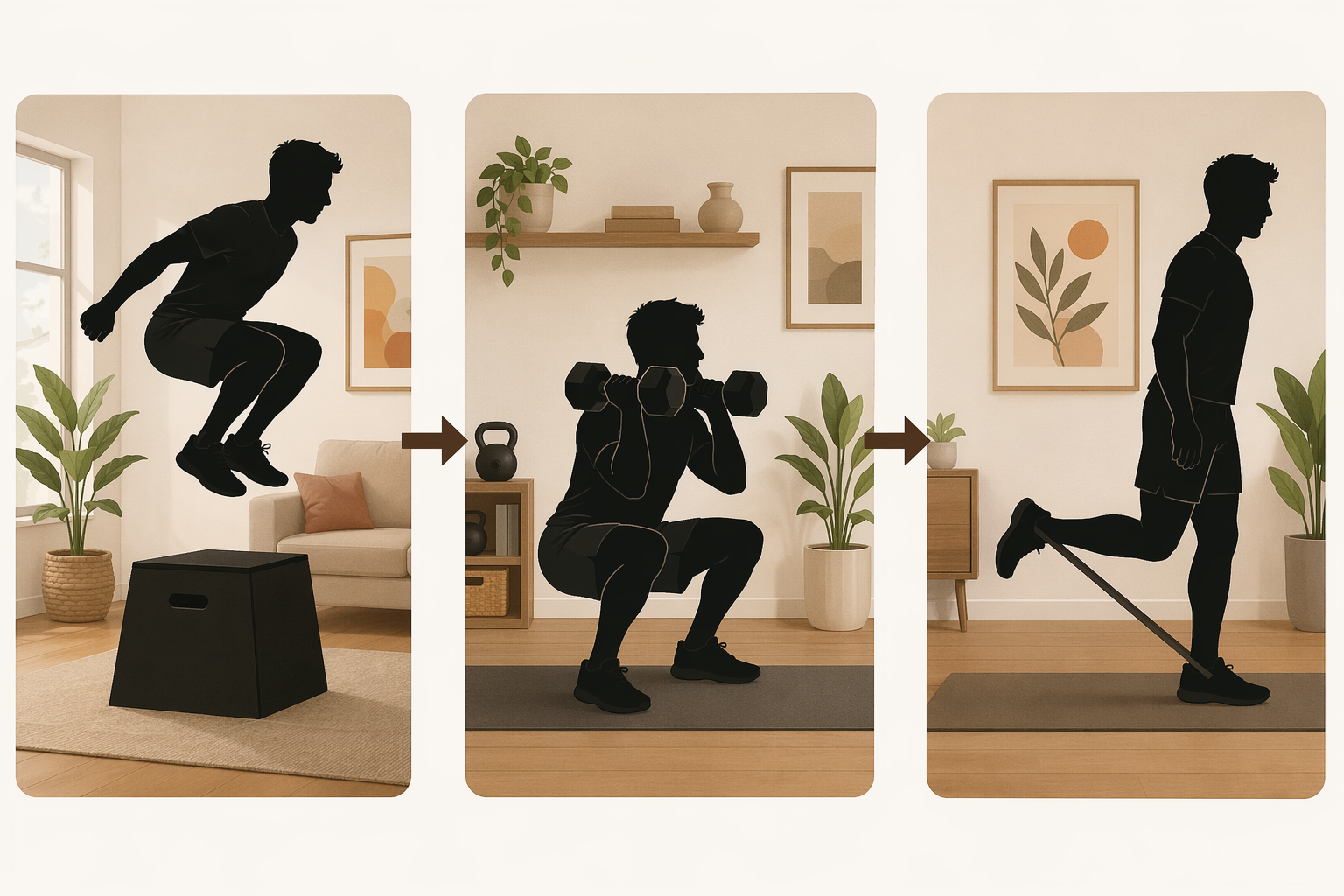
- Explosive / power moves (e.g., jump squats, box jumps, banded jumps) — 2–3 sets of 3–5 reps. These prime the nervous system and activate fast-twitch fibers.
- Compound lifts (e.g., squats, deadlifts, lunges) — the bulk of your volume. These recruit the largest muscle mass and drive the primary adaptation for your goal.
- Isolation exercises (e.g., leg curls, calf raises, glute bridges) — performed after compounds to target specific muscles without fatiguing the larger movement patterns prematurely.
Pre-Fatigue Variation for Hypertrophy
For hypertrophy-focused sessions, an optional modification reverses the sequence: perform an isolation exercise before the compound to pre-fatigue the target muscle. For example, doing leg extensions or glute bridges before squats can increase the metabolic stress on the quadriceps and glutes during the compound movement, potentially enhancing muscle growth with lighter loads — a useful tactic when you lack heavy dumbbells or a barbell.
Strength Protocol: Low Reps, Heavy Household Loads, Long Rest
Building strength at home without a barbell requires creativity with load and intensity techniques. The protocol: 5–8 reps per set, 3–5 sets per exercise, 2–3 minutes rest between sets. The goal is to work with the heaviest load you can manage for the prescribed rep range while maintaining perfect form.
How to Create Sufficient Load at Home
Nerd Fitness provides practical household object loading ideas that work well for strength work:
- Backpacks or duffel bags filled with books, canned goods, or laundry — worn on the back for squats, lunges, and step-ups.
- Milk jugs or laundry detergent bottles refilled with water or sand — held at the sides for goblet squats or Romanian deadlifts.
- Buckets — ideal for RDLs when held with both hands.
- Resistance bands — looped under the feet and over the shoulders for banded squats, or anchored for banded hip thrusts.
Load-Free Intensity Techniques
When you cannot add more weight, use these methods to increase intensity:
- Pause variations: Hold the bottom position of a squat or lunge for 2–3 seconds before driving up. This increases time under tension and removes momentum.
- Unilateral progressions: Single-leg versions of squats, deadlifts, and hip thrusts can be 2–3 times more demanding than bilateral versions, as noted by SELF. A Bulgarian split squat with a loaded backpack is a legitimate strength exercise.
- Dynamic / explosive variations: Jump squats and split jumps develop power and recruit high-threshold motor units, though they shift the adaptation toward power rather than pure strength.
Hypertrophy Protocol: Moderate Reps, Higher Volume, Shorter Rest
For muscle growth, total training volume (sets × reps) is the primary driver. Research cited by Healthline suggests that volume matters more than frequency for hypertrophy, meaning a single well-structured leg day with sufficient volume can be as effective as splitting the work across two sessions.
The hypertrophy protocol: 8–12 reps per set, 3–5 sets per exercise, 60–90 seconds rest. Use moderate loads — you should reach failure or near-failure by rep 10–12. If you can complete 12 reps with good form, increase the load or move to a harder variation.
Tempo Manipulation for Time Under Tension
With lighter home loads, increasing time under tension is a reliable hypertrophy tool. Use a 3-second eccentric (lowering phase) on squats, lunges, and RDLs. This increases metabolic stress and muscle damage — two key hypertrophy stimuli — without requiring heavier weight.
| Technique | How to Apply | Best Paired With |
|---|---|---|
| 3-second eccentric | Lower for 3 counts, drive up in 1 count | Goblet squats, lunges, RDLs |
| Pre-fatigue isolation | Perform leg curls or glute bridges before squats | Hypertrophy-focused leg days |
| Drop sets | After reaching failure, reduce load and continue | Bodyweight squats after weighted sets |
Endurance Protocol: High Reps, Minimal Rest, Circuit Style
Muscular endurance training targets the ability to sustain repeated contractions over time. The protocol: 15–20+ reps per set, 2–3 sets per exercise, 30–60 seconds rest — or run the entire session as a circuit with no rest between exercises and a 1–2 minute break between rounds.
Use bodyweight or very light loads. The goal is not to reach muscular failure in the first few reps but to accumulate fatigue across the entire set and session. This protocol is distinct from general conditioning work (covered in the Leg Workouts by Training Goal article) because it specifically targets the lower body's fatigue resistance rather than overall cardiovascular conditioning.
Sample Weekly Splits: 1x vs 2x Per Week
How often you train legs depends on your recovery capacity, total volume per session, and other training demands. A 2015 study in The Journal of Strength and Conditioning Research, cited by Verywell Fit, found that participants training three times per week with the same total load as a group training once per week saw greater gains in muscle mass. However, for home exercisers with limited time and equipment, one well-designed leg day per week can still produce meaningful results if volume is adequate.
| Schedule | Structure | Example Exercises | Best For |
|---|---|---|---|
| 1×/week | Single high-volume session covering all movement patterns | Goblet squats, RDLs, walking lunges, leg curls, calf raises | Busy schedules, full-body split programs |
| 2×/week (Workout A) | Squat-dominant day | Front squats, Bulgarian split squats, step-ups, quad-focused lunges | Balanced development, higher total volume |
| 2×/week (Workout B) | Hinge-dominant day | RDLs, glute bridges, hip thrusts, hamstring curls, calf raises | Balanced development, posterior chain focus |
If you choose the 2×/week split, allow at least 48 hours between sessions. The squat-dominant and hinge-dominant days target different muscle groups (quads and glutes vs. hamstrings and glutes), reducing the risk of overtraining while increasing total weekly volume.
Progressive Overload Without a Barbell: Rep Banking, Tempo, and Unilateral Progressions
Progressive overload — the gradual increase of training stress — is the foundation of all strength and muscle gains. Without a barbell, you cannot simply add 5 pounds each week. But you can apply overload through four alternative methods.
1. Rep Banking
Choose a rep range (e.g., 8–12 for hypertrophy). Start at the bottom of the range (8 reps) and add one rep per session until you reach the top (12 reps). Once you hit 12 reps with good form, increase the load or move to a harder variation and drop back to 8 reps. This is the simplest and most reliable overload method for home training.
2. Tempo Manipulation
Slowing down the eccentric (lowering) phase increases time under tension without changing the load. Progress from a 2-second eccentric to a 3-second, then 4-second eccentric over several weeks. This is especially effective for bodyweight and light-load exercises.
3. Unilateral Progressions
Moving from bilateral to single-leg variations dramatically increases the demand on each leg. SELF notes that unilateral moves can be 2–3 times more demanding than their bilateral counterparts. A progression ladder might look like: bodyweight squat → Bulgarian split squat → single-leg squat (assisted) → pistol squat progression.
4. Volume Increases
Adding an extra set or an additional exercise increases total training volume. This is a straightforward overload method but should be used cautiously — excessive volume without corresponding recovery can lead to overtraining. Add one set per exercise or one exercise per session every 3–4 weeks.
Programming leg day at home for a specific goal is not about finding the perfect exercise list — it is about applying the right variables to the movements you already know. Match your rep range, rest period, and sequencing to your goal, use household objects and intensity techniques to create overload, and progress methodically. Your legs will respond the same way they would in a commercial gym.
What a small equipment investment adds
We don't have a build tagged to this exact tier yet. Browse all builds.
How often should you repeat this?
See our recovery and rest reference for citation-anchored rest-interval guidance.
Spot something off?
Tell us if a movement, tier assumption, or duration didn't match your experience.