
You have two days between strength sessions. Too much movement risks blunting the next session. Too little and the stiffness settles in. Walking works, but it does not preserve the movement patterns you spent the last hour building. The 7-minute workout sits in an awkward middle. Most people use it as a daily high-intensity fix or avoid it entirely on rest days because the name says "high intensity." Neither is right.
The real value of this circuit is not a standalone workout. It is active recovery between strength days—if you treat it like one. That means lowering the intensity, extending the rest, and choosing low-impact options. The original protocol at RPE 8 is the opposite of recovery. But the structure itself, when adapted, is surprisingly well suited to the job.
What the alternating design actually gives you
The classic 12-exercise circuit alternates upper-body and lower-body movements. Push-ups are followed by wall sits. Crunches by step-ups. The New York Times original article explains: this setup lets unexercised muscles recover briefly between stations. That alternating structure is the defining feature of high-intensity circuit training (HICT), distinct from a straight HIIT session on a bike where large muscle groups work continuously. For recovery, this alternation matters. Your legs get a break during push-ups. Your upper body rests during squats. The heart rate still rises, but no single muscle group takes a beating. The body gets a movement stimulus without the same localized fatigue that would interfere with your next strength session.
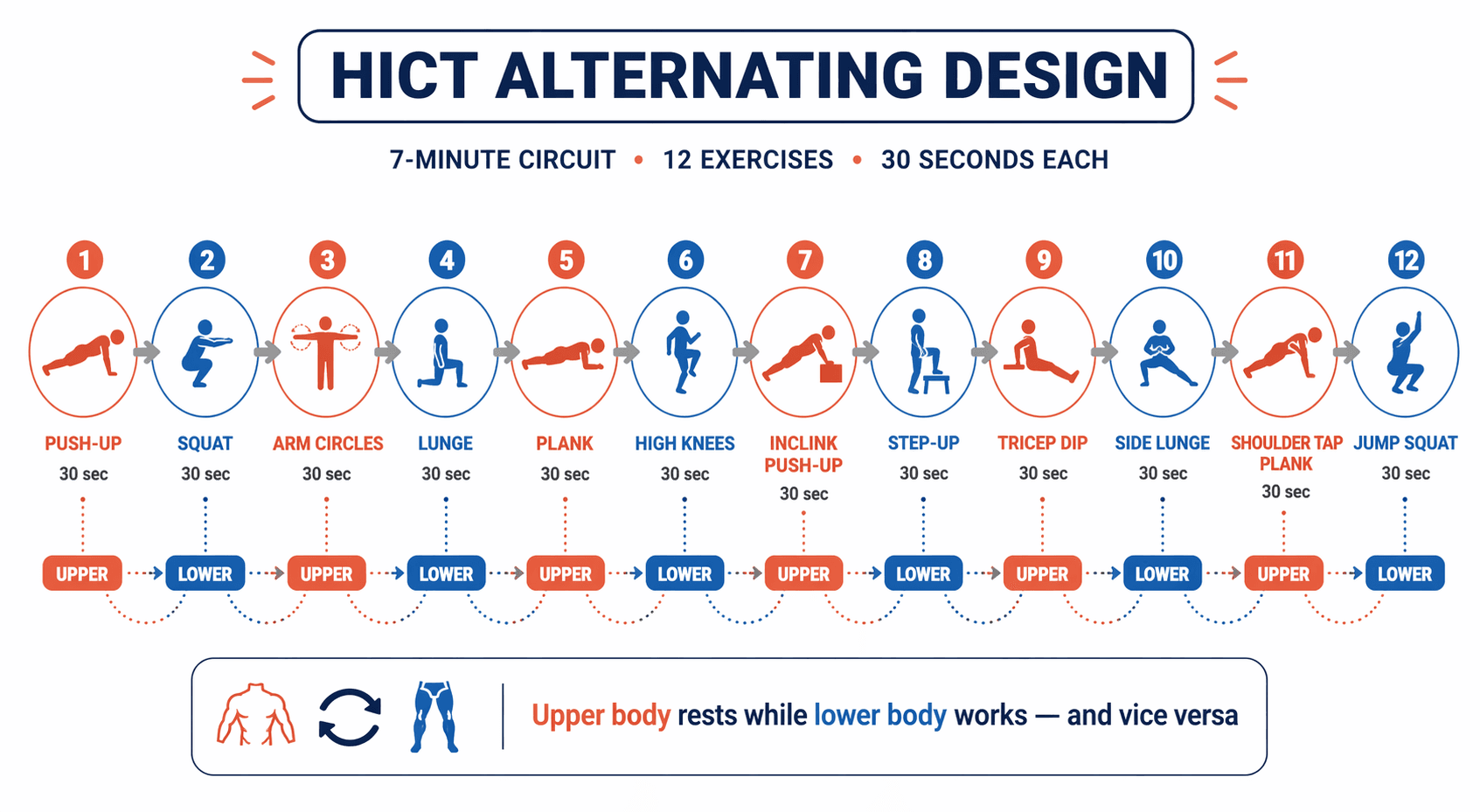
Two small studies back this up. A 2020 crossover study from Texas A&M-Kingsville (n=12) compared the 7-minute bodyweight circuit (HICE) to time-matched HIIT cycling. Diastolic blood pressure after the circuit was about 5 mmHg lower—suggesting a less pressor response. The Riegler study (n=14 active adults) found lower peak VO₂ and heart rate compared to HIIT cycling. Both agree: the circuit produces a lower peak demand than continuous HIIT. That tells you the structure can be tuned for recovery. Neither study is large, and the Riegler study also noted bursts approaching 90% HRmax when the protocol was followed as written. That is why adaptation is not optional.
Why the Cleveland Clinic quote needs context
Exercise physiologist Katie Lawton describes the 7-minute workout as 'a good filler workout, like between gym days or when you're traveling.'
That quote has been used as blanket endorsement. But if you read the full Cleveland Clinic article, she also says the workout is meant to be repeated 2–3 times and should feel like an 8 out of 10. A high-intensity circuit repeated twice is not recovery. So what does 'filler' mean in a recovery context? It means you take the same 12-exercise structure and pull the intensity way down. The Cleveland Clinic is not endorsing the original protocol as recovery. They are describing a scenario where you still want to move between heavier days—and the structure works.
That distinction is exactly why this article exists. The 7-minute workout is not automatically recovery. But its structure, when deliberately adapted, fits the recovery role better than most alternatives.
How to actually adapt it
- Drop the RPE to about 6 out of 10. You should be able to talk easily between stations.
- Increase rest between exercises to 15–20 seconds instead of the strict 10-second transition. This keeps heart rate from climbing into vigorous territory.
- Replace high-impact moves. March in place instead of high knees. Use a chair for wall sits. Skip the jumping. Controlled movement, not explosive power.
- If you are very sore or new to this, use Chris Jordan's officially published 'gentle workout' version. The Washington Post published it in 2025: no jumping, chair-based moves, marching in place. Jordan designed it explicitly for people with sore joints or those returning from a break. That is recovery validation from the original creator.
- For mobility-focused recovery, try the '7-Minute Mad Mobility' flow from Men's Health—designed by a D.P.T., including scorpion stretch, hip adductor rock, bow and arrow, and shoulder windmill. Same timed format but stretching rather than strengthening.
For more modification options, see our guide to the 7-minute workout progression, which covers tiered difficulty from gentle to advanced.
When it is better to just rest
An adapted circuit is not always the right choice. Skip active recovery entirely if:
- You are in significant sleep debt or fighting an illness.
- You have an acute injury that movement aggravates.
- Your neuromuscular system still feels heavy from the prior session—muscles are not just sore but unresponsive.
In those cases, a full rest day is the correct call. The Riegler data showing near-90% HRmax and lactate accumulation in the original circuit is a reminder that even a single circuit, if done at full intensity, is not recovery. The adaptations in the previous section are what make it work. If you cannot stay at RPE 6, do not use it at all.
For a deeper look at the workout's broader limitations, our realistic breakdown of the 7-minute workout covers when it falls short as a primary training tool.
The 7-minute workout earns its recovery role only when you dial it back. The structure—alternating muscle groups, short but not too short intervals, full-body movement—is genuinely useful between strength days. The mistake is assuming the original recipe works for every situation. Treat it as a template you modify, not a prescription you follow, and it becomes one of the more efficient active recovery options in 7 minutes.


Comments
Join the discussion with an anonymous comment.