
8-Week Full Body Dumbbell Workout Program: Progressive Overload for Home Results
This 8-week full body dumbbell program eliminates guesswork with built-in progression benchmarks, RIR guidance, and a deload protocol — perfect for home exercisers who want a structured plan they can follow for measurable strength and muscle gains.
Why Most Home Dumbbell Routines Stall
You have the dumbbells. You found a list of exercises. You know you are supposed to “progressively overload.” Then, after three weeks, nothing changes. You keep doing the same reps with the same weight because you don’t actually know when to increase. That is not a motivation problem. It is a missing‑rules problem.
Full‑body training three days per week is efficient. A 2016 study in Biology of Sport found that full‑body training burned roughly three times as much fat mass as a split over four weeks. Another study showed that multi‑joint exercises – the kind that dominate a dumbbell program – improved VO₂max by 12.5% compared to 5.1% for single‑joint work, and boosted squat 1RM by 13.8% versus 8.3%. The science says full body works. The problem: it doesn’t tell you when to grab heavier dumbbells.
Generic advice like “add weight or reps each session” sounds helpful until you try to apply it. If the rep range is 8–12 and you hit 11 on the first set, 10 on the second, and 9 on the third, did you fail to progress? Should you go up? The answer is anything but clear. That vagueness is why most at‑home dumbbell routines lose their effect after a few weeks: not because the exercises stop working, but because the lifter does not know what “progressive overload” actually demands on a given Thursday.
What This 8‑Week Program Does Differently
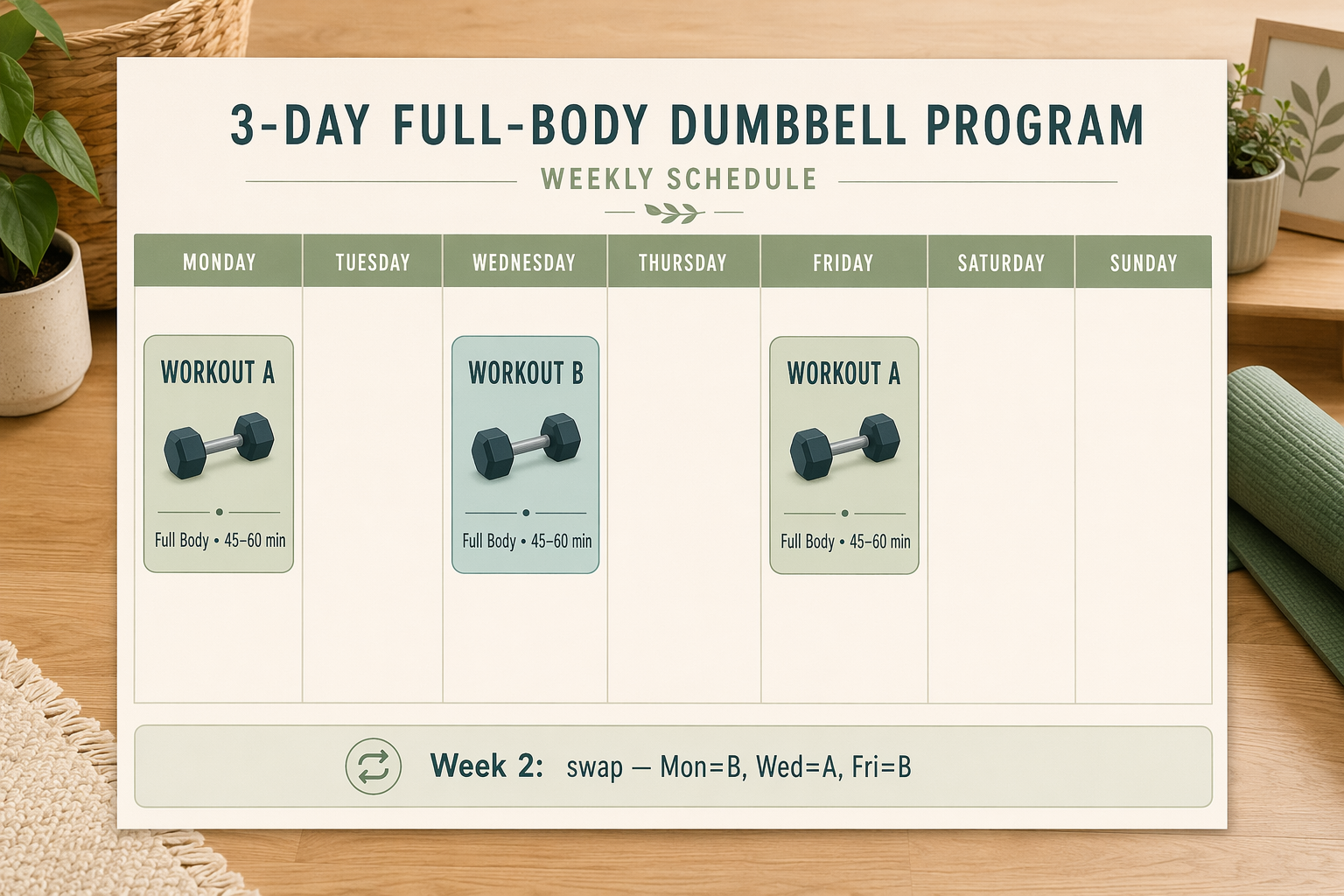
This 8‑week program removes the guesswork by giving you three things the existing site articles – including the 6‑Week Plan – leave out: explicit repetition‑in‑reserve (RIR) targets for each phase, a concrete weight‑increase trigger, and a deload protocol that is actually actionable. The structure is a 3‑day A/B split, Monday‑Wednesday‑Friday, alternating two full‑body workouts. Each session takes 45–60 minutes. The 8‑week duration is a common convention – you will find it in programs from Muscle & Strength and Progress Daily – and while no controlled trial proves it is optimal, it is long enough for measurable hypertrophy and short enough to keep you motivated.
The real departure from a generic routine is in the progression logic. You will not be told to “try to add weight.” You will be told exactly when to add weight, how many reps to leave in the tank, and what to do when accumulated fatigue demands a lighter week.
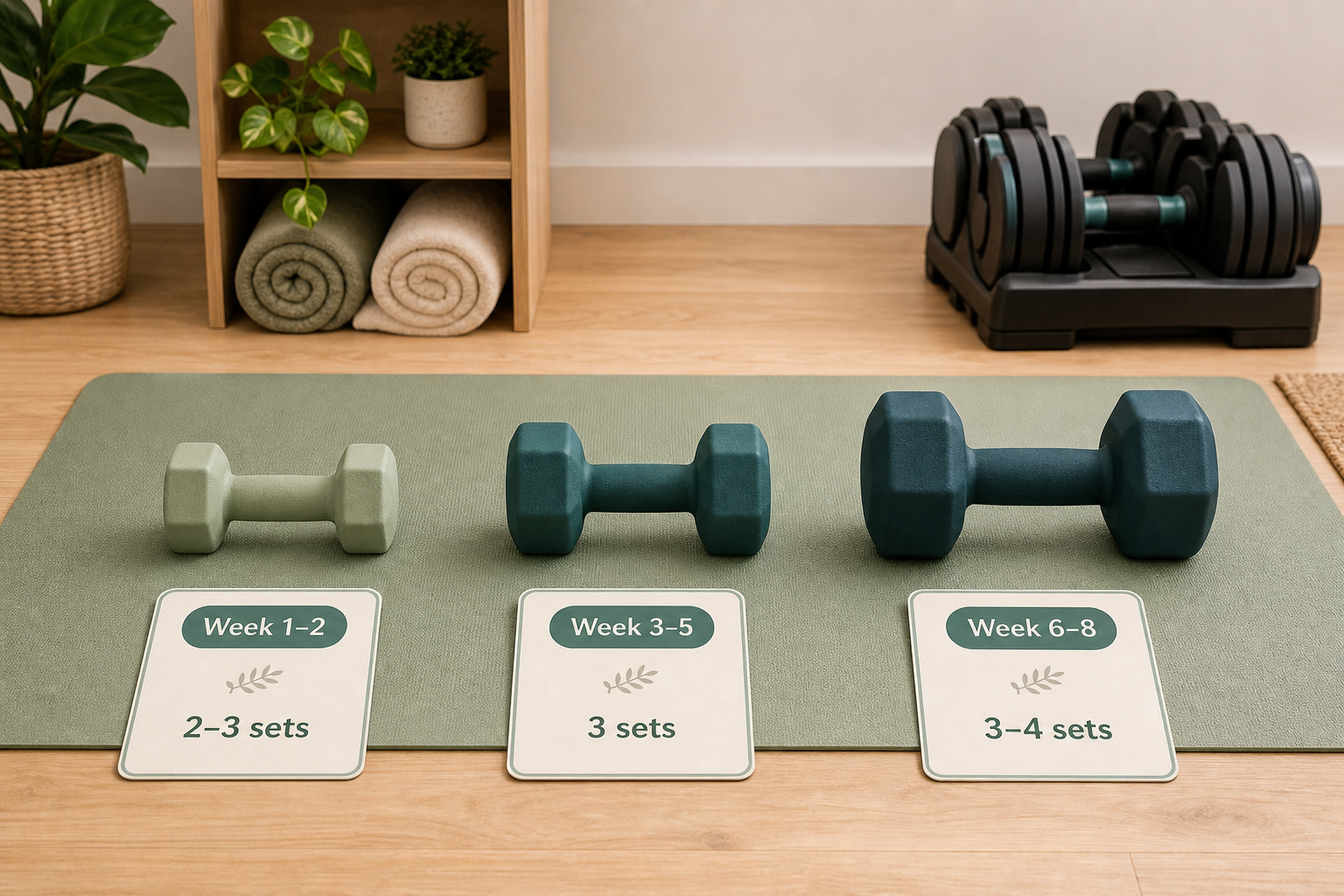
Program Structure: Workouts A and B
Both workouts are full body. You alternate them each training day. The schedule looks like this:
| Workout A | Sets × Reps | Rest |
|---|---|---|
| Goblet Squat (dumbbell at chest) | 3 × 8–12 | 60–90 sec |
| Dumbbell Bench Press (flat or floor) | 3 × 8–12 | 60–90 sec |
| One-Arm Dumbbell Row | 3 × 8–12 per arm | 60–90 sec |
| Dumbbell Overhead Press | 3 × 8–12 | 60–90 sec |
| Dumbbell Romanian Deadlift | 3 × 8–12 | 60–90 sec |
| Plank or Pallof Press | 3 × 30–45 sec | 45–60 sec |
| Workout B | Sets × Reps | Rest |
|---|---|---|
| Dumbbell Reverse Lunge (each leg) | 3 × 8–12 per leg | 60–90 sec |
| Dumbbell Row (bent-over, two-arm) | 3 × 8–12 | 60–90 sec |
| Dumbbell Floor Press or Incline Press | 3 × 8–12 | 60–90 sec |
| Dumbbell Lateral Raise | 3 × 10–15 | 45–60 sec |
| Dumbbell Hip Thrust (on bench or floor) | 3 × 10–15 | 60–90 sec |
| Hanging Knee Raise or Lying Leg Raise | 3 × 10–15 | 45–60 sec |
Weeks 1–4: Base Building with RIR 2–3
During the first four weeks, every working set should leave you with two to three reps in the tank. If you do not know what RIR 2–3 feels like with dumbbells, here is a practical test: on the last rep of a set, you should feel you could do two more clean reps but choose to stop. The bar – or in this case the dumbbell – should not slow down dramatically. If the last rep is a grind, you are too close to failure. Back off the weight by 5–10 pounds on the next set.
This phase is about form, groove, and establishing baseline numbers. You are not trying to set records. Use a weight that lets you complete all three sets within the 8–12 rep range. If you hit 12 on the first set but only 9 on the third, the weight is too heavy for now.
Progression within weeks 1–4 works like this: suppose your goblet squat uses a 40‑pound dumbbell and you hit reps 10, 9, 9 one session. Next session, aim for 10, 10, 9, then 10, 10, 10, then 11, 10, 10, and so on – until all three sets reach the top of the rep range (12). Only then do you increase the weight. This is the core of the progressive overload system that other articles describe in theory; here it is built into the schedule.
Weeks 5–8: Intensity Phase with RIR 0–2
Now the training wheels come off. Reps in reserve drop to 0–2. That means your last set of each exercise may be taken to actual momentary failure (RIR 0) – meaning you cannot complete another rep with good form. The earlier sets should still leave one or two reps in the tank. Do not go to failure on every set; that accumulates unnecessary fatigue. Save the all‑out effort for the final set of the main compound movements.
If you have been progressing properly, the weights from weeks 1–4 will now feel lighter. That is the point. Increase the weight if you hit 12 reps on all three sets of an exercise in the first session of week 5. If you are unsure whether the new weight is appropriate, err on the side of a smaller jump – 5 pounds on most dumbbell exercises – rather than a leap. The research on rest intervals suggests that short rests (30–60 seconds) maximize hypertrophy, but for compound lifts with heavier loads you still want 60–90 seconds to maintain rep quality. Stick with 60–90 throughout.
This phase is where your strength and muscle gains accelerate. The stimulus is higher, but so is the need for sleep, protein, and recovery. If you feel unusually sore or fatigued after three weeks of intensity, that is a signal, not a flaw. Read the deload section below.
The Precise Rule for Adding Weight
Here is the rule that makes this program self‑correcting: increase the weight only when you complete the top of the prescribed rep range with clean reps on all sets. For a 3 × 8–12 exercise, that means 12, 12, 12. Not 12, 12, 11. Not 12, 12, 12 with the last rep looking like a car that will not start. Twelve clean reps on every set.
If you hit 12 on the first two sets but struggle to 10 on the third, do not add weight. Repeat the session with the same load and aim to push that third set to 11, then 12. Most progression failures happen because people add weight after one good set. The rule forces you to earn the increase across all sets, which ensures the new weight will not bury you.
How to Deload (and Why It Is Non‑Negotiable)
After 8 weeks – or earlier if you feel persistent joint pain, stalled progress on multiple exercises, or a general lack of motivation – take a deload week. This is not a week off. It is a structured reduction in training load to allow recovery and supercompensation.
- Reduce weight by 40–50% across all exercises.
- Keep the same sets and reps, or drop the set count to 2 per exercise.
- Rest normally between sets.
- If you are not sore after the lighter session, you are recovering. That is the point.
Skipping a deload is the fastest way to grind your progress to a halt. The weights will feel heavier, the reps will drop, and frustration will set in. A proper deload week resets your nervous system and connective tissues so that week 2 after deload feels fresher than week 1 of the program.
After Week 8: Next Steps
Eight weeks is a practical block, not a finish line. Once you finish, you have three sensible options:
- Repeat the 8-week program from the beginning with heavier starting weights. Many of your lifts will have increased; your new starting weights should reflect that.
- Switch to the 6-Week Plan which offers different rep schemes and a tiered structure for variety.
- Try the Science-Backed 3-Day Full Body Dumbbell Workout for a program rooted in the same research but with different exercise selection.
Whatever path you choose, the common trap is to repeat the exact same program without changing the weight or the stimulus. After 8 weeks, your body has adapted. If you repeat the same program with the same dumbbells, progress will flatten. The key is to raise the starting weight so the first few weeks feel challenging again.
If you are new to home training altogether, the Beginner's Guide walks through equipment setup and foundational form before you start any program.
What a small equipment investment adds
We don't have a build tagged to this exact tier yet. Browse all builds.
How often should you repeat this?
See our recovery and rest reference for citation-anchored rest-interval guidance.
Spot something off?
Tell us if a movement, tier assumption, or duration didn't match your experience.