
Why the 7-Minute Workout Appeals to Beginners (and Why You Need Modifications)
The pitch is almost irresistible: twelve bodyweight exercises, thirty seconds each, ten seconds of rest between them, and you are done in seven minutes. No gym membership, no equipment beyond a chair and a wall, and a clear finish line that fits into the tightest schedule. For someone who has been sedentary for months or years, the 7-minute workout looks like the perfect on-ramp — a short, structured commitment that promises real results without requiring a major lifestyle overhaul.
That appeal is real, and it is backed by data. A 2023 study of physically inactive adults found that participants rated the 7-minute workout significantly more enjoyable than moderate-intensity continuous exercise, with 50% choosing it as their first-choice protocol. They also reported higher self-efficacy — the belief that they could complete the workout — compared to longer, steadier sessions.
But there is a catch that the marketing rarely mentions: the standard protocol was designed for people who already have a baseline of fitness. The creator, exercise physiologist Chris Jordan, has been clear that the intensity should feel like an eight out of ten on your personal effort scale. For a true beginner — someone who has not exercised regularly in the past six months — that level of intensity is not just uncomfortable. It can be unsafe.
The good news is that the protocol is modular. You do not have to do it as written. You can shorten the work intervals, lengthen the rest periods, swap high-impact moves for low-impact alternatives, and build up from a single modified circuit to the full dose over several weeks. Chris Jordan himself designed a low-impact "Gentle Workout" variant specifically for people who need a softer entry point. The science supports this approach: even modified versions of the 7-minute workout elevate heart rate enough to improve aerobic fitness in previously inactive adults.
The Reality Check: What an "8 Out of 10" Intensity Really Means for a Beginner
The 7-minute workout uses a simple intensity target: work at a level you would rate as 8 on a 1-to-10 scale of perceived exertion. At 10, you cannot take another rep. At 8, you are breathing hard, your muscles are burning, and you are counting down the seconds until the rest interval starts.
For a person who has been sedentary, an 8 might come from a brisk walk up a flight of stairs. Jumping jacks, high knees, and burpees can push that same person past 9 within the first fifteen seconds — long before the thirty-second work interval ends. The result is not a productive training stimulus. It is early fatigue, compromised form, and a higher risk of falling or straining a muscle.
The Poon et al. study gives us a concrete picture of what the standard protocol demands. In a group of physically inactive adults (average age 28, VO2peak 31.0 mL·kg⁻¹·min⁻¹ — a low aerobic capacity), the 7-minute workout produced a peak heart rate of 87.4% of maximum and a blood lactate level of 7.2 mmol/L. For context, blood lactate above 4 mmol/L is generally considered the threshold where the body shifts from aerobic to anaerobic metabolism. At 7.2 mmol/L, the muscles are working under significant metabolic stress.
That does not mean beginners should avoid the workout. It means beginners should start below that intensity and work up to it. The study's participants were inactive but otherwise healthy young adults. If you are older, have joint issues, or have been sedentary for longer than six months, your starting point should be even lower.
Your Modification Framework: How to Make Every Exercise Work for You
The standard 7-minute workout cycles through twelve exercises in a specific order designed to alternate upper-body, lower-body, and core movements. That alternating structure is a built-in advantage for beginners: by the time you finish a set of push-ups and move to wall sits, your upper body gets a recovery window while your legs work.
You can make three adjustments to the protocol without changing its fundamental structure:
- Shorten work intervals to 20 seconds instead of 30. This reduces the total time under tension and makes it easier to maintain good form through the entire interval.
- Extend rest intervals to 20 seconds instead of 10 when needed. The Cleveland Clinic recommends a 20-second rest period between exercises if you need more time to catch your breath.
- Substitute high-impact or high-skill movements with low-impact alternatives that target the same muscle groups.
The table below shows every exercise in the standard protocol alongside a beginner-friendly substitution. You do not have to swap all twelve at once. Start with the substitutions that address your biggest limitations — knees, shoulders, or balance — and keep the rest as written.
| Standard Exercise | Beginner Substitution | Why This Works |
|---|---|---|
| Jumping jacks | Step-jacks (step one foot out at a time, arms reach overhead) | Eliminates impact on knees and ankles while keeping the same movement pattern |
| Wall sit | Wall sit (same exercise, shorter duration) | Already low-impact — just reduce the hold time if your legs fatigue early |
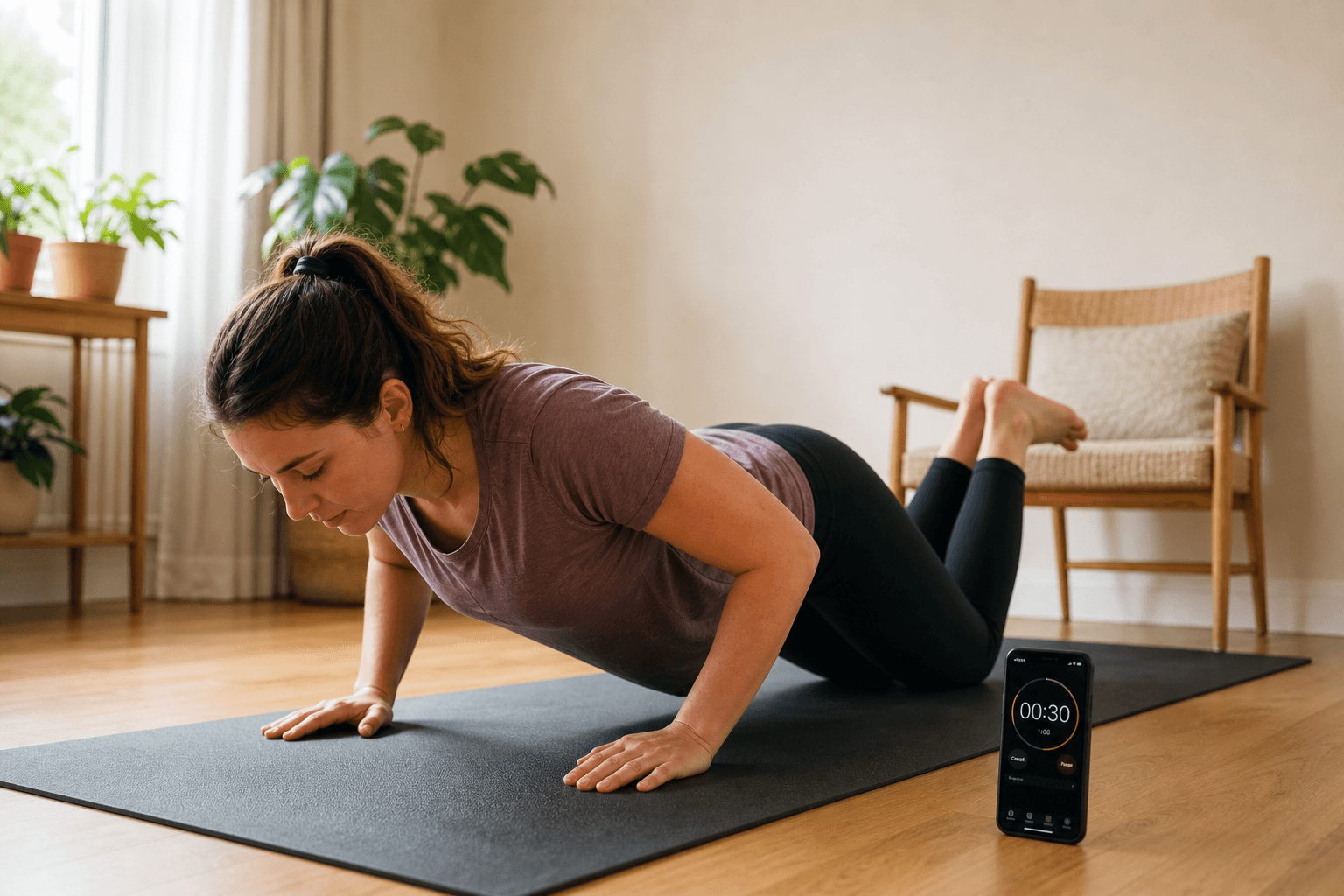
| Push-up | Knee push-up or wall push-up | Reduces the load on your upper body by 30–50%, allowing you to complete the full interval |
| Abdominal crunch | Abdominal crunch (same exercise, slower tempo) | Already low-impact — focus on controlled movement rather than speed |
| Step-up onto chair | Step-up onto chair (same exercise, no added weight) | Already low-impact — use a lower step or reduce range of motion if balance is an issue |
| Squat | Squat (same exercise, partial range of motion) | Already low-impact — squat only as deep as your mobility allows |
| Triceps dip on chair | Triceps dip on chair (same exercise, less depth) | Already low-impact — lower yourself only a few inches if full depth is too demanding |
| Plank | Plank on knees | Reduces core load while maintaining the same isometric hold pattern |
| High knees / running in place | Marching in place | Eliminates impact and reduces cardiovascular demand while keeping the legs moving |
| Lunge | Stationary lunge (no forward step) | Eliminates balance demands and reduces stress on the knees |
| Push-up with rotation | Knee push-up with rotation or standard knee push-up | Simplifies the movement pattern while still working the chest, shoulders, and core |
| Side plank | Side plank on knees | Reduces the load on the oblique muscles and shoulder stabilizers |
WebMD specifically recommends replacing jumping jacks with step-touches or marching in place, and the Cleveland Clinic advises that if jumping bothers your knees or ankles, you should "step your foot out to each side as you're bringing your arms above you." For push-ups, the Cleveland Clinic suggests trying them "on your knees instead of your toes, or perform the move against a countertop, a weight bench, or even a wall." These are not compromises — they are intelligent progressions that let you build strength and endurance before attempting the full movement.
The Gentle Workout: A Credible Starting Point Designed by the Creator
In 2025, the Washington Post published a low-impact version of the 7-minute workout created by Chris Jordan himself — the same exercise physiologist who co-developed the original protocol in 2013. Called the "Gentle Workout," it was designed specifically for people with mobility issues, joint concerns, or anyone starting from a low fitness baseline.
The Gentle Workout replaces or softens the most intense exercises. Marching in place substitutes for high knees. Step-jacks replace jumping jacks. Chair-based movements reduce the load on weight-bearing joints. According to the Washington Post report, the workout "should be doable by almost everybody who isn't physically disabled" and involves "no jumping or other high-impact motion."
This is significant because it comes from the protocol's creator. If Jordan himself endorses a lower-impact version for people who need it, then modifications are not a watered-down alternative — they are a legitimate entry point into the same training philosophy.
Don't worry if you need to start a bit tentatively.
That quote from Chris Jordan, reported in the Washington Post, should be your permission slip. The Gentle Workout is not a different program. It is the same program adjusted to your current capacity. As your fitness improves, you can gradually replace the low-impact substitutions with the standard movements.
Your Progressive Build-Up Plan: From 1 Modified Circuit to the Full Protocol
The standard 7-minute workout was designed to be performed as 2–3 circuits in a row, totaling 14–21 minutes. That is the full dose. But you do not start there. The progression below is a suggested timeline, not a rigid prescription. Move to the next phase only when you can complete the current phase without needing extra rest or breaking form.
| Phase | Duration | Work / Rest | Exercises | Goal |
|---|---|---|---|---|
| Weeks 1–2 | ~8 minutes | 20 sec work / 20 sec rest | All 12 exercises, low-impact substitutions | Build confidence and movement familiarity |
| Weeks 3–4 | ~8 minutes | 30 sec work / 10 sec rest | All 12 exercises, low-impact substitutions | Adapt to the standard interval timing |
| Weeks 5–6 | ~16 minutes | 30 sec work / 10 sec rest | 2 circuits with 1–2 min rest between | Build cardiovascular and muscular endurance |
| Weeks 7+ | ~21 minutes | 30 sec work / 10 sec rest | 3 circuits (full protocol) | Achieve the intended training dose |
How do you know when you are ready to progress? Use these three signals:
- You complete every work interval without stopping early. If you consistently need to pause before the 20- or 30-second mark, stay at your current phase for another week.
- Your perceived exertion stays at or below 7 out of 10 for the entire circuit. If you are hitting 8 or 9 in the first few exercises, you are not ready to advance.
- You feel recovered enough to talk in short sentences within two minutes of finishing. If you are still gasping for air five minutes later, the intensity is too high for your current level.
Once you can comfortably complete three circuits of the standard protocol, you have graduated from the beginner phase. At that point, you may want to explore a more comprehensive program. Our 4-Week Beginner Home Workout Plan (No Equipment Required) provides a structured next step with progressive overload built into a weekly schedule.
Warm-Up and Cool-Down: The Non-Negotiable Bookends
The 7-minute workout skips the warm-up and cool-down by design — the protocol assumes you will add them yourself. For beginners, this is not optional. A proper warm-up reduces injury risk, improves performance during the work intervals, and makes the workout feel more manageable. A cool-down helps your heart rate return to baseline gradually and may reduce post-exercise muscle soreness.
Warm-Up (3–5 Minutes)
Perform each movement for 30–45 seconds at a low intensity. You should feel your heart rate increase slightly, but you should still be able to breathe through your nose.
- Marching in place — lift your knees to hip height at a comfortable pace
- Arm circles — small circles forward, then backward, gradually increasing the range of motion
- Leg swings — hold a wall or chair for balance and swing one leg forward and back, then side to side
- Torso twists — rotate your upper body left and right with your hands on your hips
- Cat-cow on hands and knees — alternate between rounding and arching your spine to mobilize the back
Cool-Down (3–5 Minutes)
Hold each stretch for 20–30 seconds without bouncing. You should feel a gentle pull, not sharp pain.
- Quad stretch — standing, pull one heel toward your glutes while holding a wall for balance
- Chest stretch — clasp your hands behind your back and gently lift your arms while opening your chest
- Hamstring stretch — sit on the floor with one leg extended, reach toward your toes
- Child's pose — kneel on the floor, sit back on your heels, and extend your arms forward on the ground
- Deep breathing — inhale for 4 counts, hold for 4, exhale for 6
If you want to explore other home cardio options that fit into a similar time window, our Complete Guide to Cardio at Home provides a framework for choosing the right routine based on your available time, space, and fitness level.
When to Check With a Doctor Before Starting
The 7-minute workout, even in its modified form, places significant demand on your cardiovascular system. The Poon et al. study recorded peak heart rates of 87.4% of maximum in inactive adults performing the standard protocol. Your modified version will be less intense, but it still elevates your heart rate well above resting levels.
The Cleveland Clinic specifically cautions that people with cardiovascular disease should have a stress test before starting the 7-minute workout. More broadly, you should consult a healthcare provider before beginning any new exercise program if any of the following apply to you:
- You have been diagnosed with heart disease, high blood pressure, or any cardiovascular condition
- You experience chest pain, shortness of breath, or dizziness during physical activity
- You have joint or bone problems that could be aggravated by exercise
- You are over 45 and have been sedentary for more than six months
- You are pregnant or have given birth within the past six months
- You have any other medical condition that might affect your ability to exercise safely
For a deeper look at the research behind the 7-minute workout — including the full breakdown of the Poon et al. study and the ACSM origin story — see our companion article: The 7-Minute Workout: Separating Science From Hype — What the Research Actually Says.
Comments
Join the discussion with an anonymous comment.