
The Science-Backed 3-Day Full Body Dumbbell Workout (2026 ACSM Guidelines)
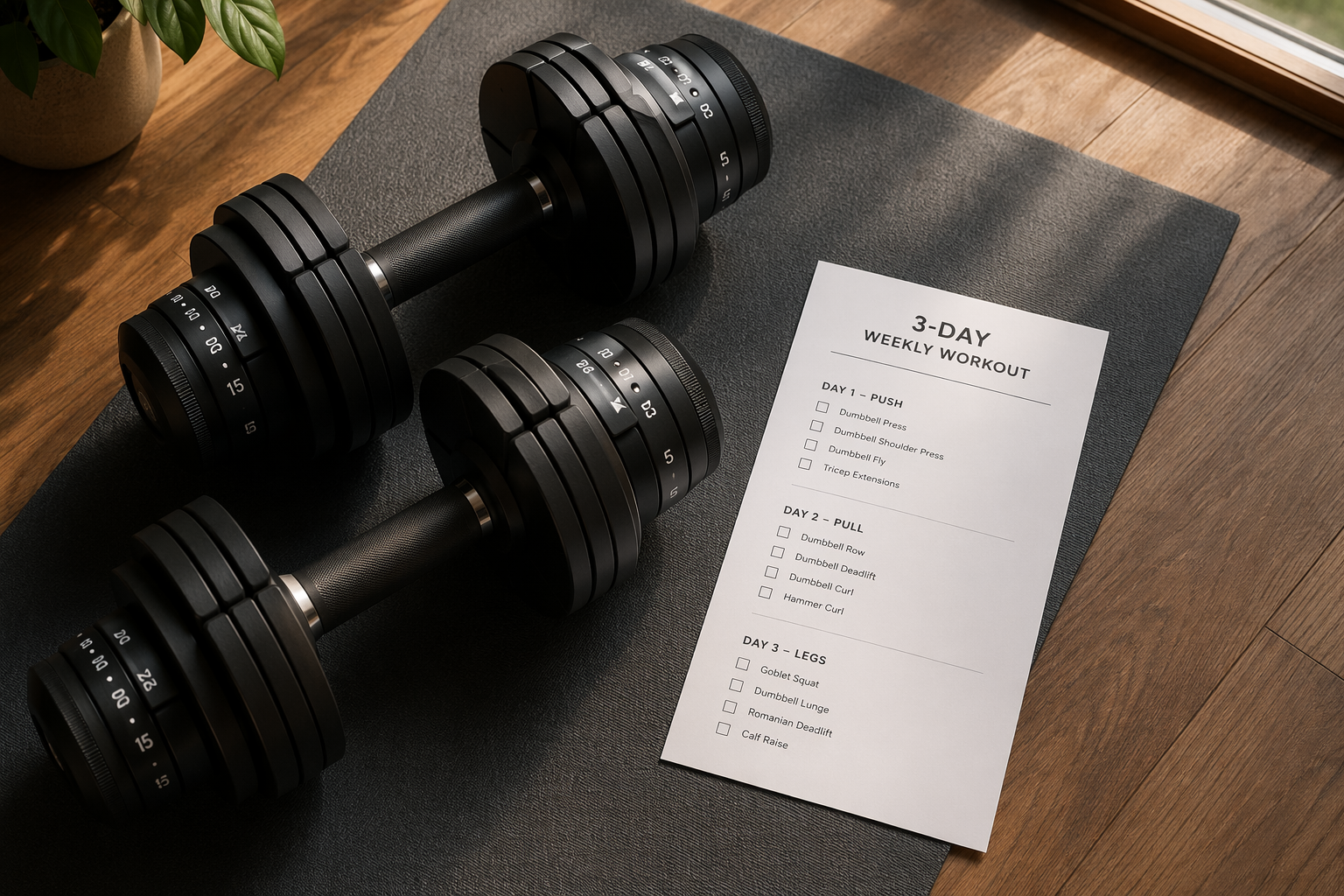
This 3-day full body dumbbell workout is grounded in the 2026 ACSM Resistance Training Guidelines, giving home fitness enthusiasts a complete, evidence-based program that proves a pair of dumbbells is enough for serious strength and muscle gains.
Can a Pair of Dumbbells Really Compete with Split Routines?
I get it. You've been told that to build real muscle you need a barbell, a rack, maybe a cable machine. The idea that a pair of dumbbells — even adjustable ones — can match a split routine sounds like a marketing line.
But the data says otherwise. A 2024 meta-analysis of 14 studies (392 subjects) found no significant difference in strength or hypertrophy between full-body and split routines when total volume was equated. Bench press strength: mean difference 1.19 kg, p=0.34. Elbow flexor growth: mean difference 0.17 mm, p=0.91. Those differences are not just statistically insignificant — they're practically nonexistent. Note: most of those studies were done in gyms with barbells and machines, not home dumbbells. But the principle of volume equating is what matters. With dumbbells, you can still match volume by using compound movements that hit multiple muscle groups at once.
The newly published ACSM 2026 Resistance Training Guidelines — the first update in 17 years — reinforce this. They synthesized 137 systematic reviews representing more than 30,000 participants and concluded that nontraditional training using elastic bands, bodyweight, and home-based routines yields marked benefits in strength, hypertrophy, and physical function. That number — 30,000 — is impressive, but it's a synthetic total across reviews, not a single trial. Still, the convergence is hard to ignore. If you stick with a program, it works. And for home trainees, the best program is the one you can actually do three times a week.
So yes, a pair of dumbbells is enough. But only if the program is built on evidence, not hope.
Hitting Each Muscle Twice in Three Workouts
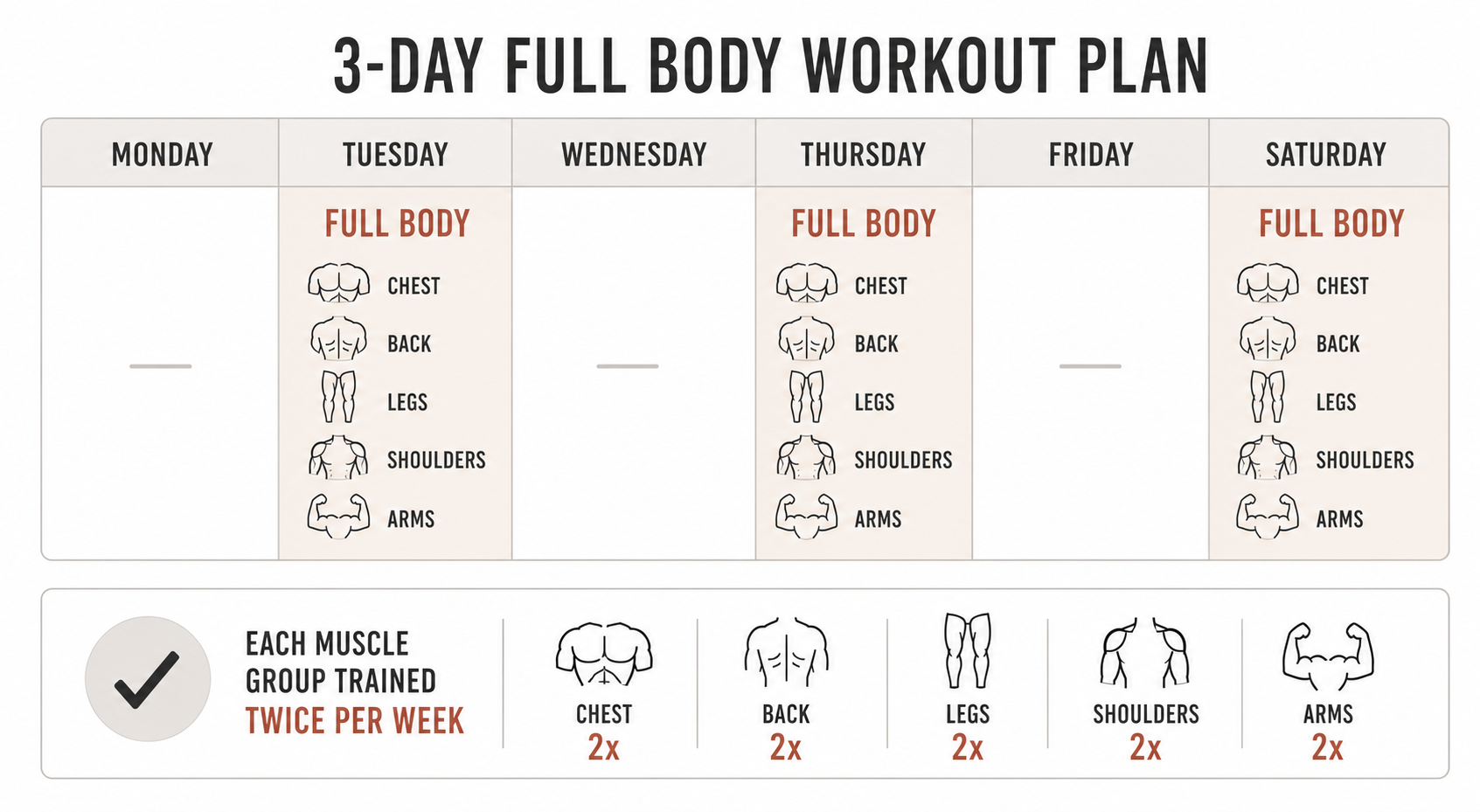
If you accept that full-body training works, the next question is frequency. The classic Schoenfeld 2016 meta-analysis found that training each muscle group twice per week produces superior hypertrophy compared to once per week (effect size 0.49 vs 0.30, p=0.002). The ACSM 2026 guidelines say ≥2x/week. So how do you hit each muscle twice in three workouts?
The answer lies in compound movements and smart rotation. Most of your exercises — squats, presses, rows — involve multiple muscle groups. By varying which exercise is performed first (when you're strongest) and adding complementary movements, you can ensure each major muscle is stimulated at least two times per week. For example: Day 1 leads with chest press (chest/triceps), Day 2 leads with bent-over row (back/biceps), Day 3 leads with overhead press (shoulders). But because every day includes a squat pattern, legs get worked every session. The result: chest gets hit on Day 1 and Day 3 (via incline press), back on Day 2 and Day 3 (via face pull or row), legs every day.
Better yet, the weekly set totals show the volume is well above the Iversen et al. 2021 minimum of 4 sets per muscle group per week:
| Muscle Group | Weekly Sets (Total) |
|---|---|
| Chest | 12 |
| Back | 10 |
| Legs (quads) | 12 |
| Hamstrings | 8 |
| Shoulders | 10 |
| Biceps | 8 |
| Triceps | 8 |
These totals come from a combination of primary and secondary stimulation. For instance, chest press directly targets the chest, but it also works triceps and front delts. The program counts only the primary workload; secondary stimulus is a bonus. No single study tested this exact routine — it's a careful synthesis of the principles from each paper.
What Loading Actually Means with Dumbbells
Here's where the ACSM guidelines can feel useless: 'lift heavier loads (≥80% of 1RM) for strength.' If you train at home with dumbbells, you probably don't know your 1RM, and you might not have heavy enough dumbbells to reach 80% on every movement. This advice was written for gym environments with barbells and machines. For dumbbell users, it needs translation.
The Iversen review also emphasizes that multi-joint exercises — which this program is built on — naturally allow higher loads than isolation moves. Paoli et al. (2017) showed that multi-joint exercises produced superior strength gains (bench press 1RM 10.9% vs. 8.1%; squat 1RM 13.8% vs. 8.3%) compared to single-joint exercises, even with equal volume. So by focusing on compounds, you're already maximizing the load you can use with dumbbells.
The Program: Built from the Evidence Up
Each workout is designed to be completed in 45-60 minutes. Rest 1-2 minutes between sets for hypertrophy (per Iversen). Warm up with one light set of the first exercise at 50% working weight (more on that later).
| Exercise | Sets | Reps | Rest |
|---|---|---|---|
| Goblet Squat | 3-4 | 8-12 | 90 sec |
| Dumbbell Bench Press | 3-4 | 8-12 | 90 sec |
| Bent-Over Row | 3-4 | 8-12 | 90 sec |
| Standing Overhead Press | 3 | 10-15 | 60 sec |
| Dumbbell Romanian Deadlift | 3 | 10-15 | 60 sec |
| Plank with Dumbbell Row | 3 | 8-12 each | 60 sec |
| Dumbbell Bicep Curl | 3 | 12-15 | 45 sec |
| Exercise | Sets | Reps | Rest |
|---|---|---|---|
| Dumbbell Deadlift (or Trap Bar) | 3-4 | 6-10 | 90 sec |
| Incline Dumbbell Press | 3-4 | 8-12 | 90 sec |
| One-Arm Dumbbell Row | 3-4 | 8-12 each | 90 sec |
| Dumbbell Lunges | 3 | 10-12 each | 60 sec |
| Lateral Raise | 3 | 12-15 | 45 sec |
| Tricep Overhead Extension | 3 | 12-15 | 45 sec |
| Exercise | Sets | Reps | Rest |
|---|---|---|---|
| Goblet Squat (or Front Squat Variation) | 3-4 | 8-12 | 90 sec |
| Dumbbell Floor Press | 3-4 | 8-12 | 90 sec |
| Pull-Up (or Lat Pulldown if no bar) | 3-4 | 6-10 | 90 sec |
| Dumbbell Shoulder Press | 3 | 10-15 | 60 sec |
| Hamstring Curl (sliding or band) | 3 | 12-15 | 60 sec |
| Face Pull (or Dumbbell Rear Delt Fly) | 3 | 15-20 | 45 sec |
If you don't have a pull-up bar, substitute with dumbbell rows (3x10-12) on Day 3. Face pulls can be done with dumbbells by lying prone on an incline bench and raising dumbbells to the sides. The key is maintaining compound movement patterns.
Every programming variable here — sets, reps, rest, exercise selection — is backed by the research cited earlier. That doesn't mean this exact routine was tested in a lab. It means each piece was chosen because a study showed that variable works. The synthesis is mine; the evidence is theirs.
When to Add Weight
The routine is only as good as the progression strategy. Without progressive overload, results plateau. The ACSM 2026 guidelines state clearly: progressive overload is the primary driver of adaptations. But what does that look like with dumbbells?
Here's a concrete decision rule: When you can complete all sets and reps at the top of the recommended rep range with perfect form on two consecutive sessions, increase the weight by the smallest increment available (typically 5 lb per dumbbell). If you can't increase weight, add one rep per set until you reach the upper end of the rep range, then increase weight and drop back to the lower end.
| Weeks | Rep Range | Effort Level |
|---|---|---|
| 1-4 | 12-15 | RPE 7-8 (2-3 reps in reserve) |
| 5-8 | 8-12 | RPE 8-9 (1-2 reps in reserve) |
| 9-12 | 6-8 | RPE 9 (0-1 reps in reserve) |
Iversen et al. confirm that linear progression works well for non-advanced lifters. You don't need complex periodization. Just add weight when the bar tells you you're ready.
Warm-Up: What You Actually Need
Most warm-up advice for home workouts is overblown. Iversen et al. (2021) specifically recommend limiting warm-ups to exercise-specific movements. For this program, that means one light set of the first compound exercise at about 50% of your working weight. Do 5-8 reps, rest a minute, then start your first working set. That's it.
For recovery, schedule at least 48 hours between full-body sessions. That means training Monday, Wednesday, Friday (or Tuesday, Thursday, Saturday). The ACSM guidelines emphasize that rest days are when adaptations occur. Don't skip them. Active recovery — walking, light stretching — is fine, but avoid heavy lifting on those days.
The Bottom Line
The 2024 Ramos-Campo meta-analysis, the 2026 ACSM guidelines, Schoenfeld's frequency data, Iversen's volume recommendations, and Paoli's compound exercise advantage all converge on one conclusion: a well-designed 3-day full body dumbbell program is not a compromise. It is a legitimate, evidence-based training approach that can produce the same strength and muscle gains as more elaborate split routines.
This program gives you the structure. The evidence gives you the confidence. Now it's up to you to pick up the dumbbells and start. Check back in 8 weeks and see the difference.
What a small equipment investment adds
We don't have a build tagged to this exact tier yet. Browse all builds.
How often should you repeat this?
See our recovery and rest reference for citation-anchored rest-interval guidance.
Spot something off?
Tell us if a movement, tier assumption, or duration didn't match your experience.