
What You Lose—and What You Gain
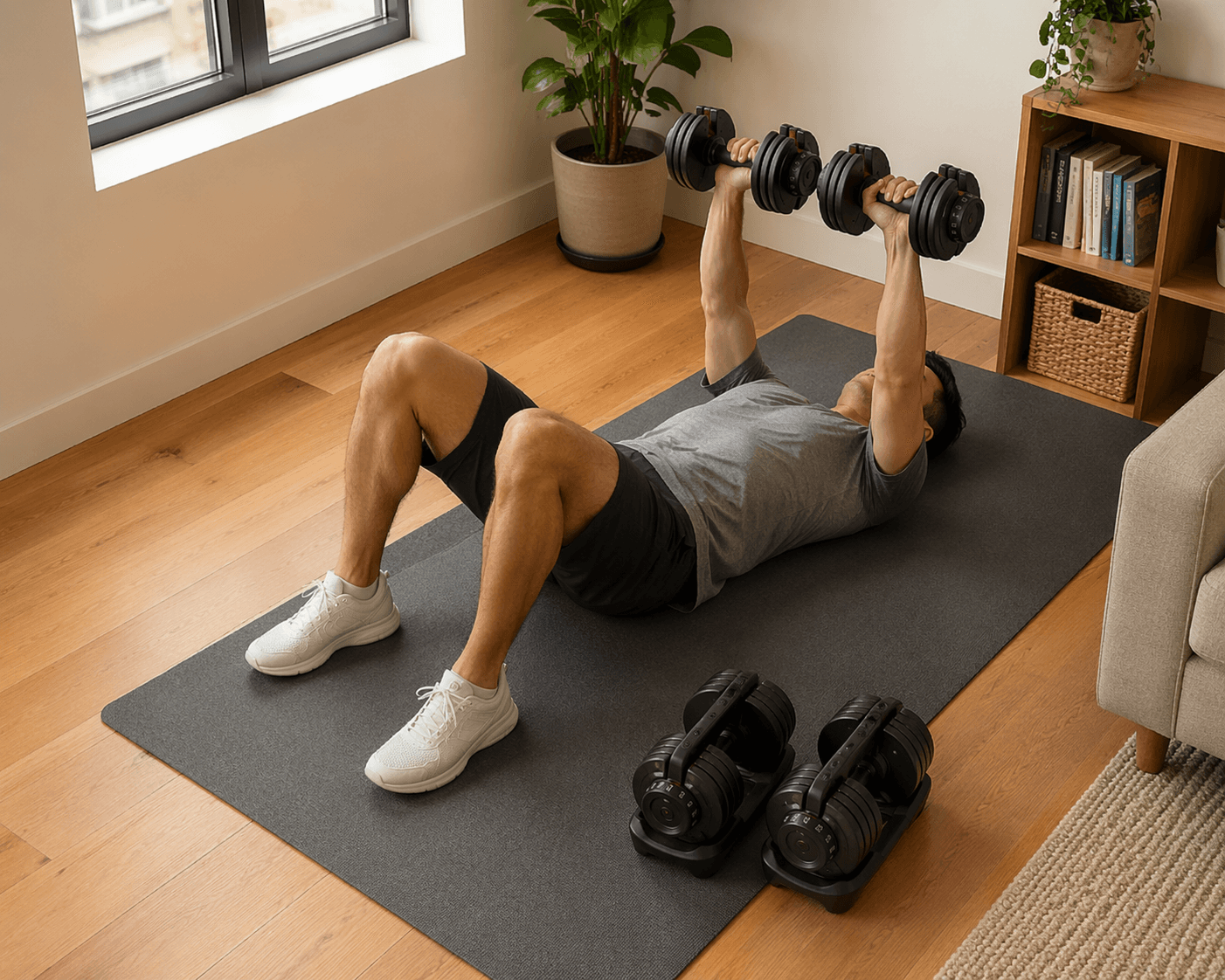
The first question anyone asks when I say “no bench” is what you give up. A bench press uses a longer range of motion than a floor press—the bar travels past your chest, and your shoulders extend further back. That eccentric stretch at the bottom is a strong stimulus for the pecs. You lose it. But the dumbbell floor press ends the moment your elbows touch the floor. That cut-off makes it easier on the shoulders because you cannot overextend into impingement territory. You lose maybe two to three inches of motion at the bottom, but you keep the whole pressing pattern intact. For someone training in an apartment with a pair of adjustable dumbbells, that trade is worth making: you eliminate shoulder risk and a bulky piece of furniture in one move. I would not claim the floor press is “just as good” for maximal strength. It is not. The shorter ROM limits how much weight you can load. But for hypertrophy—the goal of most home lifters who want to look and feel stronger—the difference is small. Pec and triceps activation remain comparable. The key is that you do not stop at the floor press. You build the whole substitution list.
Six Movements That Replace a Bench
Every movement pattern has a no-bench alternative that works. Here are the six I program, with the reasoning you need to load them intelligently.
You might see floor chest flyes in other no-bench lists. I find them underwhelming. The range of motion on the floor is very short—you cannot open your arms far enough to stretch the pecs properly. They work as a light finisher, but I would not count them as a main movement. Stick to the six above and you have a complete program.
What You Need: One Pair of Dumbbells and a Mat
Adjustable dumbbells are ideal because they let you bump weight in small increments without buying a whole rack. A floor mat defines your space, dampens noise, and protects the floor. That's it. The standing overhead press and goblet squat each need roughly a 4x4 ft square—about the size of a yoga mat with some clearance. If you train in an apartment, you can store the dumbbells under a couch or in a corner rack. The Apartment Dweller’s Compact Home Gym Setup has more detail on storage and noise control if you need it.
The Workout: 3 Days a Week, 35–45 Minutes
Three sessions per week, full body each time. I recommend full-body frequency for the home lifter because it hits every muscle group more often per week—two to three times—which research shows is optimal for hypertrophy. Full-body also beats splits for small spaces because you need fewer exercises per session, which means less equipment and less time. Two or three resistance training sessions per week produce the most muscle size and strength, per Harvard Health.
Perform the following exercises on each training day. Rest 60–90 seconds between sets for hypertrophy; if your goal is strength, extend to 3 minutes on the main lifts (floor press, goblet squat).
| Exercise | Sets | Reps | Notes |
|---|---|---|---|
| Dumbbell floor press | 3 | 8–12 | Lower until elbows touch floor; keep elbows at 45° |
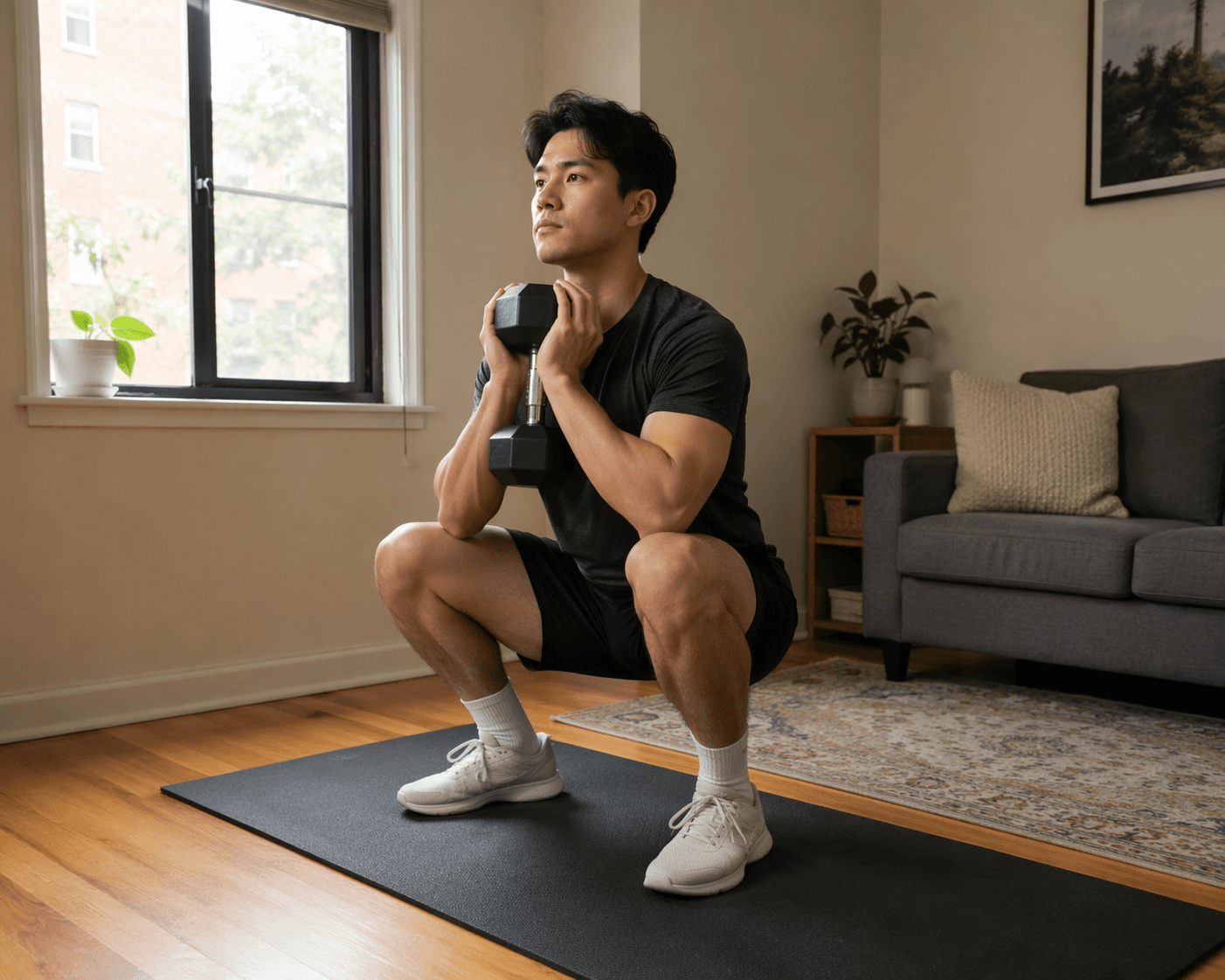
| Goblet squat | 3 | 6–12 | Hold dumbbell vertically at chest; squat to parallel or below |
| Bent-over row | 3 | 8–12 per side | Support off a couch or chair if balance is an issue |
| Standing overhead press | 2–3 | 8–12 | Stand tall; avoid arching lower back |
| Romanian deadlift | 2–3 | 10–12 | Hinge at hips; keep slight knee bend |
| Glute bridge | 2–3 | 12–15 | Place dumbbell across hips; squeeze glutes at top |
| Reverse lunge | 2 | 10–12 per side | Hold dumbbells at sides; step back, not forward |
The session takes about 35–45 minutes, including warm-up. Spread the three workouts across the week with at least one rest day between sessions—Monday, Wednesday, Friday works well. Beginners should start with two sessions per week and add the third after a month.
How to Keep Progressing Without Adding More Weight
The biggest failure point in no-bench routines is progression. Without a bench, you cannot easily add incline or decline variations to increase difficulty. So you need a different system: double progression.
Here is how it works. Pick a rep range for each exercise—say 8–12 for the floor press. Start with a weight you can lift for 8 clean reps. Each session, try to add one rep until you reach 12. Once you hit 12 reps on all sets, increase the weight by the smallest increment your dumbbells allow (usually 2.5 or 5 lbs) and drop back to 8 reps. Repeat.
Bony to Beastly gives a clean example: Week 1, you do 50 lbs for 10, 10, 9 reps. Week 2, you hit 10, 10, 10. In Week 3, you increase to 55 lbs and start the process over. That is double progression. It works even if you only own one pair of adjustable dumbbells.
Aim to keep 1–2 reps in reserve (RIR) on most sets—meaning you stop when you could still do one or two more reps. This reduces injury risk and builds in room for gradual overload. When Your Dumbbells Feel Too Light: 6 Progression Levers covers additional methods like tempo changes and drop sets if you need more options.
Practical Space Details
All the exercises above are standing or floor-based. That means they fit into roughly the same footprint as a yoga mat. Here are the concrete numbers:
For a deeper dive on fitting a gym into a small apartment—including flooring, storage racks, and noise control—The Apartment Dweller’s Compact Home Gym Setup has everything you need.
No Bench? No Problem.
A no-bench full-body dumbbell workout is not a compromise. It is a system. The floor press, standing overhead press, goblet squat, bent-over row, RDL, and glute bridge cover every major movement pattern. Double progression keeps you gaining for months. Three sessions per week deliver the frequency that drives muscle growth.
Compare that to a bench-dependent routine: you need a bench, you need more space, and you add shoulder risk for a few extra inches of range of motion that may not matter for your goals. For anyone training at home—especially in a small apartment—the no-bench approach is not a consolation prize. It is the better choice.
Comments
Join the discussion with an anonymous comment.