
You’ve Hit the Weight Ceiling. Now What?
You own a pair of dumbbells. Maybe they max out at 40 lbs, maybe 50. You’ve been running a full-body routine for a few months, and at some point the math stopped working. You can still hit 10 reps on your overhead press, but the last two reps don’t feel hard anymore. The set ends, and you’re not breathless. The dumbbells just feel light.
The obvious fix is to buy heavier dumbbells. But if you’re reading this on a home fitness site, you already know the problem: heavier dumbbells are expensive, they take up space, and your current set still has years of life in it. The real question is not “should I buy more weight?” but “how do I make this weight work again?”
You Don’t Need Heavier Dumbbells
The assumption that progress = heavier load is the easiest one to make, and it’s also the one that’s most thoroughly outdated. A 2022 review in found that lower training loads performed at higher frequencies can still improve strength and functional ability. In plain terms: you don’t need a 60-lb dumbbell to get stronger. You need a smarter way to use the one you already have.
This isn’t theory. The 2022 review covers multiple studies with real lifters. The pattern is consistent: frequency and total volume can compensate for moderate loads, provided you apply some form of progression. Without progression, even heavy dumbbells will eventually stall.
The most vivid example I’ve seen is the Dayton case from . Over 150 days, using only dumbbells up to 50 lbs, Dayton gained 7 lbs of muscle and lost 26 lbs of fat. He applied pre-exhaust and volume techniques whenever his weights started feeling too light. I should be clear: this is a single-subject case study, not a controlled trial. It shows what’s possible with persistence, but it doesn’t prove that any single lever caused the results. The pre-exhaust study that Built With Science references was conducted by the same author who wrote the article — Jeremy Ethier — which doesn’t invalidate the finding, but it’s not an independent replication either. The data suggests pre-exhaust can produce nearly identical hypertrophy compared to straight sets. I’d call it a solid hypothesis, not a settled rule.
Double Progression: The Foundation
Double progression is the most common method for a reason: you stay at the same weight until all your sets hit the target rep range, then you move up a notch. I’m not going to spend much time here because we already covered the nuts and bolts in . If you’re fuzzy on rep goals and when to jump to the next increment, that article is a good refresher. The point for now is: double progression is one lever, not the only one.
Which Lever Should You Pull?
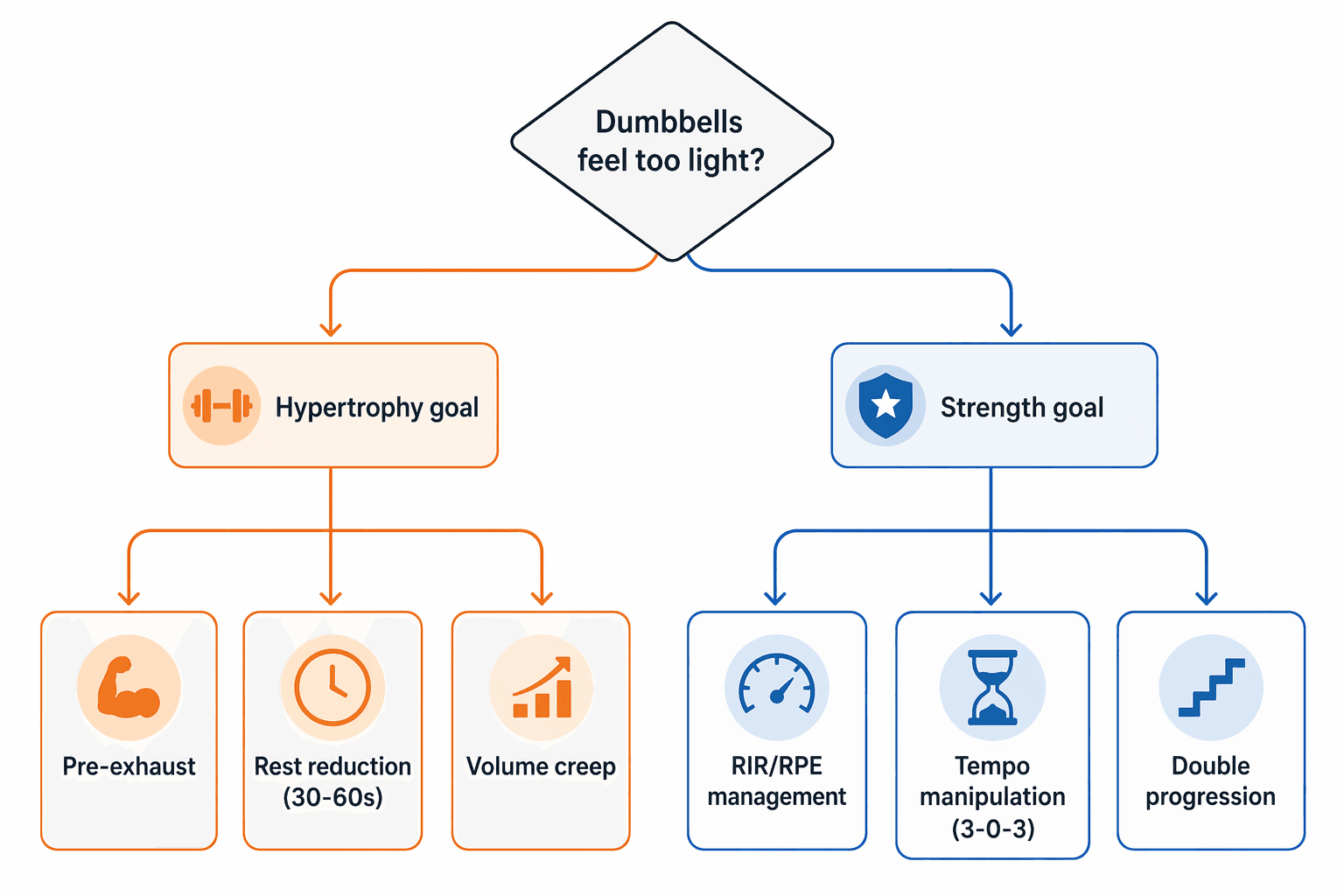
Here’s the part that most articles neglect. You now have six levers. Which one do you actually use, and when? The answer depends on your primary goal.
If your goal is hypertrophy: Start with pre-exhaust. It directly attacks the problem — making the compound feel heavy again — and the evidence, while not bulletproof, is suggestive. Pair it with rest reduction (drop to 45 sec) and, if you still have gas, volume creep (add one set per exercise per week).
If your goal is strength: Begin with double progression (the foundational method) or RIR/RPE if you’re already doing that. Then add tempo manipulation (slow eccentrics + controlled concentrics) to increase time under tension without changing load. Tempo works especially well when your dumbbells feel too light on the concentric but still offer resistance through the eccentric.
If your goal is fat loss / conditioning: Short rest intervals (30–45 sec) and volume creep will crank up metabolic demand. Combine with RIR/RPE to ensure you’re not relying on momentum.
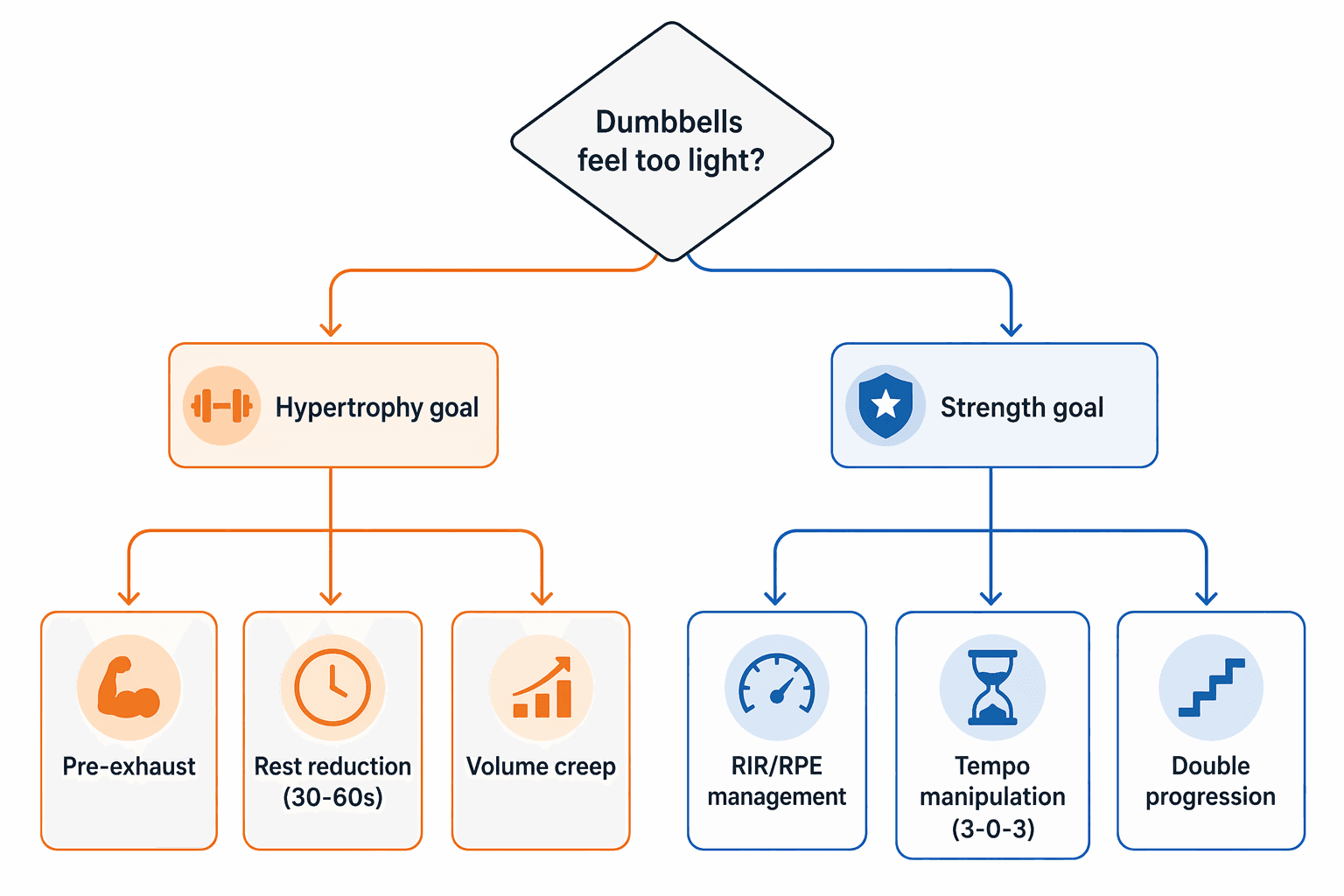
If you’re unsure where to start, the safest default is: pick one lever, use it for 3–4 weeks, evaluate. If your weights still feel too light, add a second lever. Don’t try all six at once — you won’t know what worked.
Pre-Exhaust: Making Compounds Feel Heavy Again
Pre-exhaust means you take an isolation exercise to failure before your compound lift. The idea is to fatigue the target muscle first so that when you go into the compound — say, bench press after chest flyes — the weight that used to feel easy now feels genuinely challenging. If you try it, start with one exercise per muscle group. Do isolation to failure, then immediately do the compound for the same rep target. If the compound now feels hard at your usual weight, you’ve successfully bought yourself a few more weeks with that dumbbell.
RIR/RPE: Intensity Without Changing the Load
RIR stands for reps in reserve. RPE (rate of perceived effort) is the same concept on a 1–10 scale. When you can’t increase the weight, you can still increase the intensity by pushing closer to failure. From : RPE8 means you could have done two more reps (RIR2). RPE9 means you had one more rep (RIR1). A lot of home lifters stop when they think they’re close to failure, but the gap between RPE8 and RPE9 can be significant. If you’ve been training at RPE7–8, deliberately taking your last set to RPE9 adds a meaningful stimulus without changing the weight on the bar.
Progression inside RIR/RPE looks like this: Week 1–2: Hit rep target at RPE8 (2 RIR). Week 3–4: Push the last set to RPE9 (1 RIR). Week 5–6: Add one rep to every set while keeping RPE8–9. Then you either reduce rest times or add a set. The weight hasn’t changed, but the stimulus has.
Tempo: Slow Down the Lift
Tempo manipulation is often reduced to “slow eccentrics,” but that’s only half the story. The two main levers inside tempo are: longer eccentric (3–4 seconds) increases time under tension, which drives hypertrophy; slower concentric (2–3 seconds) removes momentum and forces your muscles to generate force through the entire range of motion. This is especially useful when the weight feels too light on the concentric but still decent on the eccentric. A practical example: if your dumbbell bench press feels easy on the way up, slow the press to a deliberate 2-second push. Use a tempo like 3-0-1-0 (3 sec lower, no pause, 1 sec press, no pause) for hypertrophy work. You might only need to do this on your first compound exercise each session to reset the difficulty level.
Rest Reduction: Less Time, More Work
How long do you rest between sets? If you’ve been taking 2–3 minutes because that’s what you read for strength training, switching to 30–60 seconds can turn a comfortable set into a demanding one without changing the load. The research from is widely cited: 30–60 seconds optimizes hypertrophy, 3–5 minutes favors absolute strength. The 2009 review that established these ranges has been updated, but the basic pattern still holds. For your scenario — dumbbells feeling too light — shorter rest is a fast, zero-cost adjustment. It increases metabolic stress and forces your muscles to adapt to a higher work density.
| Goal | Rest Interval | Why |
|---|---|---|
| Hypertrophy | 30–60 sec | Higher metabolic stress, less recovery between sets |
| Strength | 3–5 min | Full ATP replenishment, heavier loads |
| Endurance / density | ≤30 sec | Maximum conditioning, but less effective for size |
Volume Creep: Add Sets Carefully
The simplest lever is also the easiest to overdo. Volume creep means adding one set per exercise per week until you reach a new ceiling. For example, if you’re doing 3 sets of dumbbell rows, go to 4 sets next week. The same weight, more total work. Volume is a reliable driver of hypertrophy, but it accumulates fatigue. If you add a set to every exercise every week for a month, your central nervous system and joints will start complaining. The fix is a deload every 4–6 weeks — reduce volume by 40–50% for one week, then restart. Many home lifters ignore deloads and wonder why progress stops. Don’t be that person.
Putting It All Together: A 4-Week Progression Sample
Let’s say your goal is hypertrophy and your dumbbells max out at 50 lbs. Here’s how you could layer the levers over a month:
| Week | What to do |
|---|---|
| 1 | Baseline double progression: all sets to rep target, record your RPE. No extra variables yet. |
| 2 | Add pre-exhaust on chest day and back day: isolation to failure, then compound. Keep rest at 60 sec. |
| 3 | Reduce rest to 45 sec across all exercises. Add one set to your primary compound (now 4 sets instead of 3). |
| 4 | Push last set of every exercise to RPE9. Maintain the higher volume and shorter rest from Week 3. |
| Deload week | Cut volume by 50%, keep intensity moderate. Let your joints and CNS recover. |
Your Dumbbell Ceiling Is Not the End
The moment your dumbbells feel too light is not a signal to open your wallet. It’s a signal that your body has adapted to a single variable — load — and it’s time to introduce others. Double progression, pre-exhaust, RIR/RPE, tempo, rest reduction, volume creep: none of them require a bigger weight. They require a smarter plan.
Start with the goal-specific decision tree. Pick one lever. Apply it for 3–4 weeks. If progress stalls again, add another. Repeat. Your dumbbells will last you a lot longer than you think.
Comments
Join the discussion with an anonymous comment.