
The Apartment Dweller's Compact Home Gym Setup: Equipment, Noise Control, and Space Optimization
A practical guide for apartment renters to build a home gym that respects lease terms, keeps noise low, and reclaims living space. Covers no-drill equipment picks, floor protection, storage solutions, and workout adaptations for small spaces.
- Budget tier
- $300–$1,000
- Space type
- apartment
Items included: —
The 39 Million People Nobody's Writing For
Nearly 39 million people in the United States live in apartments. That number comes from Garage Gym Reviews, and it matches what you already know: every "best home gym" list you’ve ever read assumes you have a garage, a basement, or at least a wall you can drill into. They recommend wall-mounted racks, heavy barbell setups, and treadmills that sound like a jet engine. If you live in a second-floor walkup, reading that advice isn’t helpful — it’s infuriating.
I’ve been that frustrated reader. I’ve had a downstairs neighbor bang on the ceiling mid-set. I’ve read a lease clause that forbids "permanent modifications" and then seen a roundup recommending a wall-mounted pull-up station. That disconnect costs people time, money, and peace with their neighbors. So I wrote this guide from a different starting point.
Three Constraints That Break a Renter's Gym
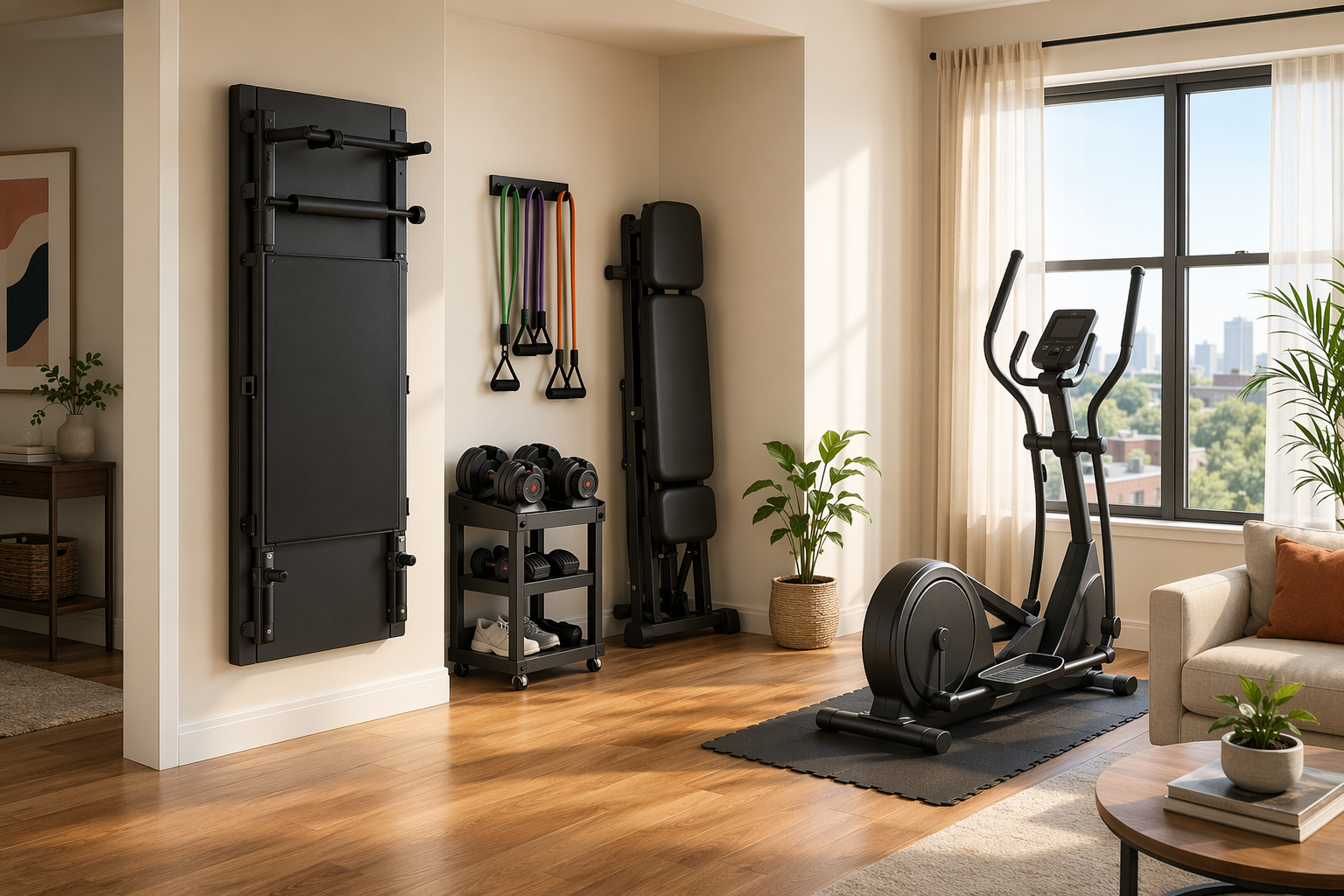
Most home gym advice treats square footage as the only constraint. For an apartment dweller, square footage is the third or fourth concern. The three real killers are noise complaints, lease violations, and space reclamation — the ability to make the gym disappear when you’re not using it. I’ve learned that the hard way. Here’s why each one changes your equipment choices.
Noise transmission
Noise isn't just how loud a machine sounds in the room. It's structure-borne — vibrations that travel through the floor into the unit below. I learned this the hard way after a neighbor complained about my treadmill. A treadmill might be 70 dB inside your apartment, but the low-frequency thump can be louder in your neighbor's living room than in yours. Magnetic resistance cardio machines (like the Niceday elliptical under $600 or the LEIKE folding bike under $200) produce far less structure-borne noise because there’s no heavy impact. The LEIKE bike weighs only 38.5 pounds — you can lift it onto a thick mat and the vibration barely reaches the floor. That’s the kind of spec that actually matters in an apartment.
No permanent modifications
If your lease says "no drilling into walls, ceiling, or floor" — and most do — then anything requiring wall anchors is out. That eliminates wall-mounted racks, most cable towers, and even some pull-up bars. The exception: a doorway pull-up bar that uses tension, like the Perfect Fitness Multi-Gym Doorway Pull-Up Bar. It installs in under two minutes, holds up to 300 pounds, and leaves zero marks when you remove it. That’s a no-drill win. Most other equipment — adjustable dumbbells, benches, bands, compact ellipticals — doesn’t need drilling either. The trick is knowing which products are designed to stay put without screws.
Space reclamation
Your apartment is not a dedicated gym. That corner near the window is also where you want to put a reading chair or a plant. The equipment has to go away when you’re done — into a closet, under the bed, or upright against a wall. That’s why the REP Nighthawk bench is a standout: it stows upright to just 1.8 square feet. Adjustable dumbbells like the NÜOBELL (5–80 lbs, $595) replace a whole rack of iron. Resistance bands (the Fringe Sport set up to 175 lbs for $192) take up less space than a pair of jeans. All of it fits under a bed or in a closet.
Match Equipment to Constraints, Not Square Footage
Once you know the three constraints, selecting equipment becomes a filtering exercise, not a shopping spree. I’ve seen too many apartment gym guides that lump everything from a $3,000 all-in-one smart gym to a jump rope into one list. That doesn’t help. Let’s split it into three tiers based on noise profile, drilling requirement, and portability.
| Tier | Examples | Noise level | Drilling? | Portability |
|---|---|---|---|---|
| No-drill picks | Adjustable dumbbells, bands, doorway pull-up bar, folding bike | Low to moderate | No | High |
| Low-noise picks | Magnetic resistance elliptical, rubber-coated weights, foam mats | Very low | No | Moderate |
| Wall-mount (with permission) | Foldable squat rack, wall-mounted cable machine | Low to moderate | Yes | Moderate |
The starter pack that covers about 80% of training needs for most renters lands near $1,000 — but the exact number depends on the bench price. I’m working with the NÜOBELL dumbbells ($595) plus the Fringe Sport bands ($192) and the REP Nighthawk bench (I couldn’t confirm the exact price from the source, but REP’s site usually lists it around $200–$250). That puts the total somewhere between $987 and $1,037 — right on the edge of the under-$1,000 claim. The margin is tight, but I’m not going to pretend it’s comfortably under. The point holds: for the price of one all-in-one machine, you get a modular system that is quieter, more portable, and far easier to store.
What about those big all-in-one machines like the Speediance Gym Monster (folds to 14.96 inches deep, $3,199) or the PRx Profile PRO Squat Rack (folds to 9 inches, $1,099, requires drilling)? They are impressive, but for most renters they’re the wrong choice. They require heavy lifting during assembly, they need wall mounting, and they’re expensive enough that moving them feels risky. Mention them only to show why you shouldn’t buy one unless you have explicit permission from your landlord and a dedicated wall.
For a more detailed breakdown of each product’s noise and footprint, check our Compact Home Gym Equipment Guide for Apartments. It has the testing methodology behind the noise claims I’m making here.
Floor Protection Isn't Optional
The cheapest upgrade you can make for your apartment gym — and the one most likely to keep your neighbors happy — is a set of interlocking foam mats. Amazon Basics Foam Interlocking Mats cover 24 square feet for under $25. That’s cheaper than a single delivery pizza, and it’s the single most effective thing you can do to dampen structure-borne noise. EVA foam mats are estimated to reduce that noise by up to 70% compared to bare floors — but I want to be honest with you: that specific figure comes from expert consensus, not a single controlled test I can point to. If you find a different number, trust the direction, not the precision. The key mechanism is that the foam decouples the equipment from the floor, breaking the vibration path.
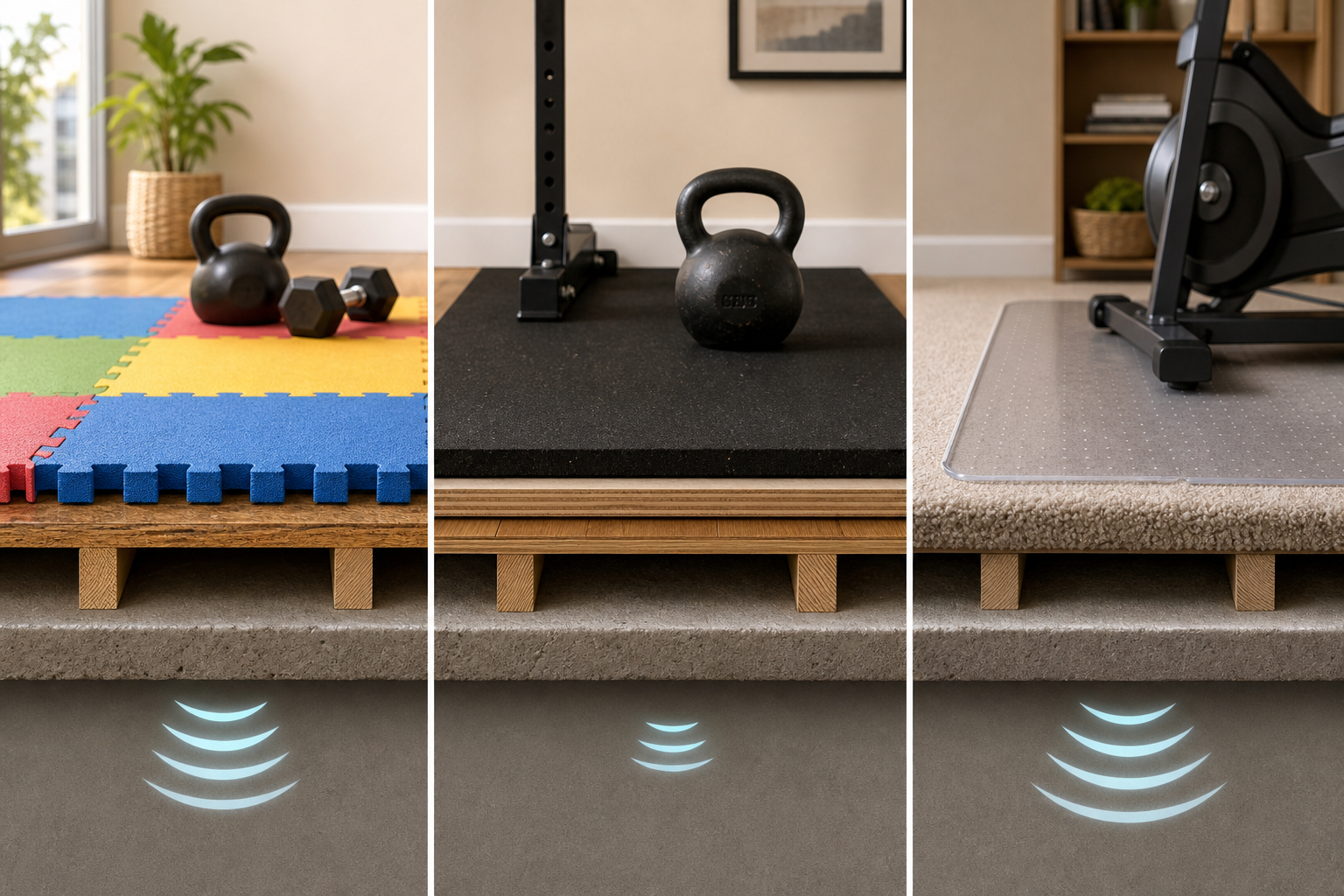
If you’re doing mostly bodyweight, bands, and dumbbell work up to 80 pounds, foam tiles are fine. If you ever plan to drop a barbell (unlikely in an apartment, but possible in a ground-floor unit), you need rubber stall mats — typically ¾-inch thick, about $50–$80 per 4x6-foot mat. But stall mats are heavy (around 100 lbs each) and have a strong rubber smell for the first few weeks. Carpet shields are a distant third: they protect the carpet fibers from compression but do almost nothing for noise.
For a full breakdown of costs per square foot across materials, see How Much Does Home Gym Flooring Cost?. And if you’re torn between foam and rubber, this comparison goes deeper into the trade-offs for each type of training.
Storage That Doesn't Look Like a Gym
You’ve got the equipment. Now you need it to disappear. The REP Dumbbell Storage Cart takes up 5.2 square feet of floor space and includes pegboard for accessories. It’s not small, but it organizes everything in one spot and can double as a sideboard if you put a plant on top. The REP adjustable kettlebell (8–40 pounds) replaces five individual kettlebells. And the Nighthawk bench stows upright against the wall, taking up less space than a floor lamp.
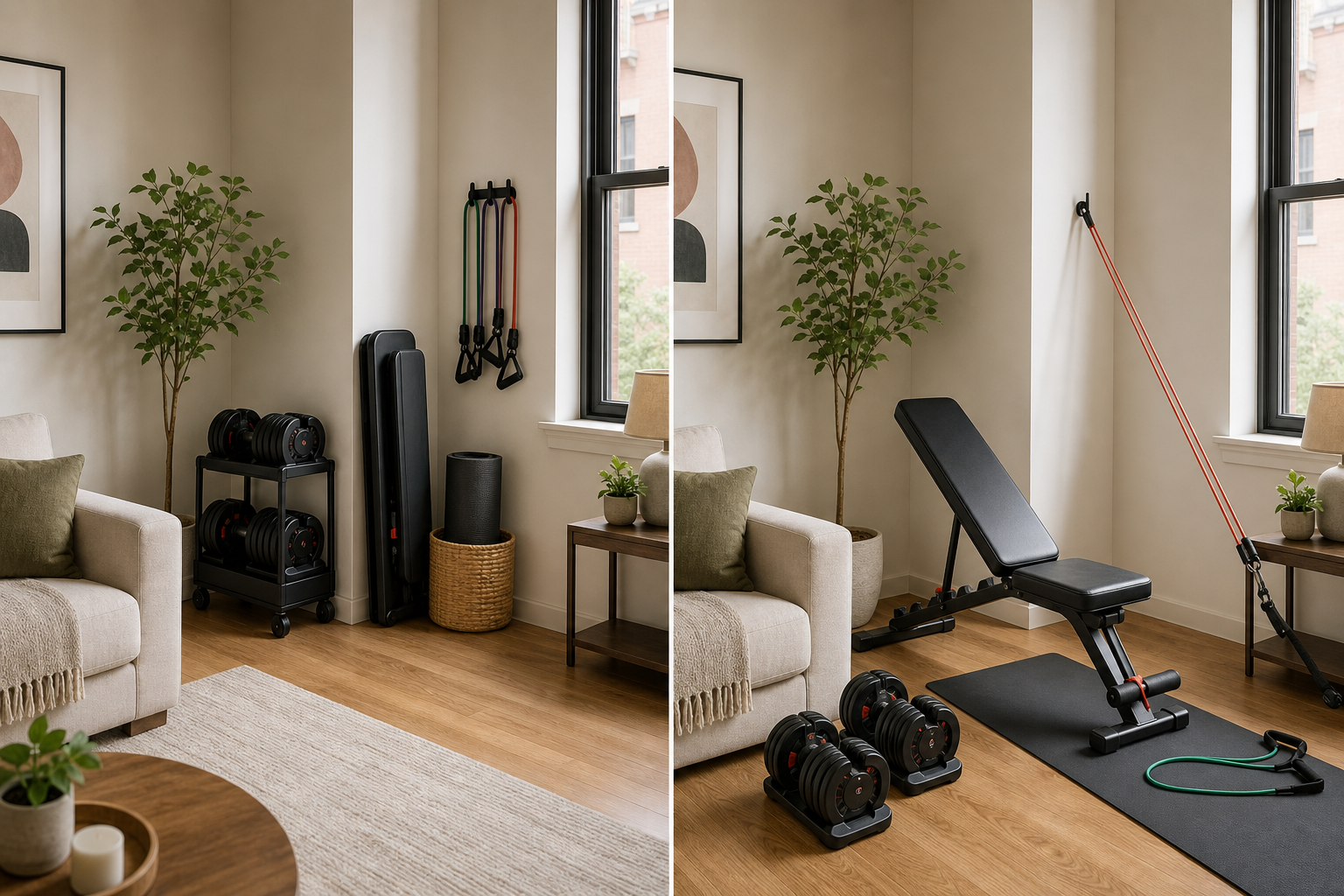
Closet shelving and under-bed bins handle the small stuff: bands, jump ropes, ankle straps. If you can hang a tension rod in your closet, you can store bands like ties. The goal is to reach a state where a visitor could walk through the room without tripping on a dumbbell.
Programming Around the 'No Jumping' Clause
Your apartment gym is set up. Now what do you actually do? Many workouts rely on explosive movements — box jumps, burpees, jumping lunges — that will get you a noise complaint within one set. The fix is substitution, not avoidance.
- Instead of box jumps, do step-ups on a sturdy chair or your bench. You lose the plyometric component but keep the quad work and heart rate effect.
- Instead of overhead slams, use tempo floor press or band-resisted push-ups. Control the eccentric and you still build tension.
- Instead of burpees, do squat-to-plank walks. Same muscle groups, less impact.
- Instead of running in place, use a magnetic resistance elliptical (Niceday, under $600) or a folding bike (LEIKE, under $200). Both are so quiet you can watch TV while using them.
For a fully structured program built around these substitutions, take a look at our 8-Week Compact Home Gym Strength Program. It’s designed for exactly the setup described here — adjustable dumbbells, a bench, and bands — and includes low-impact modifications for every session.
The Moving-Day Reality Check
You’re going to move eventually. If you’ve built your gym right, packing it up should take an afternoon, not a weekend. Here’s the concrete advice I wish someone had given me the first time I moved a set of adjustable dumbbells.
- Keep the original boxes for your dumbbells, bench, and bike. If you trashed them, measure the equipment and buy moving boxes that fit snugly. Loose items inside a box will tear through the cardboard.
- Label every part. The REP Nighthawk bench comes with hex bolts and a small wrench. Tape the wrench to the bench frame and put the bolts in a Ziploc bag taped to the underside. You’ll thank yourself when you reassemble in the new apartment.
- Know the weight limits on your moving boxes. A pair of NÜOBELL dumbbells at full weight is 160 lbs — that’s two heavy-duty small boxes, not one large one. Overload a big box and the bottom falls out mid-carry.
- Use furniture sliders under any assembled base (like a bike or elliptical) to move it across the floor without scratching doorframes. For tight doorways, disassemble the pedals and seat post first — saves five minutes of frustration.
- Deflate foam mats if you want them flat in the moving truck. Stack them like pancakes, not rolled — they don't re-lay flat if rolled for weeks.
That’s the difference between an apartment gym that works and one that causes headaches. The equipment is the easy part. The hard part — and the part most guides skip — is thinking through noise, drilling, storage, and portability before you buy anything. If you do that, you can train hard, stay on your landlord’s good side, and take the whole setup with you when you move.
Some links on this page are affiliate links — they may earn us a commission at no extra cost to you. Our tier and tests are decided before we ever check which links pay; see our full affiliate disclosure.
Spot something off?
Noise and floor-damage claims carry real deposit-risk consequences if we get them wrong — tell us if your experience with this build didn't match what's above.