
How Much Does Home Gym Flooring Cost? Per-Square-Foot Pricing for Every Material (2026)
Home gym flooring costs range from $1.12 to $7.50 per square foot, but the cheapest option isn't always the most affordable long-term. This guide breaks down per-material pricing, hidden costs like adhesive and delivery, and total cost of ownership so you can choose flooring that fits your budget and workout type.
- Budget tier
- $300–$1,000
- Space type
- garage
Items included: —
The 7x Price Spectrum of Home Gym Flooring
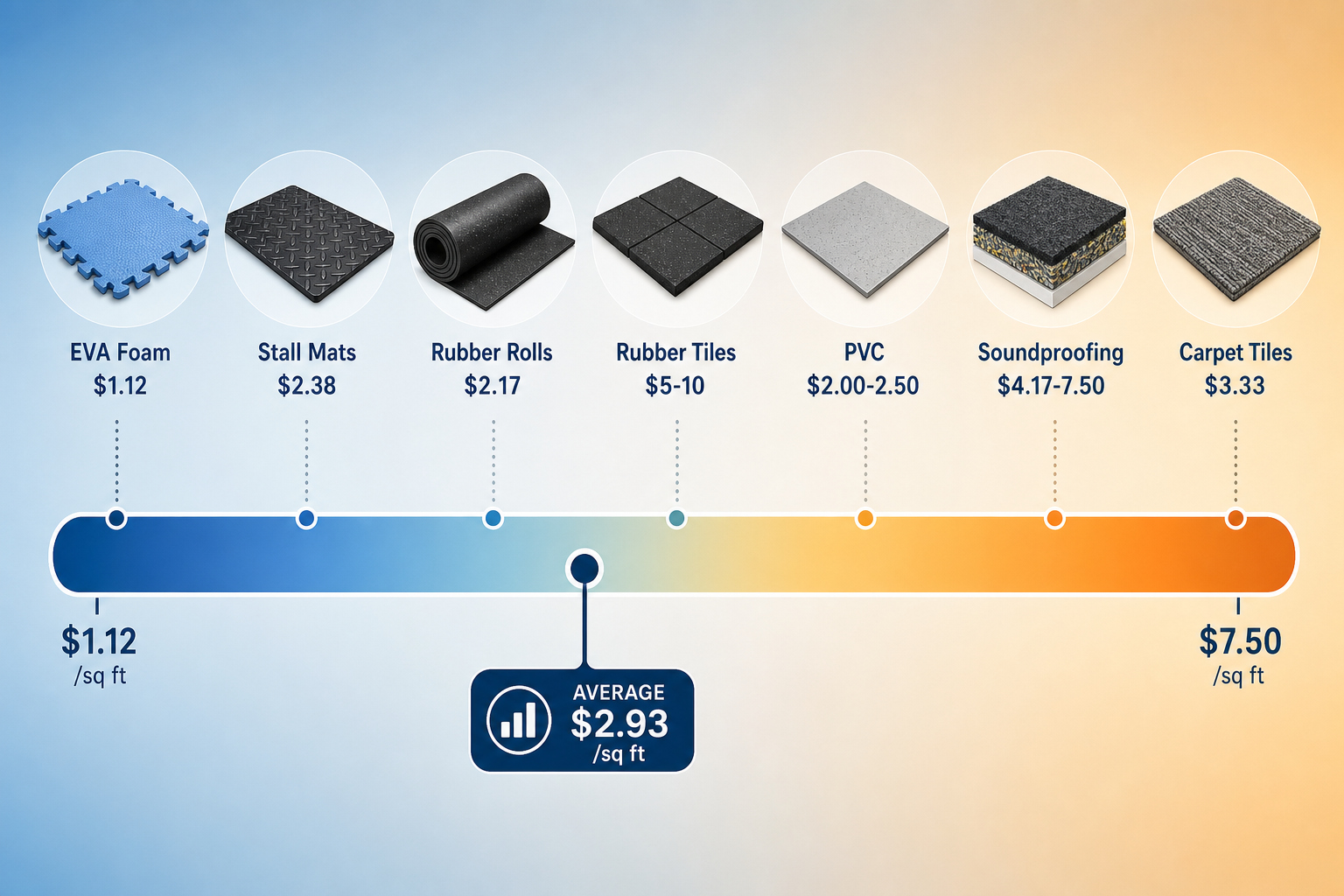
If you are planning a home gym build, flooring is likely the single largest material purchase you will make after the equipment itself. The range of options is wide, and so is the price spread: the cheapest EVA foam mats run about $1.12 per square foot, while specialized soundproofing mats can hit $7.50 per square foot. That is a nearly 7x difference before you account for installation supplies, delivery fees, or how long the material will last.
According to pricing data aggregated by Garage Gym Reviews, the average cost across all common home gym flooring materials sits at $2.93 per square foot. That figure is a useful baseline: if you are paying significantly less, you are likely in foam territory; if you are paying significantly more, you are probably looking at premium rubber tiles or acoustic underlayment systems.
This article is organized around cost as the primary decision axis. You will find a detailed per-material price table, a breakdown of the hidden costs that inflate cheap options, a lifespan cost analysis that flips the math on budget picks, and a simple metric — cost per workout year — that helps you compare apples to apples. By the end, you will know exactly which flooring material fits your training type and your budget, without the marketing noise.
Per-Square-Foot Pricing for Every Flooring Material
The table below covers every major flooring material available for home gyms in 2026. Prices are per square foot for the material only — they do not include adhesive, underlayment, trim, or delivery. Thickness and lifespan figures are based on manufacturer specifications and real-world user reports compiled by Garage Gym Reviews and other industry sources.
| Material | Price per Sq Ft | Typical Thickness | Lifespan | Best For |
|---|---|---|---|---|
| EVA Foam Mats (ProsourceFit) | $1.12 | 0.5" | 3–5 years | Bodyweight, yoga, light stretching |
| Horse Stall Mats (Tractor Supply) | $2.38 | 0.75" | 10–20 years | Heavy strength training, garage gyms |
| Rubber Rolls (Flooring Inc 8MM) | $2.17 | 8mm (~0.31") | 10–20 years | Commercial-grade, full-room coverage |
| Rubber Rolls (Living.Fit) | $2.24 | 8mm (~0.31") | 10–20 years | Full-room coverage, moderate use |
| Rubber Interlocking Tiles (Living.Fit) | $5.00–$10.00 | Varies | 10–20 years | Modular setups, easy replacement |
| PVC Tiles | $2.00–$2.50 | 0.25" | 5–8 years | Light dumbbell work, home studios |
| Soundproofing Mats (Second Skin) | $4.17–$7.50 | 0.25"–0.5" | 10–15 years | Upstairs apartments, noise-sensitive spaces |
| Peel-and-Stick Carpet Tiles (Eclipse) | $3.33 | 3/16" | 3–5 years | Multi-purpose rooms, light activity |
A few observations stand out immediately. Rubber rolls from Flooring Inc and Living.Fit are priced within a few cents of each other at roughly $2.17–$2.24 per square foot, making them the most cost-effective option for full-room coverage. Horse stall mats from Tractor Supply come in at $2.38 per square foot but offer nearly three times the thickness (0.75" vs. 8mm), which matters for heavy deadlifts and dropped barbells. At the other end, soundproofing mats from Second Skin cost nearly double the average, but they are the only option that meaningfully addresses impact noise for upstairs neighbors.
The Hidden Costs That Change the Math
The per-square-foot price of flooring material is only the starting point. Several additional costs can add 15–30% to your total upfront investment, and ignoring them can lead to budget overruns or a subpar installation.
- Adhesive or carpet tape: Rubber rolls and some tiles require double-sided carpet tape or adhesive to stay flat and prevent shifting. Expect to pay $0.50–$1.00 per square foot for quality tape. A 100 sq ft room could add $50–$100 to your cost.
- Underlayment: If your subfloor is concrete (common in garages and basements), a moisture barrier or foam underlayment is recommended to prevent mold and mildew. This runs roughly $0.50 per square foot.
- Trim and transition strips: Where your gym flooring meets carpet, tile, or hardwood, you will need transition strips to create a clean edge and prevent tripping. A basic aluminum strip costs $10–$20 per doorway.
- Delivery fees: As noted, heavy materials like horse stall mats and large rubber rolls incur significant shipping costs. Some retailers offer free shipping above a certain order value, but many do not. Always check the shipping policy before committing.
- Subfloor preparation: Uneven concrete, cracks, or moisture issues may require patching, leveling compound, or a vapor barrier. This is the most variable cost and can range from $0.50 to $2.00 per square foot depending on the condition of your space.
For a 100 sq ft gym (roughly 10x10 feet), these hidden costs can add $100–$300 to your total. That is enough to push a budget foam setup into the price range of mid-tier rubber, or to make a rubber roll installation significantly more expensive than the material cost alone suggests.
If you are building in a garage, also consider the environmental factors that can affect flooring longevity. Our Garage Gym Environmental Checklist covers moisture barriers, temperature swings, and subfloor protection in more detail.
Lifespan Cost Analysis: Why Cheap Flooring Costs More Over Time
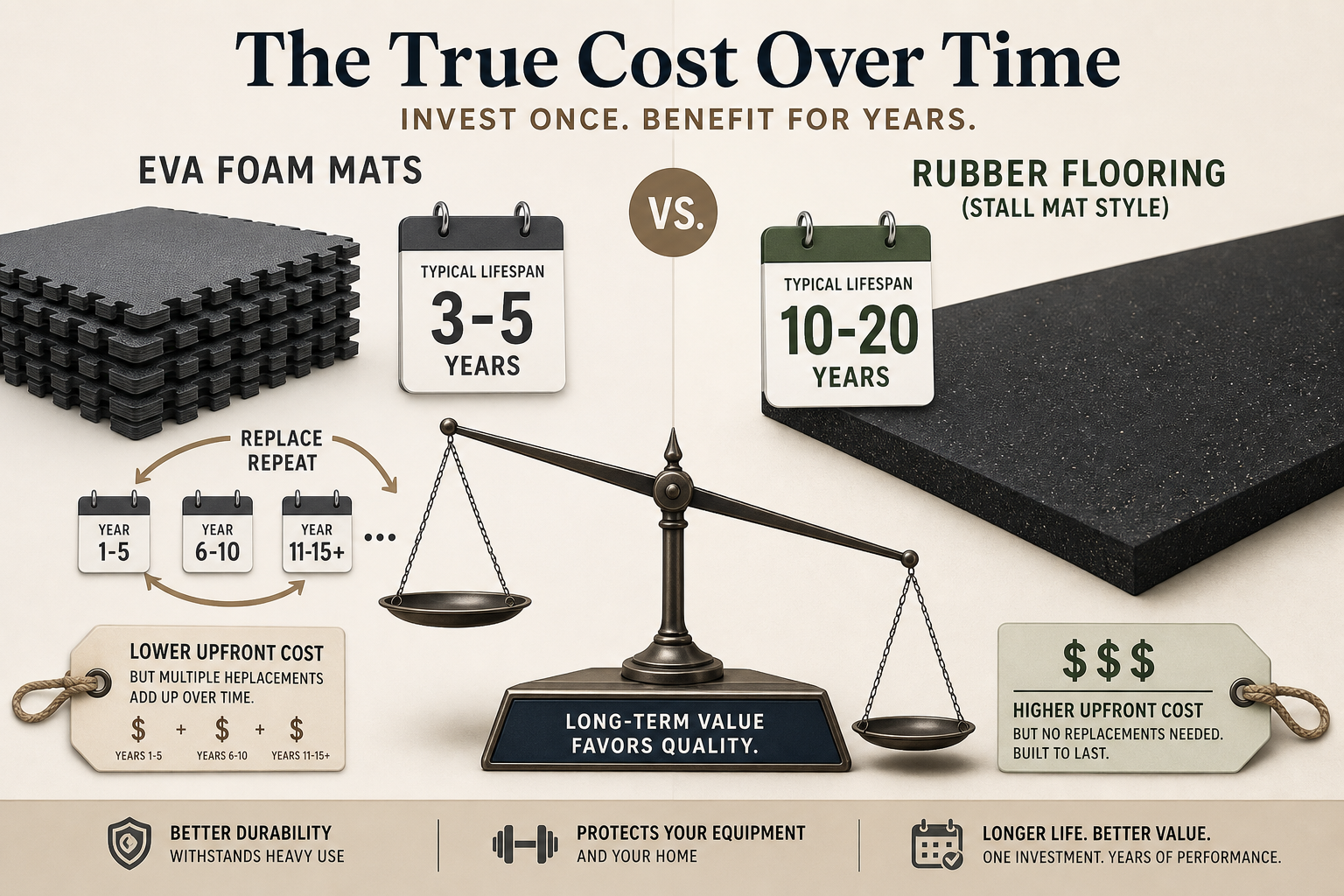
The most common mistake in home gym flooring is buying the cheapest material without considering how long it will last. EVA foam mats, at $1.12 per square foot, are undeniably affordable upfront. But they have a typical lifespan of only 3–5 years, especially under regular use. Rubber flooring, by contrast, lasts 10–20 years — often 15 years or more with proper care.
When you calculate the cost per year, the math flips. Here is how the two most popular budget options compare over a 15-year period for a 100 sq ft space:
| Material | Upfront Cost (100 sq ft) | Lifespan | Replacements Needed (15 yrs) | Total Cost (15 yrs) | Cost per Year |
|---|---|---|---|---|---|
| EVA Foam Mats ($1.12/sq ft) | $112 | 3–5 years | 3–4 | $448–$560 | $30–$37 |
| Horse Stall Mats ($2.38/sq ft) | $238 | 10–20 years | 0–1 | $238–$476 | $16–$32 |
| Rubber Rolls ($2.17/sq ft) | $217 | 10–20 years | 0–1 | $217–$434 | $14–$29 |
The foam mats cost less than half the price of stall mats upfront, but over 15 years they can cost nearly double. And that is before factoring in the labor of tearing out old mats, disposing of them, and installing new ones — a hassle that has a real time cost.
This is exactly the kind of mistake we cover in our guide to 7 Garage Gym Mistakes That Cost You Money. Choosing the wrong flooring based on upfront price alone is one of the most common and expensive errors new home gym builders make.
Cost Per Workout Year: A Better Way to Compare Flooring
The cost-per-year calculation above is useful, but it still does not fully capture the value equation for a home gym. A more practical metric is cost per workout year — the total installed cost of your flooring divided by the number of years it will last. This frames the decision around how much you are paying for each year of reliable use, rather than how much you are paying today.
Here is how the math works for a 100 sq ft gym, including estimated hidden costs (adhesive, underlayment, delivery):
| Material | Total Installed Cost (100 sq ft) | Lifespan (Years) | Cost per Workout Year |
|---|---|---|---|
| EVA Foam Mats | $162 (material + tape + delivery) | 4 (midpoint) | $40.50 |
| Horse Stall Mats | $338 (material + delivery) | 15 (midpoint) | $22.53 |
| Rubber Rolls | $317 (material + tape + delivery) | 15 (midpoint) | $21.13 |
| Soundproofing Mats | $567 (material + underlayment + delivery) | 12 (midpoint) | $47.25 |
The pattern is clear: rubber rolls and horse stall mats cost roughly half as much per workout year as foam mats, even though their upfront price is higher. Soundproofing mats, while essential for certain scenarios, have the highest cost per workout year — which is why they should only be used when noise isolation is a genuine requirement.
Budget Recommendations by Training Type
The right flooring for your home gym depends primarily on what you plan to do on it. Here are cost-optimized recommendations organized by training type, using the cost-per-workout-year framework above.
- Bodyweight training, yoga, and light stretching: EVA foam mats at $1.12/sq ft are adequate. You are not dropping weights or generating high impact forces, so the shorter lifespan is acceptable. A 6x4' mat area costs about $27 and will last 3–5 years. This is the one scenario where the cheapest option makes sense.
- Light dumbbell work and home studios: PVC tiles at $2.00–$2.50/sq ft or thin rubber rolls at $2.17/sq ft provide better protection than foam without the weight and cost of thick stall mats. A 100 sq ft installation runs $200–$250 and should last 8–15 years depending on use.
- Heavy strength training (deadlifts, squats, Olympic lifts): Horse stall mats at $2.38/sq ft or thick rubber rolls are the only sensible choices. The 0.75" thickness of stall mats provides essential protection for both your floor and your equipment. A 100 sq ft setup costs about $238 for the mats plus delivery, and will likely outlast your gym membership.
- Upstairs apartments and noise-sensitive spaces: Soundproofing mats like Second Skin at $4.17–$7.50/sq ft are the only option that meaningfully reduces impact noise transmission. A 2025 study by Frias et al. (presented at Inter-Noise 2025) confirmed that rubber flooring can reduce impact noise, but lightweight alternatives are needed when structural load is a concern. Budget $417–$750 for a 100 sq ft space, plus underlayment.
Once you have chosen your flooring, the next step is building out the rest of your gym within your budget. Our Compact Home Gym Budget Builds guide walks through complete setups at $500, $1,500, and $3,000, including flooring as a line item.
Making Your Final Choice: Balancing Upfront Cost and Long-Term Value
Home gym flooring is a long-term investment, not a disposable accessory. The data is consistent across every source: rubber — whether in rolls, tiles, or stall mat form — offers the best balance of upfront cost, lifespan, and protection for the vast majority of home gym users. The $2.93 per square foot average is a useful reference point: if you are paying significantly less, you are compromising on durability; if you are paying significantly more, you are paying for specialized features like noise isolation that you may not need.
Here is the short version of the decision framework:
- If you only do bodyweight work and yoga, EVA foam at $1.12/sq ft is fine. Accept that you will replace it in 3–5 years.
- If you lift weights, even occasionally, buy rubber. Horse stall mats at $2.38/sq ft or rubber rolls at $2.17/sq ft will save you money over a decade.
- If you live upstairs and need to keep the peace, soundproofing mats at $4.17–$7.50/sq ft are your only real option. Budget accordingly.
- Always factor in hidden costs — adhesive, underlayment, delivery, and subfloor prep — before comparing material prices.
The best flooring decision is the one that matches your training, your space, and your budget — and that you will not have to make again for a decade or more. Use the cost-per-workout-year metric, account for the hidden costs, and choose the material that gives you the lowest annual cost for the type of training you actually do.
Some links on this page are affiliate links — they may earn us a commission at no extra cost to you. Our tier and tests are decided before we ever check which links pay; see our full affiliate disclosure.
Spot something off?
Noise and floor-damage claims carry real deposit-risk consequences if we get them wrong — tell us if your experience with this build didn't match what's above.