
How We Test and Score Affordable Home Gym Equipment
Most budget equipment roundups bury their methodology — or skip it entirely — leaving readers to guess whether a recommendation is based on actual testing or affiliate commission rates. This guide takes a different approach. Every item listed below has been scored on five dimensions using a transparent 1–5 scale, adapted from the testing protocol used by Garage Gym Reviews (GGR). The five criteria are:
- Durability / Construction: Does the frame, material, or build quality hold up under regular use? Are there known failure points?
- Footprint / Portability: How much floor space does it occupy? Can it be stored or moved easily?
- Versatility: How many exercises, movements, or training styles does it support?
- Value: How does the price compare to the category average? Does the performance justify the cost?
- Warranty: What level of manufacturer protection is offered? A long or lifetime warranty signals confidence in the product.
Each item's score is followed by a comparison-to-average pricing table so you can see exactly how much you're saving — or where you're paying a premium — relative to the broader market. Trade-offs are disclosed explicitly, not glossed over. Where a product has a known weakness (inconsistent knurling, below-average warranty, thinner steel), it's called out.
If you're new to buying home gym equipment, reading about common purchasing mistakes before you spend any money will save you from the most frequent pitfalls — like buying single-purpose machines or ignoring weight ratings.
Tier 1: $0–$100 — The Essentials That Deliver the Highest Value Per Dollar
You can build a surprisingly effective home workout foundation for less than the cost of two months of a commercial gym membership. The items in this tier are not compromises — they are purpose-built tools that, in many cases, outperform their more expensive counterparts in specific roles. The key is knowing which pieces to prioritize.
WOD Nation Double Under Speed Rope — $18.99
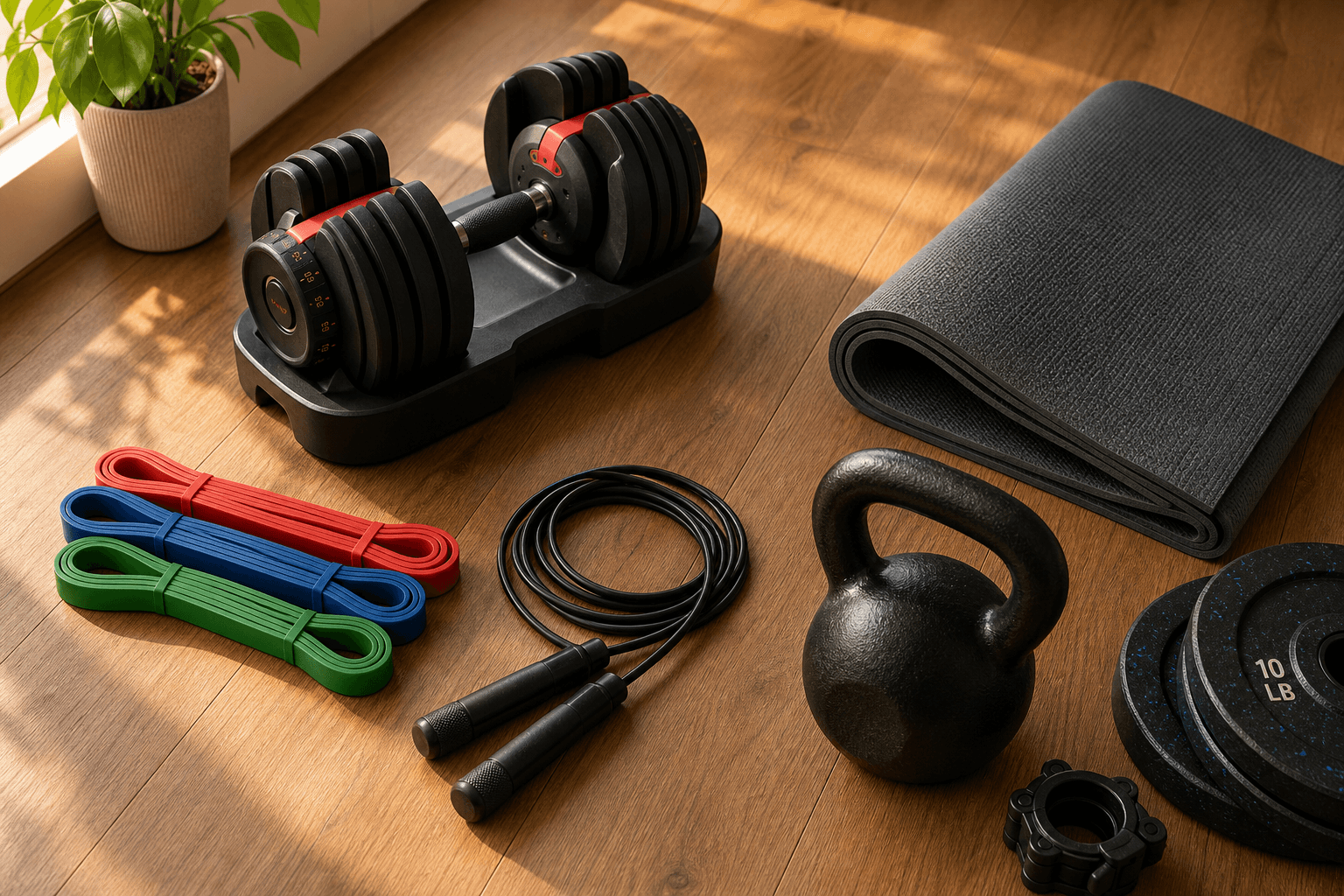
The single highest value-per-dollar item in this entire guide. GGR testers report using the same WOD Nation rope for over seven years with no degradation in performance. At $18.99, it costs roughly 60% less than the average jump rope price of $49, yet it scores a 4.3/5 overall in GGR's testing. The 10-foot cable can be cut to fit any height, and it comes in nine colorways. For cardio conditioning, coordination, and foot speed, nothing in this price bracket comes close.
| Item | Price | Category Average | Savings vs. Average | GGR Score |
|---|---|---|---|---|
| WOD Nation Speed Rope | $18.99 | $49 | 61% below | 4.3/5 |
Resistance Bands — $20 to $130
Resistance bands are the most versatile piece of equipment you can buy for under $50. A single set of loop bands covers everything from glute activation and pull-up assistance to full-body strength work. Living.Fit Resistance Bands (full set at $128.94, resistance range 6–250 lbs) score 4.5/5 from GGR and carry a lifetime warranty. For a smaller investment, Fringe Sport Latex-Free Strength Bands (full set $192, resistance 20–175 lbs) use biomedical-grade rubber and are latex-free — important if you have sensitivities. At the entry level, a four-pack of mini bands from Vergali costs $19.79 and provides four resistance levels in a fabric construction that won't roll up during use.
Yoga Mat — $18 to $144
A good mat is the floor of your home gym. The Manduka PRO Yoga Mat ($144, 6mm thick) is the lifetime option — dense, non-slip, and backed by a lifetime guarantee. At the budget end, a basic 6mm mat from any sporting goods store runs $18–$25 and will serve well for bodyweight work, stretching, and core training. The difference is longevity: a $20 mat may need replacement every 12–18 months, while the Manduka can last a decade.
Ab Roller — Under $20
An ab roller is one of the few pieces of equipment that cannot be effectively replicated by bodyweight alone. REP Fitness sells one for under $20, and it provides a core stimulus that crunches and planks cannot match. The trade-off is a steep learning curve — most beginners cannot perform a full rollout on their first attempt. Start with kneeling rollouts and progress to standing as your core strength develops.
Gymnastic Rings — $59
The Titan Gymnastic Rings ($59, wooden, 9.25-inch diameter, rated for 600+ lbs) are what GGR founder Coop Mitchell calls his number-one pick for a single strength item. If you have a pull-up bar, a sturdy beam, or a tree branch, rings unlock rows, dips, push-ups, and pull-ups with a stability demand that forces your stabilizer muscles to work far harder than they would on a stable surface. The 1.25-inch wooden rings from REP Fitness are also available for under $50.
| Item | Price | Category Average | Savings vs. Average | GGR Score |
|---|---|---|---|---|
| WOD Nation Speed Rope | $18.99 | $49 | 61% below | 4.3/5 |
| Living.Fit Resistance Bands (set) | $128.94 | $103 | 25% above (premium) | 4.5/5 |
| Titan Gymnastic Rings | $59 | N/A (niche) | N/A | N/A |
Tier 2: $100–$300 — The Starter Setup That Balances Load and Versatility
Once you cross the $100 threshold, you enter the range where equipment starts providing a meaningful resistance stimulus for strength training. This tier is where most people should begin if their primary goal is building muscle or increasing strength — not just maintaining general fitness.
TYZDMY Adjustable Dumbbells — $269.99
Adjustable dumbbells are the single most important purchase for a home gym because they replace an entire rack of fixed-weight dumbbells. The TYZDMY Adjustable Dumbbells ($269.99, 5–52.5 lbs per pair, 15 increments) sit at the entry-level end of the adjustable dumbbell market. They are not as fast to change as the premium options in Tier 3, and the weight range tops out at 52.5 lbs — which may be insufficient for lower-body exercises like goblet squats or lunges as you progress. But for upper-body work and general conditioning, they represent the best balance of cost and function in this tier.
Rogue E-Coat Kettlebells — From $44
Rogue's E-Coat kettlebells score a perfect 5/5 for durability from GGR. Prices range from $44 for the 9-lb bell to $163 for the 88-lb version. The e-coat finish is more durable than standard paint and provides a better grip texture than bare cast iron. A single kettlebell in the 35–53 lb range (for men) or 18–26 lb range (for women) is enough to run most kettlebell swing, clean, and snatch workouts. The trade-off: Rogue kettlebells are rarely discounted, and shipping costs can add $10–$20 depending on your location.
Major Fitness Adjustable Bench — $219.99
A quality adjustable bench unlocks pressing, rowing, and seated exercises that cannot be done safely on the floor. The Major Fitness Adjustable Bench ($219.99, 1,300-lb weight capacity) scores 4.3/5 from GGR and sits $87 below the average weight bench price of $307. The 1,300-lb capacity is overkill for most home users, but it means the bench will never be the weak link in your setup. The trade-off: the warranty is below average at just one year, compared to the lifetime frame warranties offered by REP and Rogue on their benches.
Sunny Health and Fitness Indoor Cycle Bike SF-B1002 — $254.34
For cardio-focused readers, the Sunny SF-B1002 ($254.34, 49-lb flywheel, steel frame) is the standout value pick in this tier. It scores 4.5/5 for value from GGR and costs roughly 80% less than the average exercise bike price of $1,409. The 49-lb flywheel provides a smooth, magnetic-resistance feel that rivals bikes costing three times as much. The trade-off: it lacks the digital features (Bluetooth, app integration, heart rate monitoring) that serious cyclists may want, and the saddle and pedals are basic — expect to upgrade both within the first year.
Fitness Reality 1000 Plus Magnetic Rowing Machine — $268
The Fitness Reality 1000 Plus ($268, 14 resistance levels, Bluetooth, 250-lb weight capacity) is the most affordable rower that provides a legitimate full-body cardio stimulus. Fourteen magnetic resistance levels give enough range for both steady-state and interval work, and Bluetooth connectivity allows pairing with apps like Kinomap. The trade-off: the 250-lb weight capacity excludes larger athletes, and the rail length may feel short for users over 6 feet tall.
| Item | Price | Category Average | Savings vs. Average | GGR Score |
|---|---|---|---|---|
| TYZDMY Adjustable Dumbbells | $269.99 | $625 | 57% below | N/A |
| Rogue E-Coat Kettlebell (35 lb) | ~$75 | $44.50–$209.15 | Varies by weight | 5/5 |
| Major Fitness Adjustable Bench | $219.99 | $307 | 28% below | 4.3/5 |
| Sunny SF-B1002 Cycle Bike | $254.34 | $1,409 | 82% below | 4.5/5 (value) |
| Fitness Reality 1000 Plus Rower | $268 | N/A | N/A | N/A |
Tier 3: $300–$800 — The Core Setup for Long-Term Training
This is the tier where a home gym stops being a collection of accessories and becomes a complete training environment. The equipment here is built to last for years and to support progressive overload — the systematic increase in training stress that drives strength and muscle gains. If your budget allows, starting here saves you from the upgrade path that Tier 1 and Tier 2 buyers inevitably face.
REP PR-1100 Power Rack — $380
The REP PR-1100 is the best budget power rack on the market in 2026. At $380, it sits $328 below the average squat rack price of $708, yet it offers a 700-lb weight capacity and a 4.3/5 GGR score. The 14-gauge steel is thinner than the 11- or 12-gauge steel found on premium racks like the REP PR-4000 or Rogue RML-3, but for anyone lifting under 500 lbs, the difference is academic. The PR-1100 includes J-hooks, safety pins, and a pull-up bar — everything you need to squat, bench, and press safely.
Fitness Reality 810XLT Super Max Power Cage — $249
If the REP PR-1100 stretches your budget, the Fitness Reality 810XLT ($249, 800-lb capacity, 14-gauge steel) is the most affordable full-size power cage available. It includes a multi-grip pull-up bar and a lat pulldown attachment — features typically found on racks costing twice as much. The trade-off: assembly is more complex than the PR-1100, and the 14-gauge steel flexes noticeably under heavy loads above 400 lbs. It is best suited for lifters working in the 200–350 lb range.
Synergee Games Cerakote Barbell — From $179.95
A good barbell is the centerpiece of any strength training setup. The Synergee Games Cerakote Barbell (from $179.95, 190,000 PSI tensile strength, lifetime warranty) scores 4.7/5 from GGR and costs roughly 52% less than the average barbell price of $375. The Cerakote finish is more corrosion-resistant than standard chrome or black oxide, making it a strong choice for garage gyms in humid climates. The 190,000 PSI tensile strength is sufficient for all but the most aggressive Olympic lifting programs.
Fringe Sport Black Bumper Plates — From $2.20/lb
Bumper plates allow you to drop weights safely, which is essential for Olympic lifts and high-rep squat sets where failure is a possibility. Fringe Sport's Black Bumper Plates (from $2.20/lb, lifetime warranty) score 4.6/5 from GGR and come in at $0.29/lb below the average bumper plate price of $2.49/lb. The 10-lb and 15-lb plates use a 90 Durometer compound that is softer than standard competition bumpers, which means they bounce more but are quieter on impact. The lifetime warranty is a strong signal of confidence — most budget bumper plates carry only a 1–3 year warranty.
REP QuickDraw Adjustable Dumbbells — From $336
The REP QuickDraw adjustable dumbbells (from $336, 5–60 lbs, 18.5 inches long) score 4.5/5 from GGR and replace up to 12 pairs of fixed dumbbells. At $289 below the average adjustable dumbbell price of $625, they represent the best value in the premium adjustable dumbbell category. The QuickDraw mechanism is faster than the screw-collar system on the TYZDMY dumbbells in Tier 2, and the lifetime warranty covers drops — a critical feature for anyone who trains to failure. The 60-lb max is sufficient for most upper-body exercises and will serve intermediate lifters for years.
PowerBlock Sport Series Adjustable Dumbbells — $409
The PowerBlock Sport Series ($409, 5–50 lbs, expandable to 90 lbs, 5-year limited warranty) is the most space-efficient adjustable dumbbell design on the market. The block-shaped form factor stores compactly and the selector pin system allows weight changes in under three seconds. The expandability to 90 lbs means this set can grow with you — you buy the base unit now and add expansion kits later. The trade-off: the block shape makes some exercises (like dumbbell pullovers or skull crushers) awkward compared to traditional dumbbell shapes, and the 5-year warranty is shorter than REP's lifetime coverage.
TRX Home Suspension Trainer — $229.95
The TRX Home Suspension Trainer ($229.95, 1.5 lbs, nylon webbing, carabiner rated at 1,300 lbs) is the most portable complete strength system in this guide. It packs down to the size of a water bottle and provides hundreds of bodyweight exercises with adjustable resistance based on body angle. The trade-off: the resistance curve is limited by your body weight — once you can perform 15+ reps of any exercise with your feet elevated, you need external load to continue progressing. It is best used as a complement to a dumbbell or barbell setup, not a replacement.
| Item | Price | Category Average | Savings vs. Average | GGR Score |
|---|---|---|---|---|
| REP PR-1100 Power Rack | $380 | $708 | 46% below | 4.3/5 |
| Fitness Reality 810XLT Cage | $249 | $708 | 65% below | N/A |
| Synergee Games Cerakote Barbell | $179.95 | $375 | 52% below | 4.7/5 |
| Fringe Sport Bumper Plates | $2.20/lb | $2.49/lb | 12% below | 4.6/5 |
| REP QuickDraw Dumbbells | $336 | $625 | 46% below | 4.5/5 |
| PowerBlock Sport Dumbbells | $409 | $625 | 35% below | N/A |
| TRX Home Suspension Trainer | $229.95 | N/A | N/A | N/A |
For a broader look at equipment across all budgets — including premium options above $800 — see our comprehensive 2026 buying guide.
Key Trade-Offs at Every Budget Tier
No piece of equipment is perfect, and the most important skill in building a home gym is knowing which compromises you can live with. Here are the most significant trade-offs at each tier:
- Tier 1 ($0–$100): You trade load capacity for portability and price. Resistance bands and gymnastic rings cannot provide the same progressive overload stimulus as heavy dumbbells or a barbell. You will outgrow this tier within 3–6 months if your primary goal is strength.
- Tier 2 ($100–$300): You trade build quality and warranty length for affordability. The Major Fitness bench has a below-average 1-year warranty. The TYZDMY dumbbells top out at 52.5 lbs. The Sunny bike lacks digital features. These are functional compromises, not deal-breakers, but they create an upgrade path.
- Tier 3 ($300–$800): You trade premium materials for price. The REP PR-1100 uses 14-gauge steel instead of 11-gauge. The PowerBlock dumbbells have an unconventional shape. The TRX trainer cannot provide enough resistance for advanced lifters. These are the trade-offs that matter least for most users — the equipment in this tier will serve you for 5+ years.
Understanding these trade-offs is essential, but the purchase price is only part of the equation. Our guide to hidden costs of home gym equipment breaks down the 5-year total cost of ownership — including flooring, storage, maintenance, and potential upgrades — so you can budget realistically.
Decision Flowchart: What Should You Buy First?
The order in which you buy equipment matters more than the total budget. Buying the wrong piece first can leave you with a garage full of gear that doesn't support your actual training needs. Use this simple decision framework to prioritize your first purchase:
- If your primary goal is strength and you have at least $300: Buy a power rack (REP PR-1100 or Fitness Reality 810XLT) and a barbell (Synergee Games Cerakote) first. Everything else is secondary.
- If your primary goal is muscle growth (hypertrophy) and you have $200–$400: Buy adjustable dumbbells (REP QuickDraw or PowerBlock Sport) and an adjustable bench (Major Fitness). This combo covers 90% of hypertrophy exercises.
- If your primary goal is general fitness and you have under $200: Buy resistance bands (Living.Fit or Fringe Sport), a jump rope (WOD Nation), and a yoga mat (Manduka PRO or basic). This setup supports full-body workouts, cardio, and mobility.
- If your primary goal is cardio and you have $250–$300: Buy the Sunny SF-B1002 cycle bike or the Fitness Reality 1000 Plus rower. Pair it with a jump rope for warm-ups and finishers.
- If you have limited space (apartment, shared living): Start with the TRX suspension trainer ($229.95) and a set of resistance bands. Both pack flat and can be stored in a drawer. Add adjustable dumbbells when space allows.
For a more detailed decision-making process that accounts for your specific space, budget, and training goals, work through our home gym equipment decision framework before making any purchase.
How to Expand Your Setup Gradually
The most common mistake new home gym owners make is trying to buy everything at once. A smarter approach is to start with a minimal setup and add pieces as your training needs evolve and your budget allows.
A realistic gradual expansion path looks like this:
- Month 1–3 (under $100): Resistance bands, jump rope, yoga mat. Focus on bodyweight and banded exercises to build a foundation.
- Month 3–6 (add $200–$300): Add adjustable dumbbells (TYZDMY or REP QuickDraw) and an adjustable bench. This unlocks pressing, rowing, and curling movements.
- Month 6–12 (add $300–$500): Add a power rack and barbell with a set of bumper plates. This is the point where your home gym becomes a complete strength training facility.
- Year 2+ (add $200–$800): Add a cardio machine (cycle bike or rower), a suspension trainer, or specialty bars (Swiss bar, trap bar) depending on your training focus.
This phased approach has two advantages. First, it spreads the financial investment over time — you're not dropping $800+ in a single month. Second, it forces you to learn what you actually need before you buy it. Many people discover that a rack and barbell are unnecessary for their goals after training with dumbbells for six months, saving them hundreds of dollars.
For a detailed breakdown of what each tier of investment actually gets you — including the $800+ setups that this guide doesn't cover — see our home gym system cost breakdown.
Comments
Join the discussion with an anonymous comment.