
Why Bike Type Matters More Than Brand or Price
Most exercise bike buyers start their search by comparing models by price. That instinct makes sense — a budget of $500 or $1,500 is a real constraint. But the single most important decision you will make is not which brand to buy or how much to spend. It is which type of bike fits your primary use case.
A spin bike built for high-intensity interval training will frustrate someone who needs a low-impact, fully supported seat for injury recovery. An air bike designed for full-body conditioning will feel punishing during a 45-minute steady-state ride. The wrong type leads to a machine that collects dust, regardless of whether you spent $300 or $2,800.
This guide is structured as a decision framework. It will help you identify your primary fitness goal, mobility needs, space constraints, and subscription tolerance — then match those factors to one of the four main bike types. Only after you have narrowed your type should you start comparing specific models.
The Four Types of Exercise Bikes at a Glance
Every exercise bike on the market falls into one of four categories. Each type has a distinct riding position, resistance mechanism, and intended use case. Understanding these differences is the first step in narrowing your search.
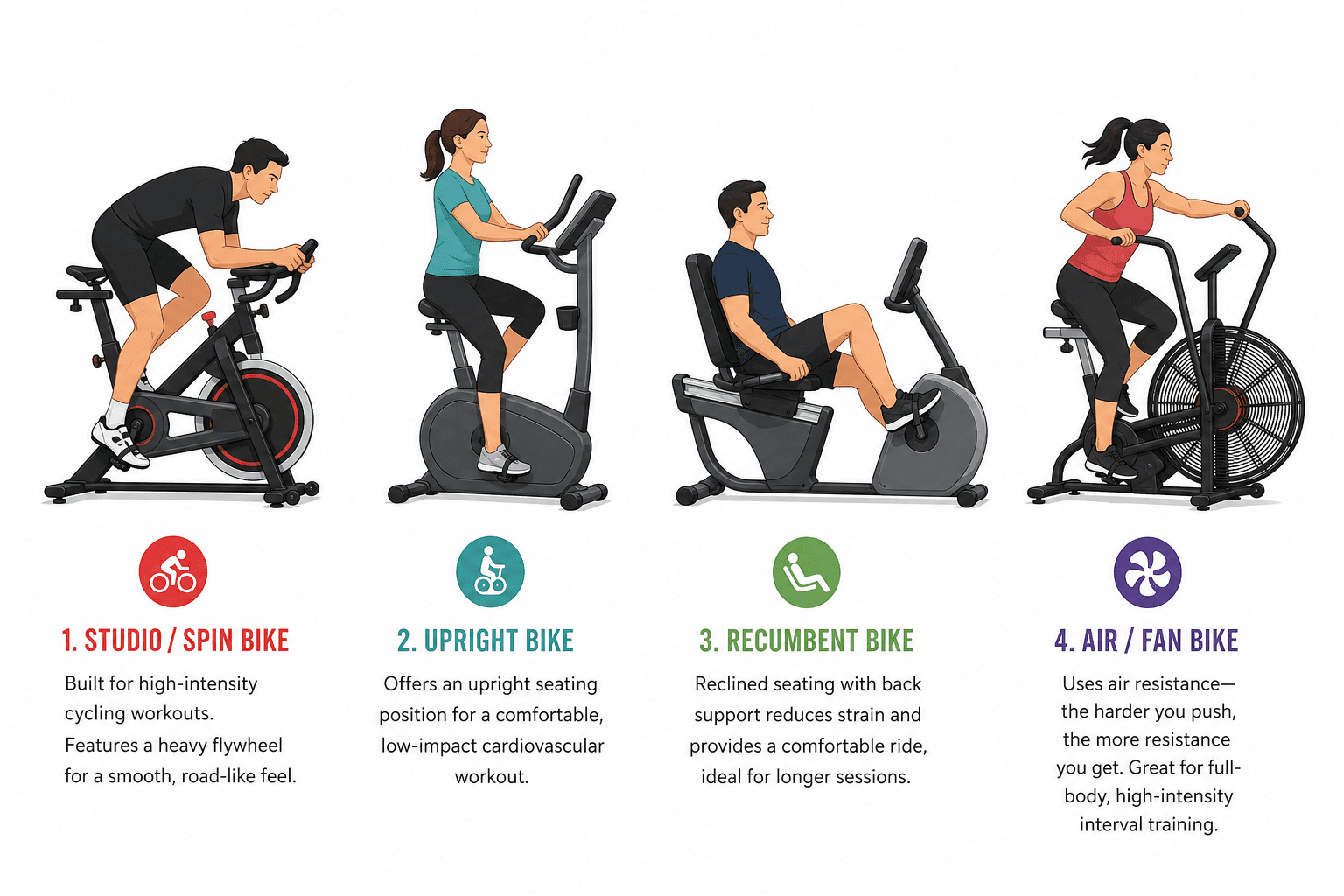
Spin / Studio Bikes
Spin bikes, also called studio cycles, mimic the geometry of a road bike. The rider leans forward over an exposed flywheel, and the pedals use a clipless or toe-cage system. Resistance comes from either a felt pad pressing against the flywheel (friction resistance) or a magnetic brake (magnetic resistance). Flywheel weights on quality spin bikes typically range from 30 to 50 pounds, which provides a smooth, road-like feel.
These bikes dominate the connected-fitness market. The Peloton Bike ($1,695, magnetic resistance, 297 lb weight capacity) and the Schwinn IC4 ($899–$999, magnetic, 330 lb capacity) are two of the most popular examples. Spin bikes are best for riders who want a cycling-specific workout, enjoy structured classes, and are comfortable in an aggressive forward-leaning position.
Upright Bikes
Upright bikes place the rider in a more vertical, casual posture compared to spin bikes. The seat is wider and more padded, and the handlebars are positioned higher and closer to the body. Resistance is almost always magnetic, and many upright bikes offer pre-programmed workout profiles and basic LCD consoles.
These bikes are a strong choice for general fitness, steady-state cardio, and riders who find the aggressive lean of a spin bike uncomfortable. The Yosuda Indoor Cycling Bike ($340, friction resistance, 270 lb capacity) and the Marcy Foldable Upright Exercise Bike ($162, magnetic, 250 lb capacity) represent the budget end of this category.
Recumbent Bikes
Recumbent bikes position the rider in a semi-reclined posture with a full seat and back support. The pedals are located in front of the rider rather than underneath, which reduces stress on the lower back, wrists, and shoulders. This design makes recumbents the most accessible type for people with chronic pain, mobility limitations, or those recovering from injury.
The Schwinn 290 ($999, magnetic, 25 resistance levels, 330 lb capacity) and the Sole LCR ($1,999.99, magnetic, 40 resistance levels, 350 lb capacity) are well-reviewed recumbent options. Recumbents are not ideal for high-intensity work — the seated position limits the ability to generate explosive power — but they excel at low-impact, sustained cardio sessions.
Air Bikes
Air bikes, also called fan bikes or Airdyne bikes, use a large fan blade for resistance. The harder you pedal, the more air resistance you generate — there is no maximum resistance level. Most air bikes also have moving handlebars that engage the upper body, making them the only bike type that provides a true full-body workout.
The Concept2 BikeErg ($1,100, air resistance, 350 lb capacity) and the Rogue Echo Bike ($945, air resistance) are the two most respected models in this category. Air bikes are loud — noise levels measure between 76 and 83 dB at high intensity — and they are best suited for HIIT, CrossFit-style conditioning, and riders who want maximum calorie burn in short sessions.
Decision Matrix: Match Your Goal to the Right Bike Type
The most reliable way to choose a bike type is to start with your primary training goal. Each type has inherent strengths and weaknesses that make it optimal for some activities and suboptimal for others.
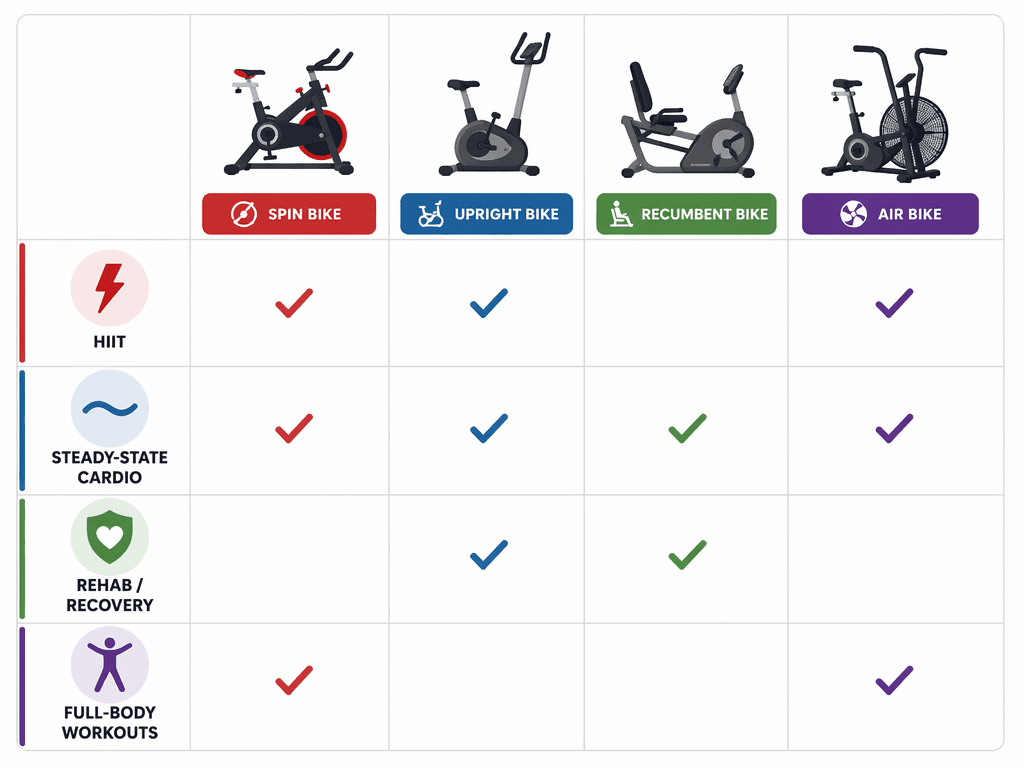
| Fitness Goal | Best Bike Type | Why It Excels | Weaknesses of Alternatives |
|---|---|---|---|
| HIIT / Interval Training | Air Bike | Resistance scales infinitely with effort; moving handlebars engage upper body for maximum calorie burn in short bursts. | Spin bikes lack upper-body engagement; recumbents cannot generate explosive power. |
| Steady-State Cardio / Endurance | Spin Bike | Smooth flywheel inertia mimics road cycling; comfortable for 45–90 minute sessions with proper bike shorts. | Air bikes are too loud and uncomfortable for long sessions; upright bikes lack the road-like feel. |
| Low-Impact Rehab / Back Support | Recumbent Bike | Full seat with lumbar support eliminates back and wrist strain; low joint stress allows pain-free movement. | Spin and upright bikes require forward lean that aggravates back issues; air bikes are too intense for rehab. |
| Full-Body Conditioning | Air Bike | Moving handlebars engage arms, shoulders, and core while legs pedal; only bike type that trains the whole body simultaneously. | All other bike types isolate the lower body only. |
If your goals span multiple categories — for example, you want both HIIT and steady-state cardio — consider which type you will use 70% of the time. A spin bike can handle moderate HIIT work, but an air bike is a poor choice for long endurance rides. Prioritize your dominant use case.
How Space, Budget, and Subscription Preferences Narrow Your Options
Once you have identified the bike type that matches your goal, three real-world filters will determine which specific models are worth your consideration: the physical space you have available, your budget ceiling, and whether you are willing to pay a monthly subscription for content.
| Filter | Spin / Studio | Upright | Recumbent | Air |
|---|---|---|---|---|
| Typical Footprint | 48–55" L x 21–25" W (~10–13 sq ft) | 31–45" L x 15–22" W (~6–10 sq ft) | 60–65" L x 28–30" W (~12–15 sq ft) | 48–52" L x 24–26" W (~8–10 sq ft) |
| Noise Level | Magnetic: ~47 dB; Friction: moderate | Magnetic: ~45–50 dB | Magnetic: ~45–50 dB | 76–83 dB at high intensity |
| Price Range | $300–$2,800 | $160–$1,000 | $210–$2,000 | $900–$1,100 |
| Subscription Required? | Many models (Peloton $50/mo, iFIT $39/mo, Echelon $40/mo) | Rarely; most are subscription-free | Optional on some models (JRNY $12/mo) | No; all major air bikes are subscription-free |
Subscription costs are often overlooked at the point of purchase. A Peloton Bike costs $1,695 upfront, but the $50 per month All-Access membership adds $1,800 over three years — more than the bike itself. The Schwinn IC4 costs $899–$999 and includes a two-month JRNY subscription ($12 per month after), which adds $360 over three years. The Concept2 BikeErg and Rogue Echo Bike have no subscription requirement at all.
Top Picks by Bike Type: Recommended Models
The following recommendations are based on expert reviews from Wirecutter, Garage Gym Reviews, BarBend, and Outdoor Gear Lab. Each model was selected for its combination of build quality, resistance performance, weight capacity, and value within its type.
| Bike Type | Recommended Model | Price | Resistance Type | Weight Capacity | Noise Level | Subscription |
|---|---|---|---|---|---|---|
| Spin / Studio | Schwinn IC4 | $899–$999 | Magnetic, 100 levels | 330 lbs | ~47 dB | Optional JRNY $12/mo |
| Spin / Studio | Peloton Bike | $1,695 | Magnetic | 297 lbs | ~47 dB | Required $50/mo |
| Upright | Yosuda Indoor Cycling Bike | $340 | Friction | 270 lbs | Moderate | None |
| Recumbent | Schwinn 290 | $999 | Magnetic, 25 levels | 330 lbs | ~47 dB | Optional JRNY $12/mo |
| Recumbent | Sole LCR | $1,999.99 | Magnetic, 40 levels | 350 lbs | ~47 dB | None |
| Air | Concept2 BikeErg | $1,100 | Air (fan) | 350 lbs | 76–83 dB | None |
| Air | Rogue Echo Bike | $945 | Air (fan) | N/A | 76–83 dB | None |
The Schwinn IC4 is the most versatile spin bike on the market. It offers magnetic resistance with 100 levels, Bluetooth connectivity for third-party apps like Zwift and Peloton, and a weight capacity of 330 pounds — all at roughly half the price of the Peloton Bike. Wirecutter has named it their top pick for multiple years running.
For recumbent riders, the Sole LCR stands out for its lifetime frame warranty and 350-pound weight capacity. It has no subscription requirement, and the free Sole+ app provides on-demand classes without a monthly fee. The Schwinn 290 is a strong alternative at roughly half the price, though it requires a $12 per month JRNY subscription for its connected features.
In the air bike category, the Concept2 BikeErg and Rogue Echo Bike are the two dominant models. The BikeErg is lighter (68 lbs) and uses the same PM5 monitor found on Concept2 rowers, making it the preferred choice for users who already track metrics from rowing. The Echo Bike is slightly heavier (123 lbs) and has a reputation for being nearly indestructible in commercial gym settings.
Total Cost of Ownership: Upfront Price vs. 3-Year Subscription Costs
The upfront price tag tells only part of the story. Subscription costs can double or triple the true cost of ownership over a few years. The table below shows the 3-year total cost for each recommended model, assuming the subscription is maintained for the full period.
| Model | Upfront Price | Monthly Subscription | 3-Year Subscription Cost | 3-Year Total Cost |
|---|---|---|---|---|
| Schwinn IC4 | $899–$999 | $12 (JRNY, optional) | $432 | $1,331–$1,431 |
| Peloton Bike | $1,695 | $50 (required) | $1,800 | $3,495 |
| Yosuda Indoor Cycling Bike | $340 | $0 | $0 | $340 |
| Schwinn 290 | $999 | $12 (JRNY, optional) | $432 | $1,431 |
| Sole LCR | $1,999.99 | $0 | $0 | $1,999.99 |
| Concept2 BikeErg | $1,100 | $0 | $0 | $1,100 |
| Rogue Echo Bike | $945 | $0 | $0 | $945 |
The gap between subscription-free and subscription-dependent bikes widens significantly over time. A Peloton Bike costs $3,495 over three years — more than triple the cost of a Concept2 BikeErg. Even the Schwinn IC4, which is often praised for its value, costs roughly $1,400 over three years if you maintain the JRNY subscription. If you are confident you will not use guided classes, the subscription-free options from Sole, Concept2, and Rogue offer the lowest total cost of ownership.
Quick-Reference Recommendation Table
Use this table as a final checkpoint before you start comparing specific models. It summarizes the entire decision framework in a single scannable view.
| Bike Type | Best For | Key Trade-Off | Top Pick | Starting Price |
|---|---|---|---|---|
| Spin / Studio | Cycling-specific training, structured classes, endurance rides | Requires forward-lean posture; many models require a subscription for full features | Schwinn IC4 | $899 |
| Upright | General fitness, steady-state cardio, casual riders | Less engaging than spin bikes; limited high-intensity capability | Yosuda Indoor Cycling Bike | $340 |
| Recumbent | Injury recovery, back pain, low-impact cardio, seniors | Larger footprint; not suitable for HIIT or standing climbs | Schwinn 290 | $999 |
| Air | HIIT, CrossFit, full-body conditioning, maximum calorie burn | Very loud; uncomfortable for sessions over 20–30 minutes | Concept2 BikeErg | $1,100 |
Next Steps: From Bike Type to Final Decision
By now you should have a clear answer to the question "Which type of exercise bike is best for me?" Your next step is to compare specific models within that type. The site's detailed comparison guides cover the top contenders in each category with full spec tables, real-world testing notes, and long-term durability assessments.
- Measure your available floor space and ceiling height before committing to a model. Recumbent bikes require the most length (60–65 inches), while upright and folding bikes are the most space-efficient.
- If possible, test the seat comfort of your chosen bike type at a local fitness equipment store. Seat comfort is the most common reason for bike abandonment, and it varies significantly between types and individual models.
- Factor in the full 3-year cost of ownership, not just the upfront price. A subscription-free bike at $1,100 may be cheaper over three years than a $900 bike with a $12 monthly subscription.
- Check the warranty terms. Industry standard is 10 years on the frame and 1–2 years on parts and labor. The Sole LCR and Horizon Fitness 5.0R offer lifetime frame warranties, which is a strong indicator of build quality.
Once you have narrowed your list to two or three models within your chosen type, read the individual reviews and comparison guides on this site for the detailed spec breakdowns, resistance feel comparisons, and real-world noise measurements that will confirm your final choice.
Comments
Join the discussion with an anonymous comment.