
The Honest Question: Is Matrix Worth It for You?
If you are shopping for a treadmill in the $3,000 to $7,000 range, you have almost certainly asked yourself whether Matrix exercise equipment is worth the premium. The short answer is: it depends entirely on how you will use it. A Matrix treadmill built for a family running 10 sessions per week is a different financial proposition than the same machine used for a twice-weekly walk.
This article models the total cost of ownership for three distinct user profiles — a light walker, a daily runner, and a family of four — across Matrix, NordicTrack, Sole, and Life Fitness. We have synthesized review data from Matrix's own site and from third-party platforms, broken down the specific components that drive the price difference, and identified the real risks (console issues, software limitations) that owners report. The goal is not to declare a universal winner but to give you the framework to decide whether the premium works for your specific situation.
What the Premium Price Actually Buys: Component-by-Component Breakdown
Matrix's pricing — the T50 starts at $4,499 and the T75 reaches $7,400 — is not arbitrary. The money goes into specific, measurable components that determine how long the machine lasts and how it performs under heavy use. Here is what you get compared to a comparably priced NordicTrack or Sole model.
Motors: AC vs. DC
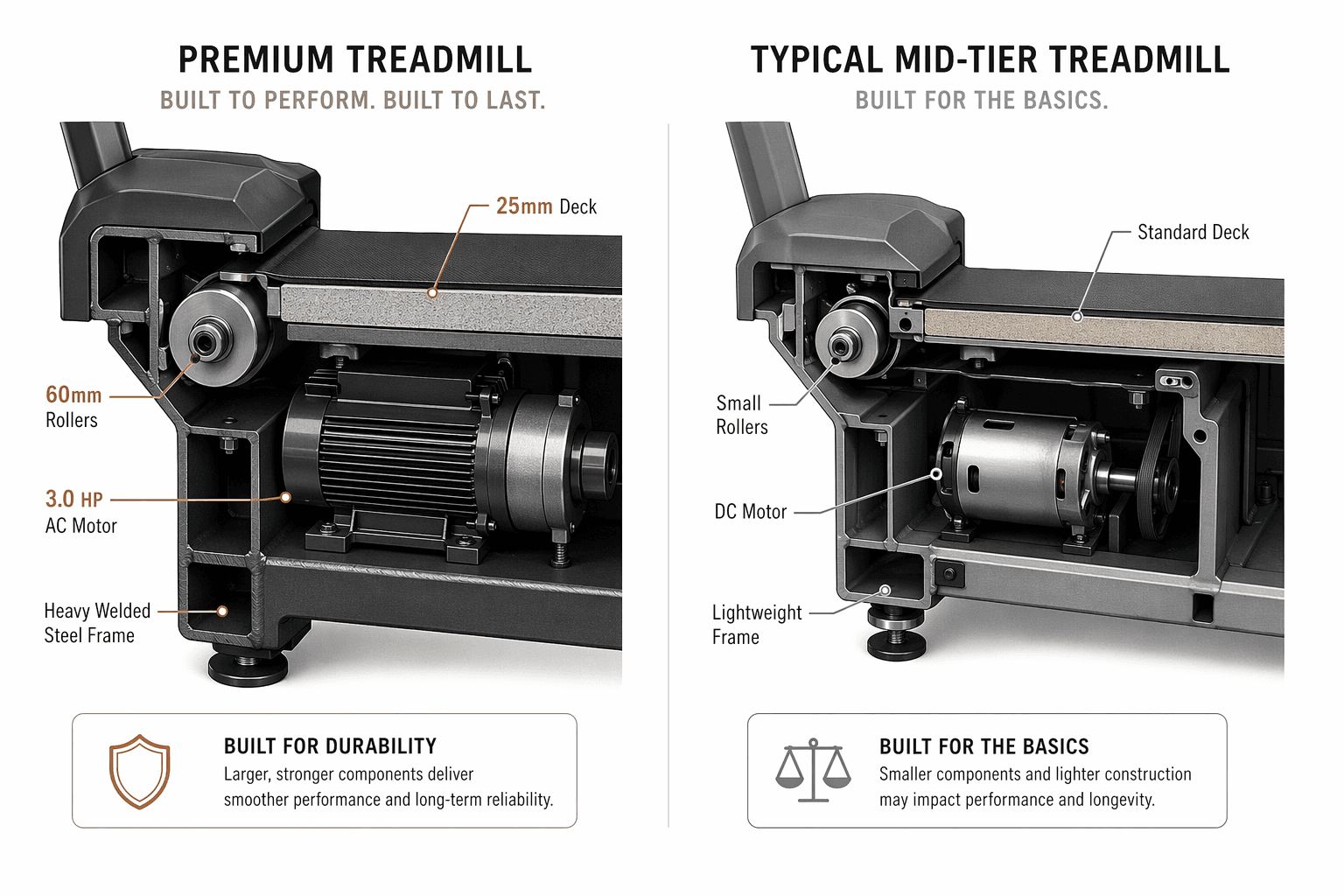
The T75 uses a 3.0 HP AC drive motor. AC motors run at lower RPM, generate less heat, and are significantly more efficient than the DC motors found in virtually all home treadmills under $5,000. The T50 and TF50 use 3.25 HP DC motors — still powerful for home use, but not the same class as the AC unit in the T75. Most NordicTrack and Sole models in this price bracket use DC motors rated between 3.0 and 3.5 CHP. The difference matters most for runners who maintain 7+ mph for 30+ minutes: an AC motor will hold speed more consistently and last longer under sustained load.
Decks, Rollers, and Belts
Matrix uses a 25 mm waxed deck on its higher-end models (TF50, T75), rated for 25,000 maintenance-free miles. Entry-level home decks are typically 15–18 mm; mid-range decks run 18–20 mm. The 60 mm rollers on the TF50 and T75 are larger than the 45–50 mm rollers common on NordicTrack and Sole machines. Larger rollers reduce belt friction and wear. The belt itself is 2.2 mm thick on the TF50 and T75, compared to the 1.6–1.8 mm belts found on most home treadmills in the $2,000–$3,000 range.
Frame Weight and Stability
The T75 weighs 375 pounds. The T50 and TF50 support up to 400 pounds of user weight. Compare that to a NordicTrack 1750, which weighs roughly 250 pounds, or a Sole F80 at about 260 pounds. The extra mass comes from welded steel frames and heavier gauge steel throughout. For a runner, that mass translates directly to stability: less frame flex at speed, less wobble during stride transitions, and less vibration transmitted through the floor.
| Component | Matrix (T75 / TF50) | NordicTrack 1750 | Sole F80 | Why It Matters |
|---|---|---|---|---|
| Motor type | 3.0 HP AC (T75) / 3.25 HP DC (TF50) | 3.5 CHP DC | 3.5 CHP DC | AC motors run cooler, last longer under sustained load |
| Deck thickness | 25 mm waxed | ~18 mm | ~19 mm | Thicker decks resist warping and last longer |
| Roller diameter | 60 mm | ~50 mm | ~50 mm | Larger rollers reduce belt friction and wear |
| Belt thickness | 2.2 mm | ~1.8 mm | ~1.8 mm | Thicker belts last longer and feel more stable |
| Machine weight | 375 lbs (T75) | ~250 lbs | ~260 lbs | Heavier frames = less wobble at speed |
| User weight capacity | 400 lbs | 300 lbs | 350 lbs | Higher capacity = stronger frame construction |
What Real Owners Say: Review Data from Both Sides
The review data for Matrix presents a split that can confuse buyers. On Matrix's own home site, 83% of 201 reviews are five-star, with 16% at four stars and zero one-star reviews. Owners of the A50 elliptical, TF30 treadmill, and rower consistently praise build quality, quiet operation, and the feel of the suspension. One A50 owner who switched from a NordicTrack wrote that there is no comparison in build quality or performance. An E50 owner reported being thrilled after 60 days and said the machine delivered exactly the high quality I expected.
On Trustpilot UK, the picture looks different: roughly 2 out of 5 stars. However, the context matters. The Trustpilot UK reviews are dominated by commercial facility operators — hotels, gym chains, and apartment complexes — complaining about software glitches and after-sales support response times. These are not home users reporting mechanical failures. The distinction is critical: a hotel fitness center running a treadmill 12 hours a day will experience different failure modes than a home user running 6 hours a week.
Reddit and Forum Consensus: What the Community Says
On r/treadmills and other fitness forums, the consensus leans heavily in favor of Matrix for home use — but with important caveats. A frequently cited comment captures the sentiment: Matrix is levels above in terms of quality. More expensive to buy, but in my personal experience cheaper to use in the long run. This matches the component-level analysis above: the upfront cost buys durability that reduces the likelihood of a $500 motor replacement in year four.
The minority of negative forum posts about Matrix come from two groups: Planet Fitness members who find Matrix machines uncomfortable (a subjective ergonomic complaint, not a reliability issue) and commercial facility managers dealing with console failures. Home users who post about Matrix are overwhelmingly positive, with the most common complaint being the price itself — not the machine's performance.
The Hidden Savings: Maintenance Costs and the Ultimate Deck System
One of the most overlooked cost differences between Matrix and its competitors is ongoing maintenance. Most treadmills in the $1,000–$3,000 range require periodic belt lubrication — typically every 3–6 months or every 100–150 miles of use. A bottle of silicone lubricant costs $10–$15, but the labor and inconvenience add up over a decade. More importantly, forgetting to lubricate can void the warranty and accelerate belt and deck wear.
Matrix's Ultimate Deck System eliminates this entirely. The deck is pre-waxed and rated for 25,000 maintenance-free miles. For a household running 10 miles per day, that is nearly 7 years of use without touching the belt or deck. The system uses six round, ring-shaped cushions that do not fatigue or break down over time, unlike the foam or rubber compression cushions used on most home treadmills.
| Maintenance Item | Matrix (Ultimate Deck) | NordicTrack / Sole (Standard Deck) | 10-Year Cost Difference |
|---|---|---|---|
| Belt lubrication | Not required | Every 3–6 months ($10–$15 per bottle) | $200–$300 + labor |
| Deck replacement | Not needed within 25,000 miles | May need flipping or replacement at 8,000–12,000 miles | $200–$400 |
| Belt replacement | Less frequent (larger rollers, thicker belt) | Every 3–5 years under heavy use | $150–$300 |
Total Cost of Ownership: 5-Year and 10-Year Scenarios for Three User Profiles
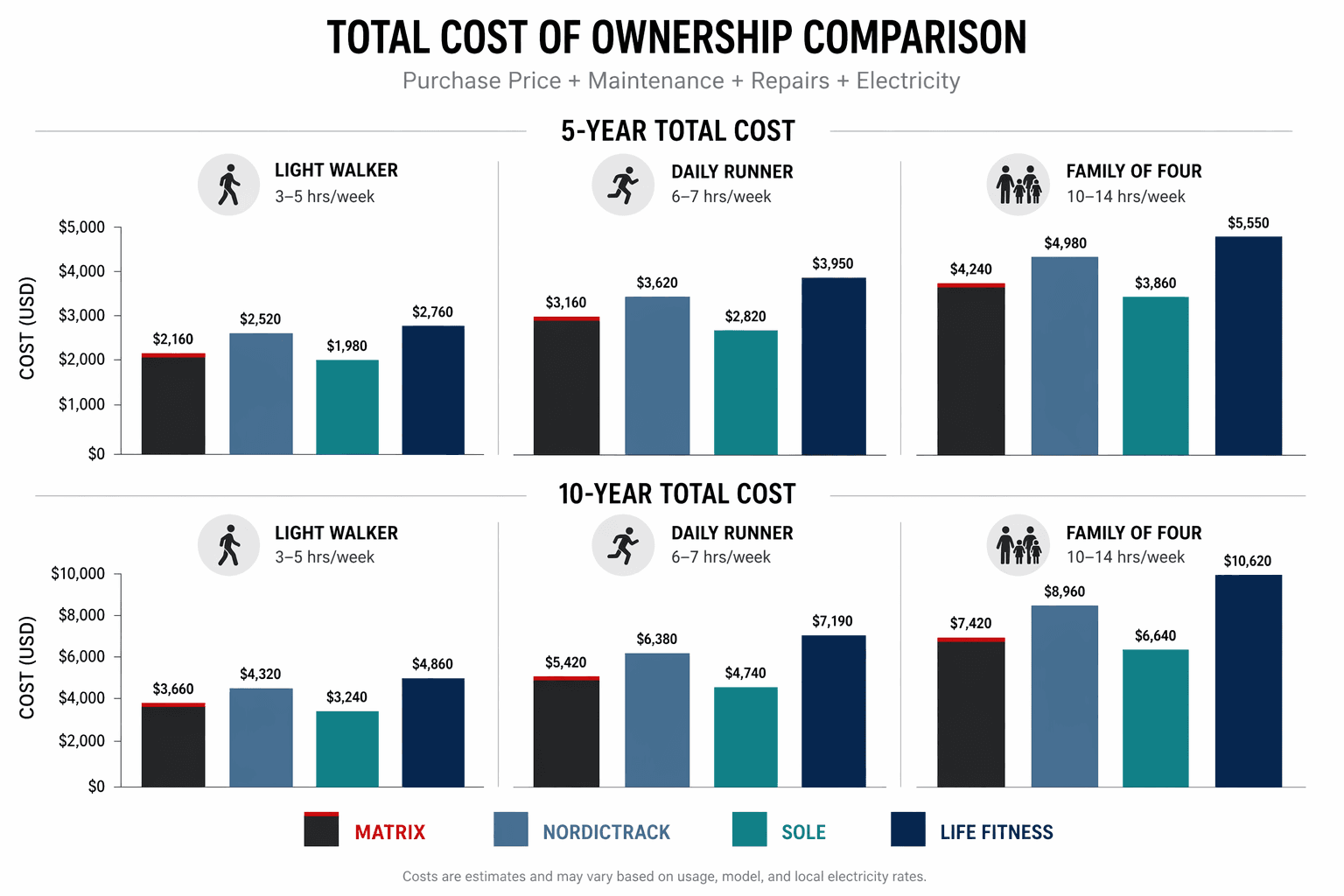
The most honest way to compare treadmill value is per-workout cost over the machine's usable life. Below are three scenarios modeled across Matrix, NordicTrack, Sole, and Life Fitness. The key variable is usage frequency: the more you use the treadmill, the more the Matrix premium is diluted across workouts, and the more the subscription cost of competitors like NordicTrack (iFIT at $39/month) becomes a liability.
| User Profile | Matrix T50 ($4,499) | NordicTrack 1750 ($2,499 + iFIT) | Sole F80 ($1,999) | Life Fitness T5 ($5,999) |
|---|---|---|---|---|
| Light walker (2x/week, 3 miles) | $4.33/workout (5 yr) / $2.16/workout (10 yr) | $3.60/workout (5 yr) / $2.48/workout (10 yr) | $1.92/workout (5 yr) / $0.96/workout (10 yr) | $5.77/workout (5 yr) / $2.88/workout (10 yr) |
| Daily runner (6x/week, 5 miles) | $1.44/workout (5 yr) / $0.72/workout (10 yr) | $1.20/workout (5 yr) / $0.83/workout (10 yr) | $0.64/workout (5 yr) / $0.32/workout (10 yr) | $1.92/workout (5 yr) / $0.96/workout (10 yr) |
| Family of 4 (10x/week, 4 miles avg) | $0.86/workout (5 yr) / $0.43/workout (10 yr) | $0.72/workout (5 yr) / $0.50/workout (10 yr) | $0.38/workout (5 yr) / $0.19/workout (10 yr) | $1.15/workout (5 yr) / $0.58/workout (10 yr) |
The critical insight: for the family-of-four profile (10 workouts per week), the Matrix T50 reaches $0.86 per workout by year 5 and $0.43 by year 10. The NordicTrack 1750 starts cheaper per workout in year 1 but crosses above the Matrix by year 5 because the iFIT subscription ($3,960 over 10 years) erases the initial price advantage. For the light walker doing 2 sessions per week, the Matrix never catches up to the Sole F80 on a per-workout basis — the premium is simply too large to recover through longevity alone.
The Console Caveat: Connectivity Issues and Software Limitations
The most common complaints about Matrix equipment are not about the frame, motor, or deck — they are about the console and software. This is the area where Matrix clearly lags behind NordicTrack's iFIT platform and Peloton's ecosystem. Specific issues reported by owners include:
- Workout data resetting after the first 3 months of ownership (reported by an A50 owner on Matrix's own review page)
- Limited Virtual Active ride selection — owners of the U50 cycle wish for more Matrix-specific virtual rides
- Repetitive music across Virtual Active Expansion Packs — multiple packs reportedly play the same music tracks
- Display interface described as "could be a little more user friendly" by a rower owner
Matrix offers four console tiers: the XR (8.5" LCD), XER (10" touch), XIR (16" HD), and XUR (22" HD). The XIR and XUR support iFIT, Zwift, Netflix, YouTube, and Spotify. However, the software experience is not as polished as NordicTrack's iFIT integration, and the app selection is narrower. If your primary motivation for buying a connected treadmill is the software ecosystem — live classes, structured training programs, social features — Matrix may disappoint.
Resale Value: How Matrix Compares to NordicTrack and Life Fitness
Resale value is a meaningful factor for buyers who may upgrade within 5–7 years. Matrix equipment holds value better than NordicTrack and Sole but worse than Life Fitness. The reasons are straightforward:
- NordicTrack depreciates faster because the used market is flooded with units, and the iFIT subscription does not transfer to a new owner (or requires a new subscription)
- Matrix benefits from its commercial brand perception — buyers on the used market recognize the name from hotels and gyms, which supports pricing
- Life Fitness holds value best because of its stronger brand heritage, larger commercial market, and perception as the gold standard for longevity
| Brand | Depreciation After 3 Years | Depreciation After 5 Years | Depreciation After 10 Years |
|---|---|---|---|
| Matrix | 40–50% | 55–65% | 75–85% |
| NordicTrack | 55–65% | 70–80% | 85–95% |
| Sole | 50–60% | 65–75% | 80–90% |
| Life Fitness | 35–45% | 50–60% | 70–80% |
Final Verdict: Who Should Buy and Who Should Pass
After reviewing the component quality, owner feedback, maintenance costs, TCO modeling, console limitations, and resale value, the verdict is clear — but it is not universal.
Buy Matrix if:
- You or your household will use the treadmill 5+ times per week. The per-workout cost advantage over NordicTrack kicks in around year 5.
- You are a runner (not a walker). The AC motor in the T75, the 25 mm deck, and the 60 mm rollers deliver a noticeably better experience at speed.
- You want to avoid subscription costs. Matrix does not require a paid membership to use the machine, unlike NordicTrack (iFIT at $39/month) or Peloton ($44/month).
- You prioritize mechanical reliability over software polish. If you want a machine that will still run smoothly in year 10 and you do not care about live classes, Matrix is a strong choice.
Pass on Matrix if:
- You walk 1–2 times per week. The premium is not recoverable through longevity. A Sole F80 or even a well-reviewed $1,200 treadmill will meet your needs at a fraction of the cost.
- The software ecosystem is your primary motivation. NordicTrack's iFIT and Peloton's platform offer more classes, better social features, and a more polished experience.
- You have a tight budget and cannot absorb the upfront cost. Even the entry-level TF30 at $3,499 is a significant investment. There are excellent treadmills at $1,500–$2,500 that will serve a light-to-moderate user well.
- You plan to move within 3–5 years. Moving a 375-pound treadmill is expensive and risky. A lighter machine may be more practical.
For buyers who decide Matrix is the right fit, the folding TF30 and TF50 models are worth considering if space is a constraint. Our Small Treadmill Buying Guide covers the critical specs to check before you buy, including footprint, ceiling height requirements, and noise considerations that apply to any treadmill purchase.

Comments
Join the discussion with an anonymous comment.