
Compact Home Gym Tech Showdown: Digital Resistance vs. Weight Stacks vs. Bands vs. Plate-Loaded
We compare four resistance technologies—digital, weight stacks, bands, and plate-loaded cables—head-to-head on feel, max load, footprint, and total cost to help small-space buyers choose the right system for their training style.
Why Resistance Type Matters More Than Brand or Price
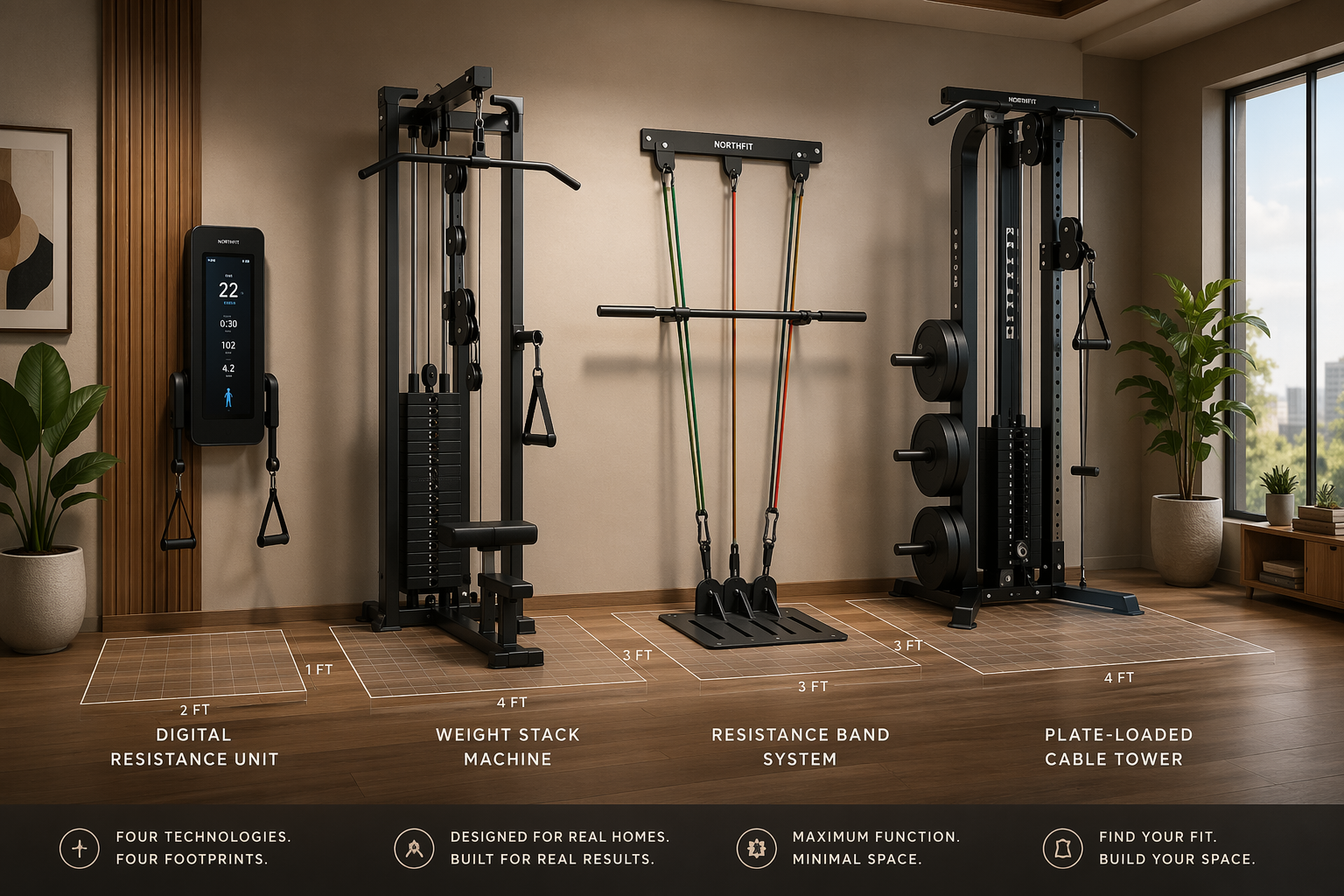
When you start shopping for a compact home gym, the first thing you notice is the price spread — a system can cost anywhere from $549 to over $4,000. The second thing you notice is the footprint range, from a 10" x 19" floor mat to a machine that occupies nearly 40 square feet. But the variable that actually determines whether you'll stick with your purchase a year from now is the resistance technology inside the box.
Most reviews and buyer guides treat digital resistance, weight stacks, resistance bands, and plate-loaded cables as interchangeable solutions to the same problem: "I need to lift weights at home." They are not interchangeable. Each technology delivers a fundamentally different feel during the lift, a different pattern of progressive overload, a different ceiling on max load, and a different relationship with maintenance and long-term cost. Choosing the wrong one for your training style means living with a compromise that no amount of brand loyalty or sale price can fix.
The Four Resistance Technologies: A Quick Overview
Before we compare them head-to-head, here is what each technology is, how it works, and which type of buyer it typically attracts.
- Digital / Electromagnetic Resistance: Uses an electromagnetic motor to create resistance digitally. The user selects a weight via a touchscreen or app, and the motor applies that resistance through cables or arms. Examples include the Tonal 2 ($4,295, 250 lbs max) and the Speediance Gym Monster (~$3,199, 220 lbs max). Appeals to tech-savvy users who want guided workouts, minimal footprint, and the convenience of 1-lb weight increments.
- Selectorized Weight Stacks: The traditional gym machine approach — a stack of rectangular iron plates connected by a cable-and-pulley system. You insert a pin to select the weight. Examples include the Major Fitness B17 ($4,199, expandable to 260 lbs per side) and the Titan Fitness Functional Trainer ($2,999, dual 200-lb stacks). Appeals to traditional lifters who want a familiar gym feel and don't mind a larger footprint.
- Resistance Bands: Heavy-duty elastic bands attached to a base platform or bar. The X3 Bar ($549) is the best-known example, offering 300–600 lbs of resistance from a 10" x 19" floor mat. Appeals to minimalist strength athletes who prioritize resistance-to-space ratio and don't need fine-grained weight progression.
- Plate-Loaded Cables: A cable tower or functional trainer frame that requires you to load your own Olympic weight plates onto a sleeve. The Bells of Steel All-in-One Home Gym (starting at $1,299, 300 lbs cable capacity) is a prime example. Appeals to value-conscious buyers who already own plates and want commercial-grade cable movement without paying for a built-in stack.
Head-to-Head: Feel, Progression Granularity, and Max Load
These three performance dimensions — how the resistance feels, how precisely you can increase it, and how high it goes — are the core of the training experience. A machine that feels wrong on the eccentric phase or jumps 10 lbs between increments will frustrate you regardless of how small its footprint is.
| Dimension | Digital (Tonal 2 / Speediance) | Weight Stacks (Major Fitness B17) | Bands (X3 Bar) | Plate-Loaded (Bells of Steel All-in-One) |
|---|---|---|---|---|
| Resistance feel | Smooth, consistent electromagnetic tension; variable eccentric (Tonal 2 offers eccentric mode) | Mechanical cable-and-pulley; consistent linear resistance through full ROM | Exponential tension curve — hardest at top of movement, easiest at bottom | Mechanical cable; consistent linear resistance, similar to weight stacks |
| Weight increments | 1-lb increments (digital precision) | 5–10 lb jumps per pin position | Not incremental — band tension varies by stretch length and band combination | 2.5–5 lb jumps (limited by plate availability) |
| Max resistance (total) | Tonal 2: 250 lbs; Speediance: 220 lbs | 260 lbs per side (expandable); Titan: 200 lbs per side | 300 lbs (standard); 600 lbs (elite band) | 300 lbs cable capacity |
| Eccentric overload | Yes (digital eccentric mode on Tonal 2) | No (gravity-driven) | No (band tension is highest at peak contraction) | No (gravity-driven) |
| Progressive overload method | App-based increments; auto-adjustment in guided programs | Manual pin change; stack upgrades available | Add or swap bands; limited granularity | Add or remove plates |
The feel difference is most pronounced on the eccentric (lowering) phase. Digital resistance systems like the Tonal 2 can apply eccentric overload — the motor pushes back harder as you lower the weight — which is a proven stimulus for muscle growth that no purely mechanical system can replicate. Weight stacks and plate-loaded cables provide a consistent, predictable resistance curve that feels identical to commercial gym equipment. Bands have an exponential curve: the resistance is lightest at the bottom of a squat or press and heaviest at the top, which changes the muscle recruitment pattern compared to constant-tension systems.
For progression granularity, digital systems win decisively. Being able to add 1 lb at a time is valuable for intermediate lifters who have stalled on 5-lb or 10-lb jumps. Weight stacks typically force 5–10 lb increments, though some machines allow fractional pin modifications. Band systems offer no granularity at all — you are limited to the discrete resistance levels of the bands you own. Plate-loaded systems fall in the middle: you can add 2.5-lb plates, but the practical minimum jump is limited by the plates you have on hand.
Total Cost of Ownership: Upfront Price, Subscriptions, and Hidden Fees
The purchase price is only the beginning. Subscription costs, required accessories, and replacement parts can double or triple the effective cost of a system over five years. The table below shows the real cost picture for each resistance type.
| System | Upfront Price | Subscription | 5-Year Total (Est.) | Hidden Costs |
|---|---|---|---|---|
| Tonal 2 | $4,295 ($3,545 on sale) | $59.95/month | $7,892 | Installation ($250–$500); wall reinforcement if needed |
| Speediance Gym Monster | $3,199 | None | $3,199 | None (all features unlocked) |
| Bowflex Xtreme 2 SE | $1,499 | None | $1,499 | Optional rod upgrade to 410 lbs ($200–$300) |
| Major Fitness B17 | $4,199 | None | $4,199 | Weight stack expansion (cost varies) |
| X3 Bar | $549 | None | $549 | Replacement bands ($30–$60 every 1–2 years) |
| Bells of Steel All-in-One | $1,299 (starting) | None | $1,299 + plates | Weight plates ($300–$800 for a full set) |
| Bells of Steel Cable Tower | $434 (starting) | None | $434 + plates | Weight plates; optional weight stack upgrade |
The subscription question is the single most divisive factor in the compact home gym market. Tonal 2 requires a $59.95/month membership to access its guided programs, auto-spot, and progressive overload algorithms. Speediance, by contrast, offers full functionality with no subscription — a significant differentiator for buyers who want to own their equipment outright. The X3 Bar, Bowflex Xtreme 2 SE, Major Fitness B17, and Bells of Steel systems have no subscription requirements, making them true one-time purchases.
Plate-loaded systems have a hidden cost that is easy to overlook: weight plates. A set of bumper plates or iron plates for a 300-lb cable stack costs $300–$800 depending on brand and material. If you already own plates, this is a non-issue. If you are starting from scratch, factor plate cost into your budget. The Bells of Steel All-in-One starts at $1,299, but a complete setup with 300 lbs of plates brings the total closer to $1,800–$2,000.
Real-World Footprint: How Much Space Does Each System Actually Need?
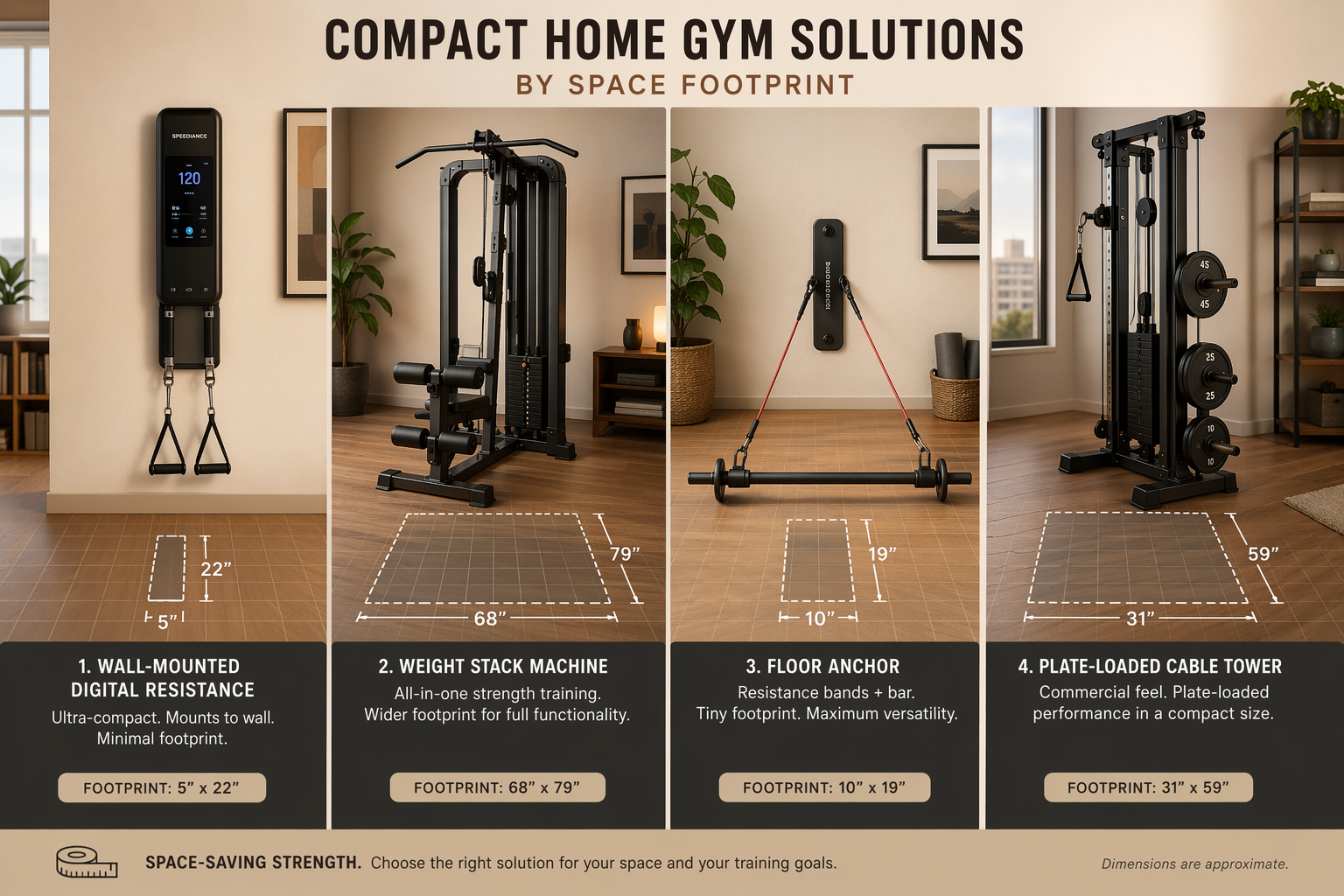
Footprint is the second-most-common dealbreaker after price, and the differences between resistance types are dramatic. The table below shows actual tested dimensions from manufacturer specs and independent reviews.
| System | Dimensions (D x W x H) | Floor Space (sq ft) | Wall-Mounted? | Folding / Storable? |
|---|---|---|---|---|
| Tonal 2 | 5.25"D x 21.5"W x 50.9"H | ~0.8 sq ft (wall) | Yes | N/A (permanently mounted) |
| Speediance Gym Monster | 49.2"L x 28.3"W x 72.8"H (open); folds to 14.96" deep | ~9.7 sq ft (open); ~3.3 sq ft (folded) | No | Yes (folds to 14.96" deep) |
| Major Fitness B17 | 68.1"D x 78.7"W x 88.1"H | ~37.2 sq ft | No | No |
| X3 Bar | 10"L x 19"W x 1"H (mat) | ~1.3 sq ft | No | Yes (portable, 17 lbs) |
| Bells of Steel All-in-One | 54.6"D x 59"W x 81"H | ~22.4 sq ft | No | No |
| Bells of Steel Cable Tower | 31"D x 28.5"W x 80.75"H | ~6.1 sq ft | No | No |
| PRx Profile PRO (rack) | Folds to 9–12" from wall | ~0 sq ft (when folded) | Yes | Yes (folds to 4" from wall) |
The average home gym occupies roughly 39" x 40" of floor space, according to Garage Gym Reviews' testing of over 50 machines. That is about 10.8 sq ft — roughly the footprint of a Speediance in its open position. The Major Fitness B17 at 37 sq ft is more than three times that average, which means it realistically requires a dedicated room or a large garage bay. The X3 Bar at 1.3 sq ft can fit in a closet or under a bed.
Wall-mounted systems like the Tonal 2 and the PRx Profile PRO offer the most efficient use of space because they occupy zero floor area when not in use. The Tonal 2 protrudes only 5.25 inches from the wall. The PRx Profile PRO folds to 9–12 inches from the wall. For apartment dwellers who cannot dedicate permanent floor space to a gym, these are the only realistic options among the four resistance types.
Durability and Maintenance: What Breaks and What Lasts
Long-term reliability is the dimension that most online reviews gloss over, yet it determines whether your $4,000 investment is still functional in year five or sitting in a corner with a broken screen. Each resistance technology has a different failure profile.
| System | Warranty | Known Failure Points | Expected Lifespan | Maintenance Required |
|---|---|---|---|---|
| Tonal 2 | 2-year limited | Touchscreen, motor, cable tension sensor, Wi-Fi connectivity | 5–8 years (electronics-dependent) | Software updates; cable replacement every 2–3 years |
| Speediance Gym Monster | 2-year limited | Motor, control board, cable pulley system | 5–8 years (electronics-dependent) | Software updates; cable replacement every 2–3 years |
| Major Fitness B17 | 1-year limited | Cable fraying, pulley wear, pin selector mechanism | 10–15 years (mechanical) | Cable replacement every 3–5 years; lubricate pulleys |
| Titan Fitness Functional Trainer | 1-year limited | Cable fraying, pulley wear, weight stack guide rods | 10–15 years (mechanical) | Cable replacement every 3–5 years; lubricate guide rods |
| X3 Bar | 5-year bar / 1-year bands | Band degradation (UV, heat, repeated stretching) | Bar: lifetime; bands: 1–3 years | Replace bands every 1–2 years with regular use |
| Bells of Steel All-in-One | Limited lifetime (frame) | Cable fraying, pulley wear, plate sleeve corrosion | 15–20 years (frame); 3–5 years (cables) | Cable replacement every 3–5 years; lubricate pulleys |
| Bells of Steel Cable Tower | Limited lifetime (frame) | Cable fraying, pulley wear | 15–20 years (frame); 3–5 years (cables) | Cable replacement every 3–5 years |
Band-based systems like the X3 Bar have the simplest maintenance profile: replace the bands every 1–2 years. The bar itself is warrantied for 5 years and will likely outlast the owner. However, band degradation is accelerated by UV exposure, heat, and frequent use. If you store the X3 Bar near a window or in an uninsulated garage, expect to replace bands more frequently.
Weight stack and plate-loaded systems are the most repairable. Cables are a standard consumable — any gym equipment repair shop can replace them for $50–$100. Pulleys and guide rods may need occasional lubrication but rarely fail. The frame warranties from Bells of Steel (limited lifetime) and Bowflex (7-year machine, 5-year rod) reflect the confidence manufacturers have in mechanical durability.
Which Resistance Type Fits Your Training Style?
The right resistance technology depends on what you want to accomplish in the gym. A powerlifter training for a 500-lb deadlift has fundamentally different needs than a general fitness enthusiast following guided workouts three times per week. The decision matrix below maps each resistance type to a training goal.
| Training Goal | Best Resistance Type | Why | Recommended System (Example) |
|---|---|---|---|
| Powerlifting / Strength (high loads, barbell movements) | Plate-loaded | Highest max load potential (300+ lbs cable); compatible with barbell and rack attachments; no electronic failure points | Bells of Steel All-in-One + separate barbell and plates |
| Bodybuilding / Hypertrophy (isolation, consistent tension) | Weight stacks | Consistent linear resistance through full ROM; easy to change weight between sets; familiar gym feel | Major Fitness B17 or Titan Fitness Functional Trainer |
| General Fitness / Guided Programs (convenience, variety) | Digital / Electromagnetic | Smallest footprint; 1-lb increments; guided programs with auto-progression; eccentric overload mode | Tonal 2 (if subscription is acceptable) or Speediance (no subscription) |
| Strength-to-Weight Ratio / Minimalist (max resistance, min space) | Resistance Bands | 300–600 lbs from a 1.3 sq ft mat; portable (17 lbs); lowest total cost of ownership | X3 Bar |
| Budget Value (lowest cost per lb of resistance) | Plate-loaded | Starting at $434 (Cable Tower) + plates; limited lifetime warranty; modular and expandable | Bells of Steel Cable Tower + existing plates |
For powerlifters and strength athletes, the plate-loaded route is the only option that supports the loads required for meaningful progressive overload in compound lifts. A 250-lb digital system like the Tonal 2 is insufficient for a lifter who can squat 315 lbs. The Bells of Steel All-in-One, with its 300-lb cable capacity and compatibility with barbell attachments, provides a path to heavier loads without requiring a full power rack.
For bodybuilders and hypertrophy-focused lifters, weight stacks offer the most familiar and effective training experience. The consistent cable tension through the full range of motion is ideal for isolation exercises like triceps pushdowns, lat pulldowns, and cable crossovers. The Major Fitness B17's expandable stacks (up to 260 lbs per side) provide room to grow without needing to buy additional plates.
For general fitness seekers who value convenience and guided programming, digital resistance is the strongest contender. The Tonal 2's AI-powered progressive overload and eccentric mode provide training stimuli that are difficult to replicate with mechanical systems. The subscription cost is the main drawback — if you want the digital experience without the monthly fee, the Speediance Gym Monster is the better choice.
For minimalist strength training, the X3 Bar's resistance-to-space ratio is unmatched. At 300–600 lbs of resistance from a 1.3 sq ft mat, it is the only system on this list that can genuinely fit in a closet. The trade-off is the exponential band tension curve and the lack of fine-grained progression — you cannot add 2.5 lbs to a band.
The Verdict: Choose by Training Style, Not by Price Tag
No single resistance technology is universally superior. The best compact home gym for you is the one whose resistance type matches how you train, not the one with the lowest price or the smallest footprint.
- Choose digital resistance (Tonal 2, Speediance) if you are a tech-savvy general fitness seeker who values guided programs, 1-lb increments, and the smallest possible footprint. Accept that you are paying a premium for convenience and, in Tonal's case, a monthly subscription.
- Choose weight stacks (Major Fitness B17, Titan Fitness) if you are a traditional lifter who wants a familiar gym feel, consistent cable tension, and the ability to train with heavy isolation movements. Be prepared to dedicate 30–40 sq ft of floor space.
- Choose resistance bands (X3 Bar) if you are a minimalist strength athlete who prioritizes resistance-to-space ratio above all else and does not need fine-grained weight progression. This is the most portable and lowest-cost option.
- Choose plate-loaded cables (Bells of Steel All-in-One, Cable Tower) if you are a value-conscious buyer who already owns weight plates, wants commercial-grade cable movement, and plans to keep the system for 10+ years. This is the most repairable and upgradeable option.
If you are still deciding between a single all-in-one machine and a modular setup with separate components, our all-in-one vs. custom gym cost-benefit analysis breaks down the trade-offs. For readers weighing smart features against traditional equipment, the smart vs. traditional comparison covers the subscription and technology considerations in more depth.
This result comes from one real apartment under the stated conditions — it is a strong signal, not a guarantee your space will measure identically.
Builds this evidence supports
Cable Machine Alternatives That Save Space and Money
Compare the best cable machine alternatives for home gyms – from resistance bands and pulley systems to suspension trainers and compact digital units – and find the right option for your space and budget.
How to Choose a Compact Home Gym That Works for Your Space, Budget, and Noise Tolerance
This article provides a structured decision framework for apartment dwellers and small-space residents to match their specific floor footprint, noise sensitivity, and budget to the most suitable compact home gym strategy — whether that's an all-in-one machine, modular build, smart digital system, or band/bodyweight setup.
The Garage Gym Reality Check: What Equipment Actually Fits in a Single-Car Garage
Most garage gym guides assume a two-car space. This article uses real dimensions, real equipment footprints, and three layout templates to show what fits—and what doesn't—in a single-car garage (10x20 to 12x20 ft).
Spot something off?
If this result didn't match your own space, let us know — floor-damage and noise claims carry real deposit-risk consequences if we get them wrong.