
Why 'Home Gym System' Is a Confusing Label
Search for a home gym system and you will find a wall-mounted digital machine, a selectorized multi-station unit, a power rack loaded with plates, a dual-cable functional trainer, and a bag of resistance bands — all described with the same phrase. These are not variations of the same product. They are five fundamentally different equipment categories that serve different training goals, require different floor space, and carry very different long-term costs.
This label problem causes a specific and expensive mistake: buyers compare products across system types as if they are competing alternatives. A $3,749 smart gym and a $1,200 functional trainer are not competing on the same axis. One is a technology-driven coaching platform; the other is a cable-pulley resistance tool. Evaluating them side by side without first understanding what type of system each one is leads to purchases that do not match the buyer's actual space, budget, or training needs.
The correct purchase sequence is: identify your constraint axes first, select the right system type, then compare products within that type. Choosing the wrong system type is more costly than choosing the wrong brand — because a mismatched system type cannot be fixed by upgrading to a better model within the same category.
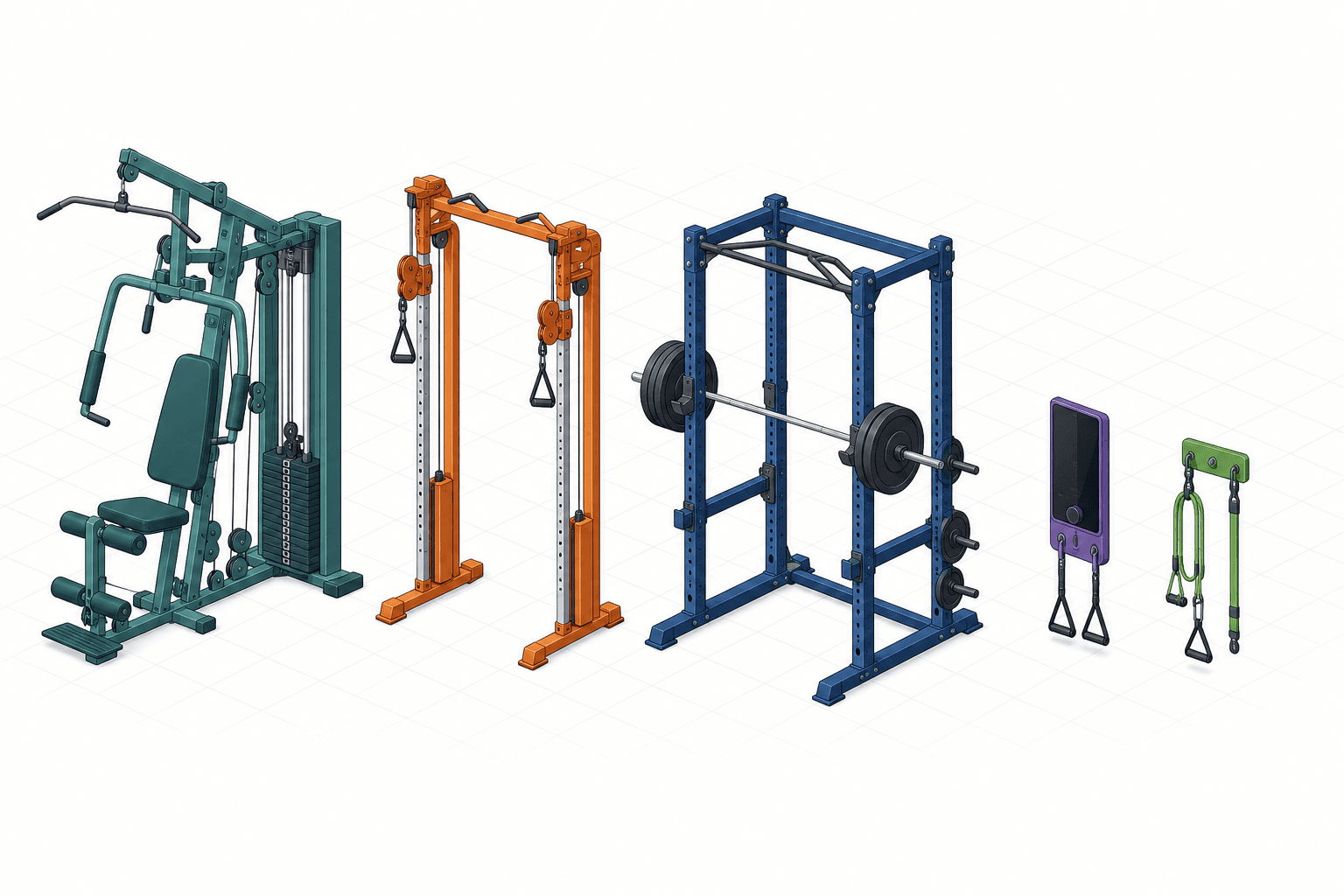
The Five Home Gym System Types Defined
Before applying any constraint filters, you need a clear definition of each system type. The taxonomy below is based on how each type works mechanically, what training style it optimizes for, and who it is genuinely suited to — not on marketing categories.
1. All-in-One Multi-Station Selectorized Machine
A selectorized multi-station machine consolidates multiple guided exercise stations — chest press, lat pulldown, leg extension, cable pulley, and others — into a single frame with one or more weight stacks. You select resistance by inserting a pin into the stack. The movement path is guided by the machine's mechanics.
The defining safety advantage of this type is that if you reach muscle failure, you simply release the handles and the weight returns safely to the stack. No spotter required. This makes it the most accessible system type for beginners training alone.
The trade-off is footprint. A standard multi-station unit typically requires an area of around 7 by 10 feet — often the largest floor requirement of any system type. No subscription cost is involved.
2. Functional Trainer / Cable Machine
A functional trainer uses two independently adjustable cable columns — each with a pulley that can be positioned at different heights — to create a wide range of movement patterns. Unlike the fixed stations of a selectorized machine, a functional trainer gives you open-ended cable freedom: you choose the angle, the attachment, and the movement path.
This type offers the best exercise variety per square foot of any non-barbell system. Standard footprints run 18 to 25 square feet, with some compact models coming in under 14 square feet. Price range spans roughly $435 to $6,000, with most full-size models in the $2,500 to $3,500 range. No subscription required.
The functional trainer asks more of the user than a selectorized machine. You need to understand which attachment to use, where to set the pulley height, and how to structure a session. It rewards intermediate trainees who already have a training framework; it can feel directionless for beginners.
3. Power Rack + Barbell Setup
A power rack is a four-post steel cage with adjustable safety bars that allows you to perform free-weight barbell movements — squat, bench press, overhead press, deadlift — without a spotter. The bar path is fully controlled by the lifter. This is the system type with the highest long-term strength ceiling.
A Smith machine is a related but distinct option: it guides the barbell on fixed vertical or slightly angled rails, which reduces the balance and technique demand. This makes it more accessible for solo training and for beginners who want to build confidence under load. The trade-off is a restricted, non-natural bar path that limits how well the movement transfers to free-weight lifting.
Both variants have zero subscription cost. A power rack has a cleaner footprint and a more direct upgrade path for serious barbell training. A Smith machine station often combines rails, cables, a pull-up bar, and storage in one unit, which can make it a more practical all-in-one for a constrained space.
4. Smart / Digital Gym
Smart gyms replace mechanical weight stacks with digitally controlled resistance — typically electromagnetic or motor-driven — and pair the hardware with a software platform that delivers guided workouts, AI coaching, and progress tracking. The two primary examples in 2026 are the Tonal 2 (wall-mounted, $4,295 hardware) and the Speediance Gym Monster 2 (freestanding, from $3,749).
The defining characteristic of this system type is that the hardware and the software platform are designed as a single product. The footprint is small — typically 40 to 49 square feet of clear floor space, with the Tonal unit itself wall-mounted at under 22 inches wide. The resistance ceiling is lower than a power rack or heavy functional trainer.
The subscription cost is the variable that most differentiates smart gyms from every other system type, and it varies significantly between products. This is covered in detail in the total cost of ownership section below.
5. Resistance Band System
Resistance band systems — whether loop bands, tube bands with handles, or door-anchor kits — are the only true zero-footprint option in this taxonomy. They store in a bag, require no dedicated floor space, and can be used in any room. No subscription, no installation, and entry-level cost is under $50.
The real constraint with bands is the upper resistance limit. For beginners and for mobility, rehabilitation, or travel use, bands are fully capable. For intermediate to advanced trainees focused on progressive strength development, bands reach a practical ceiling where adding meaningful resistance becomes difficult without adding significant complexity to the setup.
System Type Comparison at a Glance
| System Type | Typical Footprint | Hardware Price Range | Resistance Type | Subscription | Beginner-Friendly | Primary Training Fit |
|---|---|---|---|---|---|---|
| All-in-One Selectorized | ~70 sq ft (7×10 ft) | $800–$5,000+ | Selectorized weight stack | None | Yes — guided, no spotter needed | General fitness, guided strength |
| Functional Trainer | 18–25 sq ft (some under 14) | $435–$6,000 | Cable / weight stack | None | Moderate — needs training knowledge | Cable variety, intermediate strength |
| Power Rack + Barbell | 35–50 sq ft | $500–$3,000+ (rack + plates) | Free weight (barbell) | None | No — requires barbell technique | Serious strength, progressive overload |
| Smart / Digital Gym | 40–49 sq ft clear space | $3,749–$4,295+ hardware | Digital / electromagnetic | None to $59.95/mo | Yes — AI coaching included | Coached strength, tech-first buyers |
| Resistance Band System | 0 sq ft dedicated | $20–$300 | Elastic resistance | None | Yes — low barrier to entry | Mobility, beginner strength, travel |
The Constraint-Axis Decision Framework
The comparison table above tells you what each system type offers. The decision framework below tells you which system type fits your situation. Apply these three filters in sequence — do not skip to product comparisons until you have worked through all three.
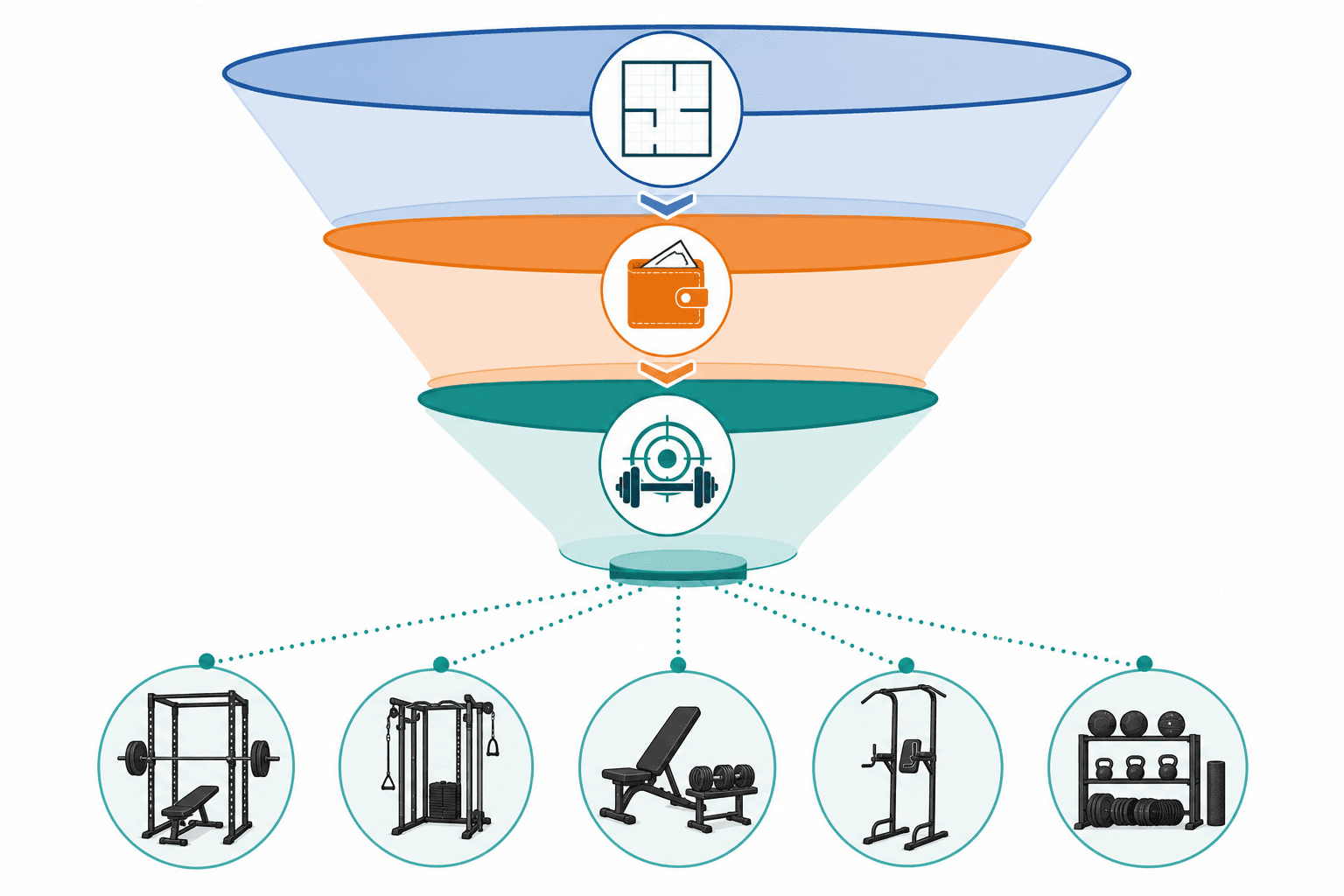
Filter 1: Available Space
Measure your available floor space in square feet before looking at any product. Include the clearance you need around the equipment, not just the machine's own footprint.
- Under 20 sq ft available: Resistance band system only, or a very compact functional trainer. Most other system types will not fit.
- 20–40 sq ft available: Compact functional trainer or smart gym. Some Smith machine combos fall in this range.
- 40–60 sq ft available: Full-size functional trainer, smart gym, or a mid-size power rack with plates. This is the practical minimum for a power rack setup.
- 60–80+ sq ft available: All system types are viable. An all-in-one selectorized machine typically needs 70+ sq ft.
Ceiling height is a secondary space constraint that eliminates power racks in low-ceiling spaces. Most power racks require 8 to 9 feet of ceiling clearance when loaded with a barbell for overhead pressing. A 7-foot ceiling rules out overhead pressing from a rack entirely. Smart gyms and functional trainers are generally ceiling-height agnostic.
Filter 2: Total Budget Including Subscription Costs
Hardware sticker price is not your actual cost for smart gym systems. You need to calculate total cost of ownership over at least two to three years, factoring in any mandatory or effectively required subscription.
For traditional system types — selectorized, functional trainer, power rack, resistance bands — the subscription cost is zero. You pay hardware once and own the full functionality of the equipment indefinitely.
For smart gyms, the subscription changes the comparison significantly. The TCO breakdown section below covers the specific numbers. As a filter: if your two-year total budget is under $4,000, smart gyms with mandatory subscriptions are likely out of range once ongoing costs are included.
Filter 3: Primary Training Goal and Experience Level
Your training goal and current experience level together determine which system type will serve you long-term — not just for the first few months.
- Goal: general fitness, no prior training experience → All-in-one selectorized machine or smart gym. Both provide structure and guided movement. The all-in-one has no ongoing cost; the smart gym adds coaching software.
- Goal: cable-based strength and variety, intermediate experience → Functional trainer. Best exercise variety per square foot for users who already have a training framework.
- Goal: progressive barbell strength, experienced lifter → Power rack + barbell. Highest long-term strength ceiling. Requires existing barbell technique or willingness to develop it.
- Goal: coached workouts with minimal footprint, comfortable with subscription costs → Smart gym. The coaching and AI features are the primary value; the hardware is the delivery mechanism.
- Goal: mobility, rehabilitation, travel, or beginner conditioning with zero footprint → Resistance band system. Fully capable for these use cases; not a long-term strength progression tool.
Total Cost of Ownership: What You'll Actually Pay Over Three Years
For four of the five system types, the cost calculation is straightforward: hardware price plus any accessories, zero ongoing subscription. For smart gyms, the subscription cost changes the comparison in ways that are not obvious from the hardware sticker price alone.
| System Type / Example | Hardware Cost | Annual Subscription | Year 1 Total | Year 2 Total | Year 3 Total |
|---|---|---|---|---|---|
| Tonal 2 (smart gym) | $4,295 + ~$295 install | $719.40 ($59.95/mo) | ~$5,309 | ~$6,029 | ~$6,748 |
| Speediance Gym Monster 2 (smart gym) | ~$3,749 all-in | $0 (basic free for life) | ~$3,749 | ~$3,749 | ~$3,749 |
| Full-size functional trainer (mid-range) | $2,500–$3,500 | $0 | $2,500–$3,500 | $2,500–$3,500 | $2,500–$3,500 |
| All-in-one selectorized (mid-range) | $1,500–$3,500 | $0 | $1,500–$3,500 | $1,500–$3,500 | $1,500–$3,500 |
| Power rack + barbell + plates | $800–$2,500 | $0 | $800–$2,500 | $800–$2,500 | $800–$2,500 |
| Resistance band system | $20–$300 | $0 | $20–$300 | $20–$300 | $20–$300 |
The Tonal 2 subscription is not optional in practice. Without an active membership, you retain only basic lift mode — you can manually increase or decrease weight, but all AI features disappear: no optimal weight suggestions, no progress tracking, no workout library, no multi-week programs, no dynamic weight modes. The subscription is where the product's core value lives.
Tonal requires a 12-month initial subscription commitment at $59.95 per month. Over two years, the hardware plus subscription reaches approximately $6,029 — not counting installation costs.
Speediance's Gym Monster 2 takes a different approach: basic access — including workouts, custom programming, and digital weight modes — is free for life. Multiple independent sources have confirmed this as of Q2 2026, and it represents a meaningful structural difference in the ownership model compared to Tonal.
Scenario-Based Recommendations
The four scenarios below apply the constraint-axis framework to common buyer situations. Each recommendation names the correct system type, not a specific brand, and explains the constraint logic behind it.
Scenario 1: Small Budget, Small Space
Available space: under 25 sq ft. Total hardware budget: under $500. Training goal: general conditioning, beginner level.
System type: resistance band system, or a compact entry-level functional trainer if budget reaches $400–$500. The resistance band system is the only option that fits the space and budget constraints simultaneously. A compact functional trainer at the lower end of its price range is possible but will have limited resistance capacity. Traditional machines and smart gyms are out of range on both dimensions.
Scenario 2: Intermediate Apartment Buyer
Available space: 20–40 sq ft. Total two-year budget: $2,000–$4,500. Training goal: cable-based strength variety or coached workouts. Experience level: intermediate, has been training for 1–2 years.
System type: compact functional trainer, or smart gym if the subscription TCO fits the budget and coached workouts are the priority. A compact functional trainer in the $1,500–$2,500 range fits both the space and the budget with no ongoing costs. A smart gym fits the space but adds $720+ per year in subscription costs — at a $4,000 two-year budget, a smart gym with a mandatory subscription may be at or over the limit once installation is included.
The subscription trade-off is the decision: if coached workouts and AI guidance are the primary value you are seeking, a smart gym makes sense at this budget. If cable variety and training autonomy are the priority, a functional trainer delivers more resistance flexibility per dollar over two years.
Scenario 3: Serious Strength-Focused Buyer
Available space: 50+ sq ft with 8+ ft ceiling. Total budget: $1,500–$3,000. Training goal: progressive barbell strength (squat, deadlift, bench, overhead press). Experience level: has prior barbell training experience.
System type: power rack + barbell + plates. This is the only system type with the strength ceiling and movement pattern fidelity that serious barbell training requires. The hardware cost is lower than most alternatives, there is no subscription, and the upgrade path (more plates, attachments, a cable attachment for the rack) is straightforward.
If the buyer lacks prior barbell experience but wants to build toward it, a Smith machine combination unit is a lower-skill-barrier entry point. It provides guided bar-path training, often includes cable and pull-up functionality, and reduces the technique barrier for solo training. The trade-off is that the fixed bar path does not transfer directly to free-weight barbell movements — it is a stepping stone, not a replacement.
Scenario 4: Tech-First, Low-Footprint Buyer
Available space: 40–50 sq ft. Total two-year budget: $4,500–$7,000. Training goal: coached strength workouts with AI guidance and progress tracking. Experience level: beginner to intermediate.
System type: smart gym. The coaching software and AI features are the primary value driver for this buyer, and the compact footprint solves the space constraint. At this budget and two-year horizon, both the Tonal 2 and the Speediance Gym Monster 2 are viable, but the subscription cost difference between them is approximately $1,440 over two years — a material gap that should be factored into the decision, not treated as a footnote.
Common Buying Mistakes to Avoid
- Comparing products across system types as if they are alternatives. A smart gym and a functional trainer are not competing on the same axis. Evaluate products within a system type after you have selected the right type.
- Evaluating smart gyms on hardware price alone. The hardware is only part of the cost. A smart gym with a mandatory subscription at $59.95/month adds over $700 per year to the total. Always calculate the two-year or three-year TCO before comparing to subscription-free alternatives.
- Recommending power racks to beginners without the prerequisite note. A power rack is not beginner-friendly by default. Barbell movements require technique development. A beginner who skips this step risks injury, not just poor results.
- Conflating all-in-one selectorized machines with functional trainers. These are distinct categories. A selectorized machine has fixed guided stations. A functional trainer has adjustable cable columns with open movement freedom. They serve different users and require different skill levels.
- Prioritizing brand reputation over constraint matching. A well-reviewed product in the wrong system type is still the wrong product for your space, budget, or training goal. The machine type matters more than the brand.
- Ignoring subscription cancellation consequences. For smart gyms that rely on subscription-gated features, canceling the subscription does not return you to a fully functional piece of equipment — it returns you to a stripped-down version. Understand what you are left with before committing.
Frequently Asked Questions
What counts as a 'complete' home gym system?
A complete home gym system is a single centerpiece piece of equipment — or a closely integrated set — that covers your primary training needs without requiring additional major equipment purchases. Each of the five system types in this guide can function as a complete system for the right buyer. 'Complete' is relative to your training goals, not to an objective standard.
Can a functional trainer replace a power rack?
For most intermediate trainees, yes — with one important caveat. A functional trainer cannot replicate heavy barbell movements like a loaded back squat or a conventional deadlift with progressive overload into the hundreds of pounds. If progressive barbell strength is your primary goal, a power rack is the correct system type. If cable variety, upper-body pulling and pressing, and accessory work are your priority, a functional trainer covers that ground and does it in a smaller footprint.
Do smart gyms work without a subscription?
It depends on the product. Tonal without an active subscription retains only basic lift mode — you can adjust resistance manually, but all AI coaching, the full workout library, progress tracking, and dynamic weight modes are locked behind the membership. Speediance's basic tier is free for life and includes workouts and custom programming. If subscription-free ownership is a requirement, Speediance's model is structurally different from Tonal's.
What is the minimum ceiling height for a power rack?
Most full-size power racks require 8 to 9 feet of ceiling clearance to perform overhead pressing safely with a standard Olympic barbell. If your ceiling is 7 feet or lower, overhead pressing inside the rack is not feasible, and some squat positions may also be constrained. Low-ceiling spaces are better served by a functional trainer or smart gym, neither of which has significant ceiling height requirements.
Is a resistance band system enough for intermediate trainees?
For mobility work, warm-up routines, and accessory movements, yes. For primary strength progression at an intermediate level, bands have a practical upper-resistance ceiling that limits their usefulness as a standalone system. An intermediate trainee who has been building strength for 12 to 18 months will likely outpace what a band system can provide for their main compound movements. Bands work well as a complement to another system type, or as a primary tool for beginners and for non-strength training goals.

Comments
Join the discussion with an anonymous comment.