
8-Week Compact Home Gym Strength Program: Build Muscle with Adjustable Dumbbells, Bands, and a Cable Tower
If you own a compact home gym setup—adjustable dumbbells, resistance bands, and a cable tower—this eight-week strength program shows how to program each resistance type for progressive overload without unlimited weight stacks.
- Space type
- apartment
Items included: —
You have adjustable dumbbells that top out at 50 lbs. A cable tower with a 150-lb stack sits in the corner. Resistance bands are coiled on the floor. That is enough gear. What you do not have is a program that treats each resistance type as what it actually is — a tool with its own loading curve, its own progression rules, and its own blind spots. Most home gym owners fail at programming not because the equipment is insufficient, but because they apply commercial-gym logic to gear that behaves differently. A dumbbell press is heaviest at the bottom. A band press is light at the bottom and heavy at lockout. A cable press is constant tension through the whole range. Program them as if they are interchangeable, and you leave gains on the table.
This 8-week program is built for three resistance types — adjustable dumbbells, loop bands, and a cable tower — in under 20 square feet. It is not a generic full-body circuit. It is a deliberate layering of progressive overload methods, each matched to the equipment that can actually deliver it.
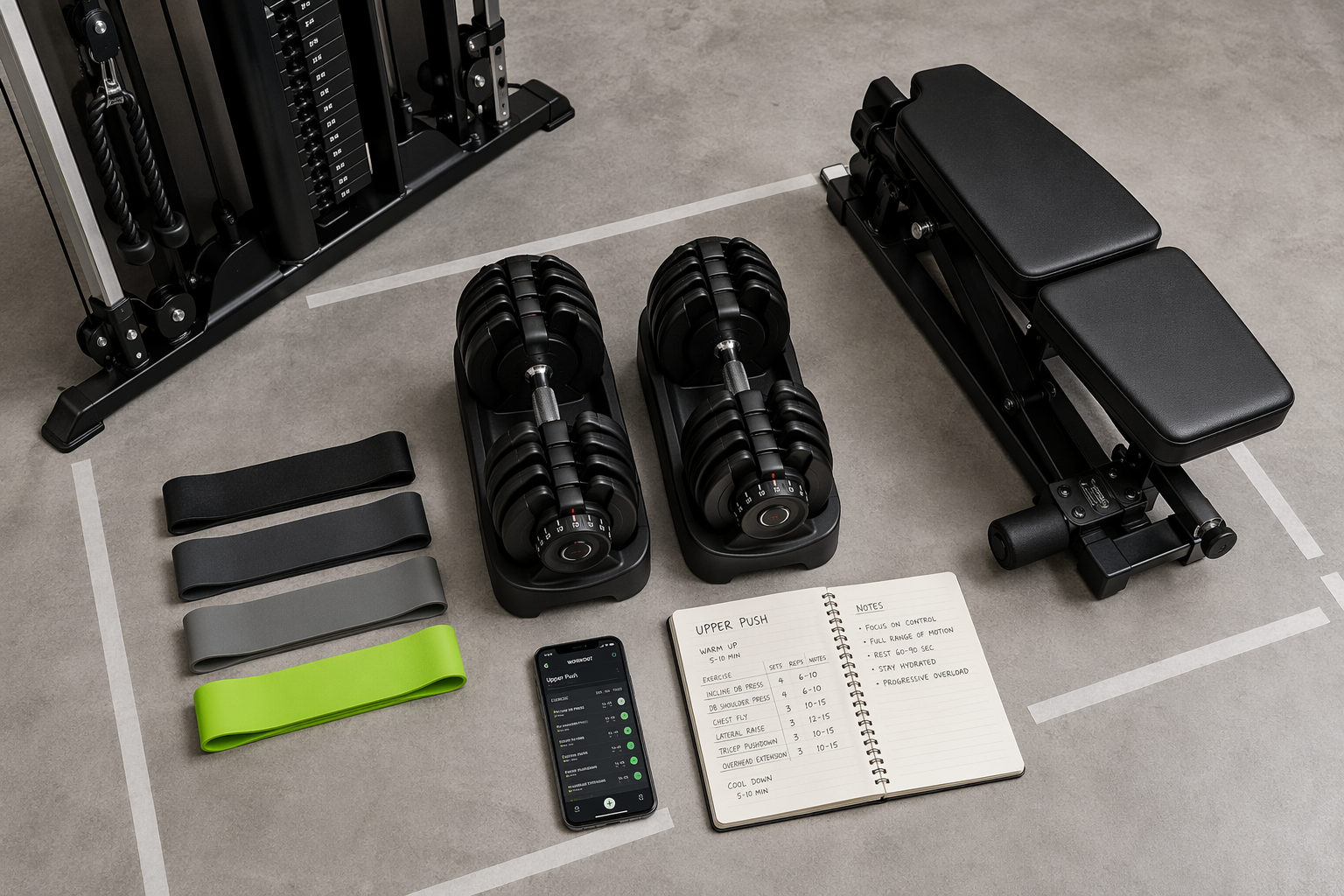
Your dumbbells top out at 50 lbs. So what?
A 50-lb dumbbell ceiling feels like a hard wall. It is not. The American College of Sports Medicine two-for-two rule turns fixed increments into a viable ladder: add weight only when you can do two extra reps on your last set for two consecutive sessions. That rule works identically with a 5-lb jump as with a 10-lb jump. The Cleveland Clinic adds a practical heuristic: if you feel you could do five more reps on your last set, add 5 lbs next time. The two-for-two rule respects the reality of adjustable dumbbells. You are not chasing fractional plates. You are building a rep record at the current weight until your performance forces an increment. That shift — from "I cannot go heavier" to "I have not earned the next weight yet" — is the difference between stalled training and consistent progress.
Bands don't behave like dumbbells
If you treat a resistance band as a portable free weight, you will undershoot its potential — and probably overshoot its risk. Bands have an ascending resistance curve: light at the start of the movement, heavy at peak stretch. That property makes them ideal for end-range strength work, but it means you cannot program them the same way as dumbbells. Progression for bands is not linear. You can increase band thickness, stack multiple bands, or increase stretch length by moving your anchor point farther away. Each change shifts the resistance curve differently. A concrete example: for a band-resisted push-up (band across the back), a light band might give 10-15 lbs of resistance at the top — suitable for 15-20 reps. A heavy band might give 30-40 lbs — too much for high reps but perfect for strength-end range work in the 6-10 rep zone. Do not just grab a heavy band and expect the same feel as adding weight to a barbell. Test the band at full stretch before loading it into your working sets.
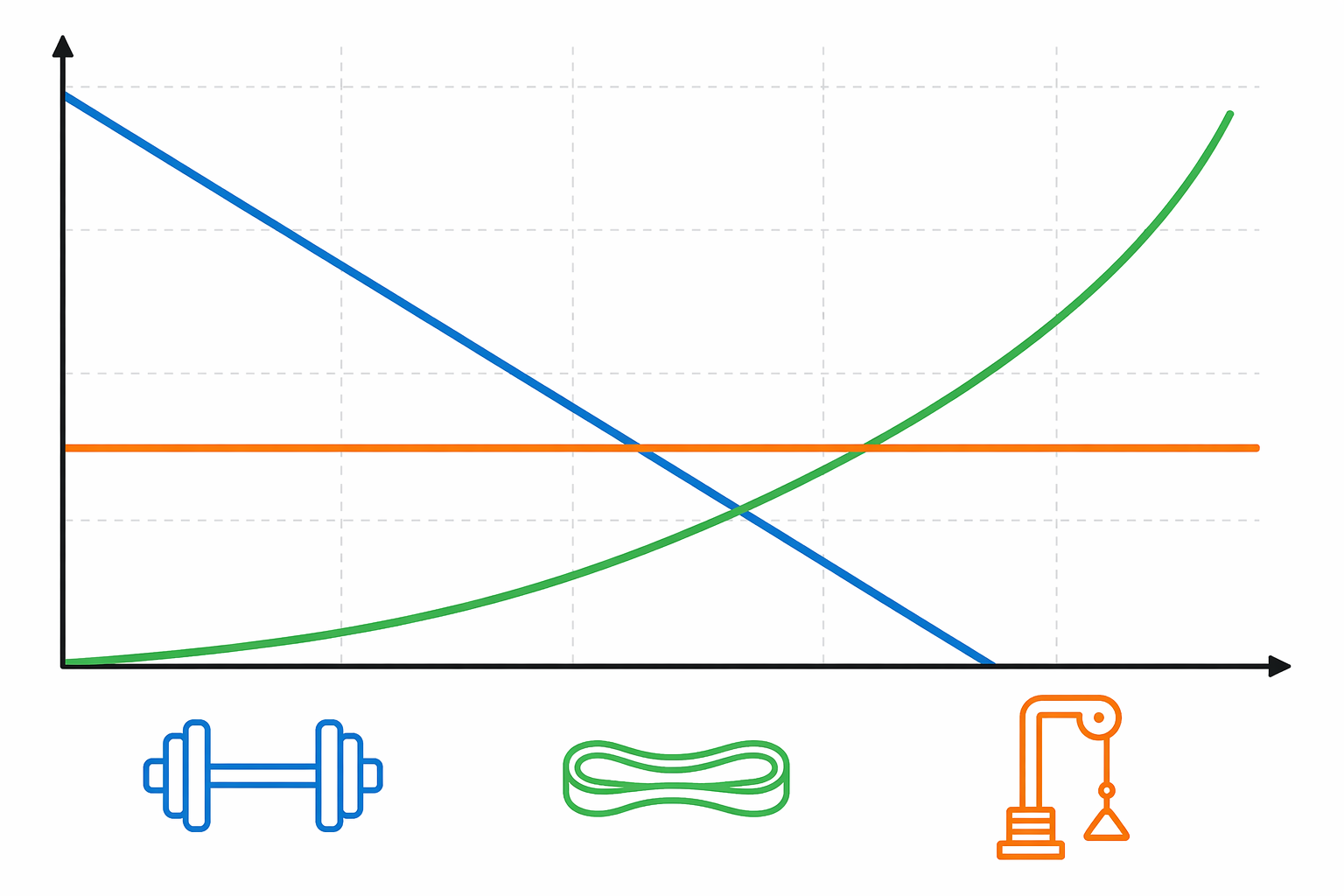
Cables: the missing piece for constant tension
A cable tower fills the gap that dumbbells and bands cannot: constant tension through the full range of motion. Research in the Journal of Strength and Conditioning Research found that cable exercises allow better range of motion compared to selectorized machines. That ROM advantage, combined with constant tension, makes cable exercises like face pulls, wood chops, and cable crossovers uniquely valuable for shoulder health, rotational strength, and isolation work. One caveat: many compact cable towers have a single pulley, not a dual-pulley functional trainer. Exercises that require two cables — cable crossovers, for instance — need adaptation. Replace them with band crossovers (using a door anchor) or single-arm cable flies. The renter's guide to compact gyms covers these substitutions in detail.
The program: three phases that use all three curves
This 8-week program is structured as three phases, each using a different split and a different primary overload method. The goal is not to list exercises but to show how each resistance type's curve fits into a deliberate progression system.
Phase 1 (Weeks 1-3): Full-body foundation
Three full-body workouts per week, rotating between Workout A, B, and C. Each session includes one compound dumbbell lift (e.g., goblet squat, dumbbell bench press, single-arm row), one band-resisted compound (band push-up, band pull-apart, band squat), and one cable isolation exercise (face pull, cable lat pulldown, cable lateral raise). Progression: follow the two-for-two rule on dumbbell lifts, increase band thickness weekly (light → medium → heavy), and add 5 lbs on the cable stack every two sessions when you hit 3x12 with good form.
| Week | Dumbbell sets x reps | Band exercises (tension) | Cable isolation sets x reps |
|---|---|---|---|
| 1 | 3x10 | Light band, 3x12 | 3x12 |
| 2 | 3x10 (add weight if two-for-two passed) | Medium band, 3x10 | 3x12 (add 5 lbs if possible) |
| 3 | 3x8-10 (progress weight) | Heavy band, 3x8 | 3x10 (increase weight) |
Phase 2 (Weeks 4-6): Upper/lower split with cable isolation
Four days per week: upper, lower, upper, lower. Dumbbells and bands cover the main compounds; cables take over isolation work entirely. This is the volume accumulation phase. Reps climb while rest intervals drop from 90 seconds to 60 seconds over the three weeks. Example upper day: dumbbell bench press (3x8-10), single-arm dumbbell row (3x10-12), band pull-apart (3x15), cable lateral raise (3x12-15), cable bicep curl (3x12). Lower day: goblet squat (3x8-10), band hip thrust (3x12-15), cable pull-through (3x12), dumbbell Romanian deadlift (3x10), cable wood chop (3x12 each side). The split allows more per-muscle volume without accumulating systemic fatigue from daily full-body sessions. Band work shifts toward accessory roles; cables provide the constant-tension isolation that dumbbells struggle to match.
Phase 3 (Weeks 7-8): Push/pull/legs with intensifiers
Six sessions over two weeks per body part (push, pull, legs repeated twice per week). This is where you deploy the advanced techniques that do not require heavier weights: tempo eccentrics, drop sets, and Myo-Reps. On dumbbell exercises, slow the eccentric to 4-5 seconds. Time-under-tension research shows that a 4-5 second eccentric phase can stimulate muscle growth comparable to adding 10-15% more weight. But this is not a substitute for progressive overload in the neural adaptation sense — it shifts the stimulus toward hypertrophy without training the same explosive strength. Use it as an intensifier in Phase 3, not as your primary progression method throughout the program. On cable exercises, use drop sets: after reaching failure, reduce the stack by 30-40% and go to failure again. On band exercises, use Myo-Reps: take a set to failure, rest 3-4 seconds, then perform 4 reps, repeating until you cannot get 4 more.
| Exercise | Phase 1 (Weeks 1-3) | Phase 2 (Weeks 4-6) | Phase 3 (Weeks 7-8) |
|---|---|---|---|
| Dumbbell press | 3x8-10, two-for-two rule | 3x10-12, rest 60-90s | Tempo 4-0-1, 3x8-10 |
| Band push-up | Light band, 3x12-15 | Medium band, 3x10-12 | Heavy band, Myo-Reps to failure |
| Cable lat pulldown | 3x10-12 | 3x12-15, increase weight | Drop set: failure → -30% weight → failure |
Don't skip the deload
Every four to six weeks, your nervous system and connective tissue need a break. The Cleveland Clinic recommends a deload week where you extend rest times or lighten the load. In this program, the deload falls at Week 5 — after the first three weeks of full-body work and one week into Phase 2. What does a deload look like with compact equipment? Drop dumbbell weight by 30-40%. Use only light bands. Cut cable stack by 20-30%. Reduce sets to two per exercise. Do not skip it. The most common injury pattern in home gyms is overuse from never backing off — because "you can't hurt yourself with light weights" is exactly wrong. You accumulate microtrauma from the same exercises, the same rep ranges, the same angles. The deload is non-negotiable. Use the deload week for active recovery: foam rolling, light mobility work, and walking. Our foam rolling and active recovery guide has specific protocols for home gym lifters.
So does it actually match the commercial gym?
You will find claims online that home gyms deliver equal results to commercial gyms when programming is consistent. The source for that claim — a retailer's blog — cites "multiple studies" without providing specific citations. I do not find that satisfying. The claim is a reasonable inference from the broader literature on training consistency, but it is not a proven fact. What I can point to with more confidence is the cable advantage from the JSCR study: better range of motion on cable exercises compared to selectorized machines. That is a concrete advantage, not an inference. And the time savings are real — 100-150 hours per year eliminated from commuting and waiting for equipment. That is time you can actually use to train.
Bottom line: the equipment is not the limiting factor. The limiting factor is whether you apply progressive overload deliberately, track your reps, know when to deload, and respect the different curves of dumbbells, bands, and cables. Follow this program. Log every set. And the gear will not hold you back.
Some links on this page are affiliate links — they may earn us a commission at no extra cost to you. Our tier and tests are decided before we ever check which links pay; see our full affiliate disclosure.
Spot something off?
Noise and floor-damage claims carry real deposit-risk consequences if we get them wrong — tell us if your experience with this build didn't match what's above.