
Home Fitness Equipment for Small Spaces: A Constraint-Based Buying Guide for Apartments, Condos, and Shared Living
This guide provides a constraint-first decision framework for apartment and small-space dwellers. Learn how to measure your workout zone, evaluate equipment by storage mode (fold flat, vertical, wall-mounted, compact footprint), and apply the '3-item max' rule to build a versatile home gym that fits your space, noise tolerance, and training goals.
- Budget tier
- under $300
- Space type
- apartment
Items included: —
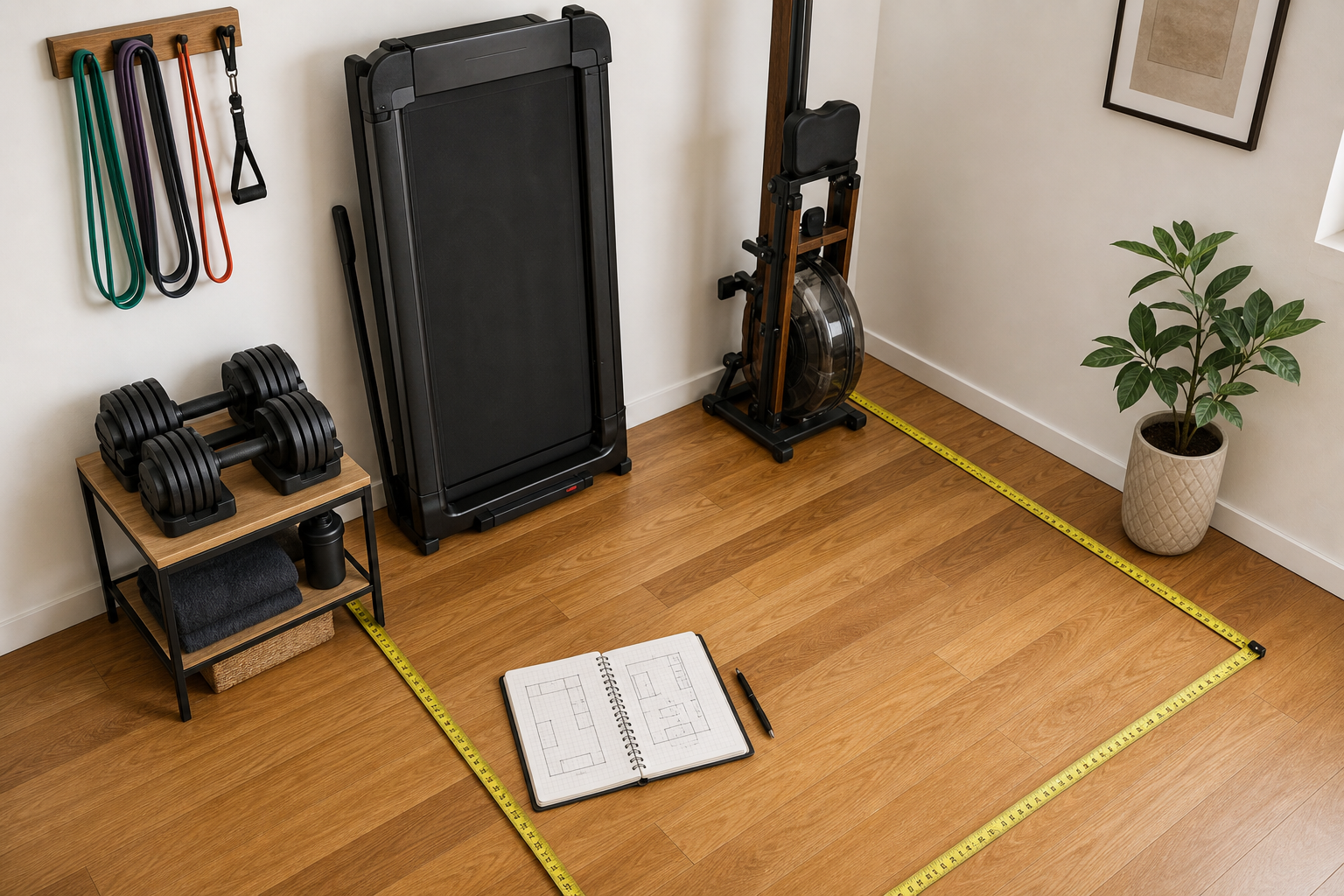
The Space Problem: Why 20% of Exercisers Don't Own Home Equipment
If you live in an apartment, condo, or shared living situation, you've likely faced the same dilemma: you want a home gym, but the only available floor space is a corner of the bedroom or a sliver of the living room. You are not alone. According to a 2022 Statista survey cited by PTPioneer, approximately 20% of US exercisers indicated that lack of space in their homes was a significant reason for not owning fitness equipment. Only cost (35.6%) ranked higher as a barrier.
This spatial incompatibility is not a personal failing — it is a structural market reality. A January 2026 report from ResearchAndMarkets, covered by Yahoo Finance, identifies 'limited floor space in modern urban residences' as a major obstacle to broader market expansion, 'which curtails the adoption of large, multi-functional equipment.' GMInsights similarly notes that space constraints restrict installation of large or multi-station equipment, driving consumer demand for 'compact and multifunctional equipment suited for small living spaces' and 'foldable and modular equipment designs.'
The standard advice — 'buy adjustable dumbbells' or 'use resistance bands' — is not wrong, but it is incomplete. It skips the most critical step: understanding your actual spatial constraints before considering any product. This guide provides a constraint-first decision framework built around four specific dimensions: minimum workout zone dimensions, storage mode taxonomy, noise tolerance, and a '3-item max' rule for multi-function combinations. By the end, you will have a clear action plan tailored to your space, not a generic product list.
Step 1: Measure Your Space — Minimum Workout Zone Sizes
Before you look at a single piece of equipment, you need to know how much room you actually have to move. The most common mistake small-space buyers make is purchasing equipment that fits the floor footprint but leaves no clearance for the actual exercise. A treadmill might occupy 10 square feet, but you need additional space to mount and dismount safely. A barbell might fit in the corner, but you cannot perform a deadlift without ceiling height and floor length.
Use these minimum workout zone sizes as your baseline. Measure your available floor area and ceiling height, then match it to the training style you prioritize.
| Training Style | Minimum Zone Size | Ceiling Height | Notes |
|---|---|---|---|
| Bodyweight / Yoga / Mat Work | 7 ft x 7 ft (49 sq ft) | 8 ft | Allows full range of motion for lunges, burpees, and sun salutations. A 6x6 ft space works for seated or lying work only. |
| Barbell Strength (Deadlifts, Squats) | 6 ft x 8 ft (48 sq ft) | 8.5 ft minimum | Requires clearance for bar path and weight plates. A 7x7 ft space is safer for Olympic lifts. |
| Stationary Bike / Spin | 4 ft x 6 ft (24 sq ft) | 7 ft | Bike footprint is small, but you need room to mount, dismount, and stretch. The NordicTrack X24 occupies only 8.54 sq ft of actual floor space. |
| Rowing Machine | 5 ft x 8 ft (40 sq ft) | 7.5 ft | Rowers require full rail extension. The Concept2 RowErg is 8 ft long but stores upright in under 3 sq ft when not in use. |
| Treadmill (Folding) | 3 ft x 6 ft (18 sq ft) when stored; 6 ft x 8 ft when in use | 8 ft | Folding treadmills like the Echelon Stride 6s can slide under a bed, but you need running clearance when deployed. |
| Strength (Dumbbells / Kettlebells) | 5 ft x 5 ft (25 sq ft) | 8 ft | Sufficient for most standing and seated dumbbell exercises. Add 2 ft of clearance on each side for lateral movements. |
If your available space falls below the minimum for your preferred training style, you have two options: adjust your training style (e.g., switch from barbell to dumbbell work) or choose equipment that stores outside the workout zone (fold flat, vertical, or wall-mounted). That is where the storage mode taxonomy comes in.
Step 2: Equipment Categories by Storage Mode
Once you know your workout zone size, the next filter is how the equipment lives when you are not using it. Most small-space buyers focus on the deployed footprint, but the storage footprint is often the deciding factor. We categorize equipment into four storage modes, each with distinct trade-offs.
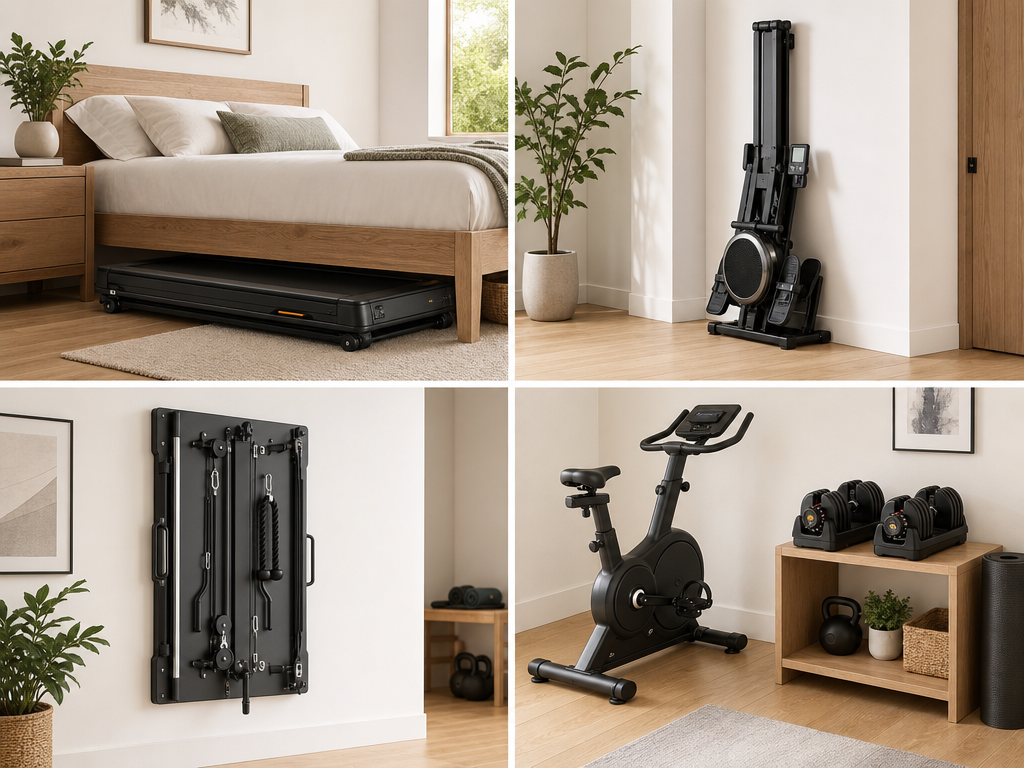
Fold Flat
Equipment that folds to a low-profile shape and can be stored under a bed, behind a sofa, or in a closet. This is the most space-efficient mode for cardio equipment.
- Echelon Stride 6s: Folds flat for storage under a bed. Garage Gym Reviews testing gave it 5/5 for both footprint and portability. Ideal for apartment dwellers who want a treadmill but cannot dedicate permanent floor space to it.
- PRx Profile PRO Squat Rack: Folds to 12 inches of depth against the wall when not in use. Also received 5/5 for footprint from Garage Gym Reviews. This is a fold-flat solution for strength training that disappears when closed.
Vertical Storage
Equipment that stands upright in a footprint much smaller than its deployed size. This mode is ideal for narrow wall gaps, closet ends, or corners.
- Concept2 RowErg: Weighs 57 lbs and stores upright in under 3 sq ft. Garage Gym Reviews gave it 5/5 for portability. The trade-off is noise — its air resistance system is louder than magnetic alternatives, which matters for shared walls.
Wall-Mounted
Equipment that mounts directly to the wall and folds or retracts when not in use. This mode consumes zero floor space during storage and is the best option for rooms where every square foot counts.
- Tonal 2: Has a depth of only 5.25 inches when folded against the wall. Garage Gym Reviews rated it 4.5/5 for footprint and portability. It replaces an entire gym's worth of strength equipment in the space of a wall-mounted mirror. Note that installation requires drilling into studs, which may not be suitable for all renters.
Compact Footprint
Equipment that is inherently small by design and does not require folding or storage. These pieces live in a permanent spot but occupy minimal space.
- NordicTrack X24 Bike: Occupies only 8.54 sq ft of floor space — less than a standard armchair. Its magnetic resistance system makes it one of the quietest options for apartment use.
- Adjustable dumbbells and resistance bands: These are the classic compact-footprint items. A set of PowerBlock adjustable dumbbells can fit in a drawer, and a resistance band set with door anchor takes up virtually no space.
Step 3: Noise Considerations for Shared Walls and Floors
Noise is the second-most-common complaint among apartment exercisers, and it is often the reason equipment gets used once and then abandoned. The type of resistance your equipment uses directly affects how much sound and vibration transfers through shared walls and floors.
| Resistance Type | Noise Level | Vibration Transfer | Best For | Examples |
|---|---|---|---|---|
| Magnetic | Low | Minimal | Apartments with shared walls, late-night workouts | NordicTrack X24 bike, magnetic rowers, spin bikes |
| Air | Moderate to High | Moderate | Garages, ground-floor units, well-insulated rooms | Concept2 RowErg, air bikes (Assault, Schwinn) |
| Impact-based (weights, plyometrics) | High | High | Ground-floor homes, garages, dedicated gym rooms | Barbell deadlifts, jump rope, box jumps |
| Hydraulic / Friction | Low to Moderate | Low | Small apartments, multi-story buildings | Compact rowers, cable machines with magnetic resistance |
The difference is not subtle. Magnetic resistance uses eddy currents to create resistance without physical contact between moving parts, producing almost no mechanical noise. Air resistance, by contrast, uses a fan blade that displaces air — the Concept2 RowErg is effective and well-reviewed, but its air resistance system generates a distinct whoosh that travels through walls. Impact-based exercises like deadlifts or jump rope create structure-borne vibration that travels through floors and framing, which is the hardest type of noise to mitigate.
If you live above the first floor, prioritize magnetic resistance equipment for cardio and limit impact-based exercises to bodyweight movements on a thick gym mat. For strength training, adjustable dumbbells and resistance bands produce minimal noise compared to dropping barbells.
Step 4: The Decision Framework — Space × Noise Tolerance × Training Style
Now that you have your minimum workout zone size, your storage mode preference, and your noise tolerance profile, you can combine them into a single decision framework. The goal is to identify which storage mode and equipment type fit your specific combination of constraints.
| Your Profile | Available Space | Noise Tolerance | Training Style | Recommended Storage Mode | Example Equipment |
|---|---|---|---|---|---|
| Urban apartment dweller, shared walls | Under 30 sq ft | Low (must not disturb neighbors) | Cardio + light strength | Fold flat or compact footprint | Echelon Stride 6s (fold flat), NordicTrack X24 (compact), adjustable dumbbells |
| Ground-floor condo or well-insulated room | 30–50 sq ft | Moderate | Strength + rowing | Vertical storage or wall-mounted | Concept2 RowErg (vertical), PRx Profile PRO (fold flat), Tonal 2 (wall-mounted) |
| Homeowner with small spare room | 50+ sq ft | High (no shared walls) | Full strength + cardio | Any mode; prioritize versatility | Tonal 2 + Concept2 RowErg + adjustable dumbbells |
| Dorm or shared living | Under 20 sq ft | Very low | Bodyweight + flexibility | Compact footprint only | Resistance bands, yoga mat, adjustable dumbbells (stored in drawer) |
| Renter, no drilling allowed | 25–40 sq ft | Low to moderate | Mixed (cardio + strength) | Fold flat or vertical storage | Echelon Stride 6s (fold flat), Concept2 RowErg (vertical), resistance bands with door anchor |
For a more detailed tool that matches your specific spatial and budget profile to equipment recommendations, use our Compact Home Gym Decision Matrix. It expands on this framework with budget tiers and specific product comparisons.
Step 5: The '3-Item Max' Rule for Multi-Function Combinations
The most common small-space mistake is accumulating too many single-purpose items. A foam roller, a yoga block, a jump rope, a set of bands, a kettlebell, a medicine ball — each is small on its own, but together they consume drawer space, closet space, and mental energy. The '3-item max' rule is a simple heuristic: the most versatile small-space gyms use no more than three core pieces of equipment that collectively cover strength, cardio, and flexibility with minimal overlap.
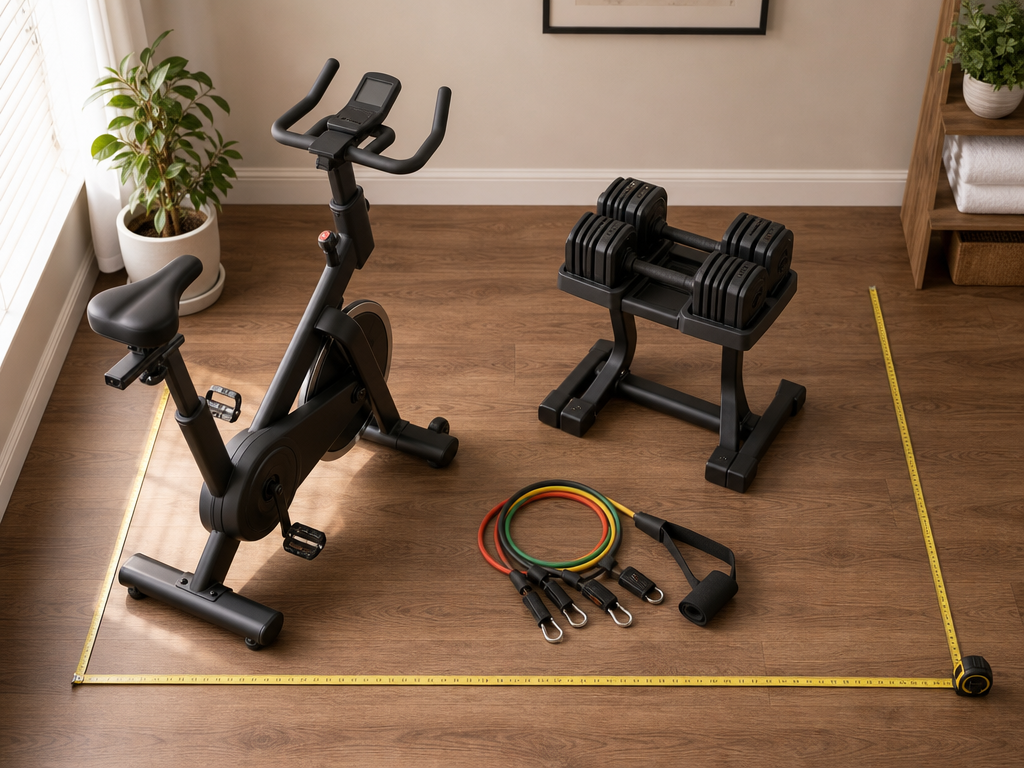
Here are three example combinations based on different training priorities:
- Cardio-First Combo: Fold-flat treadmill (Echelon Stride 6s) + adjustable dumbbells + resistance bands with door anchor. Covers running, walking, full-body strength, and flexibility. The treadmill stores under the bed; the dumbbells and bands fit in a drawer.
- Strength-First Combo: Wall-mounted smart gym (Tonal 2) + compact exercise bike (NordicTrack X24) + yoga mat. Covers full-body strength, low-impact cardio, and mobility. The Tonal 2 takes 5.25 inches of wall depth; the bike occupies 8.54 sq ft; the mat rolls up.
- Budget-Friendly Combo: Adjustable dumbbells + folding bench + resistance bands with door anchor. Covers strength, some cardio (through circuit training), and flexibility. Total footprint when stored: under 5 sq ft. Total cost: under $500.
The 3-item max rule forces you to prioritize versatility per square foot. Every item must earn its place by serving at least two distinct functions. Adjustable dumbbells replace an entire rack of fixed-weight dumbbells. A folding bench doubles as a step for cardio and a support for seated exercises. Resistance bands provide both strength and flexibility work.
For a deeper comparison of how modular, all-in-one, and smart gym approaches stack up against the 3-item max rule, see our guide on Modular vs. All-in-One vs. Smart Gym.
Step 6: Renter-Friendly Installation and Flooring Options
If you rent, installation constraints are just as important as spatial constraints. Many wall-mounted systems (Tonal 2, PRx Profile PRO) require drilling into studs, which may violate lease terms or require landlord approval. Fortunately, there are effective alternatives that require no permanent modifications.
No-Drill Equipment Options
- Tension-mounted pull-up bars: Install in a door frame using tension, not screws. Rated for up to 300 lbs. Remove without leaving marks.
- Door anchor systems: Used with resistance bands. The anchor slips over the top of a closed door and requires no hardware. Effective for lat pulldowns, rows, and chest presses.
- Free-standing power racks: Some compact racks (like the PRx Profile PRO's free-standing variant) do not require wall mounting. They use the user's body weight for stability during squats and pull-ups.
- Fold-flat and vertical storage equipment: As covered in Step 2, these require no installation at all. The Echelon Stride 6s and Concept2 RowErg are ready to use out of the box.
Flooring Solutions for Renters
Protecting your floors and dampening noise for neighbors below is critical. The right flooring choice depends on your equipment type and the surface underneath.
- Interlocking foam mats: Inexpensive, lightweight, and easy to remove. Best for bodyweight, yoga, and light dumbbell work. Provides minimal vibration dampening for heavy equipment.
- Rubber stall mats (3/8-inch or thicker): Heavier and more durable. Excellent for vibration dampening under treadmills, bikes, and rowers. Can be cut to size and removed without damage. Available at most farm supply stores for under $50 per mat.
- Carpet protectors: Clear plastic mats that prevent equipment from leaving indentations in carpet. Useful under stationary bikes and treadmills.
Putting It All Together: Your Small-Space Home Gym Action Plan
Building a home gym in a small space is not about finding the 'best' equipment — it is about finding the right equipment for your specific spatial constraints. Here is your step-by-step action plan:
- Measure your workout zone. Use the minimum zone sizes from Step 1 to determine how much clear floor space you have. Account for ceiling height, door swings, and furniture.
- Choose your storage mode. Based on your available space and whether you can drill into walls, select from fold flat, vertical storage, wall-mounted, or compact footprint. Use the storage mode taxonomy in Step 2 as your primary filter.
- Evaluate your noise tolerance. If you share walls, prioritize magnetic resistance equipment. If you are on the ground floor, you have more flexibility. Use the noise comparison table in Step 3 to guide your choice.
- Apply the 3-item max rule. Select no more than three core pieces that cover strength, cardio, and flexibility. Every item must serve at least two functions. Use the example combinations in Step 5 as a starting point.
- Choose renter-friendly installation. If you cannot drill into walls, select no-drill options like tension-mounted pull-up bars, door anchor systems, or free-standing racks. Protect your floors with the right matting.
- Use the decision framework. Combine your space, noise tolerance, and training style using the matrix in Step 4. For a more detailed tool, use our Compact Home Gym Decision Matrix.
Once you have your constraint-based profile, you are ready to explore specific products. Our Compact Home Gym Equipment Guide for Apartments provides detailed testing data on noise, footprint, and portability for nine top-rated compact equipment options. Use it as your next step after completing this framework.
Some links on this page are affiliate links — they may earn us a commission at no extra cost to you. Our tier and tests are decided before we ever check which links pay; see our full affiliate disclosure.
Spot something off?
Noise and floor-damage claims carry real deposit-risk consequences if we get them wrong — tell us if your experience with this build didn't match what's above.