
Compact Home Gym Decision Matrix: Match Equipment to Your Space, Budget, and Workout Style
Stop searching for a single 'best' compact home gym. This guide provides a structured decision matrix to match six equipment categories to your specific constraints — footprint, budget, noise tolerance, and renter status — including a 1/3/5-year cost-of-ownership comparison against gym membership.
Why "Best Compact Home Gym" Is the Wrong Question
Searching for a single "best compact home gym" is a trap. The market now offers everything from a $336 pair of adjustable dumbbells to a $4,295 wall-mounted smart gym, and each option solves a different set of problems. The question isn't which product wins an abstract comparison — it's which equipment category aligns with your actual living situation, budget timeline, and training preferences.
This guide replaces the product-list approach with a structured decision matrix. You will map your constraints — square footage, ceiling height, budget, noise tolerance, and whether you can drill into walls — against six equipment categories. By the end, you will know not just what to buy, but why that category fits your specific scenario, and what it will cost you over one, three, and five years.
The Five Constraint Axes That Define Your Choice
Before looking at any product, measure your constraints. These five axes determine which equipment categories are viable and which will end up as expensive coat racks.
1. Available Square Footage
A functional single-machine setup can fit in as little as 80 square feet, while a more complete arrangement with a cardio machine and strength system typically needs 120 to 150 square feet. For pure strength work with adjustable dumbbells, a bench, and resistance bands, you can operate in 20 to 50 square feet. Measure your actual floor space — including clearance for movement — not just the equipment footprint.
2. Ceiling Height
Ceiling height is an often-overlooked detail. Seven to eight feet is the minimum for most equipment, but some wall-mounted racks and cable towers require 8 to 9 feet of clearance. If you are in a basement with a 7-foot ceiling, many foldable rack options and overhead press movements will be off the table.
3. Total Budget
Budget tiers in the compact home gym space break down roughly as follows: $500 to $1,500 for a starter setup, $1,500 to $3,500 for a balanced setup with higher-quality components, and $3,500 or more for premium or commercial-grade equipment. Your budget must also account for flooring, storage, and any subscription costs that recur monthly.
4. Noise Tolerance
Noise is the constraint most buyers underestimate. Upstairs apartments amplify impact noise from dropped weights, plate-loaded machines, and even heavy footsteps. Magnetic resistance systems and resistance bands produce near-zero noise, while air rowers and plate-loaded cable towers generate moderate to high noise levels that can travel through floors.
5. Renter-Friendliness
If you cannot drill into walls or make permanent modifications, your options narrow to freestanding, foldable, or removable equipment. Doorway pull-up bars on decorative trim carry a risk of cracking or denting the door frame. Removable interlocking floor tiles are the best first upgrade for protecting rental floors without glue or nails.
Six Compact Home Gym Categories Compared
Each of the six categories below serves a distinct combination of constraints. Understanding the category's core value proposition is more important than comparing individual product specs at this stage.
- Smart Gyms (Tonal 2, Speediance Gym Monster): Wall-mounted or freestanding all-in-one units with digital resistance, guided workouts, and small footprints. Best for users who want guided programming and are willing to pay a premium plus a subscription.
- Cable Towers (Bells of Steel Cable Tower): Freestanding or bolted cable machines with weight stacks. Best for users who want cable-based strength training without a subscription and have moderate floor space.
- Foldable Wall-Mounted Racks (PRx Profile PRO): Racks that fold flat against the wall when not in use. Best for renters or small-space users who can drill into studs and want a full barbell setup.
- Band Systems (Fringe Sport Latex-Free Strength Bands): Resistance bands with door anchors and floor anchors. Best for upstairs apartments, travelers, and ultra-low-budget setups with zero noise concerns.
- Adjustable Dumbbells + Bench (REP QuickDraw, NÜOBELL): A pair of adjustable dumbbells plus a folding bench. Best for the strongest renter-friendly strength setup, covering presses, rows, split squats, curls, and Romanian deadlifts.
- All-in-One Machines (Concept2 RowErg, compact exercise bikes): Single-purpose cardio or strength machines that combine multiple functions. Best for users who want one machine that delivers a full-body workout with minimal setup.
Decision Matrix: Which Category Fits Your Constraints?
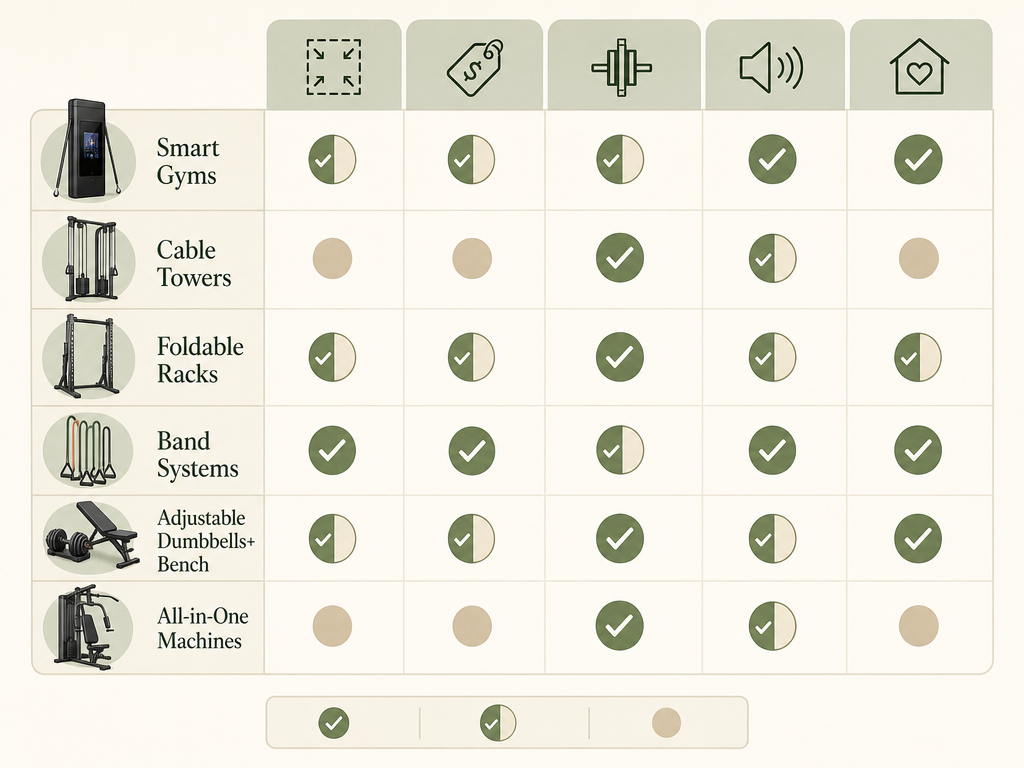
The table below maps each equipment category against the five constraint axes. Use it to identify which categories are viable for your situation before you start comparing specific products.
| Category | Footprint | Ceiling Height | Budget (Equipment) | Noise Level | Renter-Friendly |
|---|---|---|---|---|---|
| Smart Gyms | Very small (5–10 sq ft wall-mounted) | 7 ft minimum | $3,000–$4,300+ | Low (magnetic resistance) | Yes (wall-mount requires drilling) |
| Cable Towers | Moderate (6–8 sq ft) | 8 ft minimum | $435–$1,500 | Moderate (weight stack clanking) | Yes (freestanding models) |
| Foldable Wall-Mounted Racks | Very small when folded (0 sq ft) | 8–9 ft minimum | $1,100–$2,000 | Moderate (plate loading) | Yes (requires drilling into studs) |
| Band Systems | Minimal (2–4 sq ft storage) | No requirement | $50–$200 | Very low (zero noise) | Yes (no permanent changes) |
| Adjustable Dumbbells + Bench | Small (6–10 sq ft) | No requirement | $336–$1,200 | Low (controlled movements) | Yes (no permanent changes) |
| All-in-One Machines | Moderate (10–20 sq ft) | 7–8 ft minimum | $500–$3,000 | Varies (magnetic: low; air: moderate) | Yes (freestanding) |
Specific product examples within each category illustrate the price and size range. The Tonal 2 measures 5.25 inches deep by 21.5 inches wide by 50.9 inches high and costs $4,295 (on sale for $3,545) with a $60-per-month subscription. The Speediance Gym Monster has a footprint of 49.21 by 28.34 inches (folding to 14.96 by 28.34 inches) and costs $3,199 with no subscription required. The PRx Profile PRO foldable squat rack is 53 inches wide by 29.25 inches deep by 89 inches high and costs $1,099.99. The Bells of Steel Cable Tower with weight stack starts at $434.99 with a 31 by 28.5 by 80.75 inch footprint. The REP QuickDraw Adjustable Dumbbells start at $335.99 and replace up to 12 pairs of dumbbells. The NÜOBELL Adjustable Dumbbells start at $595 for a pair and are recommended for small apartments due to their compact storage and traditional dumbbell feel.
Scenario-Based Recommendations: From Apartment to Garage
The matrix narrows your options. These four common scenarios translate that narrowing into a specific build recommendation with estimated total cost.
Scenario 1: Upstairs Apartment (Noise-Sensitive, No Drilling)
Your primary constraints are noise and the inability to make permanent modifications. Resistance bands have zero noise concerns, making them the safest choice for upstairs apartments. A set of Fringe Sport Latex-Free Strength Bands costs $192 and provides resistance from 20 to 175 pounds. Pair them with a pair of NÜOBELL Adjustable Dumbbells at $595 and a folding bench that can be stowed upright, occupying about 1.8 square feet. Total estimated cost: $800 to $1,000. For quiet cardio, the LEIKE X Bike at under $200 folds to 46 by 16 by 9 inches and weighs 38.5 pounds.
Scenario 2: Ground-Floor Apartment or Condo (Some Flexibility)
Ground-floor living removes the noise constraint for downstairs neighbors but may still restrict drilling. A freestanding cable tower like the Bells of Steel Cable Tower at $435 provides cable-based strength training without wall mounting. Add the REP QuickDraw Adjustable Dumbbells at $336 and a folding bench. Total estimated cost: $900 to $1,200. This setup covers presses, rows, split squats, curls, and cable flyes without a single hole in the wall.
Scenario 3: Spare Bedroom or Home Office (Dedicated but Small Space)
A dedicated room of 80 to 100 square feet opens up wall-mounted options. The PRx Profile PRO foldable rack at $1,099 folds flat against the wall when not in use, reclaiming floor space for other activities. Pair it with a barbell, weight plates, and a bench. If you prefer guided programming, the Speediance Gym Monster at $3,199 with no subscription fits in a corner and folds to a depth of 15 inches. Total estimated cost: $1,500 to $3,500 depending on whether you choose the rack-and-barbell path or the smart gym path.
Scenario 4: Single-Car Garage or Basement (More Room, Higher Budget)
A single-car garage or basement offers 150 to 250 square feet and typically allows bolting equipment to the floor or walls. This is the only scenario where a full smart gym like the Tonal 2 at $4,295 plus $60 per month makes financial sense, because you have the space to use it consistently. Alternatively, a wall-mounted Athena cable attachment with 220 pounds per side (110 pounds working weight) integrated into a rack system provides commercial-grade cable training at a lower long-term cost. Total estimated cost: $2,500 to $5,000.
1/3/5-Year Cost of Ownership: When Does a Home Gym Beat the Gym?
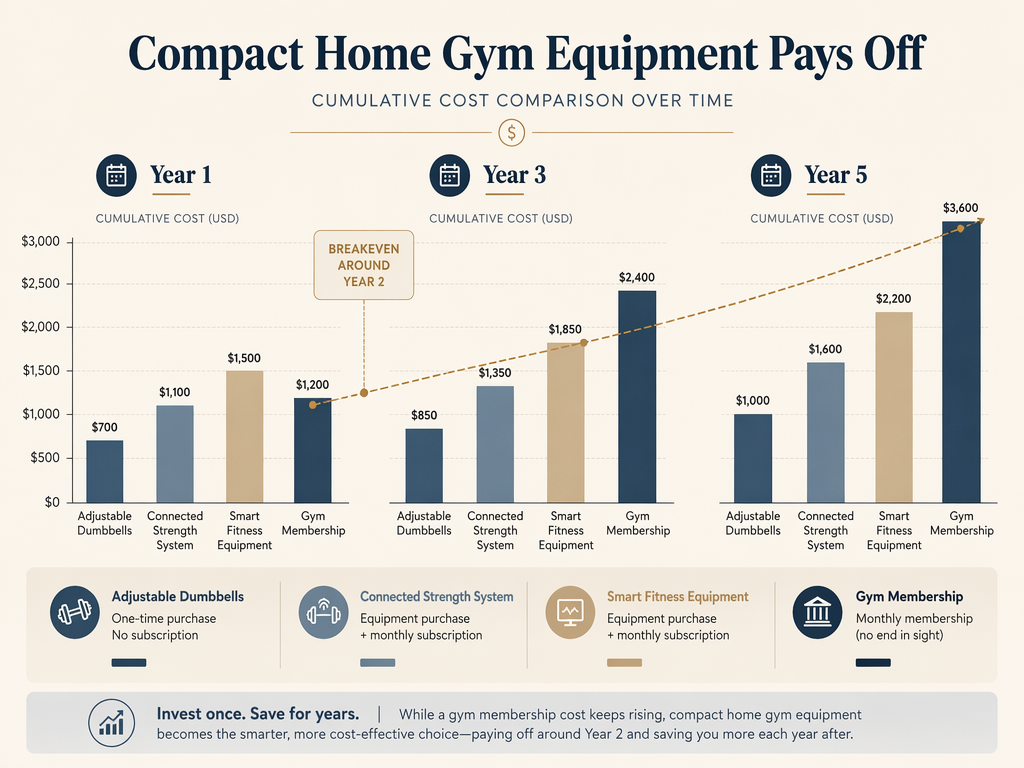
The purchase price is only the first number. Subscription costs, accessory purchases, and eventual upgrades change the total cost equation significantly over time. The table below shows cumulative costs at Year 1, Year 3, and Year 5 for each equipment category versus the average $65-per-month gym membership.
| Category | Year 1 | Year 3 | Year 5 | Break-Even vs. Gym |
|---|---|---|---|---|
| Smart Gym (Tonal 2) | $5,015 | $6,455 | $7,895 | Never (subscription costs exceed gym) |
| Smart Gym (Speediance) | $3,199 | $3,199 | $3,199 | ~41 months |
| Cable Tower + Dumbbells | $1,200 | $1,200 | $1,200 | ~18 months |
| Foldable Rack + Barbell | $1,800 | $1,800 | $1,800 | ~28 months |
| Band System + Dumbbells | $900 | $900 | $900 | ~14 months |
| Adjustable Dumbbells + Bench | $800 | $800 | $800 | ~12 months |
| Gym Membership ($65/mo) | $780 | $2,340 | $3,900 | N/A |
The break-even analysis reveals two important patterns. First, the adjustable dumbbells-plus-bench setup breaks even in about 12 months — the fastest return on investment. Second, the Tonal 2 never breaks even against a $65-per-month gym membership because its $60-per-month subscription keeps annual costs nearly identical to a gym. The Speediance Gym Monster, with no subscription, breaks even in roughly 41 months, making it the more economical smart gym choice for long-term ownership.
Your Next Steps: Measure, Budget, Prioritize
The decision matrix and scenario recommendations give you a shortlist. Now take these three concrete steps before making any purchase.
1. Measure Your Space Accurately
Measure the actual floor area you can dedicate to exercise, including clearance for movement around equipment. A 6x6 foot strength zone or a 6x4 foot mobility zone is the minimum for renters. Measure ceiling height at the lowest point in the room — not the center. If you have less than 7 feet, eliminate wall-mounted racks and cable towers from your list.
2. Set a Realistic Total Budget
Your total budget must include flooring, storage, and any subscription costs for the first year. A $500 equipment budget becomes $600 with a set of interlocking tiles and a storage rack. A $1,500 budget becomes $1,700. Do not forget that smart gym subscriptions add $720 per year to the Tonal 2 and similar devices.
3. Prioritize Your First Purchase
If you are starting from zero equipment, buy in this order:
- Flooring — Removable interlocking tiles protect your floor and dampen noise. This is the first purchase, not an afterthought.
- Adjustable dumbbells — A pair of REP QuickDraw or NÜOBELL dumbbells covers the widest range of exercises per square foot.
- Folding bench — The Nighthawk adjustable bench takes up about 9 square feet when flat but can be stowed upright occupying only 1.8 square feet.
- Resistance bands or cable tower — Add bands for $50 to $200 if you need cable-style movements on a budget. Add a cable tower for $435 to $1,500 if you have the space and want a permanent solution.
The right compact home gym is the one that fits your actual constraints — not the one with the best review score. Use the decision matrix to narrow your category, use the scenario builds to estimate your total cost, and use the cost-of-ownership table to understand the long-term financial commitment. Measure your space, set your budget, and buy in the right order. The equipment that matches your situation is the equipment you will actually use.
This result comes from one real apartment under the stated conditions — it is a strong signal, not a guarantee your space will measure identically.
Builds this evidence supports
Cable Machine Alternatives That Save Space and Money
Compare the best cable machine alternatives for home gyms – from resistance bands and pulley systems to suspension trainers and compact digital units – and find the right option for your space and budget.
How to Choose a Compact Home Gym That Works for Your Space, Budget, and Noise Tolerance
This article provides a structured decision framework for apartment dwellers and small-space residents to match their specific floor footprint, noise sensitivity, and budget to the most suitable compact home gym strategy — whether that's an all-in-one machine, modular build, smart digital system, or band/bodyweight setup.
The Garage Gym Reality Check: What Equipment Actually Fits in a Single-Car Garage
Most garage gym guides assume a two-car space. This article uses real dimensions, real equipment footprints, and three layout templates to show what fits—and what doesn't—in a single-car garage (10x20 to 12x20 ft).
Spot something off?
If this result didn't match your own space, let us know — floor-damage and noise claims carry real deposit-risk consequences if we get them wrong.