
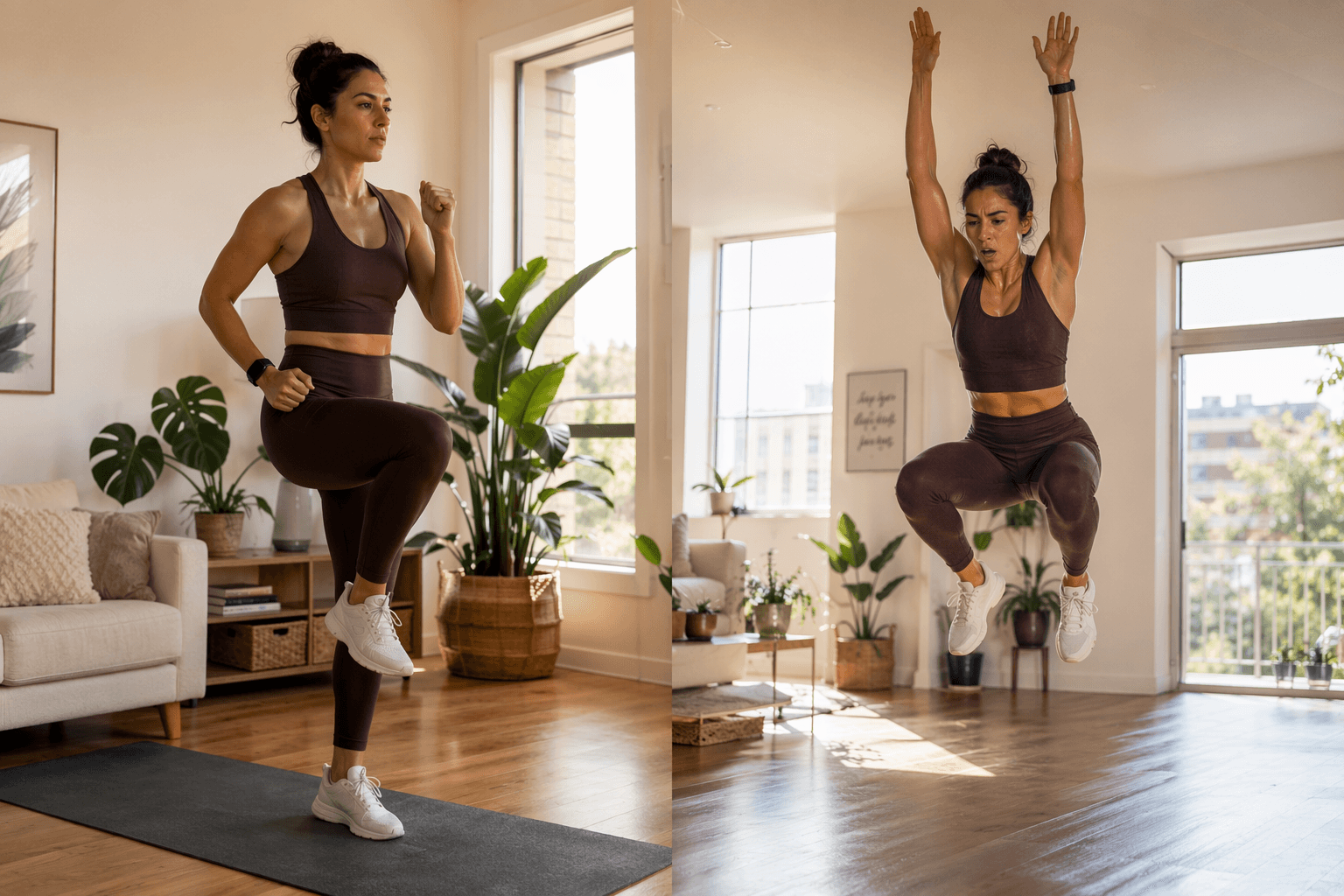
The Vague “Work Harder” Problem
Five minutes into a home cardio session and you’re breathing hard, legs burning, but is that Zone 2 or are you just flailing? At a gym you’d have a speed readout, an incline number, a trainer yelling “push.” At home you have silence and a memory that you should “go harder.” The American Heart Association reports that only about one in five adults and teens get enough exercise to maintain good health. Without clear feedback, people either under- or over-estimate effort. “Work harder” doesn’t help because you don’t have a ruler. What you need is a system that translates the same heart rate zones and perceived exertion used in labs into cues you can feel in your living room. That’s what follows.
No treadmill, no bike, no trainer. Just your body, a few movements, and the willingness to pay attention to how you feel.
Five Zones You Can Feel at Home
Heart rate zones aren’t abstract percentages. They’re physiological states you can learn to recognize. The Cleveland Clinic defines five zones based on percentage of your max heart rate. Below is the same breakdown, but with movement cues and a talk test that work without a monitor.
| Zone | % of Max HR | Feels Like | Home Movement Example | Talk Test |
|---|---|---|---|---|
| Z1: Recovery | 50–60% | Easy walking, barely warm | Slow march in place, swinging arms loosely | Full conversation — you can sing |
| Z2: Aerobic Base | 60–70% | Brisk but controlled, breathing deeper but not gasping | Brisk march in place with active arm drive | You can hum the chorus of a song without gasping |
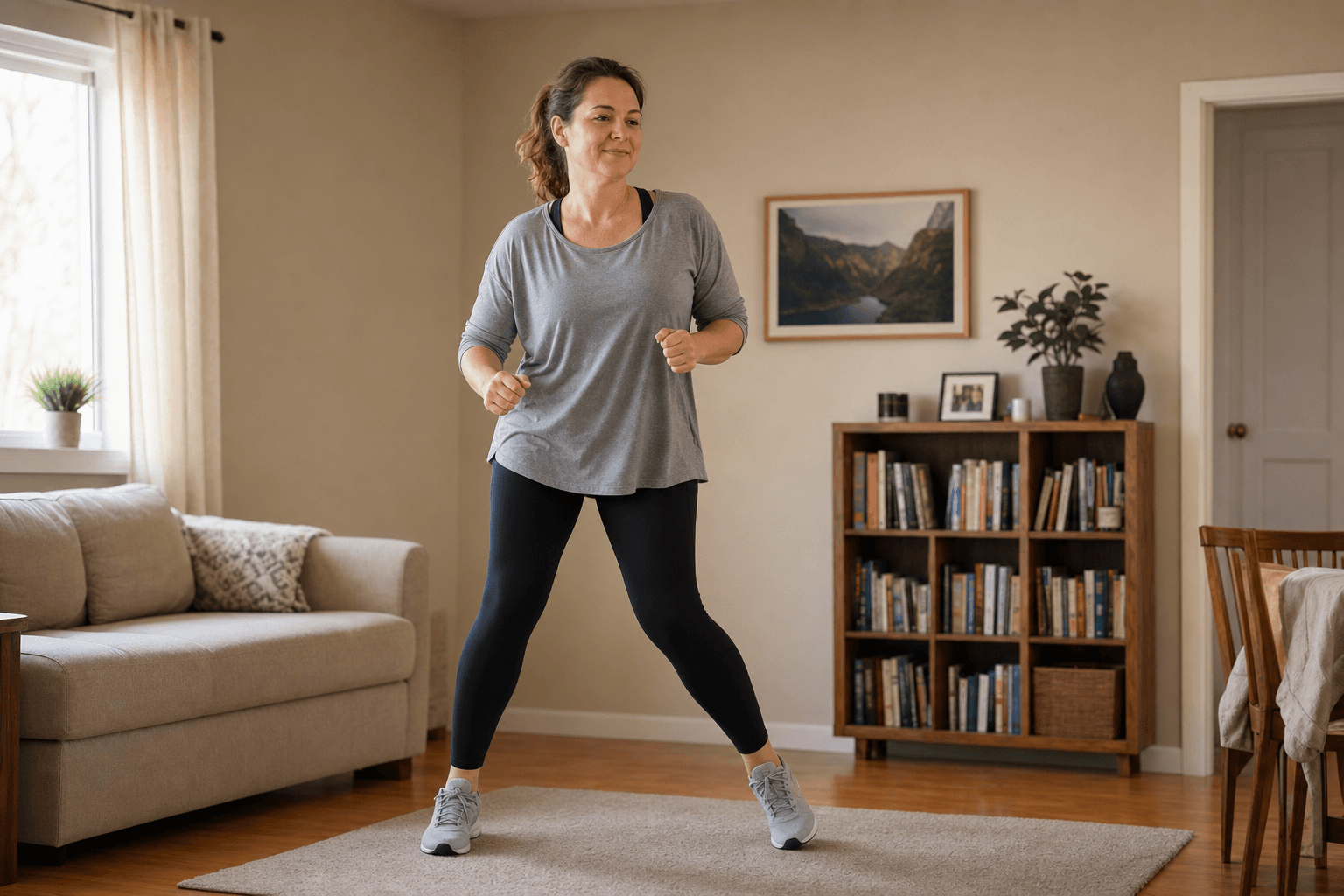
| Z3: Tempo | 70–80% | Moderate push, breathing steady but noticeable | Shuffle side-to-side with light arm pumps | You can say a short sentence but need to pause to breathe |
| Z4: Lactate Threshold | 80–90% | Hard, burning, you want to slow down | Burpee pace — each rep a deliberate effort | Single word per breath (e.g., “yes… yes…”) |
| Z5: Max Effort | 90–100% | All-out, unsustainable for more than a minute | Sprint in place, jump squats max effort | Cannot speak |
Zone 1 and 2 primarily burn fat. Zone 4 and 5 use glycogen and protein. Zone 2 is the sweet spot for building aerobic base. Zone 4 improves lactate threshold and stroke volume – one or two sessions a week is plenty. A warning: the 220-minus-age formula is a population average, not your personal ceiling. It can be off by 10 to 15 bpm either way. Do not treat it as gospel. Use the talk-test calibration below to find your own ranges.
Find Your Max in Your Living Room
You don’t need a lab test. Calibrate your zones at home with a simple effort test and the talk test.
- Warm up 3 minutes: slow march or easy jog in place.
- Perform a hard, sustained effort for 5 minutes – high knees, burpees, jump rope. Push until you can only say one word per breath.
- Immediately take your pulse for 10 seconds (neck or wrist) and multiply by 6. That’s a rough max heart rate. Or note the highest number on a wearable.
- Use that number as your 100% ceiling. For example, max 180 bpm → Zone 2 is 108–126 bpm.
- Validate each zone with the talk test: hum a tune → Zone 1 or 2. Few words before gasping → Zone 3. Speech impossible → Zone 4 or 5.
The talk test is a reliable proxy for zone boundaries. Nike’s RPE-to-talk-test mapping shows conversational effort ≈ RPE 1–3 (Zones 1–2), needing pauses for breath ≈ RPE 3–5 (Zone 3), breathlessness ≈ RPE 7–10 (Zones 4–5).
When You Can’t Look at a Watch: RPE
I use the Rate of Perceived Exertion (RPE) scale – 1 to 10 – especially when my heart rate monitor lags or during intervals. The key is to anchor each level with home-specific body sensations, not just “moderate.”
| RPE | Talk Test | What It Feels Like in Your Body | Home Cardio Example |
|---|---|---|---|
| 1–2 | Full conversation, can sing | Very easy, barely warm | Slow walk in place, gentle arm swings |
| 3–4 | Steady conversation, full sentences | Aware of breathing but not struggling | Brisk march with arm drive |
| 5–6 | Short sentences, need to pause to breathe | Breathing noticeable and rhythmic, slight sweat | Light jog in place or lateral shuffle |
| 7–8 | Single words per breath | Heavy breathing, burning, want to stop | Burpee pace, high knees sprint, jump squats |
| 9–10 | Cannot speak | Maximum effort, can’t maintain more than 30 seconds | All-out sprint in place, explosive jumps |
Medical News Today, drawing on NASM guidelines, maps RPE 3–4 to 65–75% of max HR (moderate) and RPE 5–7 to 76–96% (vigorous). The beauty of RPE is it works even when your watch is on the charger.
Wearables Help, But Don’t Trust Them Blindly
I wear a wearable myself, and I know the temptation to trust that number. But according to the 2026 Create.fit report on fitness tech, optical wrist sensors have error rates as low as 3% during steady-state. That’s decent. But during HIIT, rapid changes challenge the sensors – same report notes energy expenditure errors exceed 30% across all devices. So: use the wearable as a rough guide during steady sessions (Zone 2 marches, Zone 3 jogs) and rely on RPE and talk test during intervals. For serious Zone 4 or 5 work, consider a chest strap or armband – our form factor guide explains why. For deeper accuracy data across workout types, see our tracker accuracy report.
Three percent error is for steady state. During burpees or rapid interval changes, your optical sensor can lag by 10–20 bpm. Cross-check with RPE and talk test before adjusting effort based on a watch number.
A Sample 20-Minute Session
Here’s a session that shifts through zones using RPE and talk test as primary guides. No watch needed.
- Warm-up (3 min): Slow march, RPE 2, can sing. Zone 1.
- Zone 2 block (5 min): Brisk march with arm drive, RPE 4, can hum a song. Breathing deepens but no struggle.
- Zone 3 block (4 min): Lateral shuffles or light jog, RPE 6, can say short sentences. Sweat appears.
- HIIT interval (3 rounds): 30 sec burpee pace (RPE 8, single words), 60 sec recovery walk (RPE 2). Hits Zone 4.
- Cool-down (3 min): Slow walk, arm circles, RPE 1-2. Back to Zone 1.
If you wear a wearable, glance at your heart rate during the steady blocks and note the number. Over time you build a mental map: “When I feel like RPE 4, my HR is usually around 125 bpm.” That makes the talk test even more reliable.
AHA Guidelines: Minimum vs. What You Actually Want
The American Heart Association recommends at least 150 minutes per week of moderate-intensity aerobic activity or 75 minutes of vigorous-intensity. That’s the minimum for basic health. If your goal is endurance, aerobic capacity, or weight loss, you may need more – up to 300 minutes of moderate activity per the Physical Activity Guidelines. Now you have the tools to dose your intensity precisely at home: Zone 2 builds base, Zone 3 challenges lactate threshold, Zone 4 bursts improve capacity. You’re not just working hard; you’re working smart.
Comments
Join the discussion with an anonymous comment.