
Why the once-a-week leg day is a habit, not a plan
Ask most home exercisers how often they train legs, and the answer is almost always “once a week.” That pattern comes from old-school bodybuilding splits – a day for chest, a day for back, a day for legs – not from evidence. It persists because it’s convenient: you block one day, endure the soreness, and feel you’ve done enough. But the evidence has moved on. If you are training legs only once per week, you are almost certainly leaving muscle and strength on the table.
What the Schoenfeld study actually measured
The most direct test of the once-per-week model is a 2015 study in the Journal of Strength and Conditioning Research that compared participants training each muscle group once per week with those training three times per week – while keeping the total weekly load the same. The result: the group that spread their volume across three sessions saw greater muscle mass gains. That is a critical distinction. The advantage was not about doing more total work; it was about distributing that work so that each session triggered another wave of muscle protein synthesis before the previous one had fully decayed.
A summary of the study on Verywell Fit puts it plainly: “participants training three times per week saw greater muscle mass gains than those training once per week, even with the same total load.” The study used trained participants, which actually strengthens the case for intermediate exercisers – if frequency matters for people who already have a base, it almost certainly matters for those still building one.
Why 48 hours between sessions works better
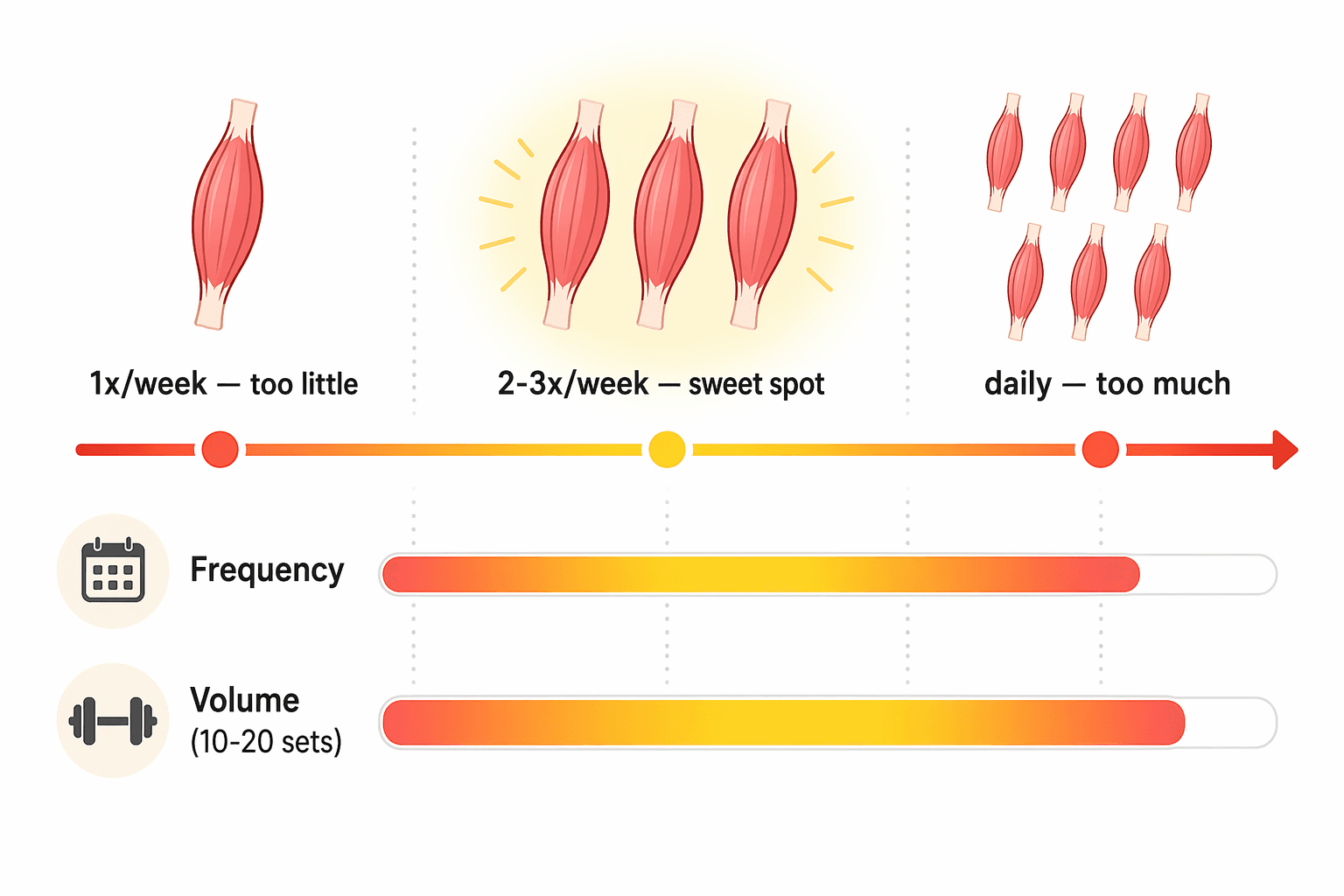
The mechanism is straightforward. After a resistance training session, muscle protein synthesis (MPS) rises sharply for about 24 hours and then returns to baseline within 48 hours. If you train the same muscle group only once a week, you get one MPS spike and then a five-day window of flat growth. If you train twice or thrice a week, you capture multiple spikes within the same recovery period.
That is why Noam Tamir, CSCS, recommends training legs two to three times per week with at least 48 hours between sessions. The 48-hour window is not arbitrary – it aligns with the typical MPS decay curve and with practical recovery from hard leg training. A Monday-Thursday or Tuesday-Friday split fits neatly into most weekly calendars.
Volume: the 4–10–20–30 rule – with context
Frequency tells you how often to train. Volume tells you how much work to do when you get there. The two are linked – you cannot pile 20 sets of squats into a single session and call it a week, but you can spread them across Monday and Thursday and thrive.
A 2024 systematic review cited in Men’s Health UK gives us three meaningful volume tiers for hypertrophy in trained lifters:
| Volume Tier | Sets per muscle group per week | Who it serves | Primary limitation |
|---|---|---|---|
| Minimum effective dose | 4 | Absolute beginners, maintenance, or high-recovery constraints | May not produce meaningful growth for most people; stops short of the reliable range |
| Sweet spot | 10-20 | Most lifters with hypertrophy goals | Requires proper load selection and progression; not directly applicable to pure strength or endurance goals |
| Advanced | 30-40 | Advanced lifters with years of training | Diminishing returns for most; higher injury risk; impractical for many home setups |
The 4-set minimum is the floor, not a target. If you are doing 4 sets and stopping, you are likely undershooting. The 10-20 range is the reliable zone for most home lifters aiming for hypertrophy. But this comes from research on trained lifters – if you are a beginner, you may respond to less. And if your goal is strength or endurance, the volume will need to shift. These numbers are starting points, not commandments.
One more thing: frequency and volume don’t matter if you are not recovering. If you ramp up to 3 sessions and 20 sets per week and notice persistent soreness, declining performance, or trouble sleeping, scale back. Drop a session or reduce sets. The evidence provides a range, but your body sets the limits.


Comments
Join the discussion with an anonymous comment.