
The first question I hear from apartment dwellers is always the same: "I need cardio that won't make my downstairs neighbor bang on the ceiling." My first reply is not an exercise list. It's a clarification: this article is for full-body cardio, not leg-day strength. If you want stronger legs, I have you covered — that's a separate piece. But if you want your heart rate up, your lungs working, and zero jumping, keep reading.
What This Article Is (and Isn’t)
The site already has a strong Apartment-Friendly Leg Day routine that uses sliders, tempo, and bands for lower-body strength. This article shares the "no jump" premise but targets cardiovascular conditioning through compound movements performed at high work-to-rest ratios. If you want stronger legs, go there. If you want better endurance, stay here.
Why “Quiet” Routines Fail
I’ve seen too many people string together a few gentle moves—arm circles, slow lunges—and call it cardio. It isn’t. The American Heart Association reports that only about one in five adults meets the minimum activity guidelines (at least 150 minutes of moderate or 75 minutes of vigorous activity per week). That gap isn’t because people aren’t moving; it’s because they aren’t moving with enough intensity.
The numbers make this concrete. According to Harvard Health, a 155-pound person burns 162 calories in 30 minutes of moderate calisthenics but 306 calories in 30 minutes of vigorous calisthenics. Nearly double. The difference isn’t the exercises—it’s the effort. Without a structure that forces you to work hard enough, you can spend twenty minutes on the floor and barely nudge your heart rate.
So what makes the difference? Two things: using compound multi-joint movements, and organizing them into protocols with specific work-to-rest ratios.
The Mechanism: Compound Movements Replace Impact
The core mechanism comes from Noam Tamir, CSCS, founder of TS Fitness, who told Self: "When you jump, you are using a lot more force—it's multiple times your bodyweight… doing moves that are multijoint, where hips, knees, shoulders, and everything is involved, are going to be more beneficial to get your heart rate up when you can't do impact."
"When you jump, you are using a lot more force—it's multiple times your bodyweight… doing moves that are multijoint, where hips, knees, shoulders, and everything is involved, are going to be more beneficial to get your heart rate up when you can't do impact." — Noam Tamir, CSCS
Compound movements—squats, lunges, push-ups, mountain climbers—engage large muscle groups continuously. Your muscles demand oxygen, your heart pumps faster, your breathing quickens. The result is genuine cardiovascular demand without a single plyometric impact. The key is to sustain that demand through the work interval and then recover just enough during rest.
Three Protocols That Actually Work
A list of exercises alone won’t get you there. You need a protocol that dictates work duration and rest. These three formats are proven to elevate heart rate when performed with compound movements.
- Tabata: 20 seconds of work, 10 seconds of rest. Repeat for 8 rounds (4 minutes total per exercise pair). RPE 5–7. Ideal for a quick, intense hit.
- EMOM (Every Minute on the Minute): Perform a set number of reps in 40–50 seconds, rest the remainder of the minute. RPE 4–6. Good for building capacity without total exhaustion.
- AMRAP (As Many Rounds As Possible): In a fixed time (5–10 minutes), complete as many rounds of a circuit as you can. RPE 4–7. Easy to scale by adjusting time or moves.
| Protocol | Work/Rest | RPE Range | Best For |
|---|---|---|---|
| Tabata | 20s / 10s | 5–7 | Short, intense bursts |
| EMOM | 40–50s / 10–20s | 4–6 | Building capacity |
| AMRAP | Variable fixed time | 4–7 | Scalable endurance |
You can adjust intensity without jumping: increase range of motion, reduce rest by 5 seconds, add a pause at the top of a squat, or move faster through the concentric phase. These levers make the same exercise harder or easier without changing the impact load.
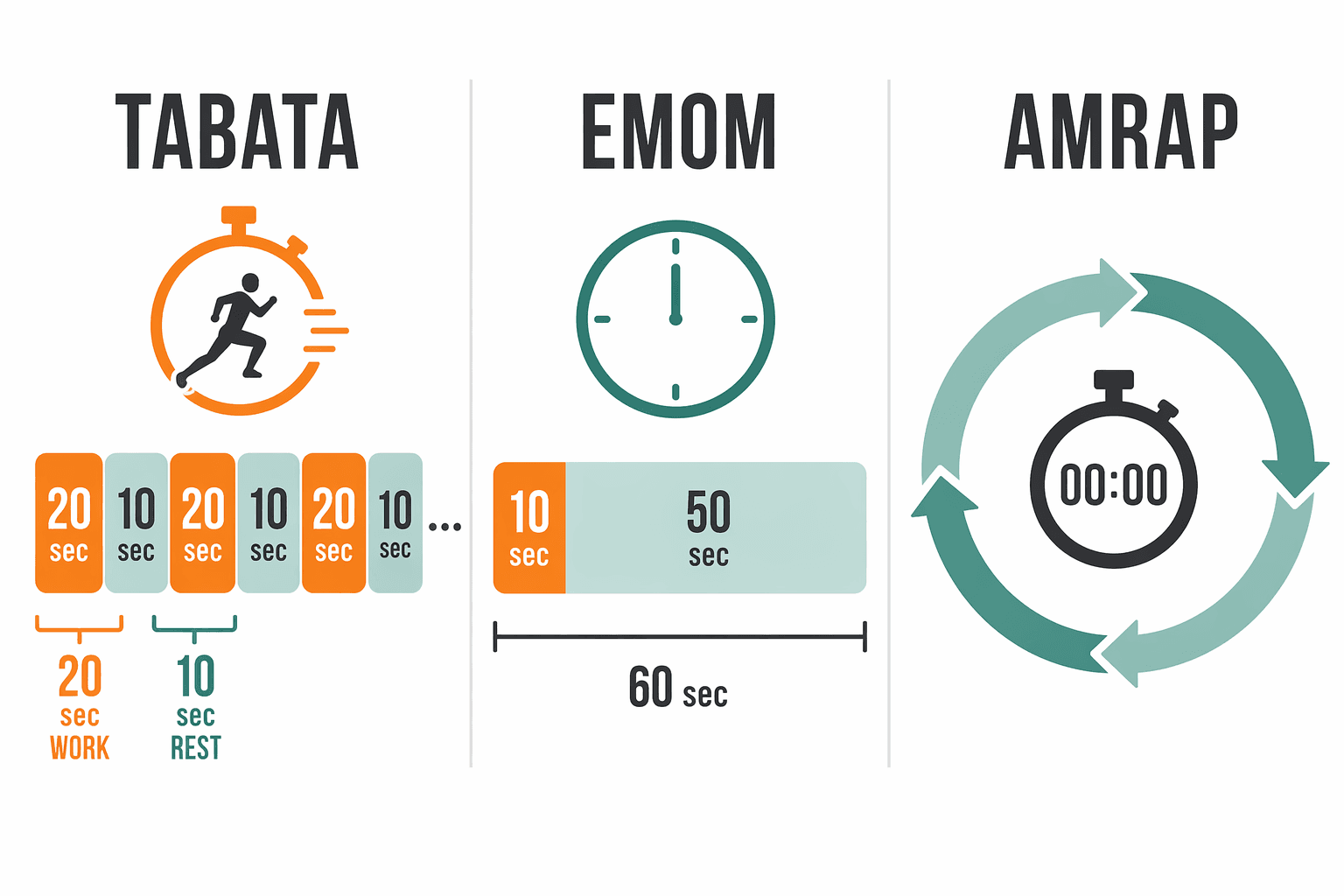
A 2015 study in the Journal of Sports Science and Medicine found that after eight weeks, VO₂max improved similarly across steady-state (+19%), Tabata (+18%), and a moderate-intensity protocol (+18%). But the Tabata group found it significantly less enjoyable. That matters: enthusiasm drives consistency. The study showed enjoyment declined over time for all groups, but the less enjoyable protocols are harder to stick with. So I offer the EMOM and AMRAP as more sustainable alternatives — they work just as well and won’t make you dread your workout.
The Routine: Warm-Up, Circuits, and Progression
Time to put it into action. This workout takes about 25–30 minutes total. No equipment needed. A yoga mat helps for floor moves.
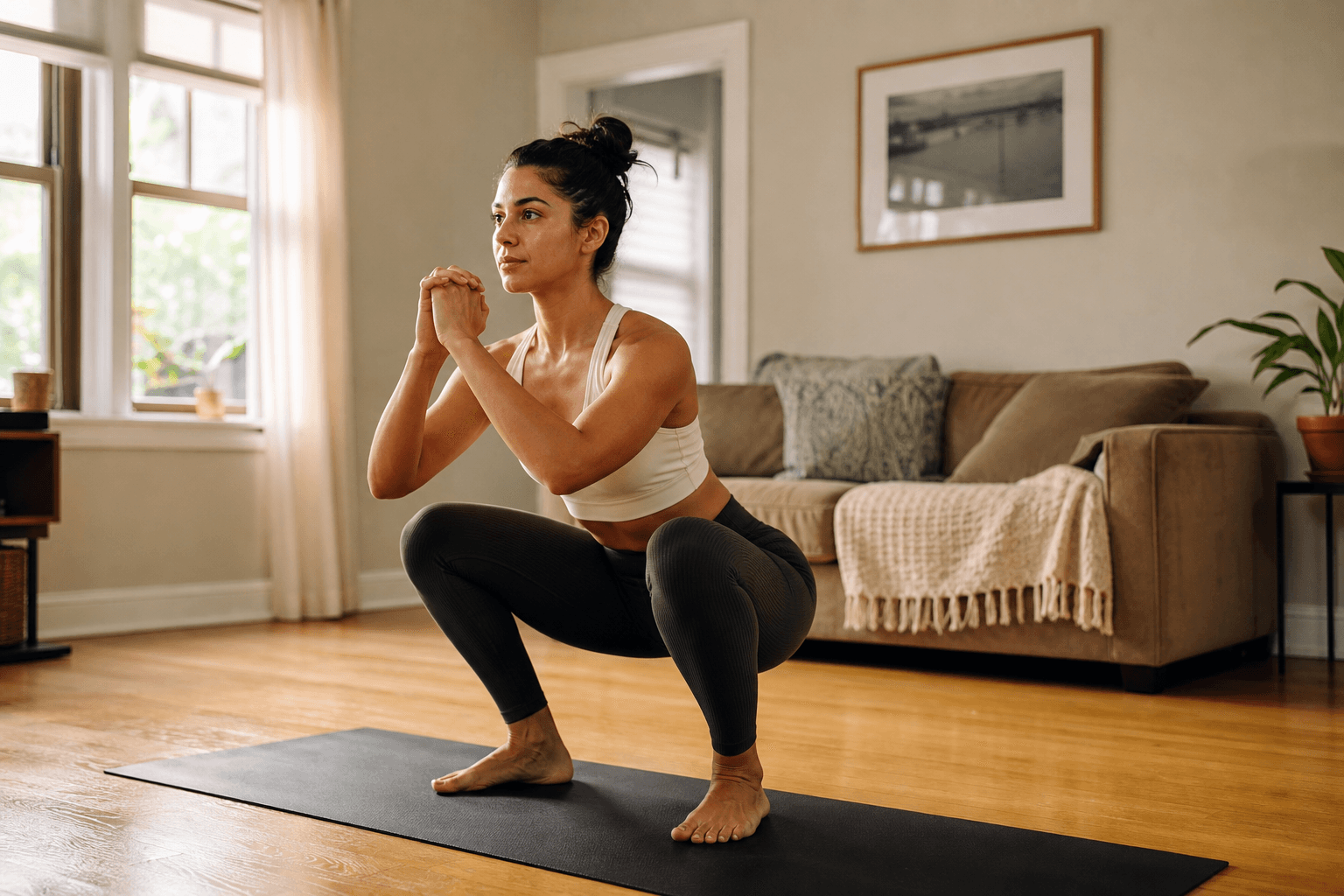
- Warm-Up (5 minutes): Controlled mobility—arm circles, cat-cow, slow bodyweight squats, walking hip openers. Keep moving, no static stretching.
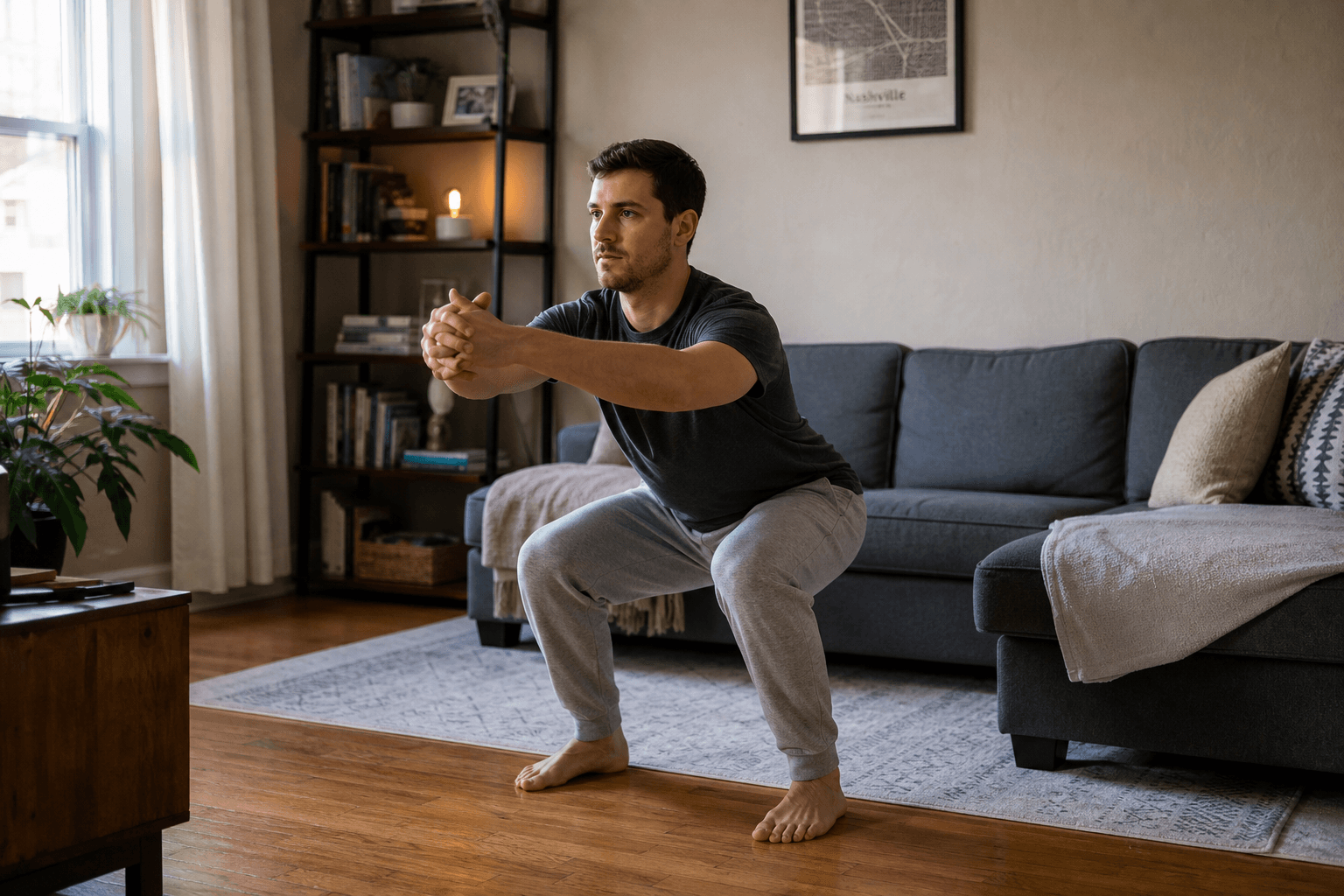
- Tabata Starter (8 minutes): Bodyweight squats (20s on, 10s off) x4 rounds, then push-ups (20s on, 10s off) x4 rounds. Rest 60 seconds between the two blocks.
- Circuit 1 – Strength-Endurance (6 minutes): Lateral lunges (40s work, 20s rest), superman holds (40s work, 20s rest), downward-dog mountain climbers (40s work, 20s rest). Repeat for 3 rounds.
- Circuit 2 – EMOM (10 minutes): Alternate between squat jumps (no jump version: toe raises + squat pulse) and high plank hold. Each exercise: 45 seconds of work, then 15 seconds rest to complete the minute. Do 5 rounds.
- Circuit 3 – AMRAP (5 minutes): Perform as many rounds as possible of 10 bodyweight squats, 5 push-ups, 5 superman holds (3 seconds each), 10 mountain climbers (each leg). Rest only as needed.
If you're a beginner, reduce the work intervals by 5–10 seconds or take longer rest. For progression, increase the number of rounds or add a pause at the bottom of each squat.
A Weekly Schedule That Meets the Guidelines
The American Council on Exercise recommends limiting high-intensity interval training to one or two sessions per week to avoid overtraining and burnout. Here's a schedule that meets the AHA guidelines while respecting that limit:
| Day | Activity | Duration |
|---|---|---|
| Monday | Low-impact HIIT (Tabata or EMOM) | 20–25 min |
| Tuesday | LISS walk or active recovery | 30–40 min |
| Wednesday | AMRAP circuit | 20 min |
| Thursday | Active recovery | 20–30 min |
| Friday | Low-impact HIIT (EMOM) | 20 min |
| Saturday | LISS walk or light hike | 40–60 min |
| Sunday | Rest | — |
This schedule gives you two HIIT sessions and three days of lower-intensity movement, totaling well over 150 minutes of moderate activity (or 75 minutes of vigorous) per week. The Harvard Health calorie estimates suggest you could burn roughly 800–1,200 calories across the HIIT sessions alone — though note these are MET-based estimates, not direct measurements. Individual results vary by effort and body composition.
If you want to add lower-body strength, the Apartment-Friendly Leg Day routine fits neatly on Tuesday or Thursday in place of LISS. For active recovery ideas, see the Active Recovery at Home guide. And if you prefer guided follow-along, the Best Workout Apps roundup includes apps with low-impact cardio tracks.
Low-impact cardio works when you engineer it to work. Pick your protocol, push your RPE, and your neighbors will never know the difference.
Comments
Join the discussion with an anonymous comment.