
Why Rest Days Feel Like a Waste
I used to treat rest days like empty calendar slots: something to fill, or else I was wasting time. If I wasn’t working out, I wasn’t getting fitter. That logic is wrong, and it’s why so many home exercisers either skip rest days or feel guilty when they take one. The barrier isn’t time. It’s that no one handed you a protocol.
Without proper rest you risk overtraining and miss the adaptations your workout was supposed to build. Houston Methodist trainers say that much. The fix isn’t more passive sitting — it’s active recovery: light, structured activity that helps your body absorb training stimulus rather than just endure it. ACE Fitness’s Dr. Erin Nitschke calls recovery methods supportive performance modalities — they support the work, they don’t do it for you.
Most people are willing. They just don’t have a clock and a count. So let me hand you both.
What Active Recovery Actually Does (and How Hard to Go)
Active recovery increases blood flow to tissues, clears metabolic waste, and dulls delayed-onset muscle soreness. A 2018 ACE-commissioned study by St. Pierre et al. found that active recovery lengthened time to fatigue in trained athletes. The effect in home beginners is probably modest, not dramatic. But it still works.
The intensity rule is simple: keep your heart rate at 30–60% of your max. That’s the conversational pace. If you can’t hold a normal conversation, you’re working too hard. If you can sing, nudge it up a little.
Foam rolling? A 2018 study by Ozsu et al., cited by NASM, confirms it can reduce DOMS onset. And ACSM recommends 5–10 minutes of low-intensity cardio post-workout to gradually lower heart rate. Those are the building blocks of the templates below.
Four Session Templates — Pick One for Your Next Rest Day
Each template assumes a yoga mat, a foam roller, and a resistance band. If you have less, I include substitution notes. Pick one and follow it exactly. No guessing.
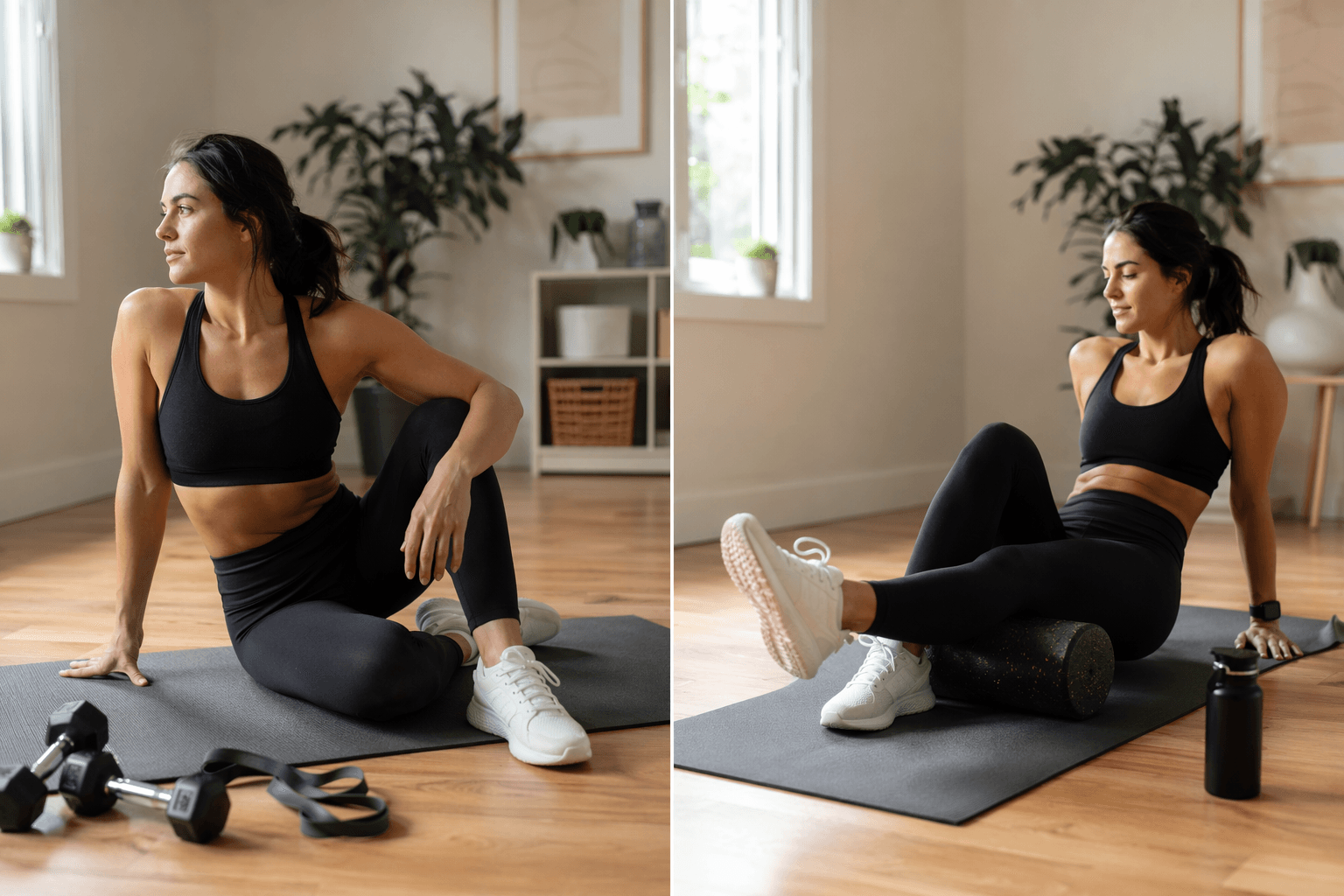
Template 1: 30-Minute Low-Intensity Cardio
- 0–5 min: Walk or cycle at an easy pace. Heart rate should feel like you are moving, not working.
- 5–25 min: Maintain conversational pace. Indoors? Alternate walking and light jogging, or use a stationary bike at low resistance.
- 25–30 min: Cool down with slower movement and light arm circles. Stop when your breathing is fully normal.
No treadmill? Walk briskly around your block or march in place. The goal is movement, not distance.
Template 2: 20-Minute Foam-Rolling Protocol
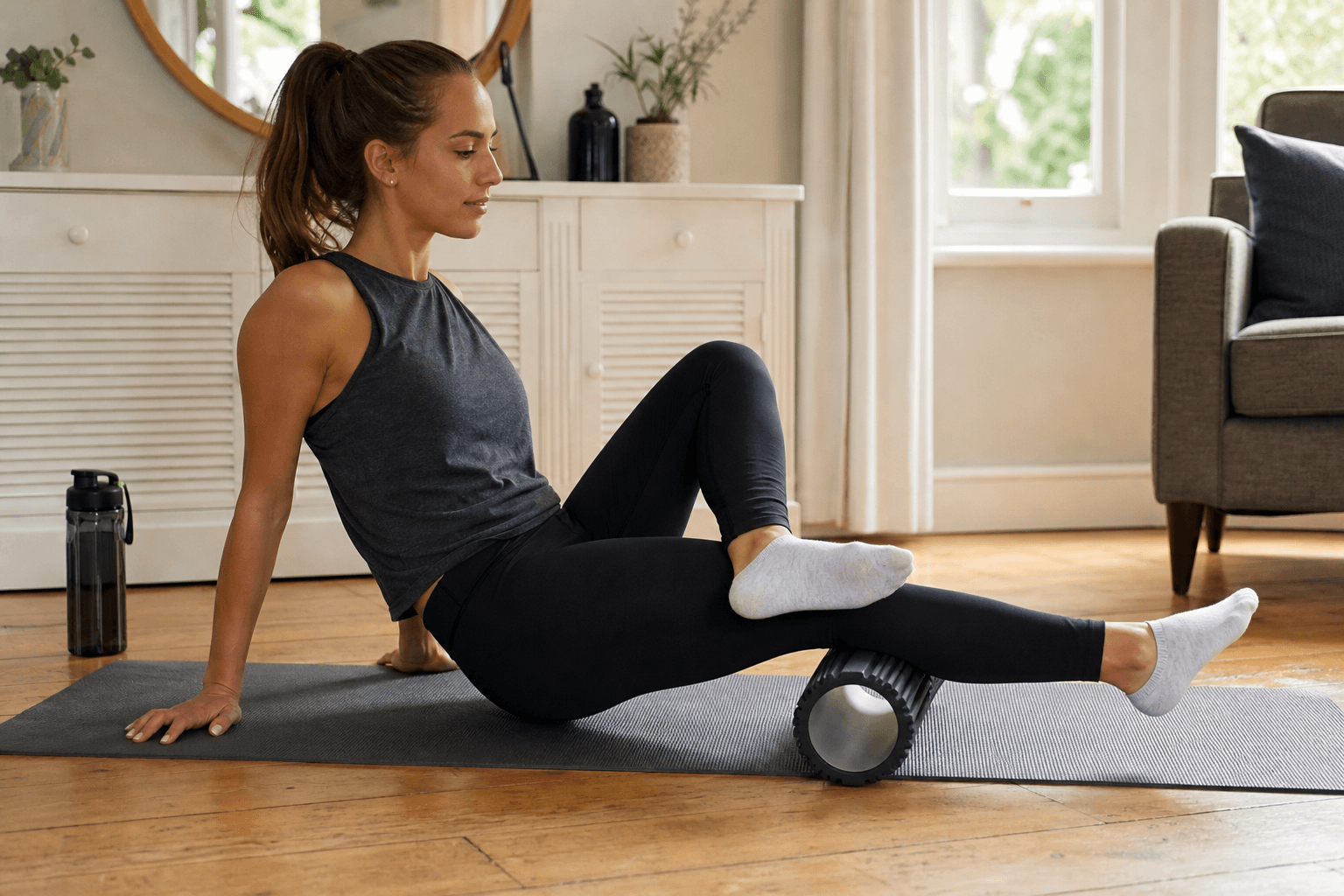
Roll each area for 60 seconds, then switch. Breathe normally — if you are holding your breath or grimacing, lighten the pressure. The sequence:
- Calves (2 min total — 1 min per leg)
- Quads (2 min total — 1 min per leg, roll from hip to just above knee)
- Glutes (2 min — sit on roller, roll one side at a time)
- Upper back (2 min — lie back on roller, arms crossed, roll from shoulders to mid-back)
- Repeat the cycle once (10 more minutes)
Template 3: 15-Minute Resistance Band Mobility Circuit

Use a light to medium resistance band. Perform each movement for the specified time, then immediately move to the next with no rest. Rest 1 minute after completing all four, then repeat the circuit once.
- Banded glute bridges (2 min) — band just above knees, squeeze glutes at top, lower slowly.
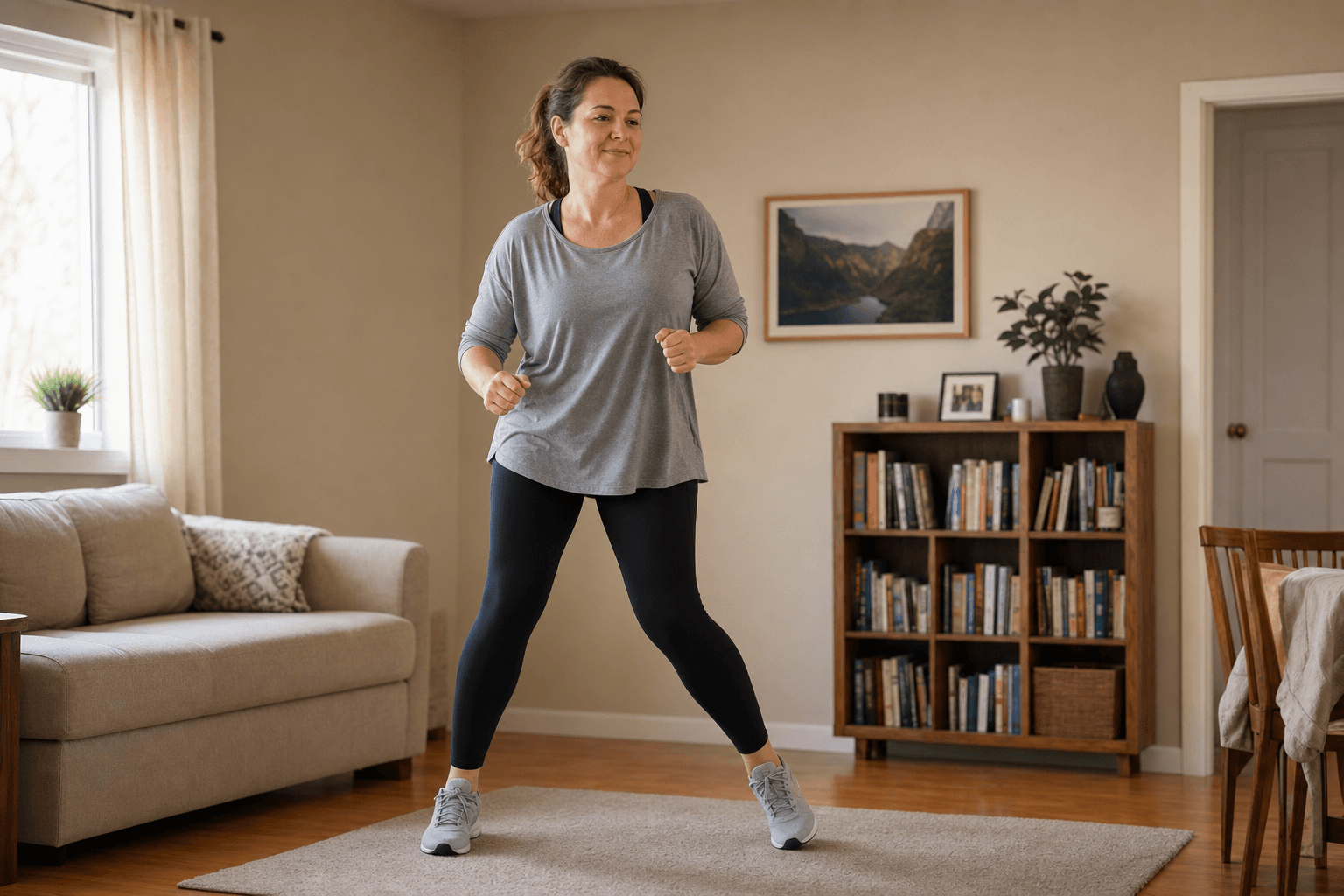
- Lateral walks (2 min) — band around ankles, take controlled steps sideways, stay low in a partial squat.
- External rotations (2 min per side) — band around ankles, rotate one foot out against the band, return.
- Reverse flys (2 min) — hold band in front of chest with arms straight, pull hands apart, squeeze shoulder blades.
Template 4: 10-Minute Cool-Down Sequence
This is the one you should do immediately after every workout, but it also works as a standalone rest-day reset. Based on the ACSM recommendation of 5–10 minutes of low-intensity cardio plus stretching:
- 0–3 min: Slow walking or marching in place with arm swings.
- 3–6 min: Standing hamstring stretch (30 sec each leg), quad stretch (30 sec each), child's pose (60 sec).
- 6–10 min: Deep breathing — inhale for 4 counts, hold 4, exhale 6. No movement, just letting the heart rate settle.
Cleveland Clinic notes that 5–10 minutes of stretching during cool-down is associated with fewer complaints of muscle soreness and fewer injuries. This is your baseline — the full templates are longer because they address the whole body.
How to Schedule Active Recovery Into Your Week
Active recovery replaces a full rest day or sits between harder sessions. Here is how I fit it into three common home-training splits. Treat these as calendar blocks, not suggestions.
- 2-day strength split: Train Monday and Thursday. Active recovery on Wednesday (choose Template 1 or 2) and optional on Saturday (Template 3).
- 3-day strength split: Train Monday, Wednesday, Friday. Active recovery on Tuesday (Template 2 or 4) and Sunday (Template 1).
- 4-day strength split: Train Monday, Tuesday, Thursday, Friday. Active recovery on Wednesday (Template 3) and Saturday (Template 1). Sunday is full passive rest.
If you are unsure which template to use on a given day, ask yourself: do I feel stiff but not sore? Pick mobility (Template 3). Do I feel generally tired but not in pain? Pick light cardio (Template 1). Do I feel specific muscle soreness? Foam roll (Template 2).
Common Mistakes (Going Too Hard, Skipping, Confusing It With a Workout)
Three specific errors I see again and again — and how to catch yourself.
- Going too hard. If you finish your foam rolling session breathing hard, you are doing it wrong. The pace should feel restorative, not challenging. If your heart rate rises above conversational level, you crossed the line into workout territory.
- Skipping active recovery entirely. The most common reason I hear: "I don't have time." But a 15-minute mobility circuit replaces a 45-minute gym session — it frees time, it does not consume it. The real barrier is not time; it is not having a specific plan. You now have four.
- Confusing active recovery with a workout. If you do a full HIIT session and call it "active recovery," you are just training twice. Active recovery is low intensity by definition. If you cannot hold a conversation, stop.
What Active Recovery Can’t Do
Active recovery is a tool, not a miracle. It will not cancel a week of missed sleep. It will not transform a poor diet into gains. The St. Pierre study showed a measurable but modest effect on time to fatigue — and that was in trained athletes. For a beginner at home, the effect is likely smaller.
The Takeaway: You Now Have a Protocol
The main barrier to active recovery is not time or motivation. It is the absence of a specific, followable plan. You now have four. Choose one, set a timer, and do it on your next rest day. That is all it takes to turn a wasted day into a productive recovery session.
No more guessing. No more guilt. Just a clock and a count.
Comments
Join the discussion with an anonymous comment.