
A beginner does the same full body dumbbell workout as a more experienced friend. The beginner wakes up so sore that squatting onto the toilet requires a strategy session. The friend is not sore at all, but has not added weight in eight weeks. Both are stuck—one from overreaching, the other from plateaus. The problem is not the workout itself. It is that the same workout cannot serve two different nervous systems, recovery capacities, and strength baselines at the same time.
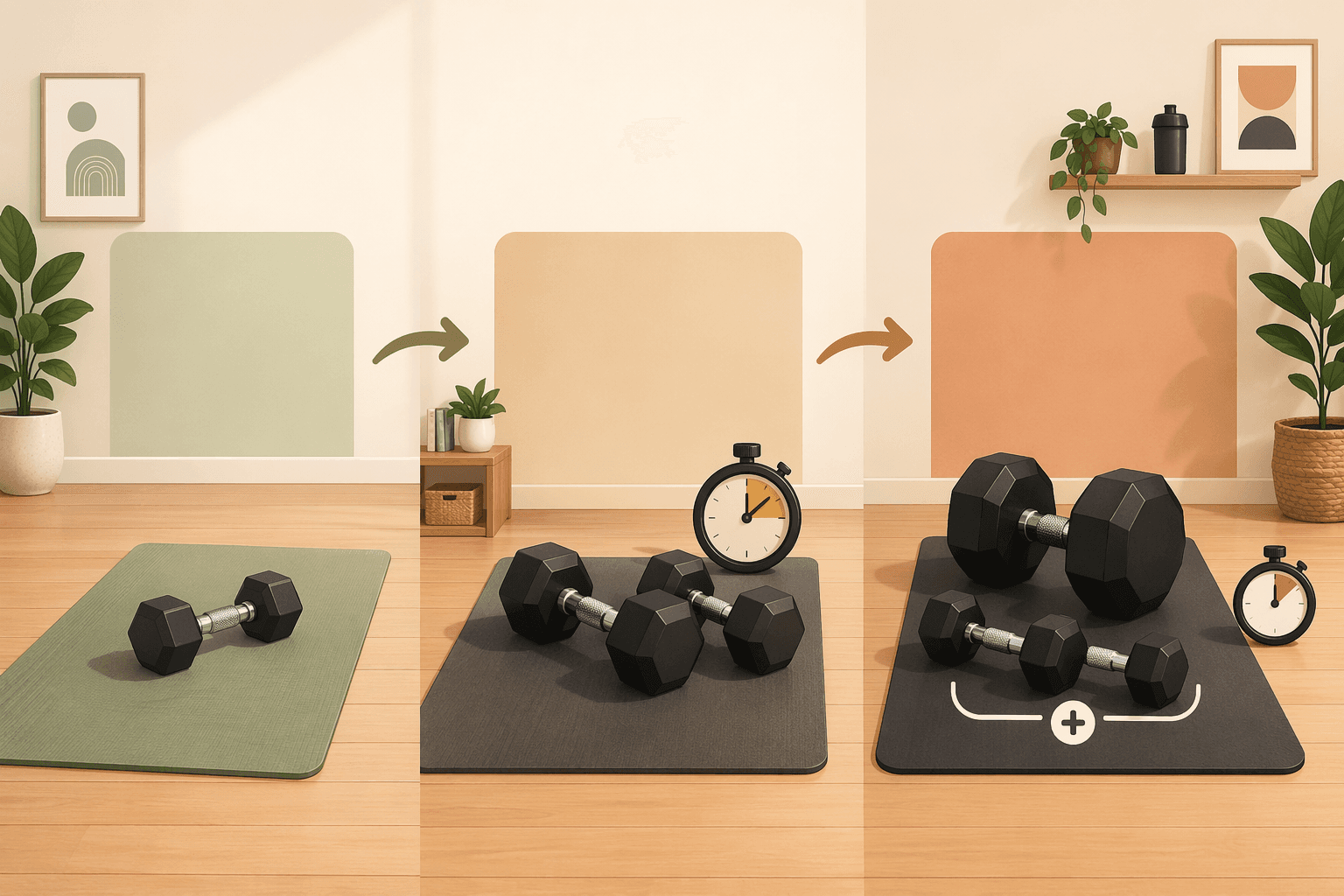
I see this pattern constantly. Someone prints a three-set-of-ten template and wonders why it stops working. The fix is not a new exercise list. It is a system that changes the core variables—weight, sets, rest, and proximity to failure—depending on where you are. Below I lay out three separate prescriptions for beginner, intermediate, and advanced lifters, with the research behind each dial and a concrete rule for knowing when it is time to move up.

The research that separates the three tiers
Most articles hand you one set of numbers and call it done. That one-size-fits-all prescription works for roughly nobody in the long run. Beginners need low volume and generous recovery to build neural drive and joint resilience. Intermediates need heavier loads and longer rest to push strength. Advanced lifters need higher volume and shorter rest to stimulate hypertrophy and metabolic stress. Ignoring those differences leads to either burnout or stalled progress.
I rely on several studies to set the dials for each tier. The most actionable is the rest-interval research by de Salles et al. (Sports Medicine, 2009). It found that resting three to five minutes between sets maximizes strength gains, while resting 30 to 60 seconds optimizes hypertrophy. That single split tells us that an intermediate lifter chasing strength should rest much longer than an advanced lifter chasing hypertrophy. That is the backbone of my tiered prescriptions.
A 2017 study in Frontiers in Physiology compared multi-joint (compound) exercises to single-joint exercises. Over eight weeks, the compound group improved VO₂max by 12.5% versus 5.1% in the single-joint group, and got better strength gains on the bench press, knee extension, and squat. That is why all three tiers stick to compound lifts—goblet squat, dumbbell bench press, bent-over row, overhead press, deadlift. The principle holds whether you use a barbell or dumbbells.
A 2022 review in Sports Medicine confirmed that even 20-pound dumbbells, used at higher frequency, can improve strength and reduce cardiometabolic risk. That finding matters most for beginners who worry they need heavy weights. You do not.
What a beginner actually needs
If you are new to strength training, your first job is not to maximize muscle growth. It is to build consistency, learn movement patterns, and let your connective tissue adapt. Overdoing volume or intensity early is the fastest way to quit.
The REP Fitness guide (NASM-certified) recommends beginners train full body two to three times per week with 48 hours between sessions, using 8 to 15 reps per set and leaving one to two reps in the tank (1–2 RIR). I use that RIR guideline as the primary safety dial: stop when you feel you could do one or two more reps, not when your form collapses.
The Garage Gym Reviews beginner template calls for 2–3 sets of 10 reps with rest as needed. That is a fine starting point, but I would treat it as a floor, not a prescription. If the last two reps feel easy, bump the set count or the rep target. The RIR rule gives you a tighter lever. When you can hit 15 clean reps on every set for two weeks straight, you are ready for the next tier.
| Variable | Beginner Prescription |
|---|---|
| Frequency | 2–3× per week, 48h rest between |
| Sets | 2–3 per exercise |
| Reps | 8–15 (stop at 1–2 RIR) |
| Rest between sets | As needed (2–3 min typical) |
| Load | Light enough that rep 8–15 feels challenging but clean (20–30 lbs is fine) |
| Exercises | Goblet squat, dumbbell bench press, bent-over row, overhead press, deadlift (or RDL) |
| Goal | Consistency, neural adaptation, joint preparation |
The 2022 Sports Medicine review is your reassurance: even 20-pound dumbbells, used consistently, produce meaningful strength and cardiometabolic improvements. Do not worry about buying heavier weights until you can complete 15 reps on all sets with good form.
Intermediate: longer rest, heavier weight, less room in the tank
Once you have been training consistently for six months or more and can complete all beginner reps cleanly, it is time to shift the dials. The intermediate tier prioritizes strength, so rest intervals go up and RIR goes down.
The rest-interval research says three to five minutes between sets for strength. The Garage Gym Reviews intermediate table prescribes 2–3 sets of 12 reps at 60–75% of your one-rep max with three minutes rest. I adopt that, but I tighten the RIR to 0–1 reps in the tank. You should be reaching the point where the last rep grinds but does not break form. That is how strength happens.
You can still use the same five compound exercises, but add complexity where appropriate: alternating lunges, single-arm dumbbell rows, and a slight tempo (e.g., two-second lower, explosive up) increase the challenge without needing more weight.
| Variable | Intermediate Prescription |
|---|---|
| Frequency | 3× per week, 48h rest |
| Sets | 3 per exercise |
| Reps | 10–12 (0–1 RIR) |
| Rest between sets | 3 minutes |
| Load | 60–75% 1RM (increase by 5–10 lbs when you hit 12 reps on all sets) |
| Exercises | Same compounds, add alternating lunges or single-arm row |
| Goal | Strength progression, hypertrophy stimulus |
Advanced: short rest, high density, supersets
Advanced lifters who have been training for more than a year and can handle heavier loads often need to shift the focus toward hypertrophy and metabolic stress to keep progressing. That is where the 30–60 second rest interval from de Salles comes in.
The Garage Gym Reviews advanced template calls for 3–4 sets of 10 reps with 60 seconds rest and optional supersets. I agree with the structure, but I add a RIR target of 0–1 and encourage superset pairings (e.g., goblet squat superset with bent-over row) to keep density high without extending the session.
| Variable | Advanced Prescription |
|---|---|
| Frequency | 3–4× per week, 48h rest or split across 4 days |
| Sets | 3–4 per exercise |
| Reps | 8–10 (0–1 RIR) |
| Rest between sets | 60 seconds (30–60 sec range) |
| Load | Heavy enough to reach failure at rep 10 (increase when you hit 10 on all sets) |
| Exercises | Same compounds, use superset pairings |
| Goal | Hypertrophy, density, metabolic conditioning |
I should mention that the decision to stay with full body at this level is backed by some evidence. A 2024 study in the European Journal of Sport Science compared full-body and split training in 23 experienced lifters over eight weeks. The full-body group achieved significantly greater fat mass reductions and reported up to 7.5 times less lower-body muscle soreness. That is one study, not a rule, but it is a compelling reason to stick with full body if recovery is a constraint.
The rule that actually tells you when to level up
Most articles give you a tiered table but no rule for when to advance. Here it is.
For example, a beginner working with 20 lbs does goblet squats for 2 sets of 8–15 reps. After several sessions, she hits 15, 15. Next session, 15, 15 again. That is the signal to move to 25 lbs and start at 8 reps again. The same logic applies to intermediate (12 reps) and advanced (10 reps). This rule is a coaching heuristic, not a research finding, but it is grounded in the concept of RIR and progressive overload.
I like the example from Bony to Beastly: start at 50 lbs × 10,10,9 reps. Next week hit 10,10,10. Then increase to 55 lbs and repeat. Tracking your last rep's difficulty is the simplest way to apply the rule.
- Track every set's rep count and note if the last rep was grind-y or smooth.
- When you hit the top of the rep range on all sets for two consecutive workouts, increase weight.
- If you cannot complete at least the bottom of the rep range (e.g., only 6 reps instead of 8), the weight is too heavy—go back down.
How to use this today
Here is the decision framework. Self-assess: if you are new and can only do 1–2 sessions per week, start with the beginner tier. If you have been training 6+ months and can hit 12 reps on most exercises with good form, try intermediate. If you have been lifting over a year and are stalling on intermediate, move to advanced. Pick the prescription, start your next workout, track your reps, and apply the two-consecutive-session rule.
If you prefer a pre-built 6-week schedule with separate tracks, check out the 6-Week Full Body Dumbbell Workout Plan. This article complements it by explaining the 'why' behind each level and how to self-assess for advancement.
The numbers here are a template. Individual recovery, joint health, and time constraints mean you may need to adjust rep ranges or rest intervals slightly. That is fine. What matters is that you have a clear framework for making those adjustments—and a concrete rule for knowing when it is time to push forward.


Comments
Join the discussion with an anonymous comment.