
Why You Don’t Need a Paid App to Build a Great Workout Plan
If you searched for a "workout planner free" because you assumed a quality plan requires a subscription, here is the reality: the logic behind an effective weekly schedule is a straightforward framework you can learn in about ten minutes. Algorithms and AI coaches are convenient, but they are not necessary. The core decisions — what goal to pursue, how many days to train, which exercises to pick, and how to know when you are getting stronger — are all choices you can make yourself with a little guidance.
This guide walks you through a five-step process to build your own personalized weekly plan using nothing more than a notebook, a free spreadsheet, or a genuinely free browser tool. You will end up with a plan that fits your schedule, your equipment (even if that is just bodyweight), and your space. No paywalls, no sign-up required, and no algorithm deciding what is best for you.
Step 1: Define Your Primary Goal
Before you write down a single exercise, you need a clear, single goal. Trying to pursue "get stronger, lose fat, and improve endurance" all at once usually leads to a plan that does none of them well. For a beginner, picking one primary focus simplifies every decision that follows.
Here is how your goal directly shapes your training variables:
| Goal | Rep Range | Rest Between Sets | Exercise Focus | Weekly Frequency |
|---|---|---|---|---|
| Build Strength | 5–8 reps | 90–120 seconds | Compound lifts (squat, hinge, push, pull) | 3–4 days |
| General Fitness / Muscle Tone | 8–12 reps | 60–90 seconds | Mix of compound and isolation | 3 days |
| Fat Loss / Conditioning | 10–15 reps | 30–60 seconds | Full-body circuits, minimal rest | 3–4 days |
If you are unsure, choose "General Fitness." It is the most forgiving starting point and allows you to build a foundation of strength and endurance before specializing later.
Step 2: Assess Your Schedule, Equipment, and Space
A plan only works if it fits into your actual life. Before choosing exercises, take five minutes to audit three constraints: time, equipment, and space.
How Many Days Can You Commit?
The U.S. Department of Health and Human Services recommends at least 150 minutes of moderate-intensity aerobic activity or 75 minutes of vigorous-intensity activity each week, plus muscle-strengthening activities on two or more days. That two-day minimum is your baseline. For most beginners, three days per week is the sweet spot — enough frequency to see progress without overwhelming your schedule.
- 2 days per week: Minimum effective dose. Works best with a full-body split.
- 3 days per week: Ideal for most beginners. Allows for a full-body or upper/lower split.
- 4 days per week: Optimal for faster progress. Requires an upper/lower or push/pull/legs split.
What Equipment Do You Have?
You do not need a gym full of machines. The most effective home plans use one of three setups:
- Bodyweight only: Squats, lunges, push-ups, rows (using a table), planks, and glute bridges. Requires zero investment.
- Dumbbells (one pair, adjustable preferred): The most versatile home gym tool. Covers all six movement patterns.
- Resistance bands: Lightweight and space-efficient. Good for pulling exercises and adding variable resistance.
What Is Your Space Like?
You need roughly a 6x6 foot area to perform most exercises safely. A living room corner, a bedroom floor, or a garage bay all work. If ceiling height is a concern, avoid overhead pressing and jumping movements. If noise is an issue (apartment living), prioritize bodyweight and dumbbell work over plyometrics.
Step 3: Choose Your Training Split
A "split" is simply how you organize your exercises across the week. For beginners, three splits dominate because they balance frequency, recovery, and simplicity.
| Split | Best For | Weekly Schedule Example | Pros | Cons |
|---|---|---|---|---|
| Full Body | 2–3 days/week, beginners, limited time | Mon / Wed / Fri | Highest frequency per muscle group; simple to schedule; great for learning form | Sessions can be longer (45–60 min); harder to add volume for lagging muscles |
| Upper / Lower | 3–4 days/week, intermediate beginners | Mon (Upper) / Tue (Lower) / Thu (Upper) / Fri (Lower) | Balances volume and recovery; allows more exercises per session | Requires 4 days for optimal results; lower frequency per muscle group than full body |
| Push / Pull / Legs (PPL) | 3–6 days/week, those who enjoy training 6 days | Mon (Push) / Tue (Pull) / Wed (Legs) / Thu (Push) / Fri (Pull) / Sat (Legs) | High specialization; clear movement focus; popular with intermediate lifters | Requires 6 days for full benefit; can be too much volume for true beginners |
For a beginner training 3 days per week, a full-body split is almost always the best choice. It hits every major muscle group three times per week, which research shows is more effective for novice strength gains than training each group once per week.
Step 4: Select Exercises Using the 6 Fundamental Movement Patterns
Instead of thinking about "chest day" or "leg day," think in terms of movement patterns. The six fundamental patterns — squat, hinge, push, pull, carry, and core — cover every major muscle group and ensure balanced development. A well-structured plan includes at least one exercise from each pattern per week.
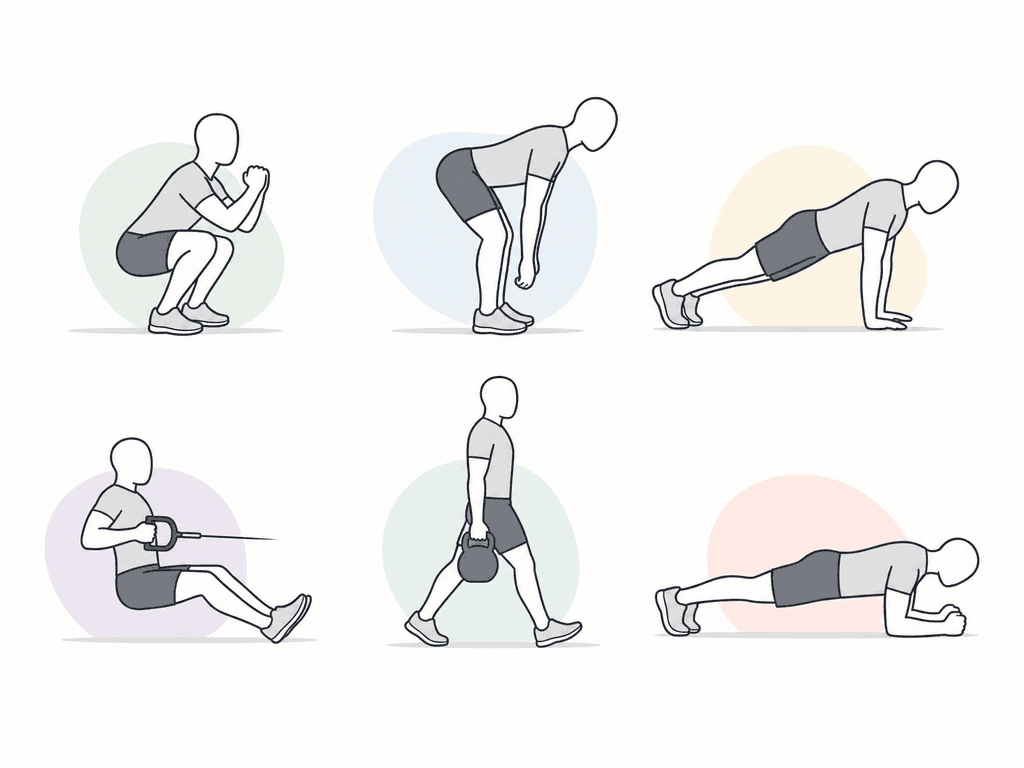
Here are exercise options for each pattern using only dumbbells or bodyweight:
| Movement Pattern | Bodyweight Option | Dumbbell Option | Primary Muscles Worked |
|---|---|---|---|
| Squat | Bodyweight squat, Bulgarian split squat | Goblet squat, dumbbell front squat | Quads, glutes, core |
| Hinge | Glute bridge, single-leg glute bridge | Romanian deadlift, dumbbell deadlift | Hamstrings, glutes, lower back |
| Push (Horizontal) | Push-up, incline push-up | Dumbbell bench press, dumbbell floor press | Chest, shoulders, triceps |
| Push (Vertical) | Pike push-up (advanced) | Dumbbell overhead press, Arnold press | Shoulders, triceps |
| Pull (Horizontal) | Inverted row (under a table), bodyweight row | Dumbbell row, single-arm dumbbell row | Upper back, biceps |
| Pull (Vertical) | Pull-up (if you have a bar), negative pull-up | Dumbbell pullover, bent-over lateral raise | Lats, biceps |
| Carry | Farmer's carry (hold heavy objects) | Dumbbell farmer's carry, suitcase carry | Grip, core, shoulders |
| Core | Plank, dead bug, bird dog, hollow hold | Weighted plank, dumbbell side bend | Entire core (abs, obliques, lower back) |
Comments
Join the discussion with an anonymous comment.