
Introduction: Building Muscle with a 150lb Stack
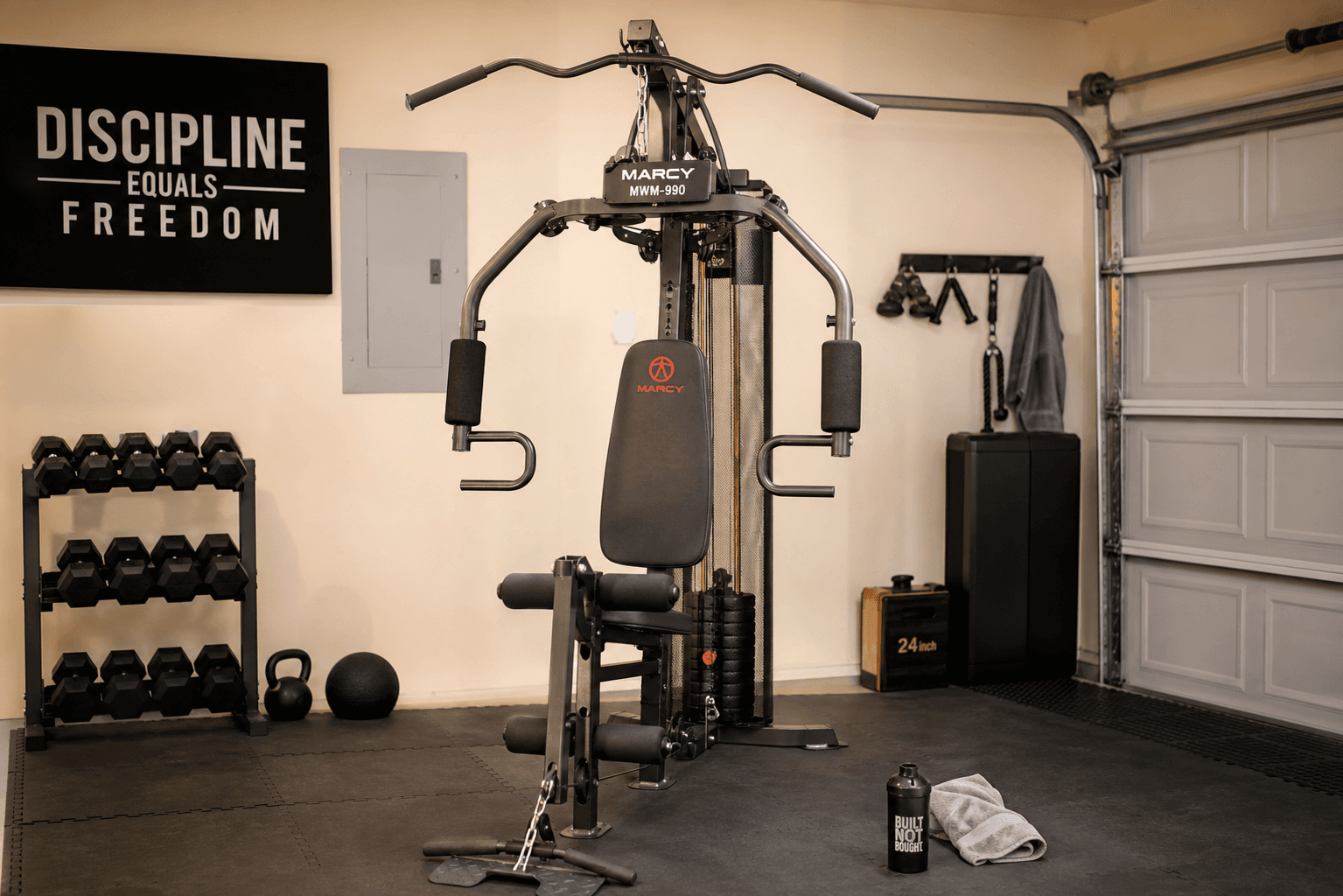
If you own a Marcy 150lb Stack Home Gym — whether it's the MWM-990, MWM-4965, or one of the functionally identical MWM-988 or MWM-1005 models — you've likely asked yourself a version of this question: can I actually build noticeable muscle with only 150 pounds of resistance?
The short answer is yes, but the path looks different than it would on a machine with a 200lb or 300lb stack. The 150lb ceiling is real, and it will eventually become a limiting factor on major lifts like the chest press and lat pulldown. However, for most beginners and many intermediates, that ceiling is still months away — and even after you hit it, creative programming strategies can keep you progressing for a long time.
This article is not a purchase evaluation. If you are still deciding whether the Marcy stack is the right machine for your space and budget, start with our full review and model comparison guide. This guide assumes you already own the machine and want structured, progression-based workout plans that maximize results within its capabilities and limitations.
Understanding the 150lb Ceiling: What It Means for Muscle Growth
The Marcy 150lb stack is a fixed, non-upgradeable resistance system. Marcy explicitly states they "have yet to create a stack home gym on which you can add weight", meaning the 150lb limit is permanent on these models. This is the single most important constraint to understand when programming for this machine.
For context, 150 pounds is plenty of resistance for many exercises, especially for beginners. A cable chest press at 150 lbs is a significant load for someone new to strength training. The same applies to lat pulldowns, seated rows, and leg extensions. The problem emerges on compound pushing and pulling movements where your larger muscle groups — chest, back, and legs — can generate force beyond what the stack can provide.
Marcy's official workout blog recommends 3 sets of 8-12 reps at higher weight for hypertrophy (muscle building) and 3 sets of 15-20 reps for weight loss or muscular endurance. This is a useful starting framework, but it assumes you have enough weight on the stack to make 8-12 reps challenging. Once you can rep out the full stack for 12+ clean reps on the chest press or lat pulldown, you have hit the ceiling — and you need to adapt.
Progressive Overload Strategies Within the 150lb Limit
Progressive overload — gradually increasing the demands on your muscles over time — is the fundamental driver of muscle growth. When you cannot add more weight to the stack, you must manipulate other variables. Here are the most effective strategies for continuing progress on a Marcy 150lb stack.
1. Higher Rep Ranges (15-25 Reps)
Once you can complete 12 reps with the full stack on a given exercise, shift your rep target to 15-20 or even 20-25 reps per set. Research consistently shows that training to muscular failure with moderate-to-high rep ranges (15-30 reps) produces comparable hypertrophy to heavier, lower-rep work, provided the set is taken close to failure. This is not a compromise — it is a legitimate training method.
2. Slow Eccentric Tempos (3-4 Second Negatives)
Slowing down the lowering phase of each rep increases time under tension, which is a powerful hypertrophy stimulus even at submaximal loads. On the chest press, for example, lower the weight over a 3-4 second count, pause briefly at the bottom, then press up explosively. This makes a 120lb set feel significantly harder than a normal-paced 150lb set.
3. Unilateral Work
The Marcy stack's dual press arms and cable system allow for single-arm and single-leg exercises. A single-arm chest press effectively doubles the relative load on each side — 80 lbs on one arm is a much greater challenge than 150 lbs on two arms. Unilateral work also corrects strength imbalances and engages your core for stabilization.
4. Drop Sets
When you hit failure at the full stack, immediately reduce the pin to a lower weight (e.g., from 150 lbs to 120 lbs) and continue the set without rest. You can drop two or three times in a single set, pushing far beyond what the top weight alone would allow. This is particularly effective on isolation exercises like tricep pushdowns and bicep curls.
5. Adding Resistance Bands
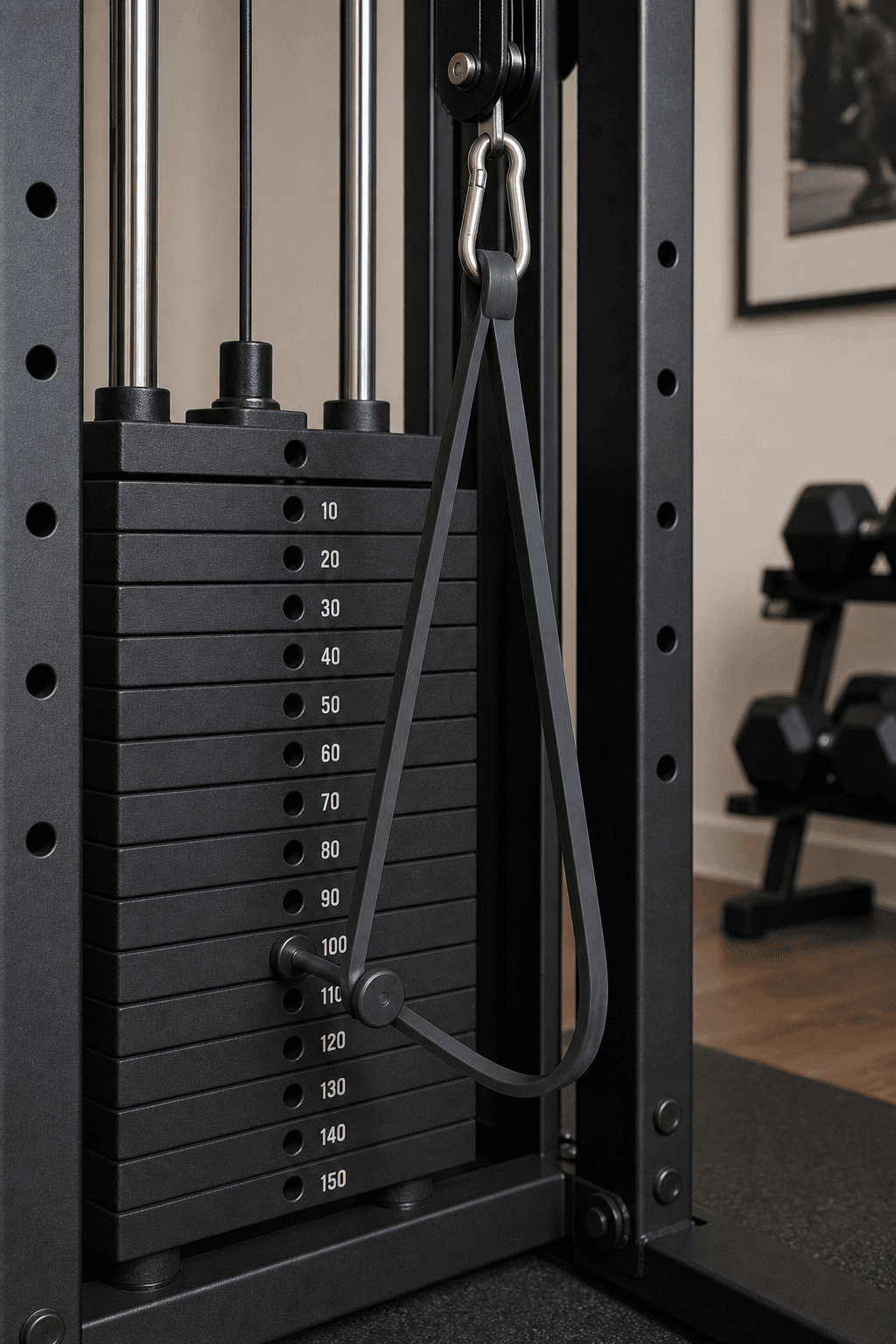
This is the single most practical workaround for the 150lb ceiling. By looping a resistance band around the weight stack selector pin and attaching it to the cable carabiner, you add variable resistance that increases as the band stretches. BarBend notes that this setup can effectively add approximately 50 pounds of resistance beyond the 150lb stack, bringing maximum resistance to roughly 200 lbs for some exercises. Marcy's own blog confirms that resistance bands can be used to increase load.
Sample 4-Day Upper/Lower Split Workout Plan
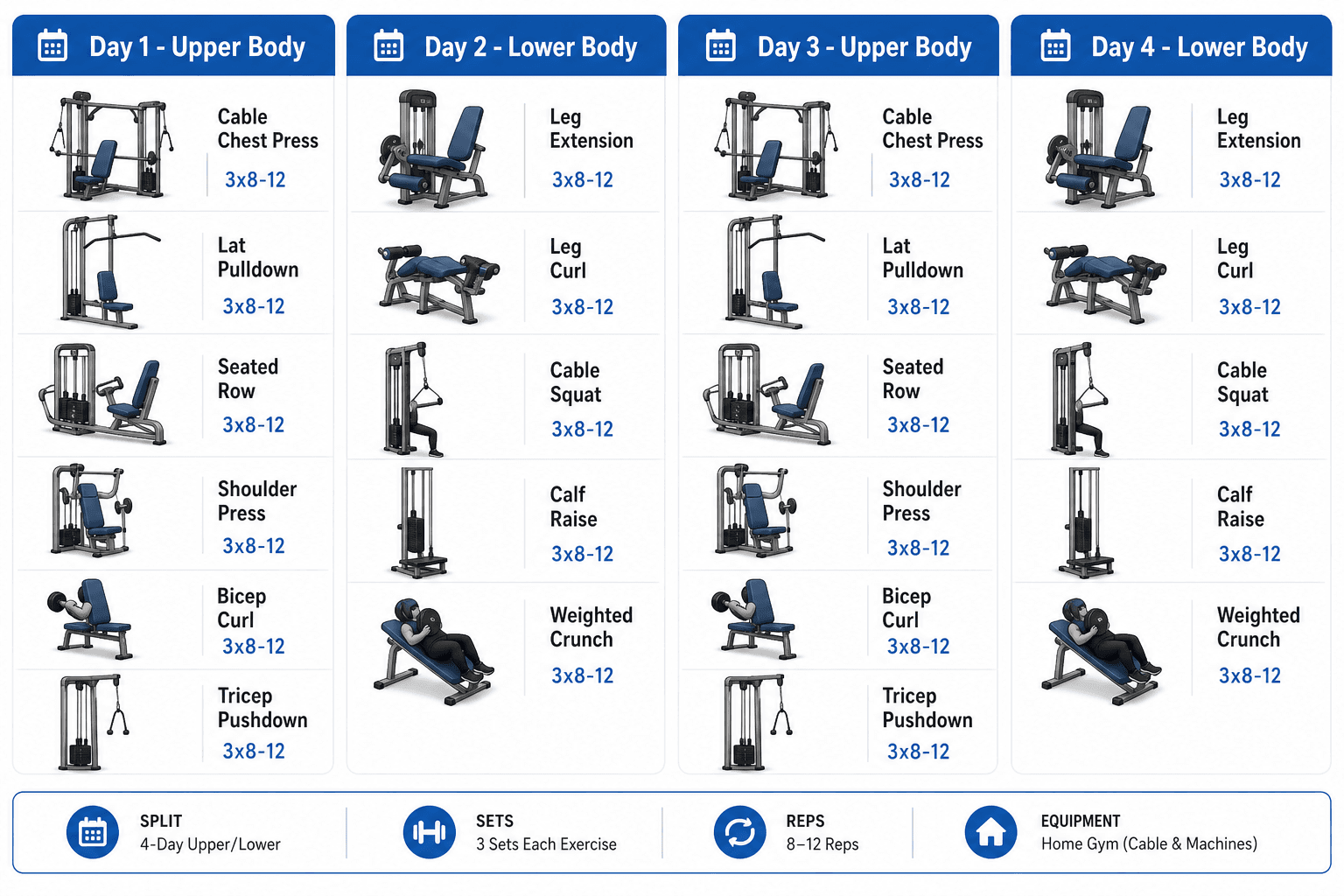
The following 4-day upper/lower split is designed specifically for the Marcy 150lb stack. It alternates between upper body and lower body sessions, giving each muscle group 48-72 hours of recovery between sessions. This is a proven split for both beginners and intermediates seeking consistent muscle growth.
Each session includes a warm-up, the main exercise sequence, and a cool-down. Perform 3 sets of 8-12 reps for each exercise unless otherwise noted. Rest 60-90 seconds between sets. If you can complete 12 reps with good form on all three sets, increase the weight on your next session.
Day 1: Upper Body (Push + Pull Focus)
Warm-up: 5 minutes of arm circles, band pull-aparts, and light cable rotations (20-30 lbs, 15 reps each direction).
| Exercise | Sets | Reps | Rest | Notes |
|---|---|---|---|---|
| Cable Chest Press | 3 | 8-12 | 90 sec | Use press arms; keep elbows at 45° |
| Lat Pulldown (wide grip) | 3 | 8-12 | 90 sec | Pull to upper chest, not behind neck |
| Standing Delt Raise (front or lateral) | 3 | 10-15 | 60 sec | Use low pulley; control the negative |
| Tricep Pushdown (rope or bar) | 3 | 10-15 | 60 sec | Keep elbows pinned to sides |
| Standing Bicep Curl (low pulley) | 3 | 10-15 | 60 sec | Avoid swinging the torso |
Cool-down: 5 minutes of light stretching for chest, lats, triceps, and biceps.
Day 2: Lower Body (Quad + Hamstring Focus)
Warm-up: 5 minutes of bodyweight squats, leg swings, and glute bridges.
| Exercise | Sets | Reps | Rest | Notes |
|---|---|---|---|---|
| Leg Extension | 3 | 10-15 | 90 sec | Full range of motion; pause at top |
| Lying Leg Curl | 3 | 10-15 | 90 sec | Use leg developer attachment |
| Cable Crunch (MWM-4965 only) | 3 | 12-20 | 60 sec | Use center pulley and ab strap |
| Glute Kickback (ankle strap) | 3 | 12-15 per leg | 60 sec | Use low pulley; keep core braced |
Cool-down: 5 minutes of light stretching for quads, hamstrings, glutes, and hip flexors.
Day 3: Upper Body (Chest + Back Emphasis)
Warm-up: Same as Day 1.
| Exercise | Sets | Reps | Rest | Notes |
|---|---|---|---|---|
| Cable Chest Fly | 3 | 10-15 | 90 sec | Use press arms; slight bend in elbows |
| Seated Cable Row (MWM-4965 only) | 3 | 8-12 | 90 sec | Use center pulley and V-grip handle |
| Standing Shoulder Press (low pulley) | 3 | 8-12 | 90 sec | Use press arms or cables; keep core tight |
| Overhead Tricep Extension (rope) | 3 | 10-15 | 60 sec | Use low pulley; extend fully overhead |
| Preacher Curl (MWM-988/990/1005 only) | 3 | 10-15 | 60 sec | Use preacher curl pad and low pulley |
Cool-down: Same as Day 1.
Day 4: Lower Body (Glute + Hamstring Focus)
Warm-up: Same as Day 2.
| Exercise | Sets | Reps | Rest | Notes |
|---|---|---|---|---|
| Leg Extension | 3 | 10-15 | 90 sec | Same as Day 2; focus on quad contraction |
| Lying Leg Curl | 3 | 10-15 | 90 sec | Same as Day 2 |
| Cable Pull-Through (low pulley) | 3 | 12-15 | 60 sec | Use rope; hinge at hips, squeeze glutes |
| Standing Calf Raise (on leg developer) | 3 | 15-20 | 60 sec | Use leg developer pad; full range of motion |
Cool-down: Same as Day 2.
Exercise Substitution Guide: Working with Your Model's Features
The Marcy 150lb stack line includes several models with different feature sets. The MWM-988, MWM-990, and MWM-1005 are functionally identical — only their appearance differs, per Marcy's official blog. The MWM-4965 is the outlier: it has a center pulley and an ab attachment for weighted crunches, but it lacks a preacher curl pad, and Marcy confirms one cannot be added.
Use the table below to adapt the workout plans to your specific model.
| Exercise | MWM-988 / 990 / 1005 | MWM-4965 |
|---|---|---|
| Preacher Curl | Available (preacher curl pad included) | Not available — substitute standing bicep curl |
| Seated Cable Row | Not available — substitute bent-over row (low pulley) | Available (center pulley) |
| Cable Crunch (Weighted) | Not available — substitute planks or leg raises | Available (center pulley + ab strap) |
| Cable Pull-Through | Available (low pulley, rope handle) | Available (low pulley, rope handle) |
| Chest Press / Fly | Available (press arms) | Available (press arms) |
| Lat Pulldown | Available (upper pulley) | Available (upper pulley) |
| Leg Extension / Leg Curl | Available (leg developer) | Available (leg developer) |
| Tricep Pushdown / Bicep Curl | Available (high/low pulley) | Available (high/low pulley) |
Accessory Add-Ons That Extend the Machine's Utility
A few low-cost accessories can significantly expand the range of exercises you can perform and the intensity you can achieve on the Marcy stack. These are not required, but they are practical investments that directly support the workout plans in this article.
- Resistance bands (light, medium, heavy): The most impactful add-on. Loop around the selector pin to add variable resistance beyond the 150lb stack. Essential for continuing progressive overload on chest press, lat pulldown, and rows.
- Ankle strap: Enables glute kickbacks, hip adductions, and hip abductions — exercises that target muscles not well covered by the standard attachments. Attaches to the low pulley carabiner.
- Tricep rope: Provides a more comfortable grip for tricep pushdowns, overhead extensions, and cable pull-throughs compared to the included straight bar.
- V-grip handle: Ideal for seated rows (MWM-4965) and bent-over rows (all models). The neutral grip position is more shoulder-friendly for many users.
- Dip belt (if you have a pull-up bar): Allows you to add weight to bodyweight pull-ups and dips, which is a completely separate progression path from the cable stack.
When to Consider an Upgrade
The 150lb stack is not a permanent ceiling for everyone. With consistent training, most users will reach a point where the machine's resistance limit becomes a genuine bottleneck to further muscle growth. Here are the signs that it is time to start evaluating upgrade options.
- You can complete 12+ clean reps with the full stack on the chest press and lat pulldown, and you have already exhausted the progression strategies in this article (tempo work, unilateral, bands, drop sets).
- You no longer feel significant muscle fatigue in the target rep range on your primary compound lifts, even with bands added.
- You have been training consistently for 6-12 months and your strength gains have plateaued for 4-6 weeks despite proper programming.
- You find yourself relying almost entirely on isolation exercises because the compound movements no longer feel challenging.
If these signs describe your situation, it is likely time to look at machines with higher weight stacks or different resistance systems. Our all-in-one home gym comparison guide covers the full landscape of options, from weight-stack machines with 200lb+ stacks to plate-loaded and digital resistance systems. The resistance type comparison can help you decide which system best fits your long-term strength goals.
Full Workout Chart and Quick Reference
The table below consolidates the entire 4-day upper/lower split into a single printable reference. Use it during your workouts to track exercises, sets, reps, and rest periods without scrolling through the full article.
| Day | Exercise 1 | Exercise 2 | Exercise 3 | Exercise 4 | Exercise 5 |
|---|---|---|---|---|---|
| Day 1 (Upper) | Cable Chest Press 3x8-12 | Lat Pulldown 3x8-12 | Delt Raise 3x10-15 | Tricep Pushdown 3x10-15 | Standing Curl 3x10-15 |
| Day 2 (Lower) | Leg Extension 3x10-15 | Leg Curl 3x10-15 | Cable Crunch* 3x12-20 | Glute Kickback 3x12-15/leg | — |
| Day 3 (Upper) | Chest Fly 3x10-15 | Seated Row* 3x8-12 | Shoulder Press 3x8-12 | Overhead Tricep Ext. 3x10-15 | Preacher Curl* 3x10-15 |
| Day 4 (Lower) | Leg Extension 3x10-15 | Leg Curl 3x10-15 | Cable Pull-Through 3x12-15 | Standing Calf Raise 3x15-20 | — |
Adjust rep ranges based on your goal: use 8-12 reps for hypertrophy (muscle building) and 15-20 reps for muscular endurance or weight loss, as recommended by Marcy's workout blog. If you are using resistance bands, perform your sets with the band attached and count the band's added resistance as part of your progressive overload — aim to increase band tension over time just as you would increase the selector pin weight.
Stick with this program for 8-12 weeks before making major changes. Track your weights and reps each session. When you can hit the top of the rep range on all sets of an exercise, apply one of the progression strategies from this article — add a band, slow the tempo, or switch to a unilateral variation. The 150lb stack is a limit, but with smart programming, it is not a dead end.

Comments
Join the discussion with an anonymous comment.