
The Core Trade-Off: Affordable Price vs. a 150lb Ceiling
The Marcy 150lb stack home gym occupies a specific and valuable niche in the home fitness market: it delivers a multi-station cable machine with a selectorized weight stack at a price point that undercuts almost every competitor. Depending on the model and retailer, you can expect to pay between $449 (Sam's Club) and $749.99 (MarcyPro). That range places it firmly in budget-territory for a machine that claims to offer over 30 exercises.
The trade-off is equally straightforward: the weight stack is capped at 150 pounds, and Marcy has confirmed that the stack is non-upgradeable. No add-on weight kits exist for any of the 150lb models. This means the machine's useful lifespan is directly tied to your current strength levels and how quickly you progress. If you are a complete beginner, 150 pounds will feel like a lot. If you have been training consistently for a year or more, you may find yourself maxing out the stack on certain exercises within months.
This article is designed to help you make that honest assessment before you buy. We will break down the actual working resistance at each station, explain how pulley ratios change the feel of the weight, estimate how long the machine will remain challenging for different training levels, and compare it directly to the 200lb Marcy MKM-81010. By the end, you will know whether the 150lb stack is a smart investment for your specific situation or a limitation you will regret within a year.
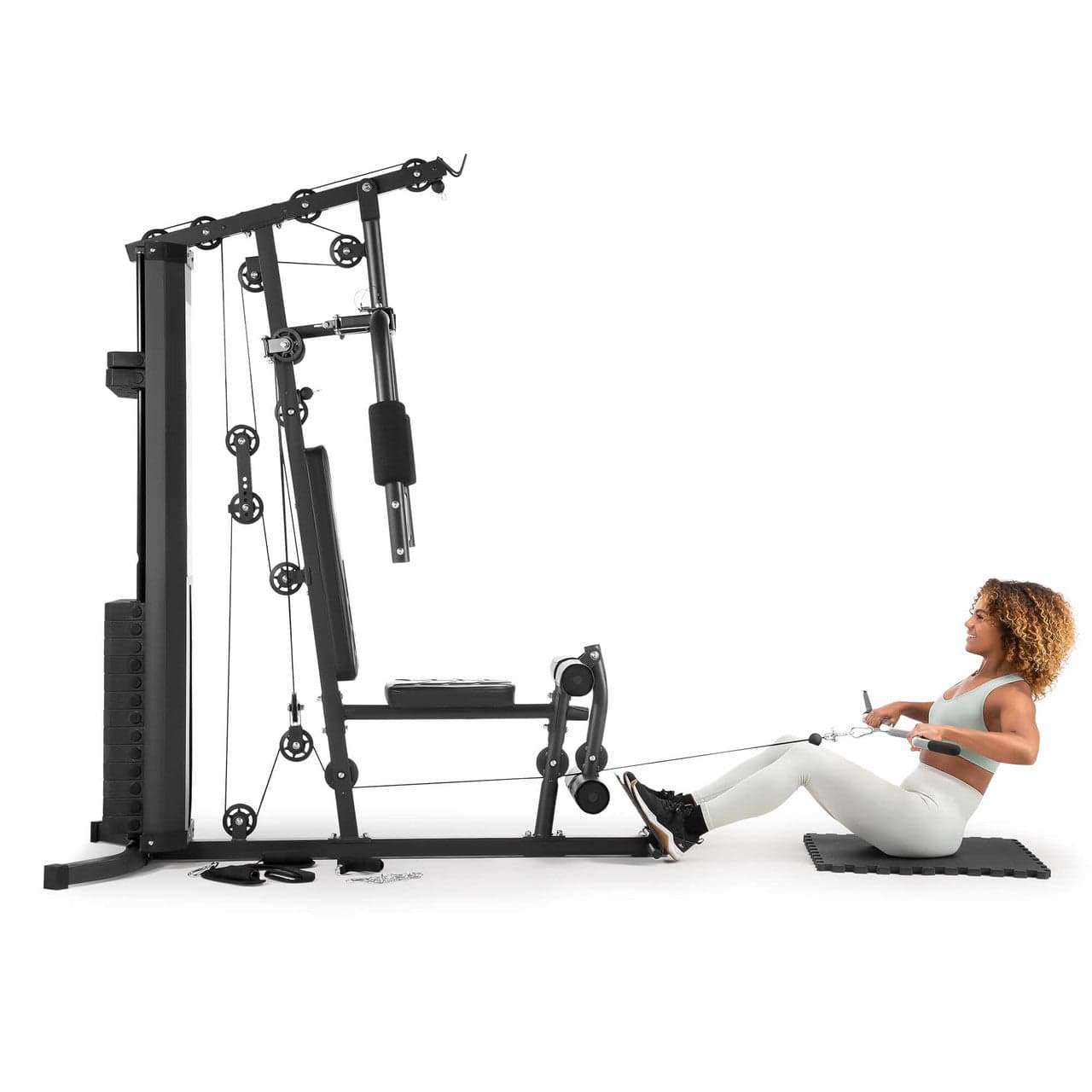
Real-World Resistance Analysis: How Much Weight Per Station?
One of the most common misconceptions about weight stack machines is that the number on the stack is the weight you are actually lifting. Due to pulley ratios and cable routing, the resistance you feel at the handle can be significantly different from the selected plate weight. This is especially true on multi-function home gyms like the Marcy 150lb stack, where a single weight stack serves multiple stations through different cable paths.
Marcy provides station-specific resistance charts for their machines, and while the exact figures for every model were not directly crawlable from the available research, the general principle is well-established in the home gym community. Below is a representative breakdown of how the 150lb stack translates to working resistance at the four most commonly used stations.
| Exercise Station | Selected Stack Weight | Approximate Felt Resistance | Pulley Ratio Effect |
|---|---|---|---|
| Chest Press (seated) | 150 lb | ~130–140 lb | Slight mechanical disadvantage due to cable angle; feels lighter than stack weight |
| Lat Pulldown | 150 lb | ~150 lb | Near 1:1 ratio; felt weight is very close to selected weight |
| Leg Extension | 150 lb | ~140–150 lb | Direct cable path; felt weight is close to stack weight |
| Bicep Curl (low pulley) | 150 lb | ~120–130 lb | Cable routing creates friction and angle loss; feels noticeably lighter |
| Tricep Pushdown (high pulley) | 150 lb | ~140–150 lb | Near 1:1 ratio; felt weight is close to selected weight |
The key takeaway from this table is that the 150lb stack does not deliver 150 pounds of resistance at every station. For exercises like the bicep curl and chest press, the felt resistance is lower, which means you will hit the effective ceiling of the machine sooner than the stack number suggests. For lat pulldowns and tricep pushdowns, the ratio is closer to 1:1, giving you the full benefit of the stack.
Who Will Outgrow It — and When?
The most important question for any potential buyer is not whether 150 pounds is a lot of weight in absolute terms, but whether it is enough weight for your specific training level and goals. A 150lb bench press is a respectable milestone for a beginner. For an intermediate lifter who has been training for two years, it is a warm-up set.
The table below provides estimated timelines for when users at different training levels are likely to hit the 150lb ceiling on key exercises. These estimates assume consistent training (3–4 sessions per week) with progressive overload.
| Training Level | Chest Press | Lat Pulldown | Leg Extension | Bicep Curl | Overall Machine Lifespan |
|---|---|---|---|---|---|
| Complete Beginner (no training history) | 12–18 months | 12–18 months | 12–18 months | 18–24 months | 2–3 years |
| Casual Beginner (some gym experience) | 6–12 months | 6–12 months | 6–12 months | 12–18 months | 1–2 years |
| Intermediate (1+ year consistent training) | 3–6 months | 3–6 months | Immediately or within 3 months | 6–12 months | 6–12 months |
| Advanced (3+ years training) | Immediately | Immediately | Immediately | 3–6 months | Not recommended |
The leg extension row is particularly telling. For most male intermediates, 150 pounds on a leg extension is a relatively light load. The quadriceps are a large, powerful muscle group, and effective leg training often requires working in the 200lb+ range for sets of 8–12 repetitions. If leg development is a priority for you, the Marcy 150lb stack will likely be inadequate from day one.
The Pulley Ratio Effect: Why 150lb Isn't Always 150lb
The pulley system on a home gym is not just a convenience feature — it fundamentally changes the resistance profile of every exercise. On the Marcy 150lb stack, the cable routes through multiple pulleys before reaching the handle. Each pulley introduces a small amount of friction, and the angle at which the cable pulls changes the effective mechanical advantage of the system.
For most exercises, the result is that the felt resistance is slightly less than the selected plate weight. This is not a design flaw — it is inherent to cable-based resistance. However, it does mean that the 150lb number on the stack is an upper bound, not a guarantee. On the bicep curl station, for example, the cable routing creates enough friction and angle loss that 150 pounds on the stack may feel closer to 120–130 pounds at the handle.
There is also a less common but noteworthy effect: on certain stations, adjustable pulleys can be repositioned to create a mechanical disadvantage, effectively increasing the resistance. BarBend's review of the Marcy MWM-990 noted that adjusting the pulleys could add roughly 50 pounds of resistance on certain movements, such as push presses, bringing the effective max closer to 200 pounds. This is not a substitute for a heavier weight stack, but it is a useful trick for extending the machine's range on specific exercises.
Understanding the pulley ratio effect is critical for setting realistic expectations. If you are an intermediate lifter who can lat pulldown 150 pounds for 10 reps at a commercial gym, you will likely find that the Marcy's lat pulldown station feels similar. But if your go-to bicep curl is 150 pounds on a dumbbell, you will find the cable version on the Marcy significantly easier — and you will hit the ceiling much faster.
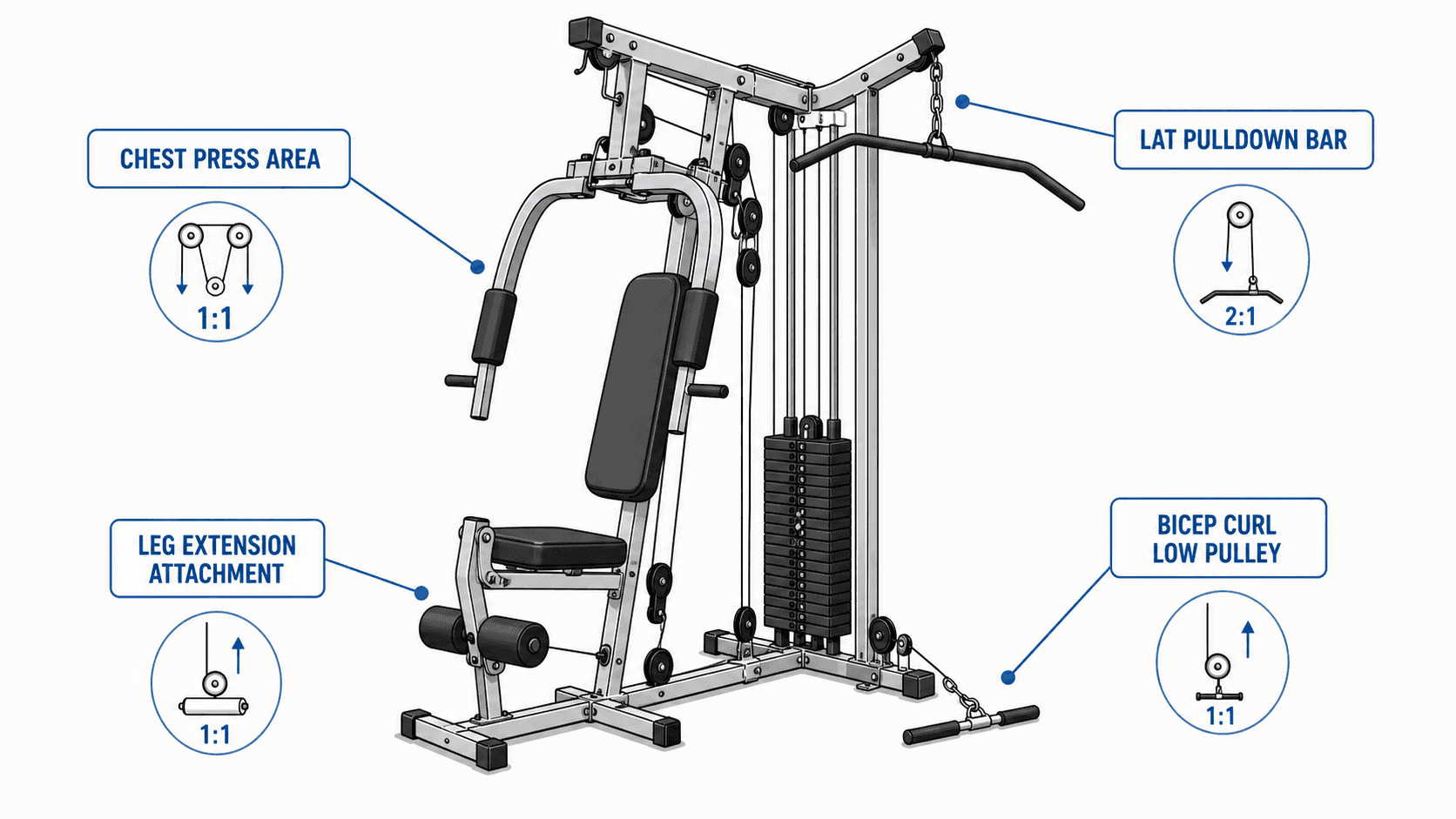
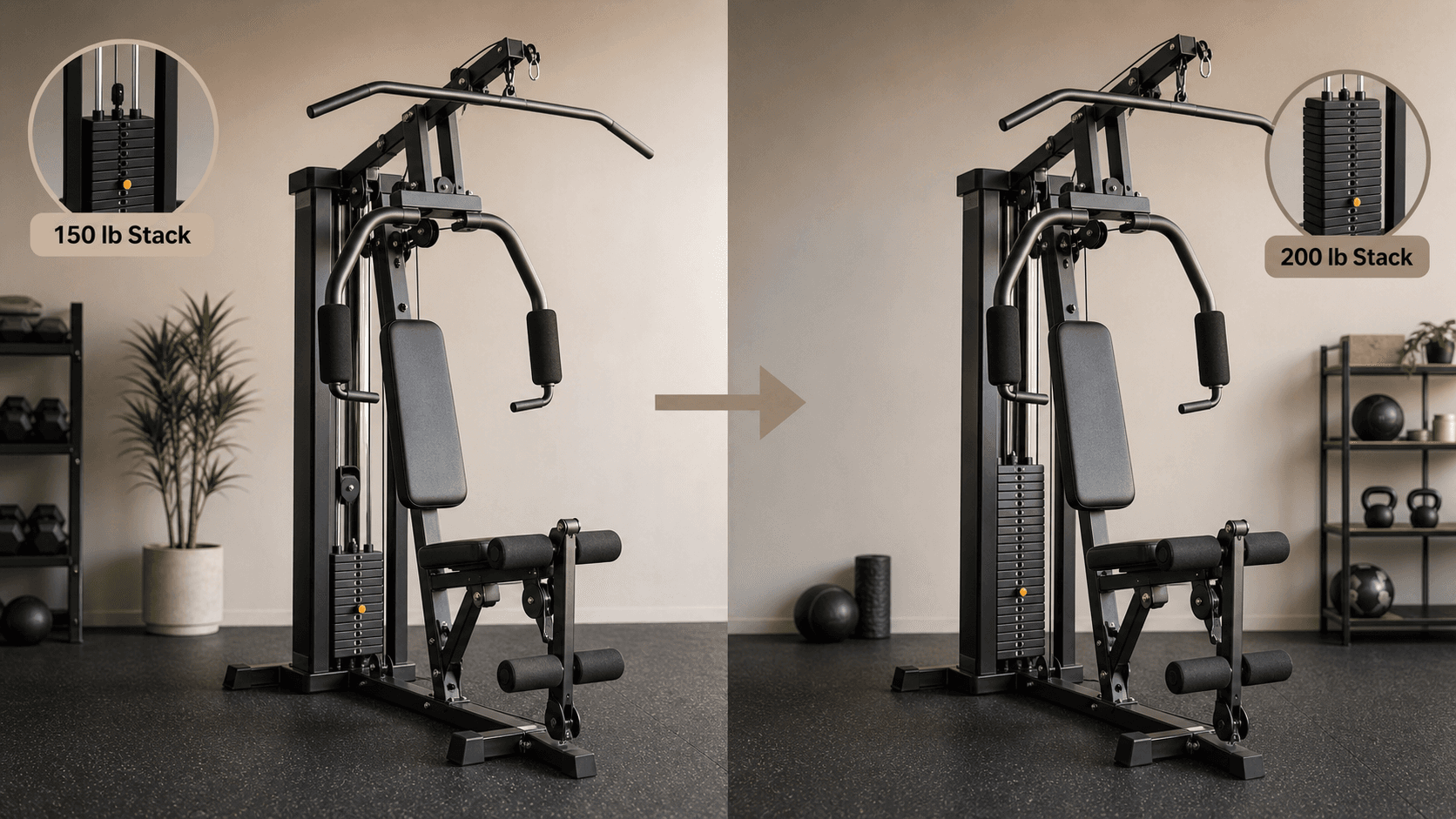
Marcy 150lb vs. Marcy 200lb (MKM-81010): Is the Upgrade Worth It?
If you are concerned that 150 pounds will not be enough, Marcy offers a direct upgrade path: the MKM-81010, which features a 200lb weight stack and retails for approximately $999.99. The $250–$550 premium (depending on where you buy the 150lb model) raises an obvious question: is the extra 50 pounds worth the money?
The answer depends almost entirely on your training level and which exercises you prioritize. The table below compares the two machines across the dimensions that matter most for a purchase decision.
| Specification | Marcy 150lb Stack (MWM-990 / MWM-4965SC) | Marcy 200lb Stack (MKM-81010) |
|---|---|---|
| Weight Stack | 150 lb | 200 lb |
| Price (MSRP) | $749.99 (MarcyPro) | $999.99 |
| Price (Discount Retailer) | $449 (Sam's Club) | ~$800–$900 (estimated) |
| Exercises | 30+ | 30+ |
| Footprint | Compact (~50" x 70") | Slightly larger (~55" x 75") |
| Upgradeable Stack? | No | No |
| Best For | Beginners, casual users, budget-focused buyers | Intermediates, users who need more leg resistance |
| Risk of Outgrowing | High for intermediates | Moderate for intermediates |
For a beginner, the 150lb stack is almost certainly the better value. The $250–$550 saved can be put toward other equipment — a set of adjustable dumbbells, a bench, or a pull-up bar — that will provide more training variety than the extra 50 pounds on the stack. For an intermediate lifter who is already pressing 150 pounds for reps, the 200lb stack is the safer long-term investment. The extra 50 pounds will not last forever, but it will buy you an additional 6–12 months of progressive overload before you hit the ceiling.
Practical Workarounds: Can You Add More Resistance?
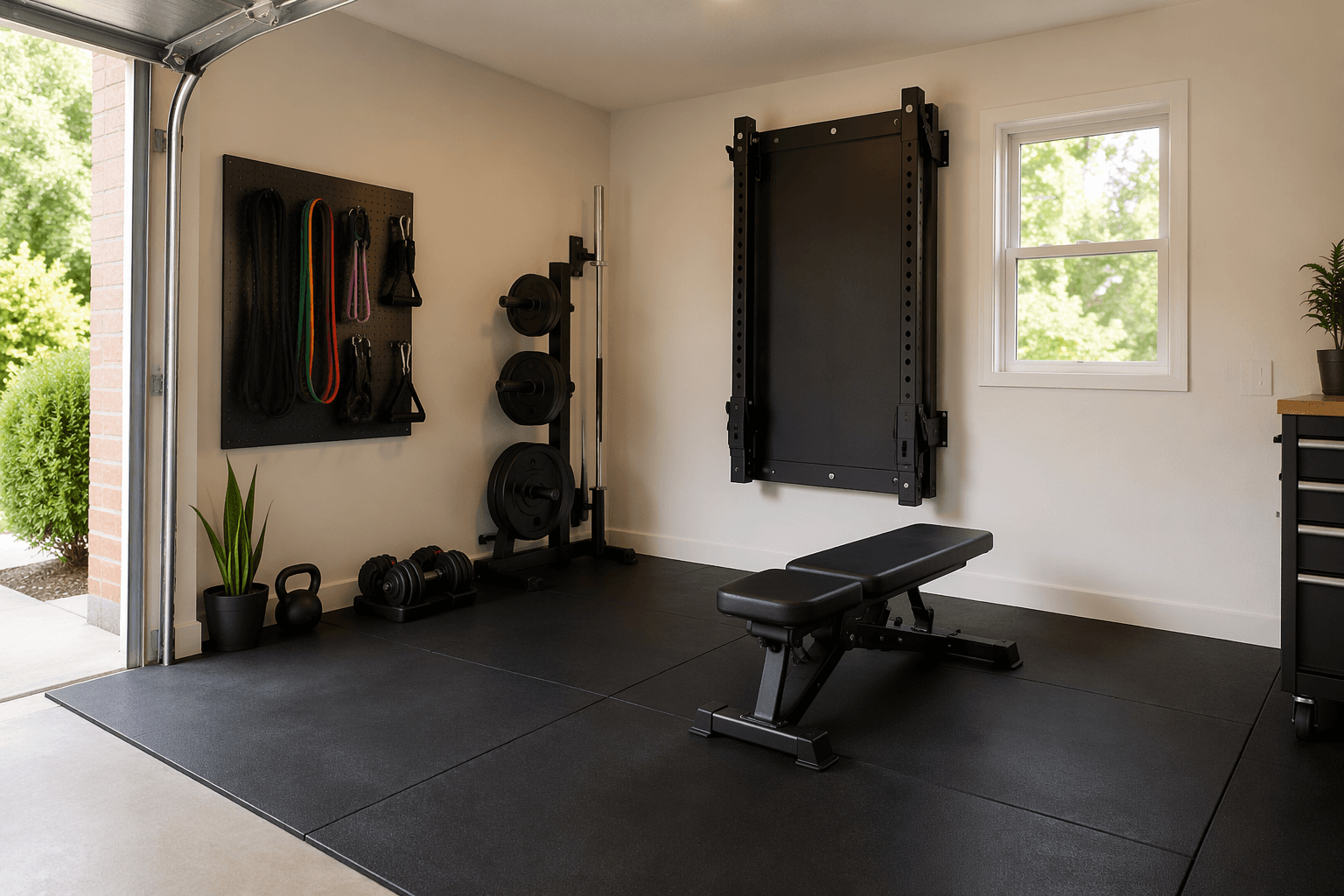
If you already own a Marcy 150lb stack home gym and are starting to bump up against the weight limit, you have a few options for extending its useful life. None of them are perfect, but some are safer and more effective than others.
- Add resistance bands: Loop a heavy resistance band over the weight stack and anchor it to the base of the machine. This adds variable resistance that increases as the band stretches, which can add 20–50 pounds of peak resistance at the top of the movement. This is the most common and generally safe workaround.
- Use the adjustable pulley trick: As noted earlier, repositioning the pulleys on certain stations can create a mechanical disadvantage, effectively increasing the resistance. This works best on push press and overhead press variations.
- Focus on tempo and volume: Slow down your repetitions (3–4 second eccentrics), reduce rest times, or increase your total set volume. These techniques can make a submaximal weight feel significantly harder and continue to drive progress.
- Supplement with free weights: Use the Marcy for isolation and cable work, but invest in a set of adjustable dumbbells or a barbell for heavy compound lifts like squats, deadlifts, and bench press. This is the most effective long-term strategy.
The most honest answer is that none of these workarounds fully solve the 150lb ceiling problem. They can buy you a few more months of use, but if you are an intermediate lifter who is consistently outgrowing the stack, the real solution is to upgrade to a machine with a heavier weight stack or transition to a free-weight setup.
Bottom Line: Should You Buy the Marcy 150lb Stack Home Gym?
The Marcy 150lb stack home gym is not a bad machine. It is a well-built, compact, and affordable entry point into cable-based strength training. The problem is that its value proposition is highly dependent on who you are and what you expect from it.
- Buy it if you are a complete beginner with no prior training experience. The 150lb stack will last you 1–2 years, and the low price leaves room in your budget for other equipment.
- Buy it if you are a casual user who prioritizes convenience and variety over maximum strength. If your goal is general fitness, toning, and maintaining muscle, 150 pounds is plenty.
- Buy it if you have limited space and budget. The compact footprint and sub-$500 price (at discount retailers) make it one of the best values in the home gym market for its category.
- Skip it if you are an intermediate or advanced lifter. You will outgrow the stack within months, and the non-upgradeable design means you will be shopping for a replacement machine sooner than you would like.
- Skip it if leg strength is a priority. The leg extension station will likely be inadequate from day one for anyone with a consistent training history.
- Consider the 200lb Marcy MKM-81010 if you are an intermediate lifter on a budget. The extra 50 pounds will buy you significant additional time before you hit the ceiling.
The Marcy 150lb stack is a classic example of a product that is excellent for its target audience but frustrating for anyone outside it. If you are that target audience — a beginner or casual user with realistic strength expectations — it is one of the best investments you can make in a home gym. If you are not, the 150lb ceiling will become a source of frustration rather than a tool for progress. Be honest with yourself about where you are in your training journey, and choose accordingly.

Comments
Join the discussion with an anonymous comment.