
The Science-Based Home Leg Workout: EMG Data, Exercise Selection, and Programming for Real Results
An evidence-backed home leg workout for fitness enthusiasts who want to know why each exercise works. Learn which exercises activate the most muscle based on EMG studies, how to program sets, reps, and frequency for hypertrophy, and follow a complete sample workout for bodyweight or dumbbells.
- Duration
- 30 min
Most leg routines you see online are built on popularity, not evidence. Someone with a big following does Bulgarian split squats, so everyone copies them. The real question is whether the data backs it up. I look first at the study citation and sample size, then at whether the recommendation actually works in a living room with a single dumbbell. That is the only way to build a leg workout at home that outperforms the generic stuff.
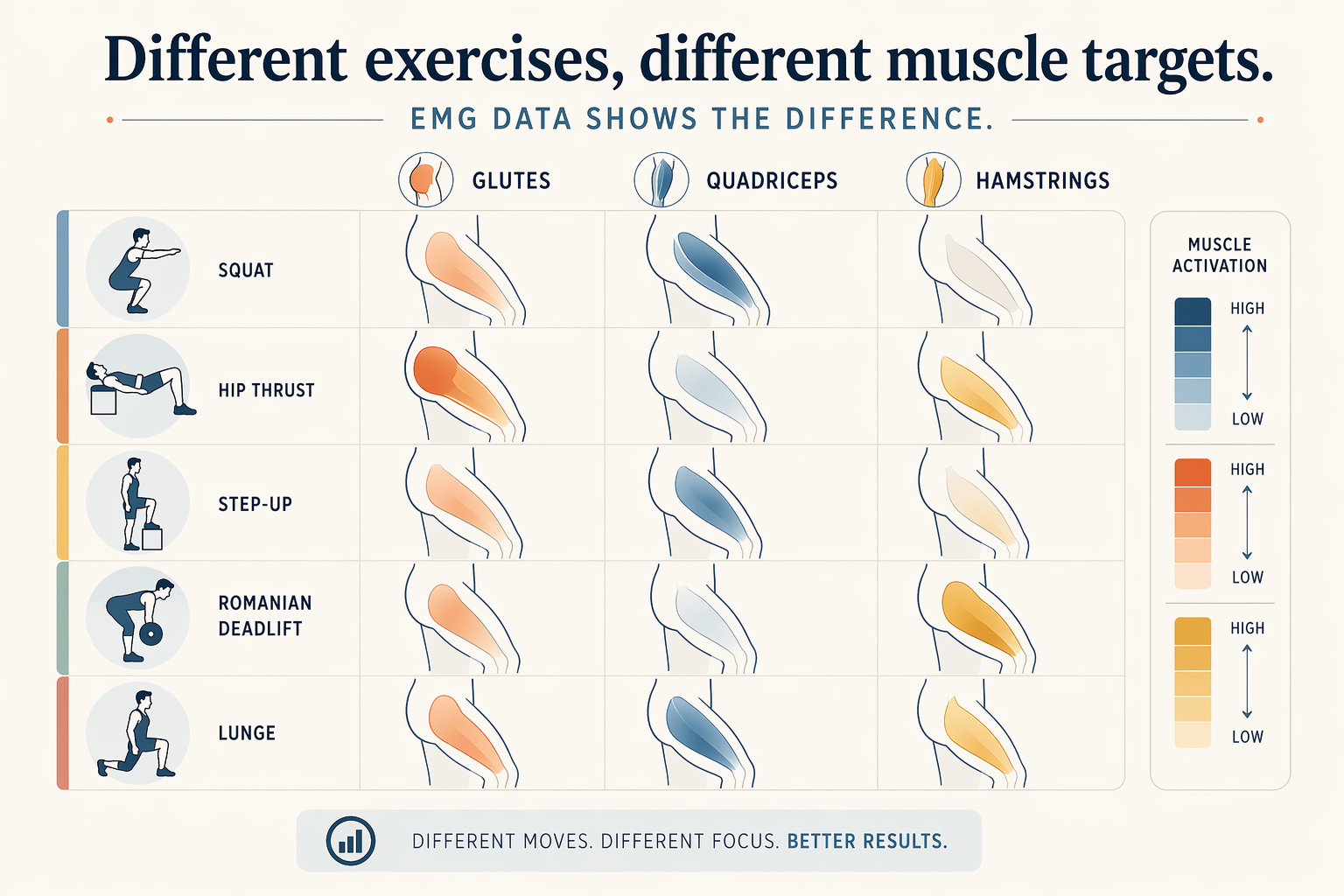
Take hip thrusts versus squats. One number changed how I think about glute training: hip thrusts produce roughly 100% of maximal voluntary contraction (MVIC) in the glutes at the same relative load, versus only 50–70% during squats. That comes from Bret Contreras’s work, cited by Built with Science. Impressive, right? But here is the catch: the comparison holds at the same relative load — a percentage of your one-rep max. In practice, you can squat more absolute weight than you can hip thrust, so the actual tension might differ. The data tells you that if glute growth is your priority, you should not rely on squats alone. It does not tell you to replace squats entirely.
Another number worth looking at: barbell back squats elicit 43% higher average leg muscle activity than Smith machine squats, based on a 2009 study by Binsted et al. (also cited by Built with Science). That study has a small sample — I would not bet my program on it alone. But it aligns with a basic observation: free-weight squats demand more stabilizer activation. For home trainers, that means a goblet squat with a dumbbell or kettlebell is probably a better bet than any machine-based alternative, even if you have a Smith machine in your garage.
| Exercise | Glute Activation (MVIC%) | Quad Activation (relative) | Key Study |
|---|---|---|---|
| Hip thrust | ~100% | Moderate | Contreras (cited by Built with Science) |
| Back squat | 50–70% | High | Binsted 2009 |
| Front squat | Lower than back squat | Higher VL & RF activation | Tillman 2009 |
| Step-up | Top among bodyweight moves | Moderate | Neto 2020 |
| Romanian deadlift | Moderate (hamstring focus) | Low | McAllister 2014 (top hamstring activator) |
But here is what I have learned from years of reading these studies: EMG measures neural drive, not hypertrophy. A higher activation number does not automatically mean more muscle because the actual tension and mechanical load vary. Use the table as a guide for which exercises to prioritize, but do not treat it as a formula. The exercise that wins on EMG might not win on progressive overload once you factor in grip strength, balance, and equipment.
Why Rep Ranges Need to Match Your Fibers
Leg muscles have roughly equal proportions of type I (endurance) and type II (power) fibers — a useful approximation from Edgerton 1975 and Schoenfeld 2014, cited by Built with Science. That average hides individual variation — some people have more type I in their vastus lateralis, others more type II. Still, it is good enough to build a strategy around. If you always do sets of 8–12, you are probably understimulating type I fibers that respond better to higher reps, and type II fibers that respond better to lower reps with heavier weight.
The practical takeaway: mix rep ranges within the same week. On heavier days, work in the 6–10 rep range with compound moves like goblet squats and hip thrusts. On lighter days, go for 12–15 reps with lunges and step-ups. This covers both fiber types and gives you two different stimuli. The Healthline dumbbell leg workout guide recommends 80–120 total reps per leg per workout. That is a solid target. If you do 3 sets of 10 reps on each of four exercises, you land at 120 reps per leg. Adjust up or down based on recovery.
Training Frequency: 2 or 3 Times a Week
A 2015 study by Schoenfeld et al. in the Journal of Strength and Conditioning Research found that training legs three times per week produced greater muscle mass gains than once per week, when total volume was equal. Verywell Fit cites this as support for a 2–3 days per week frequency, with at least 48 hours between sessions. The caveat: in the study, total volume was equated. If you train once per week with the same volume as three times, the frequency advantage shrinks. But for most home trainers who struggle to accumulate volume, a higher frequency helps spread the workload. I recommend starting with two leg sessions per week: one heavier (6–10 reps, compound focus) and one lighter (12–15 reps, more unilateral work). After 4–6 weeks, add a third session if recovery allows.
A Sample Workout That Actually Follows the Data
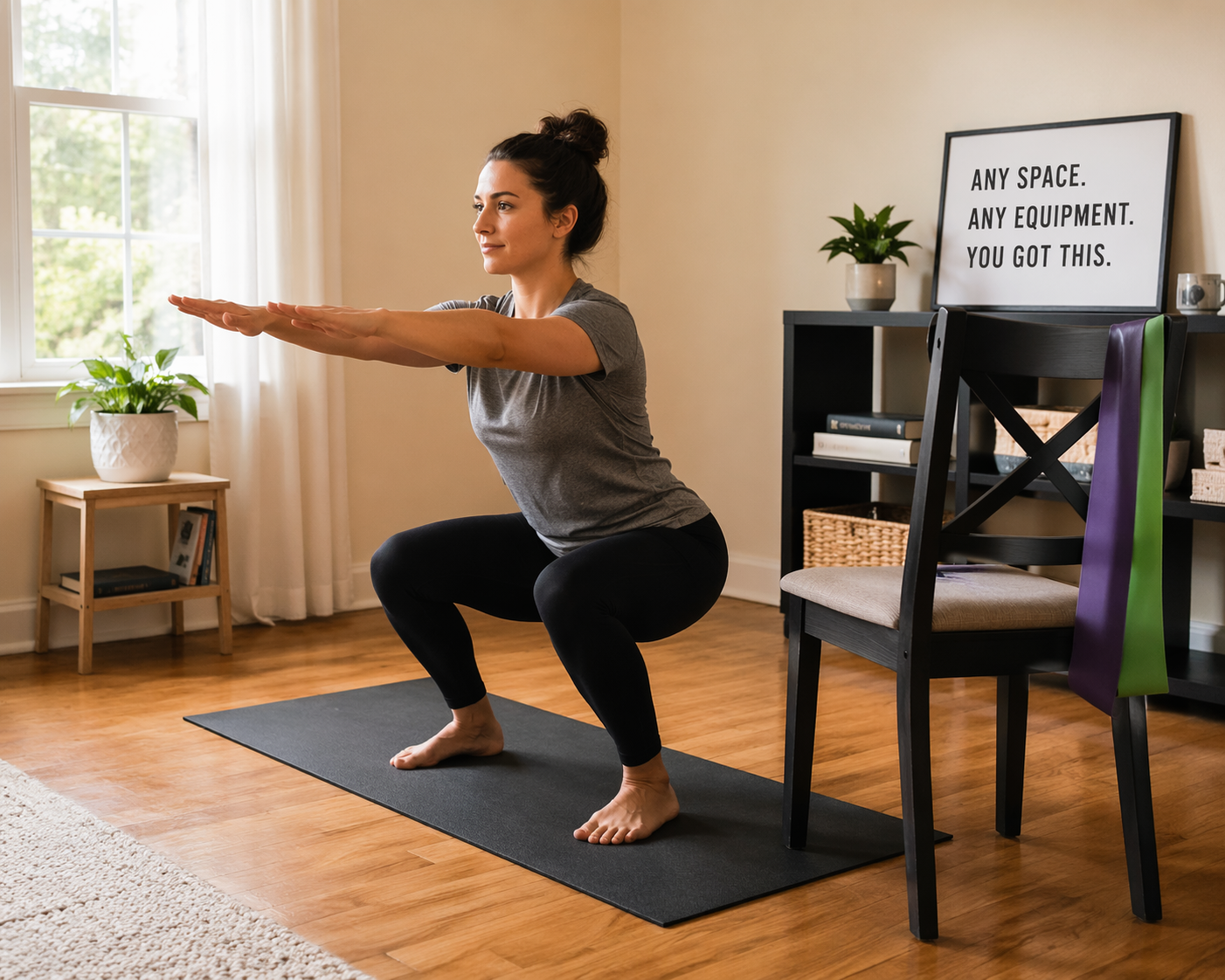
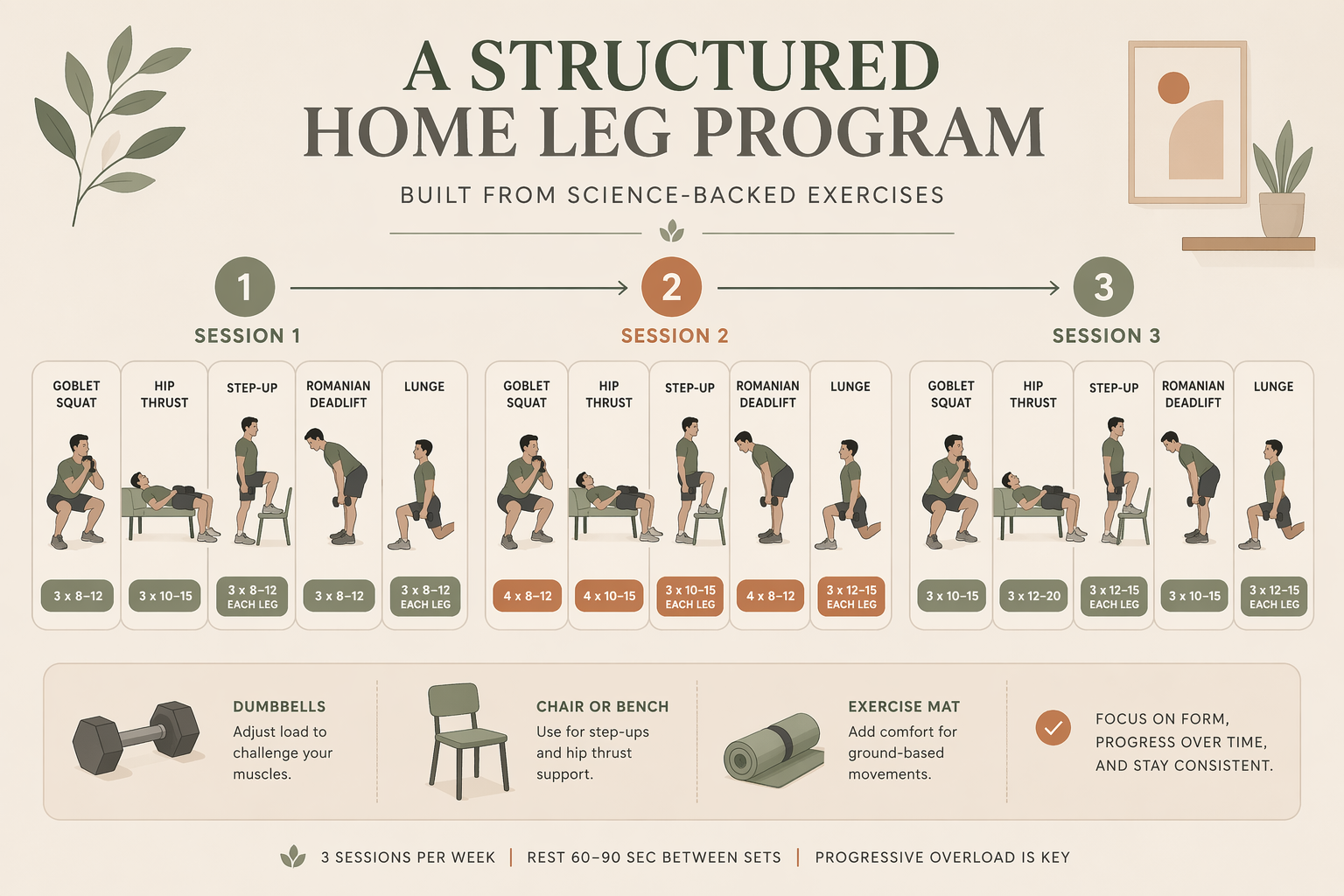
Here is a workout built from the principles above. It works for both bodyweight and dumbbell versions. Perform it 2–3 times per week, adjusting rep ranges per the heavier/lighter split. Rest 60–90 seconds between sets.
Bodyweight Version
- Goblet squat (use a dumbbell or kettlebell; if no weight, bodyweight squat): 3 sets x 8–15 reps. Focus on full ROM — Morse et al. 2013 showed a two-fold increase in thigh muscle size for full squats versus partials. This matters for home trainers who might be tempted to half-squat.
- Hip thrust: 3 sets x 8–15 reps. Use a chair or couch. Best glute activation per EMG.
- Step-up: 3 sets x 8–15 reps per leg. Top bodyweight glute activator (Neto 2020).
- Reverse lunge: 3 sets x 8–15 reps per leg. Hits quads and glutes; easier on the knees than forward lunges.
- Single-leg Romanian deadlift (bodyweight or light weight): 3 sets x 8–15 reps per leg. Targets hamstrings; the best hamstring activator per McAllister 2014.
Dumbbell Version
- Goblet squat: 3 sets x 6–12 reps. Use a dumbbell held at chest.
- Dumbbell hip thrust: 3 sets x 8–15 reps. Place dumbbell on hips; hold in place.
- Dumbbell step-up: 3 sets x 8–12 reps per leg. Use a sturdy chair or bench.
- Dumbbell reverse lunge: 3 sets x 8–12 reps per leg.
- Romanian deadlift (dumbbell): 3 sets x 8–12 reps. Keep back straight, hinge at hips.
Total volume: 15 sets across 5 exercises. Aim for 80–120 total reps per leg per session. If you are new to leg workouts at home, start with 2 sets per exercise and build up.
How to Keep Progressing Without Adding More Weight
If you cannot increase dumbbell weight — because your grip gives out or you maxed out your set — use these methods from Men's Health:
- Slow down the eccentric: Take 3–4 seconds to lower the weight. Increases time under tension without heavier load.
- Reduce rest between sets: Drop from 90–120 seconds to 60–75 seconds.
- Go unilateral: Switch to single-leg variations to increase the load per leg without needing heavier dumbbells.
- Increase range of motion: Ensure you are squatting to full depth; partials reduce growth by half.
That last point — full ROM — is worth repeating. Morse et al. 2013 showed a two-fold increase in thigh muscle size for full squats compared to partials. If you are doing half squats because you think they are safer or easier, you are leaving a lot of potential growth on the floor.
What This Means for Your Home Leg Training
The best leg workout at home is not the one with the most followers. It is the one built on data — exercises that activate your glutes, quads, and hamstrings effectively, programmed at rep ranges that match your muscle fiber composition, and done with enough frequency to accumulate volume. The sample workout above gives you a starting point. Adjust the weight, rep range, and exercises based on your equipment and recovery. And remember: EMG is a guide, not a guarantee. The real test is whether you can progressively overload over weeks and months.
If you are completely new to home training, start with our Beginner Bodyweight Workout Routine for a full-body plan. And if you need guidance on building the habit, read How to Start Working Out at Home (and Actually Stick With It).
What a small equipment investment adds
We don't have a build tagged to this exact tier yet. Browse all builds.
How often should you repeat this?
How Whoop and Oura Ring track recovery for home workouts
For home exercisers deciding between WHOOP and Oura Ring, the better sleep and recovery tracker depends on training style: WHOOP's strength-aware tracking fits dumbbell and grip-heavy sessions, while Oura's sleep-first scoring suits yoga and indoor cycling. The verdict hinges on how each builds its daily recovery score, their home-workout tracking gaps, and who pays for hardware versus subscription.
Spot something off?
Tell us if a movement, tier assumption, or duration didn't match your experience.