
The No-Equipment Upper Body Workout That Trains Both Push and Pull
This article shows you how to build a complete upper body workout with zero equipment by solving the pulling movement problem. It provides specific bodyweight alternatives for rows, back, and biceps to pair with push-up variations, so you avoid the muscle imbalances common in bodyweight-only training.
- Duration
- 22 min
Most people who search for a no-equipment upper body routine already know what they are going to find: push-ups, more push-ups, maybe dips on a chair, then a plank variation. That can make your chest, shoulders, and triceps work hard. It can also leave you with the quiet feeling that your back, rear shoulders, and biceps were invited to the workout but never given a real job.
That feeling is not you being picky. It is the main design problem with no-equipment upper-body training. Pushing is easy to scale on the floor. Pulling has to be engineered from the room: a doorframe, a sturdy table, a towel, and enough judgment not to turn your apartment into a failed physics experiment.
Bodyweight training can build useful upper-body strength, but it is not magic. TIFFxDAN frames the real question well: bodyweight alone can challenge the upper body if the exercises are progressed and performed close enough to the trainee’s current capacity, but the available movements are not evenly distributed across push and pull patterns.[1] That unevenness is where most no-equipment routines go wrong.
Why No-Equipment Upper Body Workouts Become Push-Heavy
Look at the usual living-room setup. The floor gives you push-ups. A chair gives you triceps dips. A wall gives you handstand or pike push-up progressions. Even a beginner can change the angle and make a pushing exercise easier without needing a single object to hold.
Pulling is different. In a gym, your back gets cables, rows, pulldowns, dumbbells, and pull-up bars. At home with no equipment, there is no obvious handle. So many routines quietly skip the hard part, add supermans or arm circles, and call the workout balanced. Supermans can train spinal extension and some upper-back endurance, but they do not give your lats and biceps the same kind of loaded pulling challenge as a row or pull-up.
The good news is that bodyweight training is not just a consolation prize. Harvard Health discussed research in which a small group of young women completed a 10-week bodyweight exercise program and improved aerobic capacity by 33%, muscle endurance by 11%, and lower-body power by 6%.[2] That is not proof that every no-equipment routine builds every muscle equally, and the sample was narrow. It is still enough to say that bodyweight work can create measurable adaptation when the program actually challenges the body.
For the upper body, the challenge is simple to name: use leverage to solve pushing, and use household structures to solve pulling.
Pushing Is the Easy Half to Scale
Push-ups are not one exercise. They are a family of leverage choices. A wall push-up asks much less of you than a standard floor push-up because less of your bodyweight is loaded through your arms. Nerd Fitness, citing Dr. Stuart McGill’s work, gives approximate loading estimates ranging from about 9% of bodyweight for a wall push-up to about 64% for a standard push-up.[3] Treat those numbers as useful approximations, not lab-perfect constants.
| Push-up variation | Best use | How to progress |
|---|---|---|
| Wall push-up | Very new beginners, warm-ups, joint-friendly practice | Step farther from the wall or move to a higher counter |
| Counter or table incline push-up | Beginners building full-range strength | Use a lower surface over time |
| Knee push-up | Intermediate bridge if incline options are limited | Keep hips forward and ribs down |
| Standard push-up | Main chest, shoulder, and triceps strength work | Add reps, slow the lowering, or elevate the feet |
| Pike push-up | Shoulder-focused pushing | Raise the hips higher and keep the head moving forward and down |
This is why push-up progressions can carry a lot of the routine. If a standard push-up is too hard, you can raise your hands. If it becomes too easy, you can slow the lowering, pause near the floor, elevate your feet, or shift toward pike push-ups. The room gives you angles.
Pulling needs a different kind of creativity.
The Four Household Pulls That Make the Routine Work
A complete no-equipment upper-body workout needs more than one pulling workaround because each substitute solves a different piece of the problem. None is a perfect replacement for a pull-up bar or cable row. Together, they give your back, rear shoulders, and biceps enough work to stop the routine from becoming push-ups plus decoration.
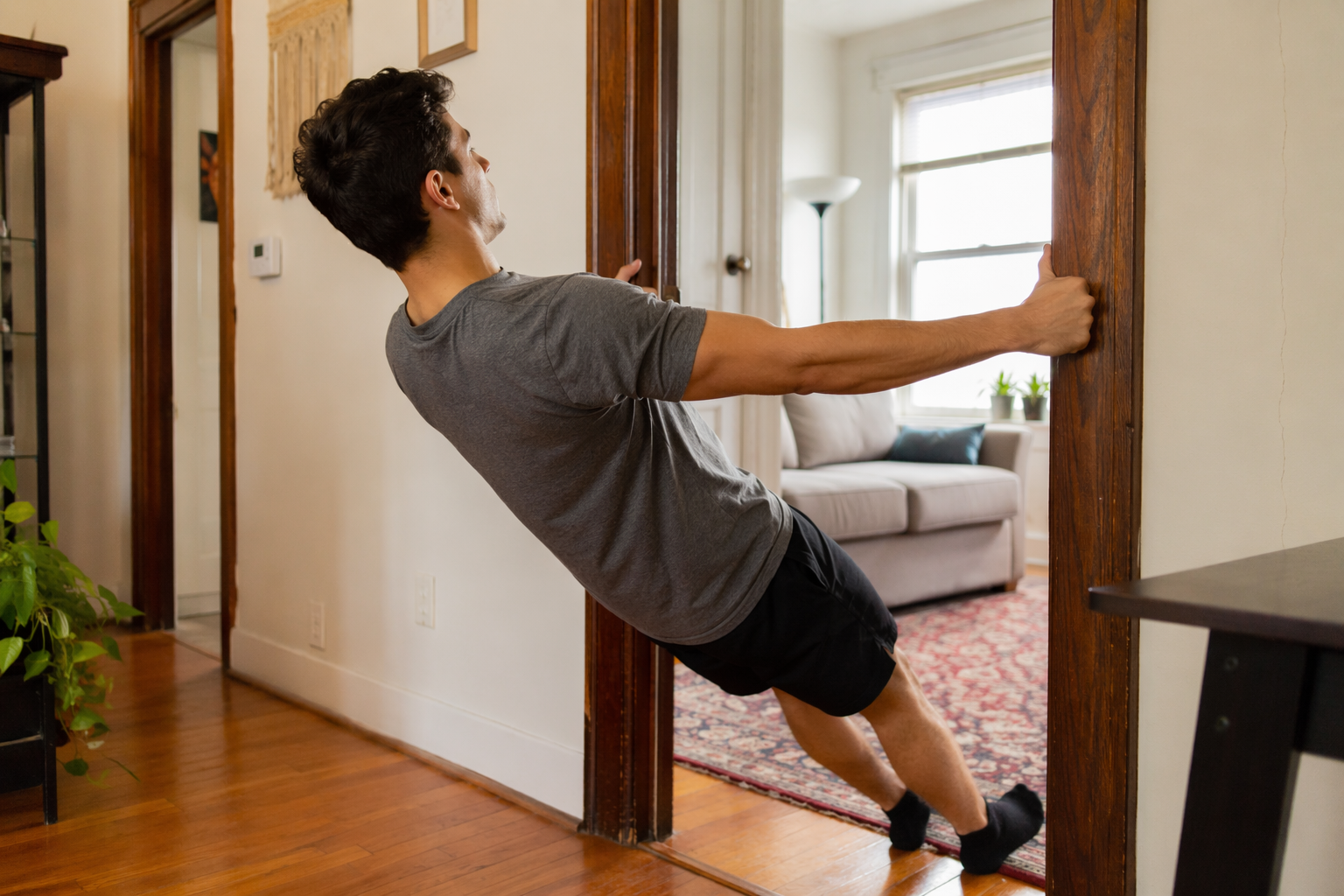
Doorway Rows
A doorway row is the first pulling substitute I would teach in most living rooms because it is easy to set up and easy to scale. Stand inside a doorway, hold both sides of the frame, place your feet close to the frame, lean back with straight arms, then pull your chest toward the doorway. Walk your feet farther forward to make it harder; keep them closer under you to make it easier.
What it trains: mid-back, lats to a modest degree, rear shoulders, elbow flexors, and grip. What it does not fully replace: a heavy horizontal row or pull-up. The range of motion can be shorter, and the grip position is limited by the frame. Still, for many beginners, it is the missing movement that finally makes the back feel like part of the workout.
- Safety cue: use a solid doorframe, not trim that flexes, cracks, or feels decorative.
- Form cue: start each rep by pulling the shoulder blades back, then bend the elbows.
- Beginner version: bend the knees and keep the torso more upright.
- Harder version: straighten the legs and pause with the chest close to the frame.
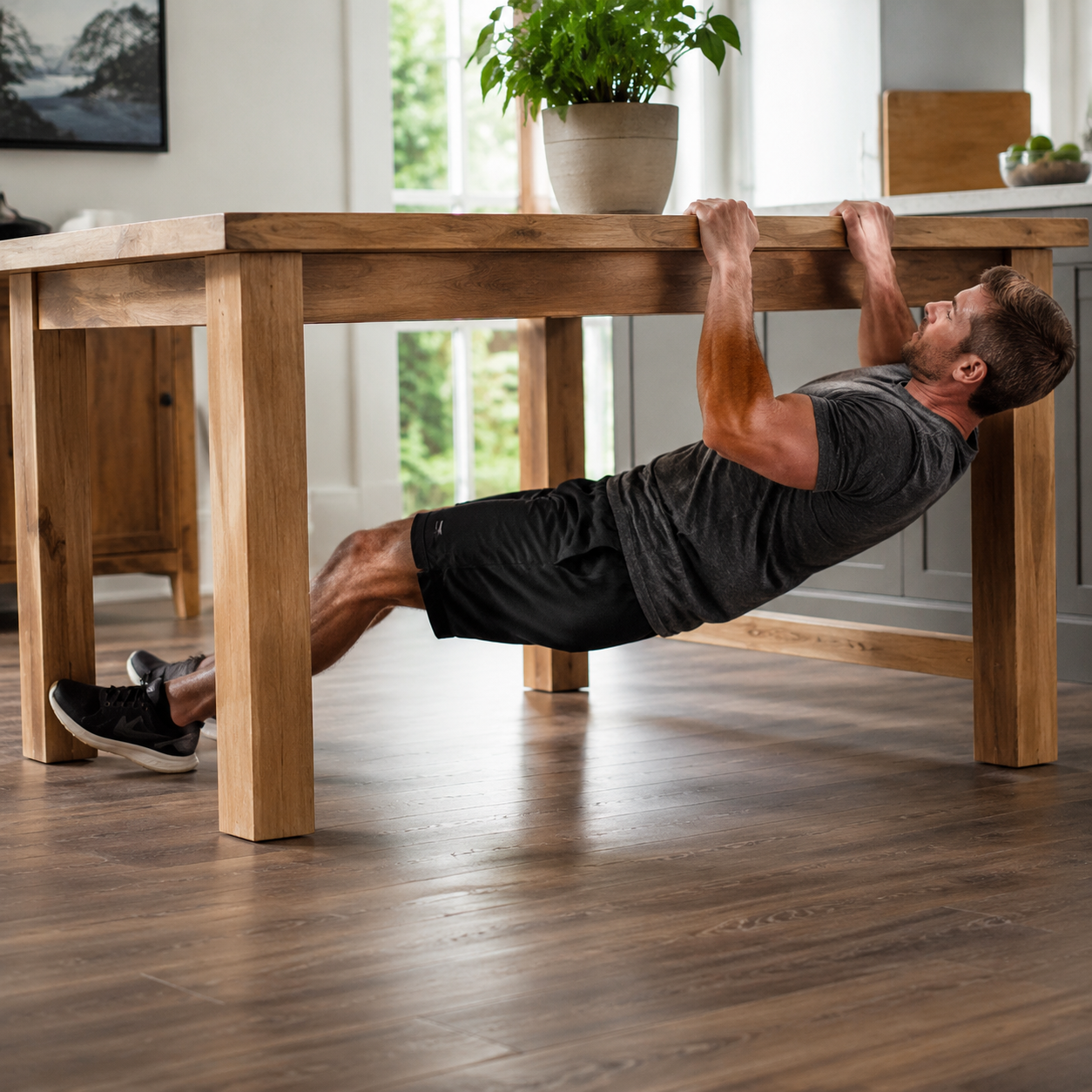
Table Inverted Rows
The table inverted row is the strongest household pulling option if the table is genuinely sturdy. Lie under the table, grip the edge, keep your body long, and pull your chest toward the underside. This feels closer to a gym row than most no-equipment alternatives because your bodyweight becomes the load.
What it trains: mid-back, lats, rear delts, biceps, forearms, and trunk tension. What it cannot promise: the same vertical pulling pattern as a pull-up. SET FOR SET’s bodyweight upper-body template includes pull-ups as a main movement, which makes sense when a bar exists.[4] In a true no-equipment routine, the table row is a practical horizontal substitute, not a one-for-one transfer.
- Safety cue: do not use a folding table, glass table, lightweight desk, or table that tips when pulled.
- Form cue: keep the body in one line from shoulders to knees or heels.
- Beginner version: bend the knees and keep the feet flat.
- Harder version: straighten the legs or pause for one second at the top.
Towel Pull-Aparts
A towel pull-apart will not turn into a pull-up no matter how serious your face looks. That does not make it useless. Hold a towel at shoulder height with both hands, pull outward as if trying to rip it, and keep that outward tension while moving through small controlled reps or holds.
What it trains: rear delts, upper back, rotator cuff area, and the habit of keeping the shoulders from collapsing forward. What it cannot replace: loaded elbow flexion or heavy lat work. This is more of a posture and shoulder-balance movement than a mass-building row. Its value is highest when paired with push-ups, dips, and pike push-ups that otherwise pull the shoulders into a forward-dominant week.
Batwing Scapular Retractions
For batwing scapular retractions, lie face down, bend the elbows to about 90 degrees, and pull the shoulder blades back and down as if trying to lift the elbows slightly away from the floor. Hold briefly, lower, and repeat. The movement is small. That is the point. You are teaching the upper back to create tension without turning the low back into the main worker.
What it trains: rhomboids, mid-traps, lower traps, rear shoulders, and scapular control. What it cannot replace: a row loaded through a full arm path. I like it as a warm-up before rows or as a finisher after towel pull-aparts, especially for people whose push-ups look strong but whose shoulder blades wing or shrug.
The Balanced No-Equipment Upper Body Workout
Use this as an A/B routine two or three days per week. If you train twice weekly, alternate A and B. If you train three times weekly, run A/B/A one week and B/A/B the next. Leave at least one day between sessions when possible.
Absolute beginners who are still building the habit of training may be better served by a simpler full-body plan first, such as the Beginner Bodyweight Workout Routine. This routine is upper-body-specific and assumes you can practice a few movements carefully without rushing.
Warm-Up: 5 to 7 Minutes
- Arm circles: 30 seconds forward, 30 seconds backward
- Scapular push-ups: 2 sets of 8 to 10 reps
- Batwing scapular retractions: 2 sets of 8 reps with a brief squeeze
- Easy incline push-ups: 1 set of 8 reps
- Easy doorway rows or towel pull-aparts: 1 set of 8 to 12 reps
Workout A: Push-Up Strength Plus Rows
| Order | Exercise | Sets and reps | Rest | Main cue |
|---|---|---|---|---|
| 1 | Push-up variation | 3 to 5 sets of 5 to 12 reps | 60 to 90 seconds | Choose a version that leaves 1 to 3 good reps in reserve |
| 2 | Table inverted row or doorway row | 3 to 5 sets of 6 to 12 reps | 60 to 90 seconds | Pull chest toward the anchor without shrugging |
| 3 | Pike push-up or incline pike push-up | 2 to 4 sets of 5 to 10 reps | 60 to 90 seconds | Move head forward and down, not straight to the floor |
| 4 | Towel pull-apart | 2 to 3 sets of 12 to 20 controlled reps | 30 to 45 seconds | Keep constant outward tension |
| 5 | Close-grip incline push-up or floor close-grip push-up | 2 to 3 sets of 6 to 12 reps | 45 to 75 seconds | Keep elbows close without jamming the wrists |
The first two exercises are the heart of the day. Pair a push-up with a row and treat both as real strength work. If you finish all push-up sets but skip the rows because the setup is annoying, the routine has lost its balance.
Workout B: Shoulders, Upper Back, and Arm Balance
| Order | Exercise | Sets and reps | Rest | Main cue |
|---|---|---|---|---|
| 1 | Doorway row | 4 sets of 8 to 15 reps | 60 to 90 seconds | Start with shoulder blades, then bend elbows |
| 2 | Pike push-up | 3 to 5 sets of 5 to 10 reps | 60 to 90 seconds | Keep hips high and neck neutral |
| 3 | Batwing scapular retraction | 3 sets of 10 to 15 reps or 10-second holds | 30 to 45 seconds | Squeeze back pockets, not the low back |
| 4 | Standard, knee, or incline push-up | 2 to 3 sets of 8 to 15 reps | 45 to 75 seconds | Use clean reps, stop before form collapses |
| 5 | Towel pull-apart hold | 2 to 3 rounds of 20 to 40 seconds | 30 to 45 seconds | Pull outward evenly with both hands |
This day puts the pull first so the back does not always get whatever energy remains after push-ups. The shoulder work is still there, but it sits between rowing and upper-back control instead of dominating the whole session.
How to Choose the Right Version
Use the version that lets you complete the low end of the rep range with control. If the target says 6 to 12 reps and you can only manage three shaky reps, make the exercise easier. If you can do more than the top of the range on every set, make it harder next time.
| If this happens | Change this |
|---|---|
| Push-ups collapse at the hips | Raise your hands to a table, counter, or wall |
| Rows feel too easy | Move the feet farther forward, slow the lowering, or pause at the top |
| Rows feel unsafe | Switch to towel pull-aparts and batwing retractions until you find a sturdier setup |
| Wrists hurt during push-ups | Use an incline surface and keep hands under shoulders |
| Neck tightens during upper-back work | Lower the intensity and keep the chin gently tucked |
Do not chase fatigue by letting the room get sketchy. A slightly easier doorway row done every week beats a heroic table row under furniture that should never have been loaded in the first place.
Progression: Make the Same Room Harder
Progression does not require buying anything. For four to six weeks, keep the same exercise menu and change one variable at a time.
- Add reps until you reach the top of the listed range on all sets.
- Add one set to the first push and first pull exercise if recovery is good.
- Slow the lowering phase to make each rep stricter.
- Pause at the hardest point of rows, push-ups, or pike push-ups.
- Move to a harder angle only after the current version looks repeatable.
For most home trainees, the best first goal is not a dramatic variation. It is matching your pulling volume to your pushing volume. If you do 12 hard sets of push-ups and dips every week, your back needs more than two casual sets of towel pull-aparts.
Where This Fits in a Weekly Home Plan
A simple week can look like this: upper body A on Monday, legs on Wednesday, upper body B on Friday. If you want a lower-body session that matches the same home-training logic, pair this routine with The Science-Based Home Leg Workout.
If the bigger problem is consistency rather than exercise selection, start with How to Start Working Out at Home. If you already know you will eventually add resistance bands, dumbbells, or a pull-up bar, the Home Gym Workout Plan by Equipment Tier can help you decide what changes first. For people who like reminders and logging, free workout apps for limited equipment can make the sessions easier to track.
Honest Limits
This routine can train the chest, shoulders, back, biceps, and triceps with no formal equipment. It does that by treating the room as the pulling setup, not by pretending every household movement is equal to a gym station.
The limits are real. Doorway rows and table rows are mostly horizontal pulls. They do not fully replace pull-ups. Towel pull-aparts and batwing retractions are useful for rear-shoulder and scapular work, but they are not heavy lat or biceps builders. If you eventually outgrow the available angles, run out of safe furniture, or want stronger vertical pulling, that is the point where bands, rings, a pull-up bar, or dumbbells stop being clutter and start being progression tools.
Until then, stop letting no equipment mean push-ups plus abs. Give pulling a real place in the workout, choose the safest version your home allows, and progress the push and pull sides together.
References
- Can You Build an Upper Body With Bodyweight Workouts Alone? — TIFFxDAN
- The advantages of body-weight exercise — Harvard Health
- Push-Up Progression Plan — Nerd Fitness
- Upper Body Bodyweight Workout — SET FOR SET
What a small equipment investment adds
We don't have a build tagged to this exact tier yet. Browse all builds.
How often should you repeat this?
How Whoop and Oura Ring track recovery for home workouts
For home exercisers deciding between WHOOP and Oura Ring, the better sleep and recovery tracker depends on training style: WHOOP's strength-aware tracking fits dumbbell and grip-heavy sessions, while Oura's sleep-first scoring suits yoga and indoor cycling. The verdict hinges on how each builds its daily recovery score, their home-workout tracking gaps, and who pays for hardware versus subscription.
Spot something off?
Tell us if a movement, tier assumption, or duration didn't match your experience.