
The 7-Minute Workout: What Research Says About Its Real Results and Limits
The 7-minute workout is often dismissed as a gimmick, but research shows it produces measurable improvements in endurance and body composition—when performed as originally designed. This article breaks down what the studies actually found, who it's best for, and where it falls short.
- Duration
- 7 min
The annoying thing about the 7 minute workout is that the name is both useful and misleading. Useful, because plenty of people really do need a workout that fits into a small, awkward gap in the day. Misleading, because the version most people picture—a single casual round, checked off between emails—is not the version that made the original idea credible.
The workout is not fake. It is also not a seven-minute replacement for training. The original 2013 article by Brett Klika and Chris Jordan in ACSM’s Health & Fitness Journal proposed a high-intensity bodyweight circuit using 12 exercises, 30 seconds of work per exercise, and short transitions between moves. Crucially, it described the routine as high-intensity circuit training and recommended 2 to 3 circuits depending on time and fitness level—not simply one round forever.[1]
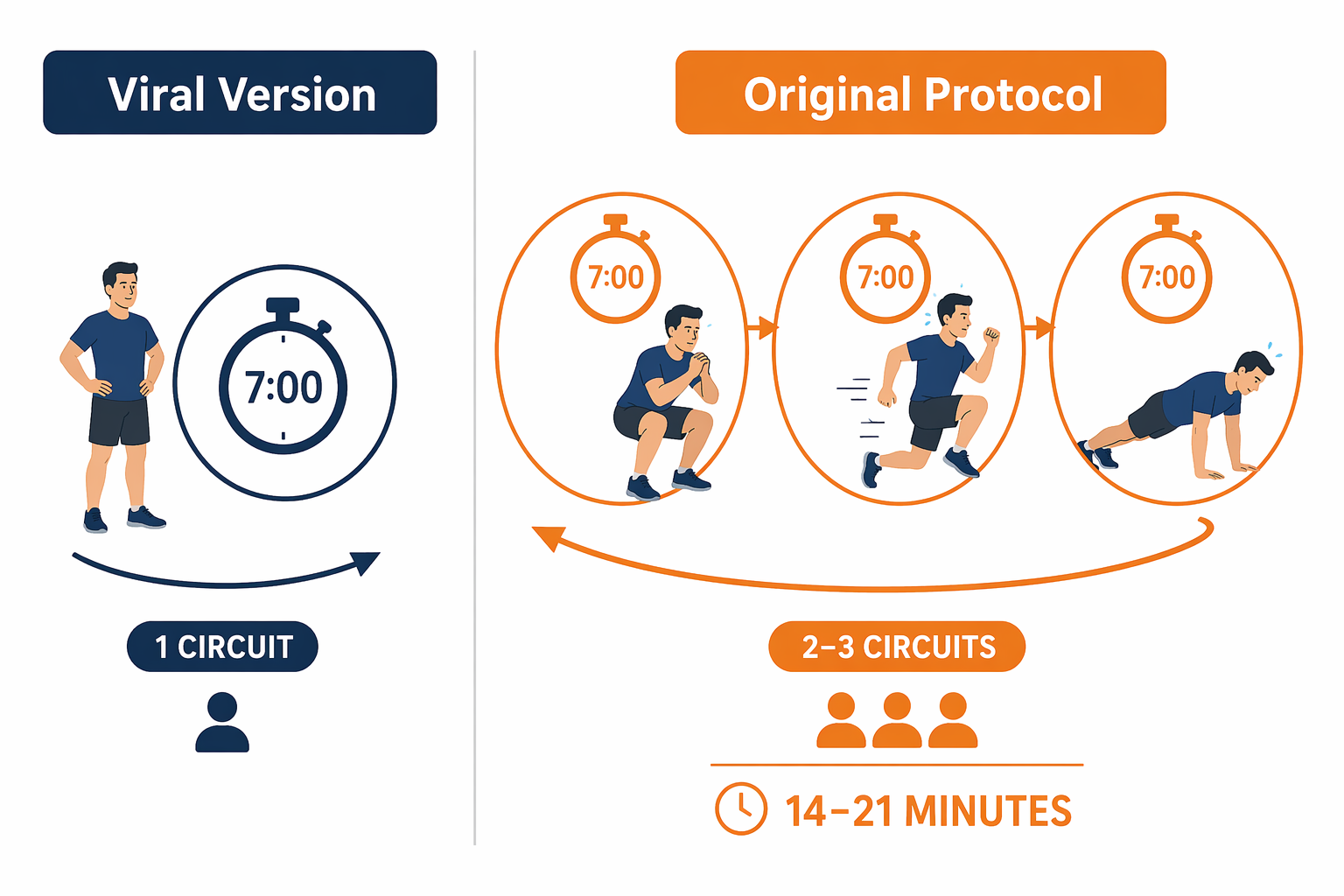
That distinction matters because it changes the workload. One round is a quick conditioning hit. Two or three rounds is a short but demanding session. And the effort is not supposed to feel like warm-up calisthenics. Jordan told The New York Times that the exercises should feel like “about an 8 on a scale of 1 to 10.”[2] If someone does one easy circuit and concludes the 7 minute workout does nothing, they have tested the brand name more than the protocol.
What was proposed, and what was actually tested
The original ACSM article is often flattened into the phrase “science-backed,” which is technically half-right and half-sloppy. Klika and Jordan built the circuit from existing research on high-intensity interval training and circuit training principles. They did not, in that 2013 article, run a trial proving that this exact 12-exercise sequence would produce specific results in a specific population.[1]
That does not make the idea unserious. Exercise programming often starts with informed design before direct trials catch up. But it does mean the strongest claims should come from later studies that actually put people through the workout and measured what changed.
| Question | What the evidence supports |
|---|---|
| Does it improve muscular endurance? | Yes, especially in push-up and circuit-style endurance tests. |
| Does it improve body composition? | Some evidence says yes, but the strongest body-composition result used daily sessions. |
| Is it equal to bike-based HIIT for cardio? | Mixed. Some acute responses look similar; peak oxygen uptake and heart rate may be lower. |
| Is it a strength or performance program? | No. It can challenge muscles, but it is not built like progressive strength training. |
| Why might it work for normal people? | Low setup, no equipment, and better enjoyment than cycling HIIT in at least one adherence-focused study. |
The strongest direct test: better endurance, not magic
The largest direct test in the research brief is the 2016 Schmidt study, with 96 participants over 8 weeks. It compared 7-minute and 14-minute circuit groups and found significant improvements in push-up endurance and overall strength in both groups.[3] That is a meaningful finding, especially because it does not require pretending the routine is a full gym program.
Push-up endurance is exactly the kind of thing this circuit should improve. The workout repeatedly asks the body to move under fatigue: push-ups, squats, lunges, step-ups, planks, wall sits, and similar bodyweight efforts performed with short rests. If someone gets better at tolerating that kind of work, the result is not surprising. It is also not trivial.
Where the interpretation needs discipline is the word “strength.” In casual fitness language, doing more push-ups feels like getting stronger. In training language, absolute strength usually means producing more force against progressively heavier resistance. The original authors themselves cautioned that this style of bodyweight circuit “may be inferior to create absolute strength and power.”[1] So the fair read is this: the 7 minute workout can improve muscular endurance and general circuit performance, especially for less-trained users, but it should not be sold as a substitute for progressive resistance training.
The body-composition result is interesting, with one large caveat
The 2017 Mattar study is the one that makes the 7 minute workout look more impressive for body composition. In 58 participants over 6 weeks, daily sessions were associated with an average waist-circumference reduction of about 4 cm, a significant decrease in fat mass, and weight loss, with no diet changes reported in the study design.[4]
That deserves attention. Waist circumference and fat mass are not vague “I feel toned” outcomes. They are measurable changes. But the daily-session detail is not fine print; it is the condition under which the result occurred. A daily high-effort circuit for 6 weeks is a very different commitment from doing one round twice a week when motivation appears.
For a normal home exerciser, the lesson is not that seven minutes automatically melts fat. It is that a short circuit can contribute to body-composition change when the frequency is high and the effort is real. If the actual plan is occasional use, expected body-composition results should be much more modest.
Cardio: good enough for many people, not clearly the best HIIT option
The cardiovascular evidence is more mixed, and that is where the conversation gets more useful. In a 2020 crossover study with 12 participants, the bodyweight circuit produced acute cardiometabolic responses similar to 7-minute cycling HIIT, with lower diastolic blood pressure after exercise.[5] That supports the idea that the workout can generate a legitimate cardiovascular stimulus, at least in the short term.
But a 2017 study with 14 participants found that the bodyweight workout produced lower peak VO2 and heart rate than 7-minute cycling HIIT.[6] That matters because cycling lets someone drive intensity continuously with fewer interruptions from local muscle fatigue, coordination, or exercise transitions. A bike can punish the cardiovascular system very efficiently. A bodyweight circuit may be limited by whether your shoulders, wrists, knees, or ability to move quickly through exercises becomes the bottleneck first.
So the honest answer is not that the 7 minute workout is the most efficient cardio protocol. It is that it can be a useful no-equipment conditioning option, especially when the alternative is doing nothing. If the goal is to build a more deliberate aerobic base or progress beyond short intervals, a structured plan such as a 4-week at-home cardio progression is a better next step than endlessly repeating the same circuit.
The effort requirement is where most versions fall apart
A real 8-out-of-10 effort is uncomfortable. It means the 30-second work periods are not just movement slots; they are work sets. The transitions are short. The breathing gets messy. The wall sit is not a pose. The push-ups are not decorative. By the second or third circuit, the workout has very little in common with the breezy app-store fantasy of “done before your coffee cools.”

This is also why modifications can be completely legitimate. A beginner may need incline push-ups instead of floor push-ups, step-backs instead of jumps, or a shorter range of motion on lunges. That does not ruin the workout if the relative effort is still high and the person can repeat it safely. What does ruin the claim is removing both the intensity and the repeated circuits, then expecting the same outcome.
The original structure also leaves room for recovery decisions. Doing 2 or 3 hard rounds every day is not the same stress as one moderate round used as a movement break. Frequency should match conditioning, soreness, joint tolerance, and the rest of the week’s training. Readers trying to place it into a weekly schedule should think about rest days and total workload, not just the timer; a more specific frequency discussion belongs in how often to do the 7-minute workout.
The best argument may be adherence
There is a version of fitness skepticism that ignores the part where people have lives. A workout can be physiologically superior and still lose if nobody wants to repeat it. That is why the 2023 Poon study is useful: sedentary participants enjoyed the 7 minute workout more than cycling HIIT and described it as “less boring.”[7]
Enjoyment is not the same as effectiveness, but it affects whether effectiveness ever has time to accumulate. A bodyweight circuit that someone will actually do in a hotel room, at home before childcare pickup, or on a low-motivation day has a practical advantage over a more elegant session that never happens.
That does not mean every app-guided version is equally good. Timers can help, especially for people who do better when the next exercise is simply announced for them. But the app is not the program; the work is the program. Some once-prominent options may also change or disappear over time, so it is safer to choose any guide that lets you control modifications, rounds, rest periods, and progression. For broader app-based routines, a guide to using free fitness apps to build a home workout routine is more useful than treating one branded timer as essential.
Who should use it, and who should move on
The 7 minute workout makes the most sense for beginners, returning exercisers, travelers, and people who need a low-friction consistency tool. Cleveland Clinic exercise physiologist Katie Lawton put it plainly: “It’s not going to replace your other fitness routines, but it can be a good filler workout, like between gym days or when you’re traveling.”[8]
That is the right-sized claim. Men’s Health UK reached a similar practical assessment: useful for beginners and newer exercisers, but not enough for specific strength or performance goals.[9] Someone trying to build a bigger squat, improve sprint power, train for a race, or make significant weight-loss progress needs more than a fixed bodyweight circuit.
The safety line is also practical rather than dramatic. Most beginners can modify the exercises. People with joint issues, heart conditions, very low conditioning, or concerns related to age and deconditioning should be more cautious and may need professional guidance before pushing high-intensity intervals. The problem is not that bodyweight training is inherently dangerous; it is that “only seven minutes” can make hard exercise sound harmless.
If the circuit exposes weak spots—legs tiring first, push-ups collapsing, knees disliking repeated lunges—that is useful information. It may be a sign to keep the circuit as conditioning while adding more focused work elsewhere. For example, someone who wants more lower-body development would be better served by a dedicated science-based home leg workout than by hoping the same 30-second squat slot keeps progressing indefinitely.
The fair verdict
The 7 minute workout works best when it is treated as a hard, repeatable conditioning circuit: usually 2 to 3 rounds, short rests, and an effort level around 8 out of 10. Under those conditions, research supports improvements in muscular endurance, some body-composition measures, and cardiovascular demand. Under the easier viral version, the evidence should not be stretched.
It is a good filler workout. It is a good travel workout. It can be a useful entry point for someone who has been sedentary and needs a simple start. It can keep momentum alive during a crowded week, which matters when time pressure is real; one 2025 survey reported that 48% of American adults said they were too busy to exercise at all.[10]
It is not a complete program for strength, power, sport performance, or major weight-loss goals. Once the circuit stops feeling like a serious challenge—or once the goal becomes more specific—the next move is not to worship the timer. It is to progress the training.
References
- HIGH-INTENSITY CIRCUIT TRAINING USING BODY WEIGHT: Maximum Results With Minimal Investment, ACSM’s Health & Fitness Journal, 2013
- The Scientific 7-Minute Workout, The New York Times, 2013
- Schmidt et al. 2016, PubMed, 2016
- High-intensity interval training and body composition in normal weight and overweight/obese adults, PubMed, 2017
- Acute Cardiometabolic Responses to a 7-Minute Bodyweight Resistance Exercise Circuit and a 7-Minute High-Intensity Interval Cycling Protocol, PMC, 2020
- Riegler et al. 2017, 2017
- Poon et al. 2023, 2023
- Should You Try the 7-Minute Workout?, Cleveland Clinic
- Is the 7-Minute Workout Actually Science-Backed?, Men’s Health UK
- The viral 7-minute workout delivers — but there’s a catch, New York Post, 2025
What a small equipment investment adds
We don't have a build tagged to this exact tier yet. Browse all builds.
How often should you repeat this?
How Whoop and Oura Ring track recovery for home workouts
For home exercisers deciding between WHOOP and Oura Ring, the better sleep and recovery tracker depends on training style: WHOOP's strength-aware tracking fits dumbbell and grip-heavy sessions, while Oura's sleep-first scoring suits yoga and indoor cycling. The verdict hinges on how each builds its daily recovery score, their home-workout tracking gaps, and who pays for hardware versus subscription.
Spot something off?
Tell us if a movement, tier assumption, or duration didn't match your experience.