
Can a workout in your living room deliver the same heart-health benefits as a gym session? The largest, most recent studies say yes—but only under the right conditions. Let me walk through the evidence and its limits, so you know exactly what the science says about cardio at home.
I'm not going to rehash the small 30-person trial we covered in Does Cardio at Home Really Work?. What we have now is bigger, newer, and more clinical.
What CardioRACE Actually Found (and Who It Applied To)
The strongest piece of evidence is the CardioRACE trial, published in the European Heart Journal in 2024. 406 participants aged 35 to 70 with a BMI between 25 and 40 and elevated blood pressure were randomized to one of three exercise groups—aerobic only, resistance only, or a 50/50 split—all performed at home under supervision. After one year, the combined group reduced cardiovascular disease risk as much as the aerobic-only group. That is a direct clinical outcome, not a surrogate marker.
Those are strong results. But I need to pause on the population. These were overweight or obese adults with high blood pressure. That describes a large slice of the population, but it does not automatically generalize to everyone. If you are normal weight and already active, the relative benefit may be smaller—though the absolute benefit is still almost certainly positive based on dose-response data we will get to.
What makes CardioRACE particularly useful is the fat-loss relationship it revealed. For every 1% reduction in body fat, the risk of developing hypertension dropped by 3%, hypercholesterolemia by 4%, and metabolic syndrome by 8%. Those are not huge effect sizes individually, but they compound. If someone drops 5% body fat over a year, the risk reductions become 15%, 20%, and 40% respectively. That is meaningful.
The combined exercise group improved both VO₂max and muscular strength. Aerobic-only and resistance-only each improved only their respective domain. If you want both fitness and fat loss, the split approach looks like the most efficient use of time.
The 30-Year Cohort That Shows Dose Matters (but Can't Prove Setting)
One year is a good trial duration, but long-term health outcomes really need decades. The Circulation study published in 2022 tracked 116,221 adults over 30 years, with participants reporting their leisure-time physical activity up to 15 times during the period. It is the kind of dataset that lets you see dose-response more clearly than any single trial ever could.
The headline numbers: people who did 300 to 599 minutes of moderate activity per week—two to four times the minimum guidelines—had 26% to 31% lower all-cause mortality. Even meeting the minimum (150 minutes moderate or 75 minutes vigorous per week) was associated with a 22% to 31% reduction in cardiovascular disease mortality. And the best combinations of moderate and vigorous activity gave the largest reduction, 35% to 42%.
Here is the important caveat: this is an observational study, not a randomized trial. People who exercise more also tend to have better diets, sleep, and healthcare access. The association is real and robust—the dose-response curve is remarkably clean across the whole 30-year window—but it does not prove that home cardio specifically caused the effect. The activity could have been gym, outdoor, or home. What it does show is that the volume of activity matters enormously, and that the setting is likely secondary to the dose.
What a Supervised 12-Week Program Achieved (and Why That's Not Your Living Room)
A 2019 study by Roberts and colleagues in PMC tested home-based training systems—a multi-exercise pulley in one group and an incline trainer in another—combined with a controlled diet over 12 weeks. The results are striking: body weight dropped by 6.2 kg in the pulley group and 9.1 kg in the incline group. Visceral fat fell by 183 grams (37.8%) and 400.8 grams (32.1%) respectively. Resting heart rate dropped 7 to 8 beats per minute, diastolic blood pressure fell 6 to 8 mmHg.
Those numbers make you want to start immediately. But I have to step in with a boundary the study authors themselves acknowledged: the participants attended supervised group exercise sessions three times a week, and the meals were provided. Compliance was 94% and 92.6%—far higher than what unsupervised home exercisers typically achieve. This is a best-case scenario, not a guarantee.
The study still tells us something important: the physiological potential of home-based training is very real. The cardiovascular adaptations (HR, BP, VO₂max) matched what you would expect from supervised gym programs of similar volume. The gap is not biological—it is logistical. The challenge for the typical home exerciser is not that the body responds differently, but that sticking to the dose without external structure is harder.
So What Does 'Properly Structured' Really Mean?
The thesis of this article is that home cardio works when properly structured. But that phrase is vague in the research. The CardioRACE trial had supervised sessions; the Circulation cohort used self-reported activity. Neither gives you a recipe for your living room. Let me translate what the evidence actually supports.
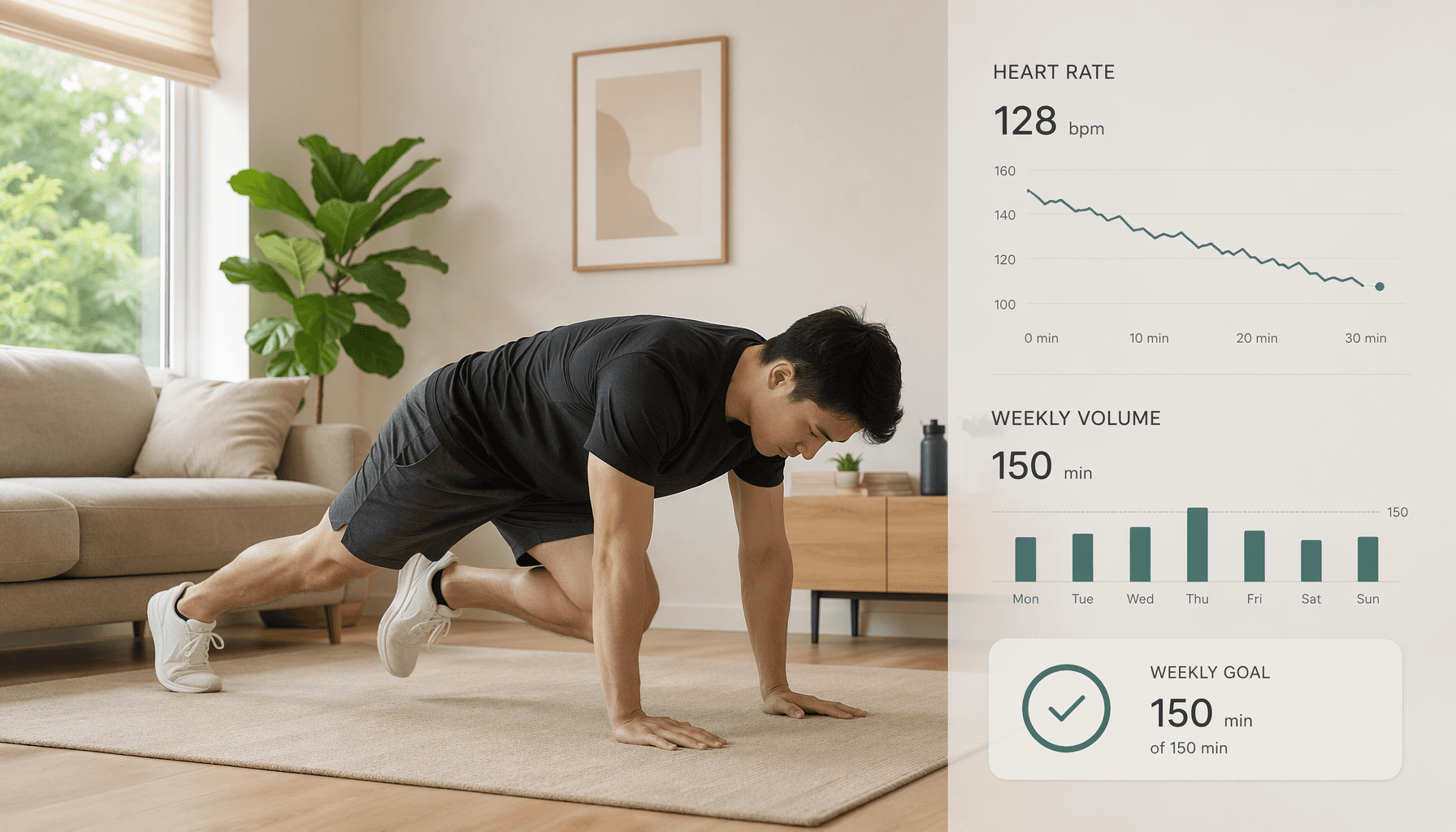
The AHA and CDC recommend at least 150 minutes of moderate-intensity aerobic activity or 75 minutes of vigorous activity per week. Achieving that at home means deliberately scheduling it. Most home exercisers underestimate intensity—a casual walk around the block is not enough. You need to be breathing harder, and you should be able to talk but not sing (the talk test). Alternatively, use perceived exertion: moderate feels like a 5 or 6 out of 10, vigorous feels like 7 or 8.
- Volume: at least 150 minutes of moderate cardio or 75 minutes vigorous per week. More is better up to about 300–600 minutes moderate (2–4× minimum), where mortality reduction plateaus.
- Intensity: moderate enough to raise your heart rate and breathing, not a leisurely pace. The talk test is your simplest gauge.
- Consistency: spread across most days of the week. A long single weekend session is far less effective than daily 20-minute sessions in terms of adherence and cumulative adaptation.
This is where the research from the CardioRACE and Circulation studies converges: the dose-response relationship holds regardless of setting. If you hit the volume and intensity, the benefits follow.
Home Cardio Is a Valid Modality—But You Have to Schedule It
After looking at a year-long randomized trial, a 30-year cohort, and a mechanistic study, the evidence is consistent: home-based cardio is a clinically valid modality. It is not a compromise. It produces comparable cardiovascular risk reduction, fat loss, and fitness improvements when the volume, intensity, and consistency are matched.
But 'when properly structured' is doing real work. The research shows that the dose is what matters, and achieving that dose at home requires deliberate scheduling and self-monitoring. If you want a complete, progressive program that was built from these principles, the Progressive Home Cardio Training Plan (6 weeks, beginner to intermediate) is designed to get you there step by step. For a gentler ramp, the 4-Week At-Home Cardio Progression Plan starts at 10-minute sessions and builds up.
The science says yes, home cardio works. Now the only remaining question is whether you will schedule it.
Comments
Join the discussion with an anonymous comment.