
What Goes Wrong by Week 2
You searched “cardio at home.” You got a list: jump squats, high knees, burpees, mountain climbers. Maybe you did it once. By the second week, the motivation was gone and the list was back in the tab graveyard. That pattern is not your fault. It is the structural failure of exercise-list content. The CDC reports that only 46.9% of U.S. adults meet aerobic guidelines. The problem isn’t that people don’t know any exercises — it’s that they don’t have a plan that deliberately forces them to get better week after week.
The scientific case for structured home training exists. Roberts et al. (2019) ran a 12-week home-based program combined with diet and saw a mean weight loss of 6.2 kg, a fat mass drop of 6.8 kg, and a 10.2 mL/kg/min increase in relative VO₂max. Those are real physiological changes. But — and this is where most articles mislead you — that study included supervised group sessions and provided meals. Unsupervised home training alone will not replicate those numbers. I am not going to pretend it will.
The missing piece is progression logic — not a list of “fat‑burning moves,” but a week‑by‑week ramp that tells you exactly what to do, at what intensity, and when to take the next step. That is what this 6‑week plan provides.
How Progression Works
Progressive overload is the mechanism that forces your cardiovascular system to adapt. You increase either the volume, the intensity, or the complexity. A list tells you none of that — it gives you the ingredients but no recipe.
The site already has a solid 4‑week beginner cardio plan and a 4‑week progression plan that ramps from 10 to 30 minutes. Both are beginner‑only. This 6‑week plan takes you further: it adds a challenge phase (weeks 5‑6) with HIIT circuits and endurance intervals that the 4‑week plans never touch. If you have already built a base and want to push into intermediate territory, this is the next step.
Every session in this plan assigns a specific work/rest ratio and an RPE target. You will never see “do mountain climbers” alone. You will see “mountain climbers at RPE 5, 30 s work / 30 s rest, week 3.” That is the difference between a bookmark and a program.
The 6‑Week Plan: Foundation, Build, Challenge
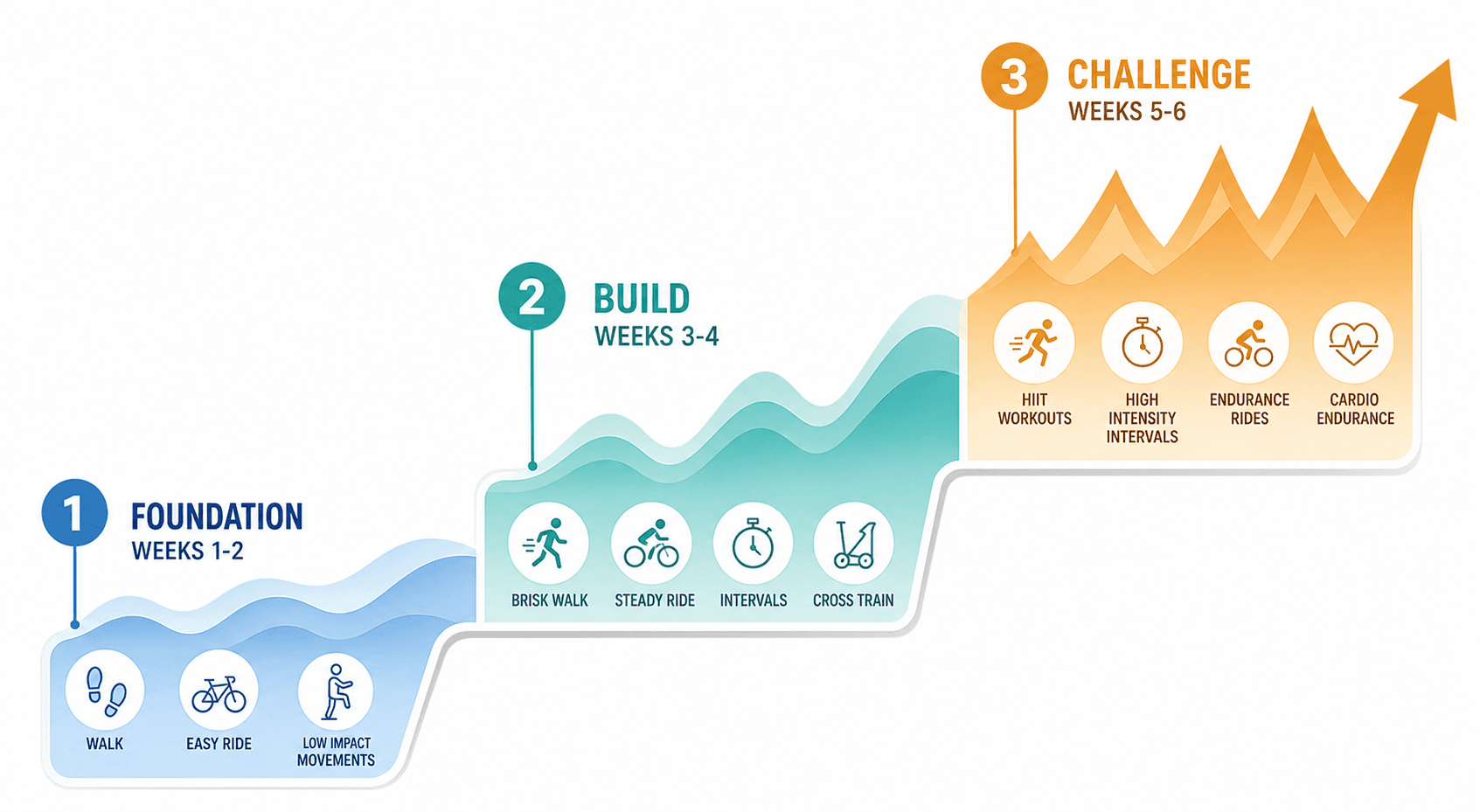
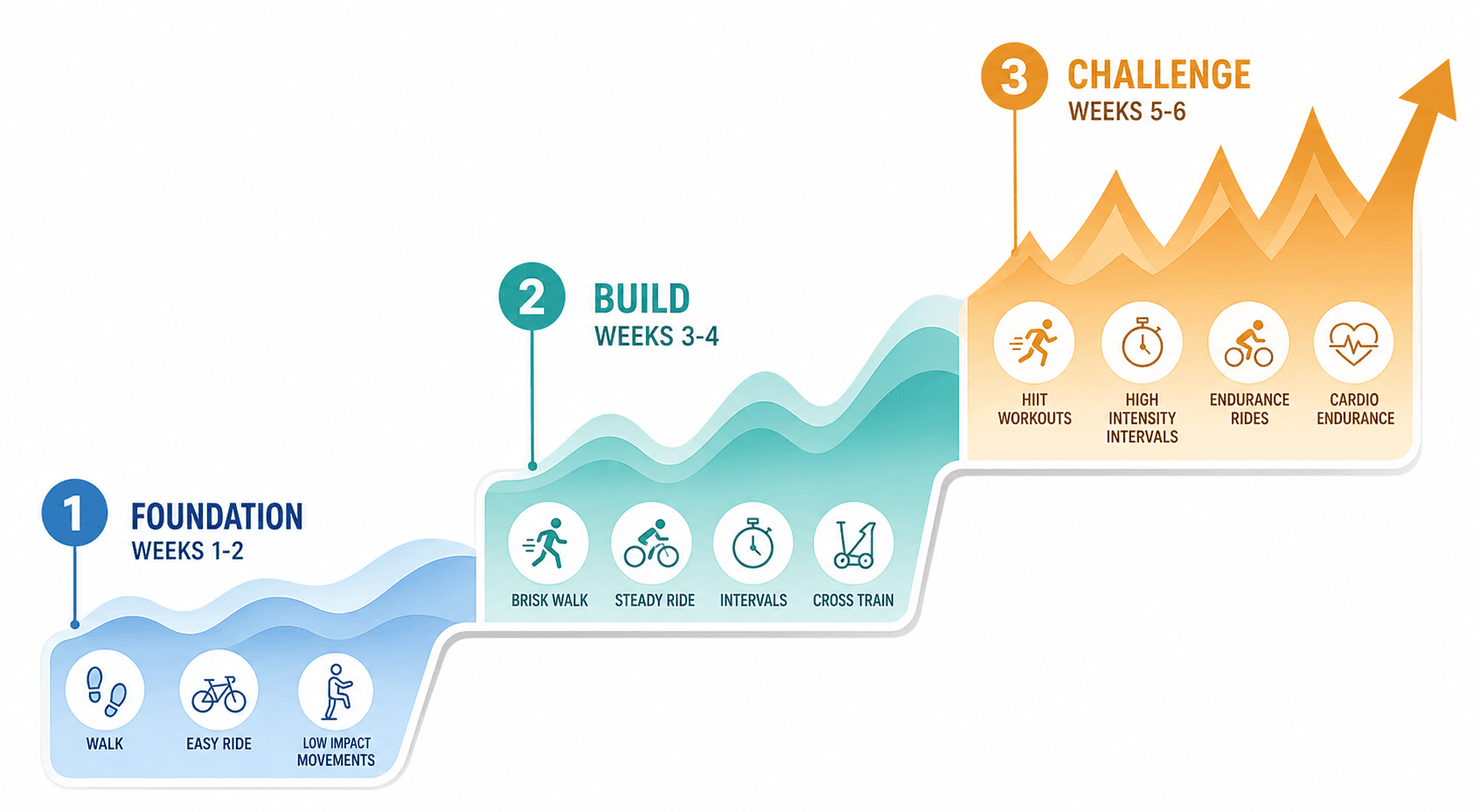
The plan runs three phases. Each phase has a clear purpose, a prescribed session frequency, and specific RPE and work/rest targets. Beginners start at phase 1. Intermediates who can already sustain 20 minutes of moderate cardio continuously can skip to week 3 (see the self‑assessment below).
| Phase | Weeks | Sessions/week | Work/Rest | Target RPE | Focus |
|---|---|---|---|---|---|
| Foundation | 1‑2 | 3 | 30 s / 30 s | 3‑4 | Baseline aerobic capacity, low‑impact movements |
| Build | 3‑4 | 4 | 45 s / 15 s | 5‑6 | Interval mix, longer sessions, moderate impact |
| Challenge | 5‑6 | 4 | 30 s / 15 s (HIIT); 60 s / 30 s (endurance) | 6‑8 | HIIT circuits, sustained endurance intervals |
Foundation Weeks 1‑2
Goal: establish a baseline without overwhelming your joints or your willpower. Every exercise is low‑impact — no jumping, no pounding. You work at an RPE where you can hold a conversation (3‑4). Three sessions per week, 20 minutes each, including a 5‑minute warm‑up and 5‑minute cool‑down.
Sample session (week 1, session A):
- Warm‑up: 5 min of marching in place + arm circles
- Circuit (repeat 3 times): 30 s marching in place, 30 s rest; 30 s bodyweight squats, 30 s rest; 30 s walking lunges, 30 s rest; 30 s standing calf raises, 30 s rest
- Cool‑down: 5 min of slow walking + hamstring stretch
If you have noise or space constraints, substitute lateral steps, glute bridges, or other low‑impact moves from the apartment‑friendly guide.
Build Weeks 3‑4
Goal: increase work capacity. Sessions expand to 30 minutes, four per week. Work intervals lengthen to 45 s, rest shrinks to 15 s. RPE climbs to 5‑6 — you can still speak in short sentences. Exercises introduce moderate impact: jumping jacks, high knees, split jumps (with a soft landing). The volume jump from week 2 to week 3 is deliberate — it forces adaptation.
Challenge Weeks 5‑6
Goal: push past your current ceiling. Two session types alternate: HIIT circuits (30 s work / 15 s rest, RPE 6‑8) and endurance intervals (60 s work / 30 s rest, RPE 6‑7). Monday and Thursday are HIIT; Tuesday and Friday are endurance. Exercises include burpees (with push‑up optional), skaters, mountain climbers at pace, and squat jumps. Four sessions per week, 30‑35 minutes each.
If you are an absolute beginner — you cannot sustain 10 minutes of walking without getting winded — start with the 4‑week beginner plan first before stepping into this 6‑week program. The ramp is honest: it challenges you, but only from where you actually are.
How to Know You’re Ready for the Next Phase
Progression is not automatic on a calendar date. Use these criteria before moving from one phase to the next:
- You completed all prescribed sessions in the current week without excessive soreness or missing a workout due to fatigue.
- During the longest work interval of the week, you could maintain conversation at the target RPE without gasping. (RPE 3‑4 = full conversation; RPE 5‑6 = short sentences; RPE 7‑8 = only single words.)
- If you can already sustain 20 continuous minutes of moderate cardio (brisk walking, light jogging) without stopping, you can skip foundation and start at build (week 3).
Your First Week: Sessions You Can Do Today
Three sessions for week 1. Do them Monday, Wednesday, Friday. Each takes about 23 minutes total (5 min warm‑up, 13 min circuit, 5 min cool‑down).
| Session | Warm‑up (5 min) | Circuit (×3 rounds) | Cool‑down (5 min) |
|---|---|---|---|
| A (Mon) | March in place + arm circles | 30 s each: march, bodyweight squat, walking lunge, calf raise — 30 s rest between | Slow walk + hamstring stretch |
| B (Wed) | March in place + torso twists | 30 s each: side shuffle, glute bridge, standing toe tap, alternating knee raise — 30 s rest between | Slow walk + hip flexor stretch |
| C (Fri) | March in place + leg swings | 30 s each: step‑up on low step (or march), half squat with hold, reverse lunge, calf raise — 30 s rest between | Slow walk + quad stretch |
The RPE guide: a 3‑4 means you can talk in full sentences during the work interval. If you cannot, slow the movement down or shorten your range of motion. If it feels too easy, increase the range of motion (deeper squat, longer lunge) before you increase speed.
Commit to the Process, Not the List
The difference between plateau and progress is structured progression. That is why most people plateau at week 2. Don’t be most people.
Start week 1 today. Stick with the three phases. At the end of six weeks, you will not need another list — you will know exactly how to keep building your own progress.
Comments
Join the discussion with an anonymous comment.