
4-Week At-Home Cardio Progression Plan: From 10 Minutes to 30 Minutes (No Equipment)
This 4-week bodyweight cardio plan takes you from 10-minute sessions to full 30-minute workouts using progressive overload through work-to-rest ratios, exercise complexity, and RPE targets. Designed for beginners and lower-intermediate exercisers who want a structured ramp without equipment.
Most “Cardio at Home” Articles Are Just a Pile of Exercises
Search for “cardio at home” and you get lists: jumping jacks, high knees, burpees, mountain climbers. That is it. No structure, no progression, no reason to come back on Thursday. I have seen those listicles. They do not work because there is no ramp. You start strong Monday, gas out Wednesday, and quit Friday. This 4-week plan is different: it uses work-to-rest ratios, RPE anchors, and three levers you can pull without weights. I designed it for the person who has stalled on those lists. Someone who needs a schedule that builds, not just a pile of moves.
If you are not sure what kind of cardio at home fits your situation, start with the Complete Guide to Cardio at Home. This plan assumes you already know you want bodyweight cardio and are ready to follow a schedule.
Three Levers That Work Without a Barbell
Progressive overload is not just for gym rats. With bodyweight cardio, you increase difficulty by three levers. Each week changes at least one.
- Work-to-rest ratio. Shorter rest forces your heart and lungs to adapt. Self’s ladder works nicely: 30/30, 40/20, 50/10 (source). I start at 20:40 in week 1 because even 20 seconds of marching can feel long for a true beginner.
- Session duration. Add 3–6 minutes per week. Garage Gym Reviews suggests starting at 15 minutes and adding 1 each session (source). I build from 10 to 30 minutes over four weeks.
- Exercise complexity. Plyometrics, tempo changes, multijoint moves increase oxygen demand without equipment. PopSugar notes speed squats can spike heart rate without jumping (source). Health.com offers low-impact alternatives for every plyometric move (source). I weave those in so nobody has to bail on the plan.
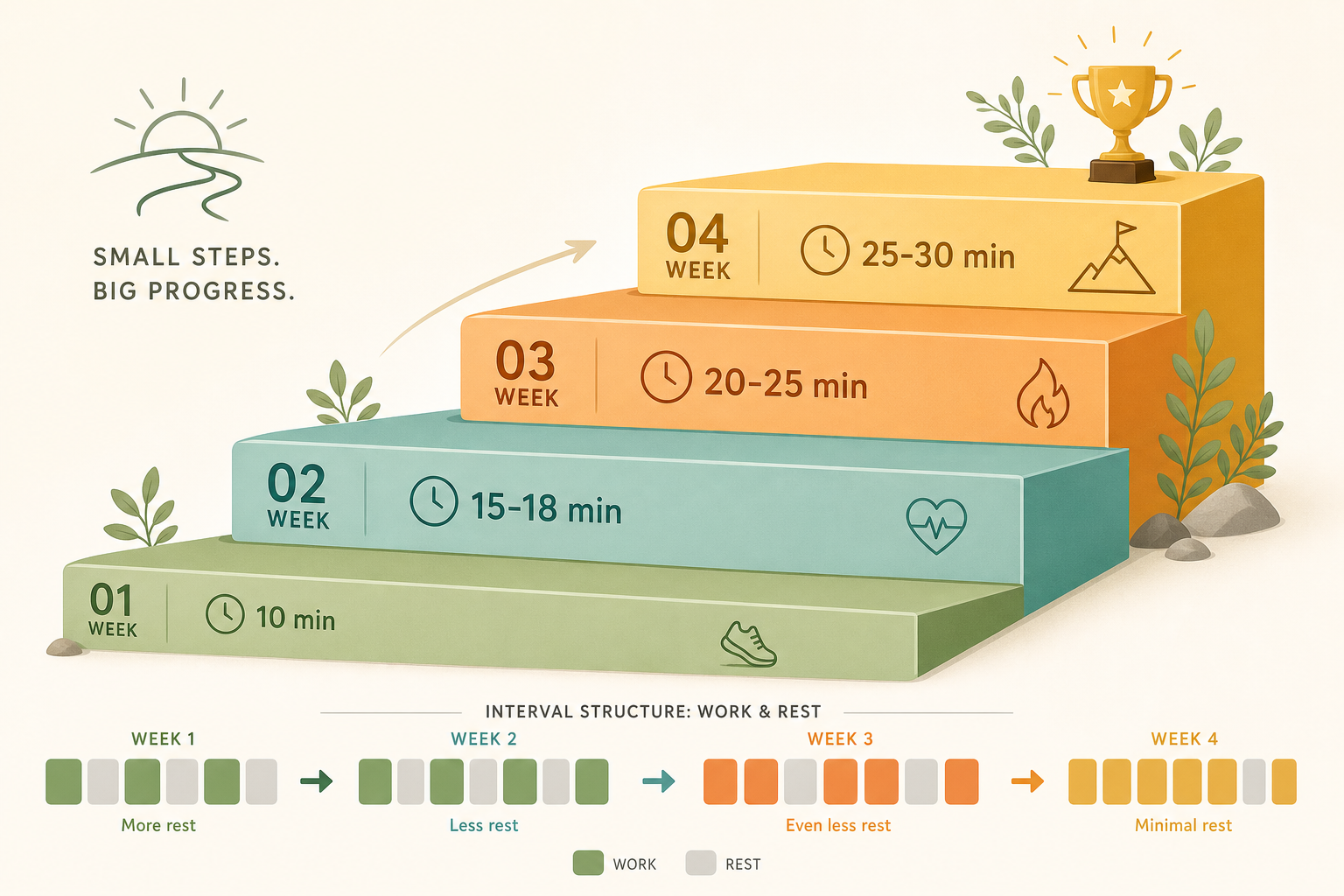
| Week | Duration (min) | Work:Rest | Sessions / Week | RPE Target | Key Exercises |
|---|---|---|---|---|---|
| 1 | 10–12 | 20:40 | 3 | 3–4 | March in place, bodyweight squat, standing hamstring curl |
| 2 | 15–18 | 30:30 | 3 | 4–5 | Lateral shuffle, speed squat, high‑knee skip (or low‑impact alternative) |
| 3 | 20–25 | 40:20 | 3 | 5–6 | Mountain climber, squat jump, plank jack |
| 4 | 25–30 | 45:15 or 50:10 | 4 | 6–7 | Burpee progression, skater, circuit blend |
Week 1: Just Get Moving
Three sessions, 10–12 minutes each. Work 20 seconds, rest 40. That 2:1 rest advantage is deliberate. Even a true beginner can sustain 20 seconds of marching, squats, and hamstring curls at a conversational effort. RPE should stay 3–4. The rule: you should be able to say a short sentence but not sing. I use that test myself when coaching.
The moves:
- March in place – knees to hip height, arms swinging.
- Bodyweight squat – feet hip-width, thighs parallel at bottom.
- Standing hamstring curl – heel to glute, alternate legs.
Do each move for 20 seconds, rest 40, then the next. After three moves, rest 60 seconds. That is one circuit. Complete 4 circuits. Add a 3-minute warm-up (marching, arm circles, leg swings) and a 2-minute cool-down (walk in place, deep breathing).
If you are truly starting from zero, read How to Start Working Out at Home: A Beginner's Guide first. It covers setup, safety, and listening to your body.
Week 2: Add Tempo and Sideways Movement
Three sessions, 15–18 minutes each. Work:rest shifts to 30:30 – same work as rest. Tougher, but manageable if you controlled week 1. New exercises: lateral shuffles, speed squats, and high-knee skips (or a low-impact march with knees up). RPE 4–5. You can still talk, but you need to pause between sentences.
Lateral shuffles introduce side-to-side movement. Speed squats exploit the tempo lever: squat as fast as you can while staying controlled. PopSugar calls speed squats a quiet way to raise heart rate (source). High-knee skips build coordination and ankle power.
Low-impact alternatives: replace lateral shuffles with step-touch side steps; replace high-knee skips with marching high knees (no hop).
Circuit: 4 exercises, 30 sec work, 30 sec rest, move to next. After all four, rest 60 seconds. Repeat 3–4 times. Include warm-up and cool-down as before.
Week 3: Safely Introduce Plyometrics
Three sessions, 20–25 minutes. Work:rest becomes 40:20 – you work twice as long as you rest. This is where cardiovascular demand jumps. RPE 5–6. You can speak a few words at a time.
Exercises: mountain climbers, squat jumps, plank jacks. These are plyometric – speed and force to build power. But every jump move has a low-impact alternative:
- Squat jump → bodyweight squat (add a small pulse at the bottom to keep intensity)
- Mountain climber → step-back climber (step one foot back, alternate)
- Plank jack → shoulder tap (tap opposite shoulder from high plank, no leg jump)
Circuit: 3 exercises, 40 sec work, 20 sec rest, 3–4 rounds. The short rest means you recover actively – keep your feet moving lightly. If you cannot finish a round, take an extra 10–20 seconds rest. That is still progress.
Week 4: Push to 30 Minutes, but Be Realistic
Four sessions this week, 25–30 minutes each. The jump from three to four sessions is the biggest change in the plan. I want to be honest with you: if you miss a session earlier in the week, do not try to cram it in. Stay at three sessions and repeat week 3 for another week before attempting four. The plan is a framework, not a prison.
Work:rest advances to 45:15 or 50:10. At 50:10 you work 50 seconds and rest only 10 – a genuine challenge. RPE 6–7. You can say a word or two, but not full sentences. Exercises: a circuit combining burpee progressions (burpee without push-up, then add the push-up as you progress), skaters (or leg swings), and a blend from previous weeks (mountain climber, squat jump, lateral shuffle).
At 4 sessions × 30 minutes you accumulate 120 minutes of moderate-intensity cardio per week. That is below the CDC/ACSM recommendation of 150 minutes (source). I will not pretend this plan alone gets you to the target. It gives you a foundation. To reach 150, add a fifth 20-minute session, or extend each workout by 5 minutes. Do not jump from 120 to 150 in one week – add 5–10 minutes per week.
Important: four sessions per week requires honest scheduling. If you can only commit to three, stay at three and increase the duration to 35 minutes. The plan adapts to you, not the other way around.
Why This Ramp Works – and Where It Stops Short
The logic is simple: each week adds 5–7 minutes and tightens the rest ratio. That kind of measured overload gives your cardiovascular system time to adapt. I think a structured ramp reduces the chance of injury and dropout compared to jumping into high-intensity circuits. But I do not have a study that proves that directly – it is a logical consequence of gradual adaptation, not a research certainty. I will not oversell it.
What I can cite: the CDC and ACSM recommend 150 minutes of moderate or 75 minutes of vigorous activity per week (source). This plan builds toward that range. The RPE scale and talk test give you reliable intensity without a heart rate monitor (Nike’s talk test: easy conversation = 1–3, need to pause = 3–5, few words = 5–7, cannot talk = 7–10 – source). Everything here is achievable with bodyweight and a timer.
After four weeks, you will have a solid endurance base. If you want to keep going, consider the 6-Week Home Strength Training Plan for a combined approach, or simply repeat the capstone week with longer sessions or a fifth day. This plan is a ramp, not a permanent routine – that is the point. You climb it, then you decide where to go next.
What a small equipment investment adds
We don't have a build tagged to this exact tier yet. Browse all builds.
How often should you repeat this?
See our recovery and rest reference for citation-anchored rest-interval guidance.
Spot something off?
Tell us if a movement, tier assumption, or duration didn't match your experience.