
How Often Should You Do the 7-Minute Workout?
Wondering if you can do the 7-minute workout every day? This guide explains how the right frequency depends on your fitness level, the intensity you sustain, and how many circuits you complete — with evidence-based guidelines for rest days.
Yes, some people can do the 7-minute workout every day. But that answer only holds if the session is truly one circuit, the effort is moderate, and you are recovering normally. Once you turn it into two or three circuits, push close to all-out effort, or start from a low fitness base, rest days become part of the workout plan rather than a sign that you are slacking.
The cleanest split comes from Cleveland Clinic exercise physiologist Katie Lawton: “If you’re a regular exerciser, this workout is OK to do every day. If you’re just starting out, give yourself a rest in between, with some days of walking.” [1]
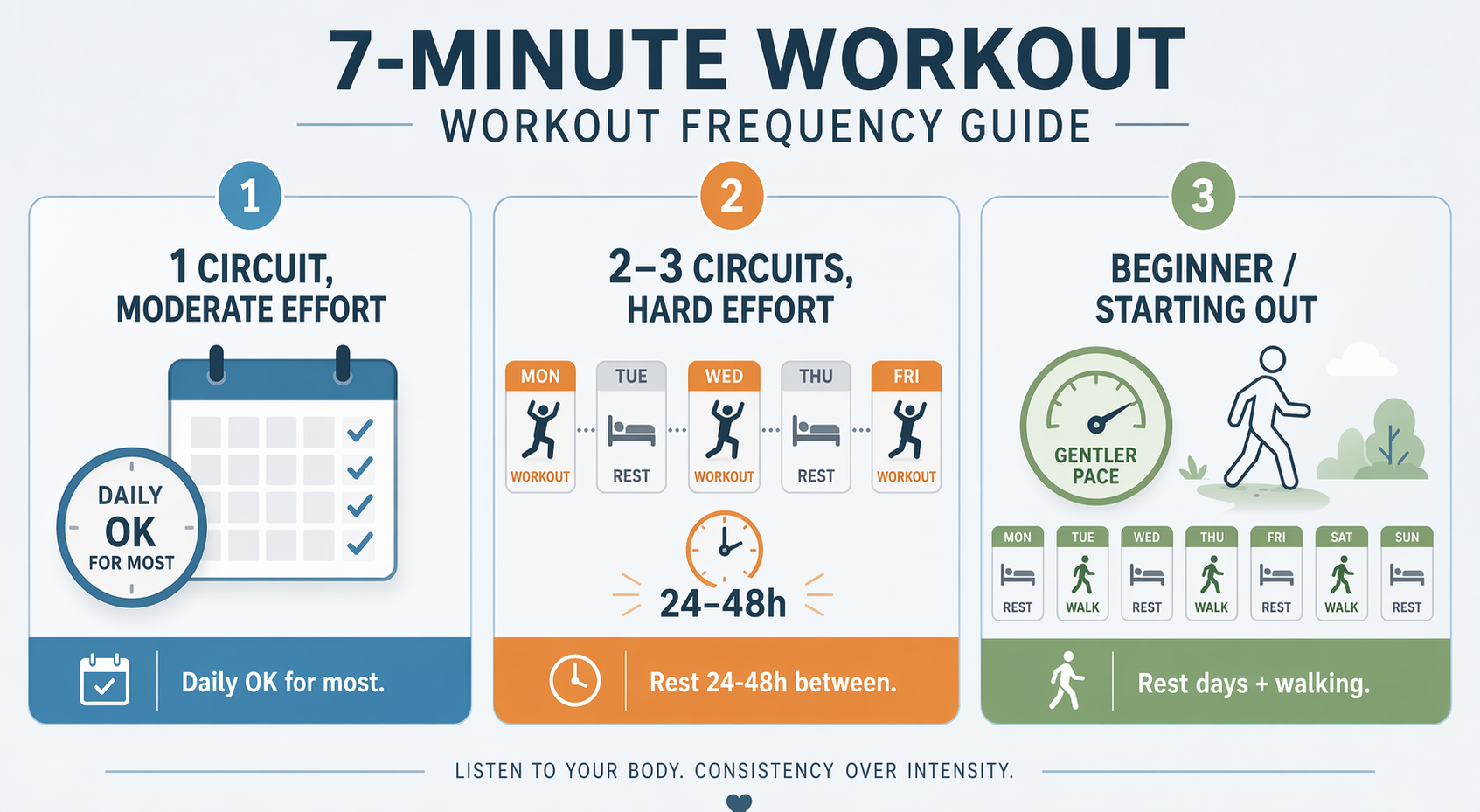
The practical frequency guide
| How you are doing the 7-minute workout | Best starting frequency | Why |
|---|---|---|
| One circuit, moderate effort, already exercise regularly | Daily is usually reasonable if soreness and performance stay normal | This matches Cleveland Clinic’s daily OK for regular exercisers, assuming the workout is not being treated as a maximal-effort session. |
| One circuit, hard effort, already exercise regularly | Most days may work, but rotate in easier days or rest when performance drops | A hard 7 minutes is still hard. Short duration does not erase muscular and nervous-system fatigue. |
| Two to three circuits, hard effort | About 3–4 times per week, with 24–48 hours between hard sessions | NASM recommends 24–48 hours between high-intensity strength sessions for adequate recovery. [2] |
| Beginner doing the standard circuit | Every other day at first, with walking or mobility on off days | Beginners are adapting to the movements, impact, pacing, and soreness all at once. |
| Beginner using modified, low-impact, moderate-effort versions | Start with 2–4 days per week, then increase only if recovery is easy | Lower intensity changes the recovery demand, but form and tolerance still matter. |
That table is more useful than the usual “do it every day” or “never do it daily” answer because it separates the two things people often mix together: duration and load. Seven minutes tells you how long the timer runs. It does not tell you how hard your legs, shoulders, lungs, joints, or connective tissue are working.
A moderate one-circuit version might feel like a brisk bodyweight tune-up. A hard three-circuit version can become a 21-minute high-intensity strength-and-cardio session. Those are not the same recovery problem.
One circuit is not the same thing as the 14- to 21-minute version
This is where a lot of frequency advice breaks. Someone asks whether the 7-minute workout can be done daily, but they may mean one pass through the circuit. Another person answers while imagining two or three rounds. The name stays the same; the workload does not.
If you do one circuit, you are managing a short exposure: roughly one set per exercise with fast transitions. If you repeat it two or three times, you are multiplying the squats, push-ups, step-ups, planks, lunges, and jumping work. At that point, the session is no longer just “a quick 7 minutes.” It is a compact high-effort workout that may need the same recovery thinking you would give any other demanding strength circuit.
That is why NASM’s 24–48 hour recovery window matters most for the stacked version. The guidance is not about the brand name of the workout; it is about what happens when high-intensity strength work asks the same muscles and joints to produce force again before they have recovered. [2]
So if your version is one moderate circuit, daily use can be reasonable. If your version is two or three circuits at a hard effort, plan recovery days between hard sessions. You can still move on those days. Walking, mobility, or a deliberately easier circuit belongs in a training week; it is not a failed workout.
What “hard” means here
The original popular version of the workout was built around high-intensity circuit training, with effort described around an 8 out of 10 on perceived exertion. [3] That matters because an 8 out of 10 is not casual movement. It is the kind of pace where talking is limited, form starts to demand attention, and the final seconds of each interval feel costly.
But the same exercise list can be performed at very different intensities. A wall sit can be shallow or brutal. Push-ups can be full, inclined, or from the knees. Step-ups can be controlled or rushed. Chris Jordan later showed a gentler approach to a short workout format, which reinforces the point that exercise selection alone does not determine intensity. [4]
For frequency decisions, use effort more honestly than the clock. Around 5–6 out of 10, one circuit may function almost like daily movement practice for many regular exercisers. Around 8 out of 10, especially for multiple circuits, you should treat it as a hard training day.
Beginners should not use daily soreness as proof of commitment
Beginners have a separate issue: they are not only recovering from effort. They are learning the movements. A regular exerciser may know how to keep a lunge under control when tired. A beginner may turn the same interval into a form breakdown, especially when the timer is pushing the pace.
That is why the beginner branch should start with rest between sessions. Do the circuit, take the next day for walking or light movement, then repeat if soreness is manageable and form stays clean. If you need help scaling the exercises, use a beginner-specific version rather than forcing the standard circuit to fit your current capacity; our 7-minute workout beginners guide walks through modifications and form choices.
There is some evidence that daily practice can produce measurable changes, but it should not be stretched too far. In a 2017 six-week study of 29 adults aged 18–30, participants performed the workout once daily and saw an average waist circumference reduction of about 4 cm along with decreased fat mass. [5] That supports the idea that daily use can be tolerated and effective in a short-term young-adult sample. It does not prove that all beginners, older adults, or people doing hard multi-circuit versions should train daily for months.
For a closer look at what the research does and does not show, see our guide to the science behind the 7-minute workout.
So why do some sources disagree about beginners?
You may see one source describe the workout as beginner-friendly and another say it is not good for beginners. Cleveland Clinic and Healthline present it as approachable with the right context, while WebMD says the 7-minute workout is “not good for beginners.” [1][6] That disagreement is less mysterious once you ask what version of “beginner” and what version of the workout each source has in mind.
A beginner doing modified push-ups, controlled step-ups, and a moderate pace is in a different situation from a beginner trying to copy a full-intensity circuit with jumping jacks, chair step-ups, push-ups, planks, and lunges under time pressure. The first can be a reasonable entry point. The second can become too much too soon.
Intermountain Health makes the risk side plain by listing “potential for injury and pain” as a con and noting that these are hard workouts. [7] That is not a reason to avoid the 7-minute workout altogether. It is a reason to stop pretending that short workouts cannot accumulate fatigue.
How often did the creator say to do it?
Chris Jordan, one of the names most associated with the workout, has recommended exercising three to five times a week at minimum for results. [8] That is a useful anchor because it does not turn daily training into the price of admission. If your goal is consistency, three to five well-recovered sessions can be a much better starting point than seven rushed ones that leave your knees, shoulders, or motivation irritated.

Use this recovery check before repeating the circuit
Before doing the workout again tomorrow, run through a quick check. One warning sign does not automatically mean you must stop training, but several of them together are a good reason to choose walking, mobility, or an easier version instead.
- Persistent soreness that changes how you squat, lunge, step up, or push.
- A noticeable drop in reps at the same effort level.
- Joint pain rather than ordinary muscle soreness.
- Poor sleep after several hard sessions.
- An unusually elevated resting heart rate or low readiness signal if you track recovery.
- Dreading the session because your body feels flat, not because you are simply unmotivated.
If you want a lower-impact option for a day between hard circuits, use the workout as an easier recovery session instead of trying to beat yesterday’s pace. Our active-recovery 7-minute workout shows how to lower the demand without dropping movement entirely.
Wearables can also help, as long as you do not let a score override obvious soreness or pain. If you use recovery data, our guides to how the Oura Ring tracks readiness and improving your Whoop recovery score can help you interpret the broader recovery picture.
The decision rule for tomorrow
If you are already active, doing one 7-minute circuit at moderate effort, and waking up without lingering soreness or performance drop-off, daily use is usually a reasonable choice. Keep the effort honest; moderate means you finish feeling worked, not wrecked.
If you are a beginner, put rest days between sessions at first and use walking or light mobility on the days in between. If you are doing two or three circuits, or pushing the circuit near an 8 out of 10, give yourself 24–48 hours before the next hard version. The workout is short, but your body still has to recover from the work.
References
- Should You Try the 7-Minute Workout, Cleveland Clinic.
- Active Recovery: Benefits & Best Practices, NASM.
- The Scientific 7-Minute Workout, The New York Times, May 9, 2013.
- A gentler 7-minute workout that still delivers, The Washington Post, 2025.
- Effects of a 7-minute high-intensity circuit training workout on body composition, PubMed, 2017.
- The 7-Minute Workout, WebMD.
- Pros and Cons of the 7 Minute Workout, Intermountain Health.
- The 7-minute workout is the fitness routine everyone should be doing, Business Insider, 2017.
This is general fitness education, not medical advice. For diagnosis or treatment of pain or injury, consult a qualified clinician.
Pick your next session
Browse all routines to find an appropriately-spaced next session.
Spot something off?
This content sits adjacent to health guidance — tell us if a citation or figure needs a correction.