
5 Science-Backed Ways to Improve Your Whoop Recovery Score
A practical, data-driven guide for current Whoop users who want to actively improve their daily recovery scores by targeting the modifiable behaviors that actually move HRV, RHR, and sleep quality.
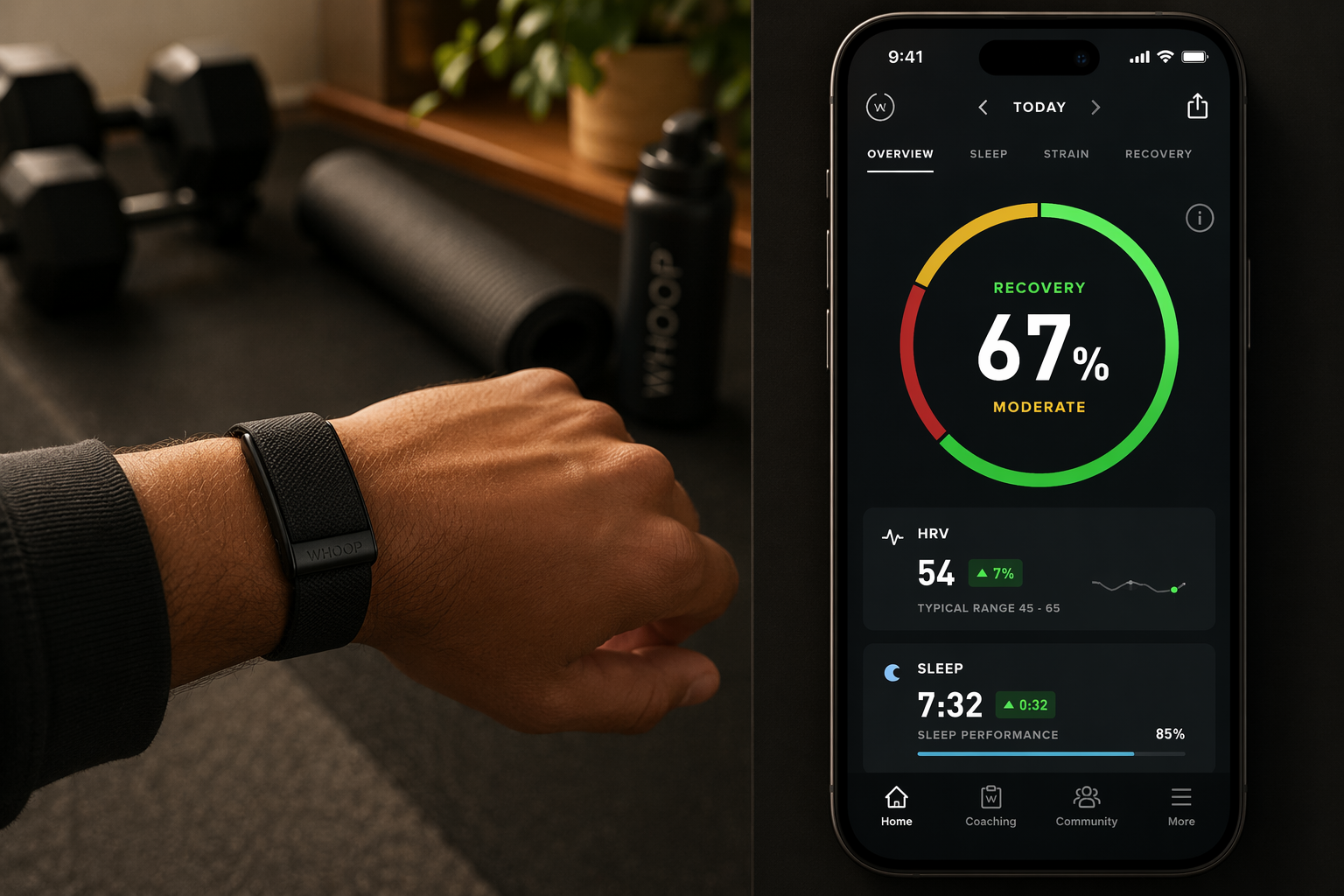
If your WHOOP recovery score is stuck in yellow most mornings, the usual advice — sleep more, eat better, stress less — is true but useless. To actually move the number, you need to know which specific behaviors work and by how much. A 2025 study published in Sensors analyzed nearly a million days of data from 11,914 WHOOP subscribers. The findings point to a small set of high-leverage behaviors. But the study was written by WHOOP employees, so treat the causal language as associative, not proven. Even so, the sample size and the mediation analysis make the direction hard to ignore. Here is what the evidence says, and what you can do tonight.
Go to bed at the same time every day
The strongest finding is sleep consistency. Daily wearers had a resting heart rate 3.769 bpm lower than those who wore it fewer than five days per week. That difference was accompanied by 4.596 percentage points better sleep consistency and about 20 minutes longer sleep. The mediation analysis tested whether the lower RHR came from extra sleep or extra activity. Answer: sleep duration partially mediated the relationship (indirect effect −0.0387, p < 0.001); physical activity minutes did not (0.0003). Longer sleep explains part of the RHR drop; more exercise explains essentially none. But the headline number is the 4.6 percentage points on consistency — not duration. Daily wearers slept 20 minutes more, but they also went to bed and woke up at more regular times. Your first priority should be a consistent sleep window, not an extra hour. Practical steps: set a fixed bedtime and wake time even on weekends, wear the band to bed every night, and if you already sleep seven hours, stabilize the schedule before adding more.
Massage before bed? Maybe 1%
WHOOP's member data on recovery activities comes from self-selected journal logs, not a controlled trial. That means the numbers are directional, not proven causes. The five most logged activities — meditation, stretching, breathwork, ice baths, massage therapy — are all associated with lower heart rate and improved HRV. The most interesting timing finding: massage logged closer to bedtime showed a 1% positive impact on next-day recovery, versus 0.6% when done earlier. That is a 67% relative lift, but 1% on a 60% score will not turn it green overnight. Stack a few such behaviors — a consistent bedtime, a pre-sleep breathing session, a stretch before bed — and the compound effect can shift the dial over a week. Pick one or two, log them, and see your own correlations later.
Hydration and the 80/20 heuristic

A 2017 WHOOP article collected habits from top-recovered members — anecdotal but consistent: hydration, consistent eating schedules, avoiding sugar before bed, and the 80/20 training intensity rule. Even mild dehydration reduces blood volume, which raises heart rate and lowers HRV. The 80/20 rule is more about strain management: 80% of weekly training at low-to-moderate intensity, 20% at high. If you spend most of your time in the endurance zone, your strain stays lower, leaving more room for recovery. I would not treat 80/20 as a formula — it is a starting heuristic. If your week already skews high-intensity, redistribute rather than add more low-effort volume. Practical steps: track water intake (at least 2 liters on rest days, more on training days), avoid sugar and processed food within two hours of bedtime, and review your weekly strain distribution.
For more on active recovery practices, see our guide to foam rolling and active recovery for home gym training.
Strength work eats sleep need
WHOOP's muscular load feature estimates strain from strength work. Higher muscular load — heavy weights or high-volume functional fitness — can increase Sleep Need. If you log a strength session in the afternoon and see your Sleep Need jump by an hour that night, that is not a glitch; the body needs time to repair. Use Strength Trainer to log sets and reps so the algorithm gets a clearer picture. After a high-load session, plan an earlier bedtime or a lower-strain next day. Check your Sleep Need baseline before scheduling back-to-back hard strength days.
Your own data, after weeks of logging
All of the above is population-level evidence. The most honest move WHOOP has made in the past year is the Behavior Insights feature, launched March 2026. It shows how each journal habit you log is associated with changes in your recovery. But it needs at least five "yes" and five "no" logs for a given habit within a 90-day window before it can calculate a correlation. That is weeks of consistent journaling before you see a result. It is not instant insight. But when it fires, it gives you a personalized signal: for you, afternoon caffeine may cost 3% recovery, while a 10-minute evening walk may add 2%. Use the voice entry (added April 2026) to make logging easier. Start journaling consistently, focus on habits you can realistically change — sleep timing, hydration, screen time before bed, pre-sleep activities — and check the tab after 4–6 weeks.
The score is not the target
A green recovery is satisfying, but it is a lagging indicator. The leading indicators are the behaviors you control. Pick one from this list and start tonight. Consistency on a single lever will move your numbers more than trying all five at once. If you have not already, read our data-driven review of whether WHOOP is worth it for home gym recovery to confirm the investment makes sense for your setup.
The recovery score is a mirror. What you do in front of it is what matters.
This is general fitness education, not medical advice. For diagnosis or treatment of pain or injury, consult a qualified clinician.
Pick your next session
Browse all routines to find an appropriately-spaced next session.
Spot something off?
This content sits adjacent to health guidance — tell us if a citation or figure needs a correction.