
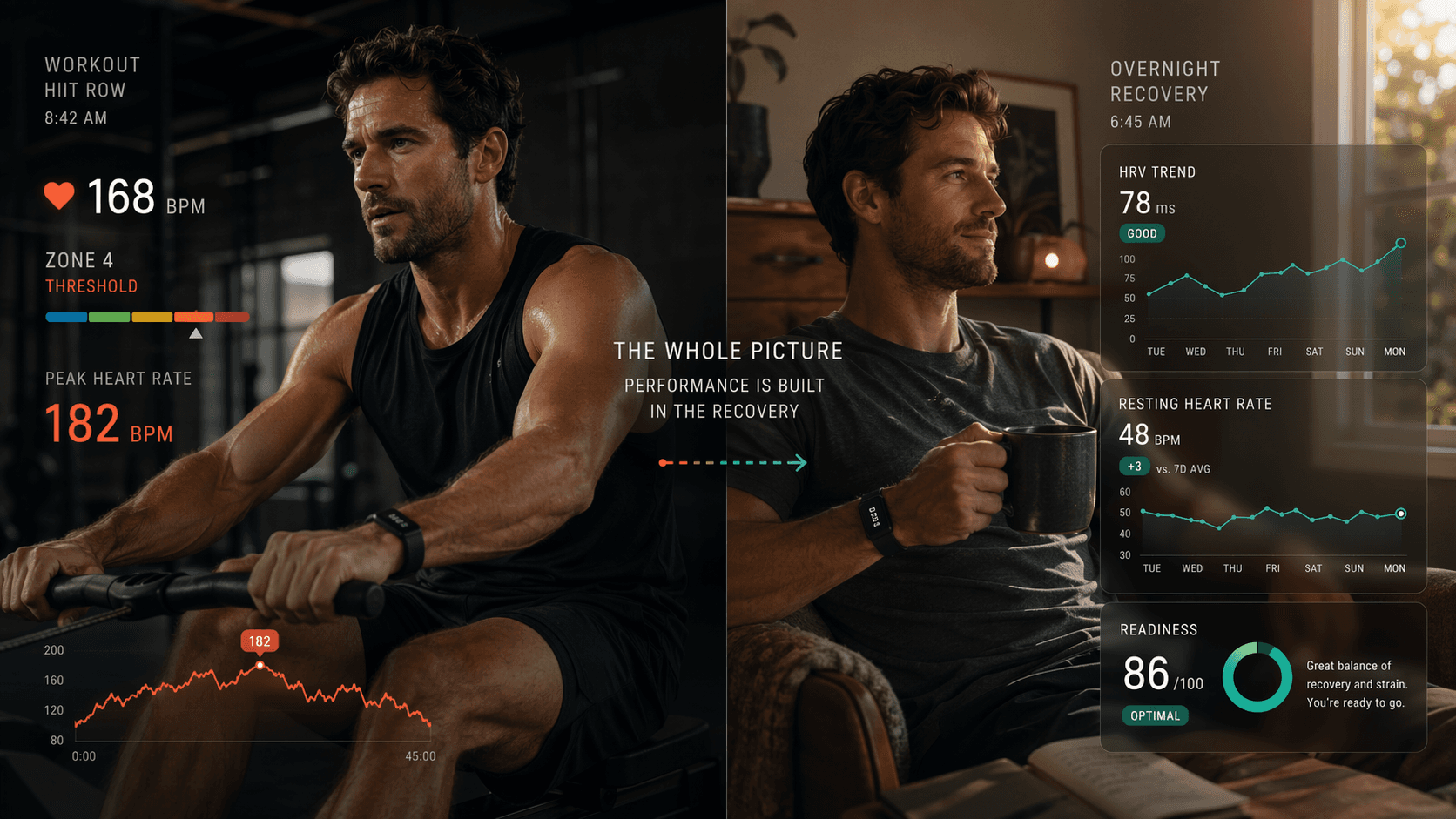
You wake up. Your Whoop says 85% recovery. Your Oura reads 72 readiness. Garmin Body Battery shows 68. Three different numbers for the same body. Which one is right? Probably none.
In June 2026, the wearable analytics platform Kygo published an analysis that examined the major recovery scores on the market. The finding: only 2 out of 12 composite recovery scores have any published peer-reviewed validation. Two out of twelve. I will repeat that because it matters: only two. That means the score you check every morning — Whoop Recovery, Oura Readiness, Garmin Training Readiness, Fitbit Daily Readiness — is operating without independent scientific scrutiny. Kygo’s analysis is self-published, not a peer-reviewed meta-analysis, but it is the most comprehensive cross-device audit available, and the finding is stark. The composite score layer is scientifically thin, even as raw sensor accuracy improves.
I am a recovery coach who has watched the wearable industry sell composite scores without independent science for years. I check first whether a metric has been peer-reviewed or validated against a gold standard, not whether it sounds plausible. If you train four or more days per week and want a heart rate fitness tracker that actually helps manage recovery, here is what I have found: the recovery score layer is largely unvalidated, and the industry hides behind the fact that raw HRV and RHR sensors are reasonably accurate. I will show you how each device weights the same base signals — HRV, resting heart rate, sleep — and why two devices can give opposite verdicts on the same morning. Then I will walk through the real cost, the real validation landscape, and a buying framework that prioritizes what you can verify.
Why Your Whoop and Oura Scores Disagree on the Same Morning
The most actionable independent data on this question comes from Sportsmith, which analyzed real-world daily scores from Whoop and Oura users. The correlation between Whoop Recovery and Oura Readiness is only r = 0.41. That is moderate — they agree less than half the time. The reason is signal weighting. Whoop's recovery score is 56% HRV; Oura's readiness score is less than 5% HRV but 29% resting heart rate. I have seen athletes get a green Whoop and a yellow Oura on the same morning. That kind of weighting difference makes the scores nearly incomparable.
| Factor | Whoop Recovery | Oura Readiness |
|---|---|---|
| HRV explains | 56% of score variance | <5% of score variance |
| Resting heart rate explains | ~20% (estimated) | 29% of score variance |
| Other (sleep, movement, etc.) | ~24% | ~66% |
But the validation problem is only part of it. Subscription costs matter. Whoop costs $199–$359 per year. Oura costs $70 per year. Garmin gives you the same raw data for free. You are paying $239 a year for a score that has never been tested against any real outcome. That is not a small detail. And Apple Watch users: check your HRV sampling. Sportsmith found Apple's HRV correlation with resting heart rate is r = -0.14, near zero. Whoop's is r = -0.63. The measurement protocol itself undermines trend analysis for recovery. Most people think Apple Health is reliable — it is not for this purpose.
How to Choose a Tracker for Recovery
If you want raw data to interpret yourself — HRV, RHR, sleep stages — choose Garmin or Suunto. They give you access to the signals without a subscription, and you can apply clinical thresholds like the Cleveland Clinic's HRR drop of 18+ bpm to assess your own recovery. If you want a simple verdict and are willing to pay for it, Whoop or Oura can work — but understand that the composite score is not validated. Use it as a trend signal, not a prescription. Ignore the marketed readiness score. It is not science.
The best recovery tracker is the one whose data you can verify. Pick based on signal quality, data access, and total cost. The rest is marketing.
Comments
Join the discussion with an anonymous comment.