
Does a wearable make you recover better, or does it just measure something? I carried that question through three years of swapping between Whoop, Oura Ring, and Apple Watch. I wanted a device that would change what I did the next day, not one that would hand me a number I already felt. Former competitive athlete turned home coach, I have watched people buy the most accurate sensor and never look at the data. I no longer believe accuracy decides usefulness.
After digging through real-world comparisons, deep-dive single-reviews, and one large study that was funded by Whoop employees (I will name that bias outright), I have settled on a framework that actually helps: the three leading recovery wearables differ not in sensor quality but in how they close the feedback loop.
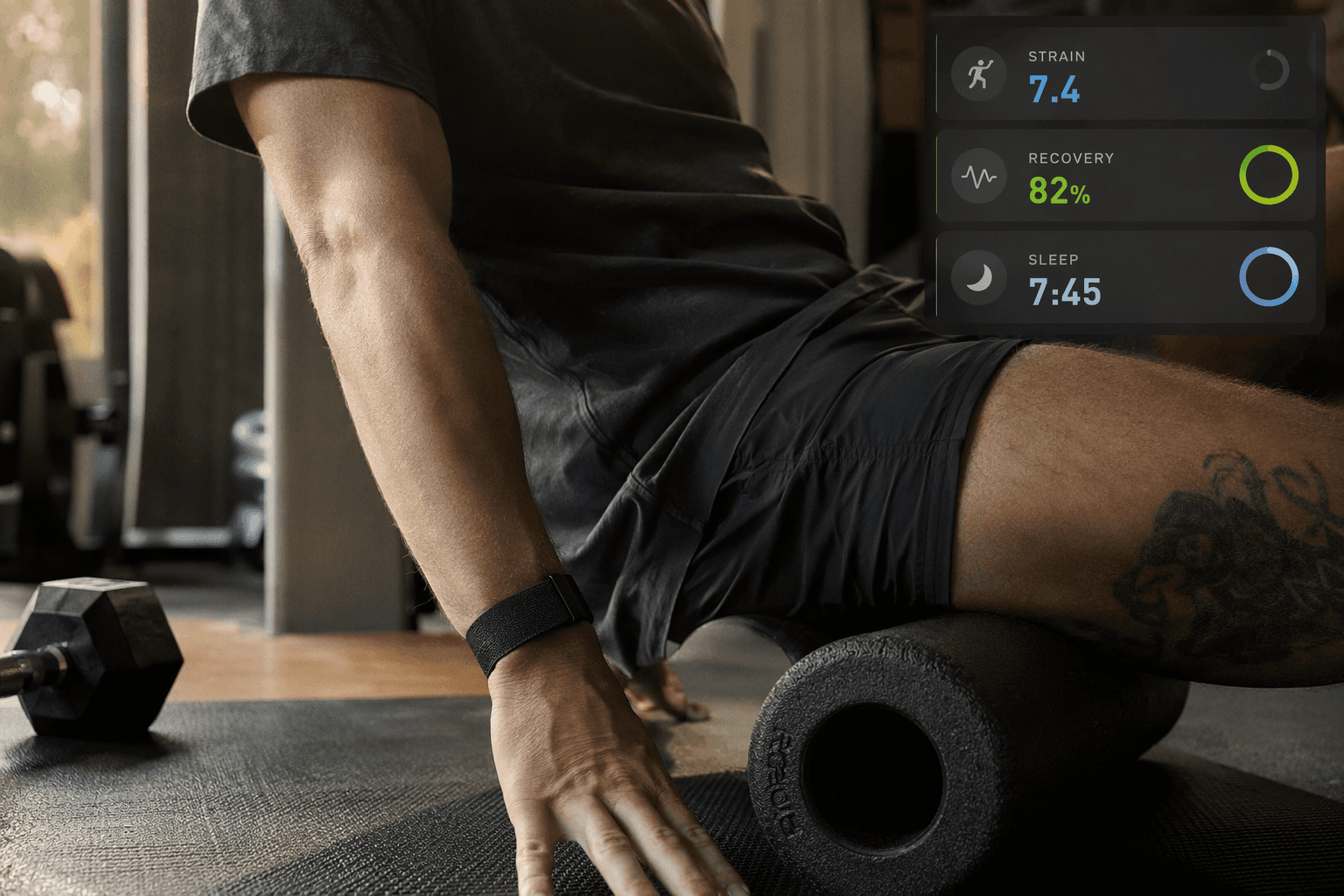
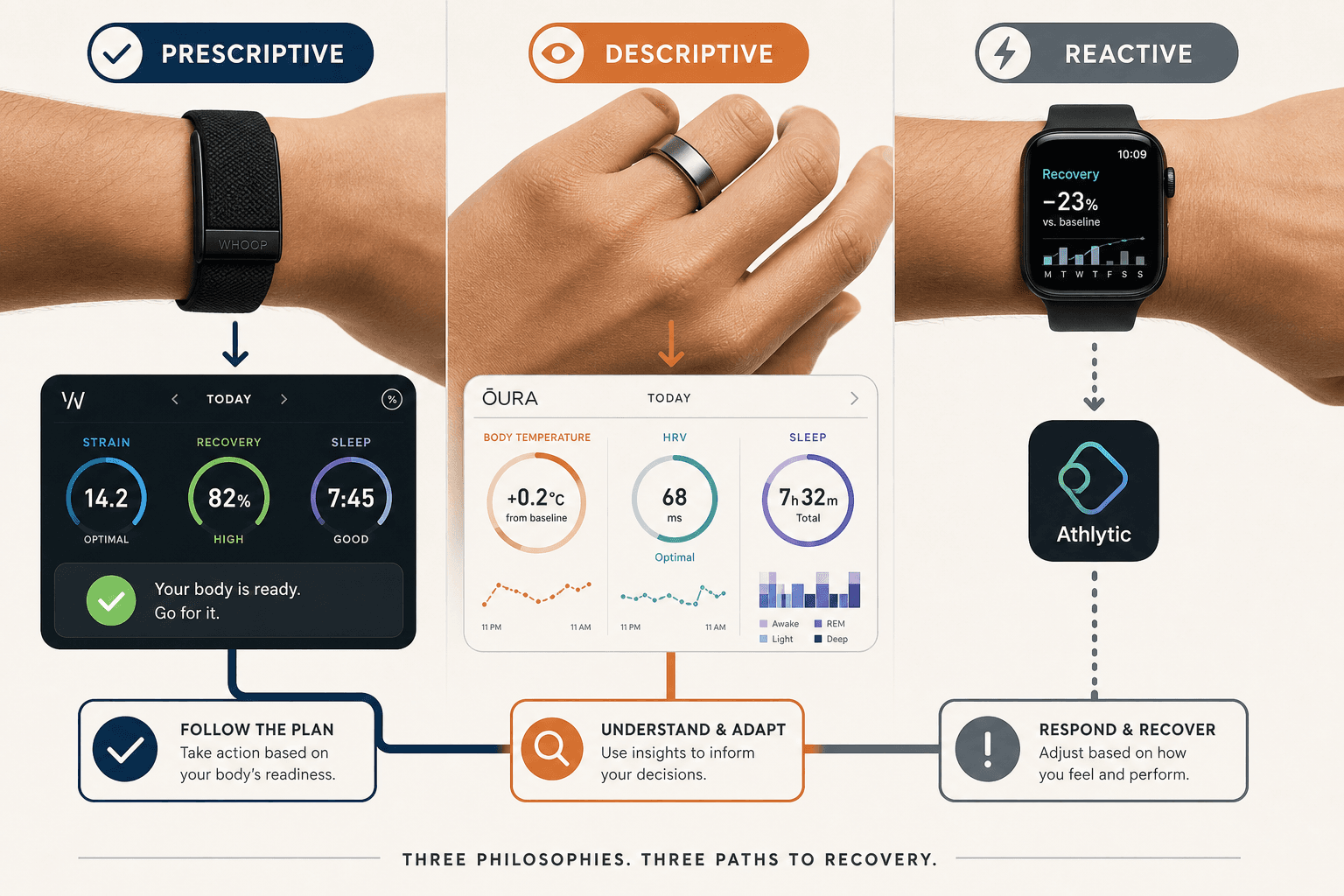
Whoop is prescriptive. It gives you a daily strain target and a green/yellow/red recovery score that says "train hard" or "recover today." Oura is descriptive: it hands you a Readiness score, body temperature, HRV, sleep stages — and leaves the decision to you. Apple Watch is reactive: the raw data (HRV, sleep, activity) is there, but you must install a third-party app like Athlytic to interpret it. And even then the interpretation is only as reliable as the raw input.
Accuracy alone does not decide this. I have seen people with a Garmin that boasts 99% HR accuracy on steady runs who never once checked their recovery data. And I have seen people with a cheap fitness band who followed the sleep recommendations religiously and dropped their resting heart rate by five beats in three months. The device that keeps you engaged is more valuable than the one with slightly better sensors.
The numbers are close — except one gap that undermines Apple Watch
Let me get the accuracy comparison out of the way fast, because the differences are smaller than marketing suggests — except for a critical exception that makes Apple Watch's recovery data noisy.
The 5krunner put Whoop 5.0 MG and Oura Ring 4 through a 30-night comparison. Overnight RMSSD HRV measurements correlate at r≈0.841. That is strong. REM sleep: Oura averaged 98.57 minutes (within the expected 90–120 minute range), Whoop averaged 115 minutes — slightly high but still usable. Neither is perfect; the difference is academic for most home athletes.
| Metric | Whoop 5.0 MG | Oura Ring 4 | Apple Watch Series 10 |
|---|---|---|---|
| Overnight HRV correlation (vs. reference) | r≈0.841 with Oura (30 nights) | r≈0.841 with Whoop | Not directly compared, but sampling inconsistency is a known issue |
| REM sleep detection (mean) | 115 min | 98.57 min | Not independently measured in this comparison |
| HRV-RHR correlation (312 days, Sportsmith) | r = -0.63 | r = -0.62 | r = -0.14 |
| Total sleep time correlation (Whoop vs Oura) | r = 0.91 | r = 0.91 | N/A |
The critical gap is Apple Watch's HRV sampling. Sportsmith's real-world analysis of 312 days found that Apple Watch samples HRV at inconsistent times each day. The result: a correlation between resting heart rate and HRV of r=-0.14 for Apple Watch, compared to r=-0.63 for Whoop and r=-0.62 for Oura. A correlation that low means the raw HRV data is essentially noise for trend analysis. You cannot build a reliable recovery score on a signal that jumps around that much.
This is not a minor caveat. It supports the "reactive" classification directly: Apple Watch's data is available, but it is unreliable for trend-based decisions without manual curation.
What each does with your data — and one thing each gets wrong
Accuracy is table stakes. The real differentiator is how the device closes the feedback loop. And each has a weakness that may be a dealbreaker.
Whoop: prescriptive, but wrist HR is inconsistent
Whoop gives you a single Recovery score (green/yellow/red) each morning and sets a daily Strain target. You do not decide how hard to train; Whoop decides for you. The algorithm is driven primarily by HRV — Sportsmith data shows HRV explains 56% of the variance in that score. Also sleep, resting heart rate, respiratory rate. Simple, action-oriented.
The weakness: wrist-based heart rate is inconsistent. Wareable found that during a steady 7-mile run, Whoop overreported average HR (159 vs 153 BPM from a chest strap). During a 90-minute tennis session, it underreported (130 vs 144 BPM from Garmin's chest strap). The biceps band resolves this — Whoop on the biceps showed a 0.98 correlation with reference monitors across 19 workouts — but you have to buy the biceps band separately. If you do strength training and hate wearing a chest strap, the biceps band is worth it. If you are just a runner, you may be frustrated.
Oura: descriptive, but cannot measure workout strain
Oura gives you a Readiness score, body temperature trend, HRV, sleep stages, and a timeline. But it does not tell you what to do with it. The Readiness score is driven more by resting heart rate (29% variance) than by HRV (less than 5%), making it less sensitive to autonomic nervous system changes than Whoop's score. Oura rewards curiosity — but you must connect the dots.
The weakness: it cannot measure workout strain. The Ring tracks recovery beautifully, but it does not measure training load. You cannot know if your easy run was actually easy or if your heavy squat session was a 7 out of 10 on the strain scale. You need a separate app or device for that. Oura tells you how ready you are — it does not tell you what to do with that readiness.
Apple Watch: reactive, but raw data is too noisy
Apple Watch records HRV, sleep, and activity passively. To use it for recovery tracking, you need a third-party app like Athlytic. That app calculates a recovery score from Apple Watch's HRV and sleep data. But the inconsistent HRV sampling — the r=-0.14 correlation I mentioned — means the score is noisy. You can still use it manually by checking HRV trends over a week, but that takes discipline. Most home fitness practitioners will not do it consistently.
The weakness is the sampling inconsistency itself. You cannot build a reliable daily recovery score on a signal that jumps around that much.
What the sticker price buys — and what it does not
| Device | Upfront cost | Annual subscription | 3-year total |
|---|---|---|---|
| Whoop (Peak tier) | $0 (device included) | $239/yr | $717 |
| Oura Ring 4 | $349 | $69.99/yr | $558.97 |
| Apple Watch Series 10 | $399 | $0 (no mandatory sub) | $399 |
Apple Watch is the cheapest by a large margin. Whoop is the most expensive. But cost correlates with the level of built-in guidance. Whoop's subscription buys you the Strain target, the Strength Trainer, and Healthspan features. Oura's subscription buys you the readiness score and body temperature. Apple Watch buys you hardware; recovery guidance is a third-party job.
There is evidence that paying more can pay off. A study of 11,914 Whoop subscribers (conducted by Whoop employees — I am calling that bias out) found that more consistent wear over 12 weeks was associated with 3.769 bpm lower resting heart rate, 0.615 hours longer sleep, and 89.75 more weekly activity minutes. The study has a clear sponsorship, but the mechanism is plausible: the device that keeps you engaged through daily prompts is more likely to change your behavior than the one you glance at once a week. Engagement matters more than sensor accuracy.
Which device fits your training style?
| Profile | Best device | Why |
|---|---|---|
| Strength athletes, CrossFitters, people who want to be told what to do | Whoop | Daily strain targets, Strength Trainer, biceps band for contact safety. Prescriptive approach removes decision fatigue. |
| Data lovers, sleep optimizers, people who like to explore metrics | Oura Ring | Detailed sleep staging, body temperature, cycle tracking. Descriptive approach rewards curiosity. |
| Apple ecosystem users who want recovery as a secondary feature | Apple Watch + Athlytic | Cheapest up front, but requires third-party effort. Works if you are disciplined about manual review. |
For a broader look at screenless trackers, I have also written a buyer's guide that includes the Fitbit Air (launched May 2026 at $99.99 with no subscription) if these three do not fit.
The best recovery wearable is the one that matches how you make decisions, not the one with the highest sensor correlation. If you want to be told what to do, pay for Whoop. If you like digging into the data, get Oura. If you already own an Apple Watch and are willing to work for it, you can make it work — but expect to put in the effort. I have used all three, and the one I keep coming back to is the one that changes what I do the next morning. That is the only metric that matters.
Comments
Join the discussion with an anonymous comment.