
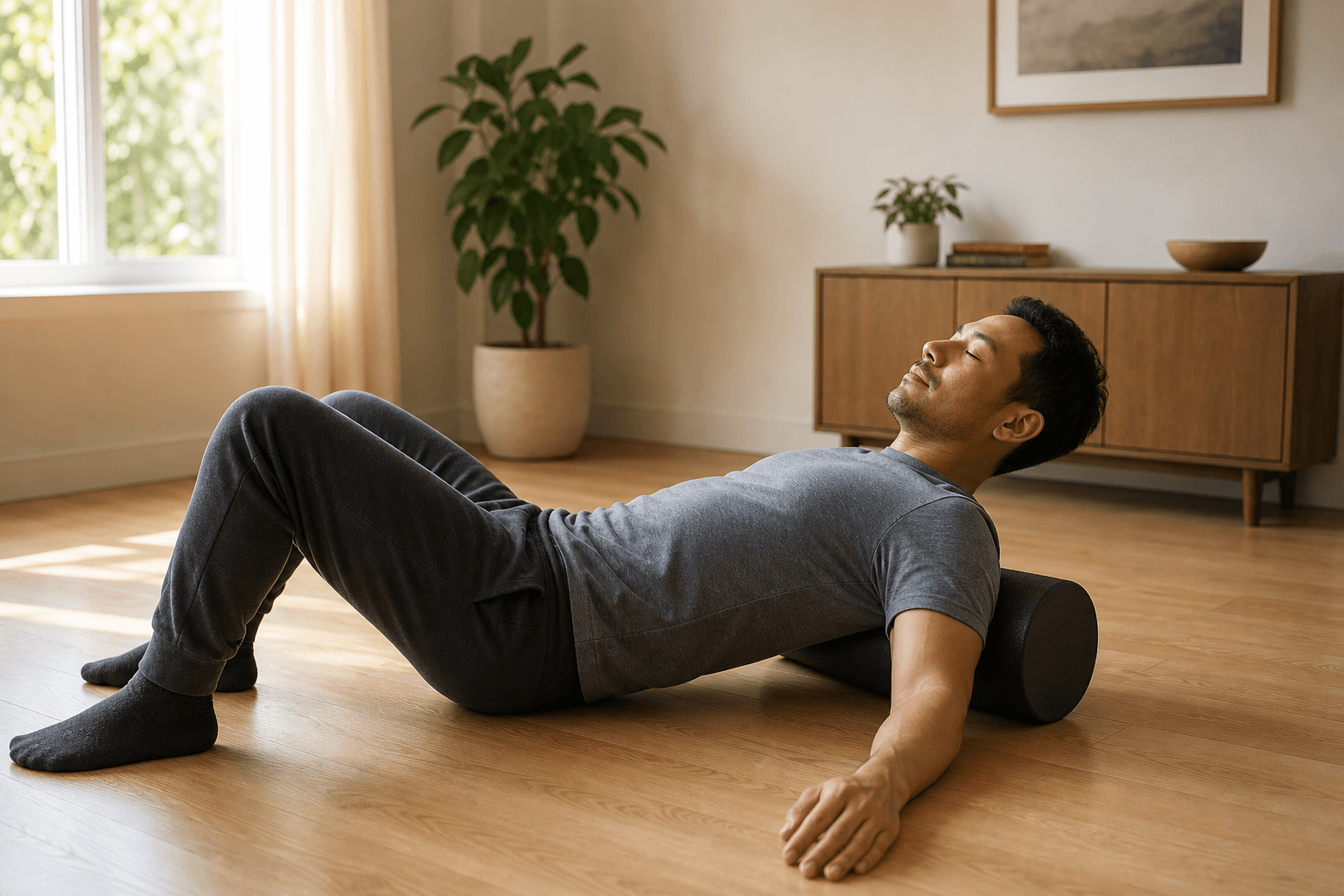
Why Foam Rolling Matters for Home Workouts
When you work out at a commercial gym, recovery infrastructure surrounds you — massage chairs, stretching areas, sometimes on-site trainers who can walk you through a cool-down. At home, none of that exists. You finish a workout, and you're on your own.
A foam roller closes most of that gap. It's a single piece of equipment that costs less than one massage session, stores under a bed, and works in the same floor space you already use to exercise. For home fitness beginners especially, it's the most practical recovery tool available — no appointment, no commute, no trainer required.
The problem is that most beginner foam rolling content either drops you into a list of exercises with no context, or it's written to sell you a specific roller. This guide does neither. What follows is a structured 10-minute routine built around correct technique — slow speed, deliberate pauses, the right muscle sequence — so you can start recovering smarter from your very first session.
What Foam Rolling Actually Does
Foam rolling is a form of self-myofascial release (SMR) — applying controlled pressure to muscles and the surrounding connective tissue to reduce tension, increase blood flow, and support range of motion. You're essentially giving yourself a targeted massage using your own body weight.
Three practical benefits are reasonably well supported. First, it may help reduce delayed-onset muscle soreness (DOMS) — the stiffness that peaks 24 to 48 hours after a hard workout. A study published in the Journal of Athletic Training found that foam rolling immediately after exercise and every 24 hours thereafter substantially reduced quadriceps tenderness and limited performance decrements at 24 and 72 hours post-workout. Second, it increases local blood flow to the tissue being worked. Third, it supports range of motion — particularly when combined with static stretching afterward.
The NASM 4-step model — Search, Destroy, Mobilize, Flush — provides a useful technique framework: roll slowly to find tender spots, hold pressure on the most sensitive areas, perform a gentle movement while holding, then finish with full-length passes to clear the area. The routine below is built around this logic.
What You Need to Know Before You Start
Most beginner mistakes happen in the first few sessions, before technique becomes intuitive. These five rules prevent the errors that make foam rolling feel useless or cause unnecessary discomfort.
- Roll at approximately 1 inch per second. This is the single most important rule. Fast rolling — the kind most beginners do instinctively — skims over the tissue without creating any meaningful release. Slow, deliberate movement lets you locate tension and actually address it.
- Pause 20–30 seconds on tender spots at a 6–7 out of 10 discomfort level. A 9 or 10 means you're overloading the tissue and will likely tense up, which defeats the purpose. A 2 means there's not enough pressure to do anything useful. Aim for noticeable but tolerable discomfort — uncomfortable but not sharp.
- Avoid joints and the lower back. Rolling directly on knees, elbows, or ankles can cause hyperextension. The lumbar spine lacks the rib-cage protection that the upper back has, making direct lower back rolling risky for beginners. If your lower back is tight, address it by rolling your glutes and hips instead — that's where the tension usually originates.
- Breathe through the discomfort. Holding your breath when you hit a tender spot is a natural reflex, but it causes the surrounding muscles to tighten. Slow, steady exhales while holding pressure help the tissue relax into the roller.
- Consistency beats intensity. Short sessions three to five times per week produce better results than an occasional 30-minute grind. Ten minutes done regularly is more effective than an hour done once a week when you're already sore.
Your 10-Minute Beginner Foam Rolling Routine
This routine follows a bottom-to-top sequence — calves up through the lats — which mirrors how tension accumulates during typical beginner home workouts and allows you to move through positions without constantly repositioning the roller. Each area gets 60 to 90 seconds, putting the full session at around 10 minutes.
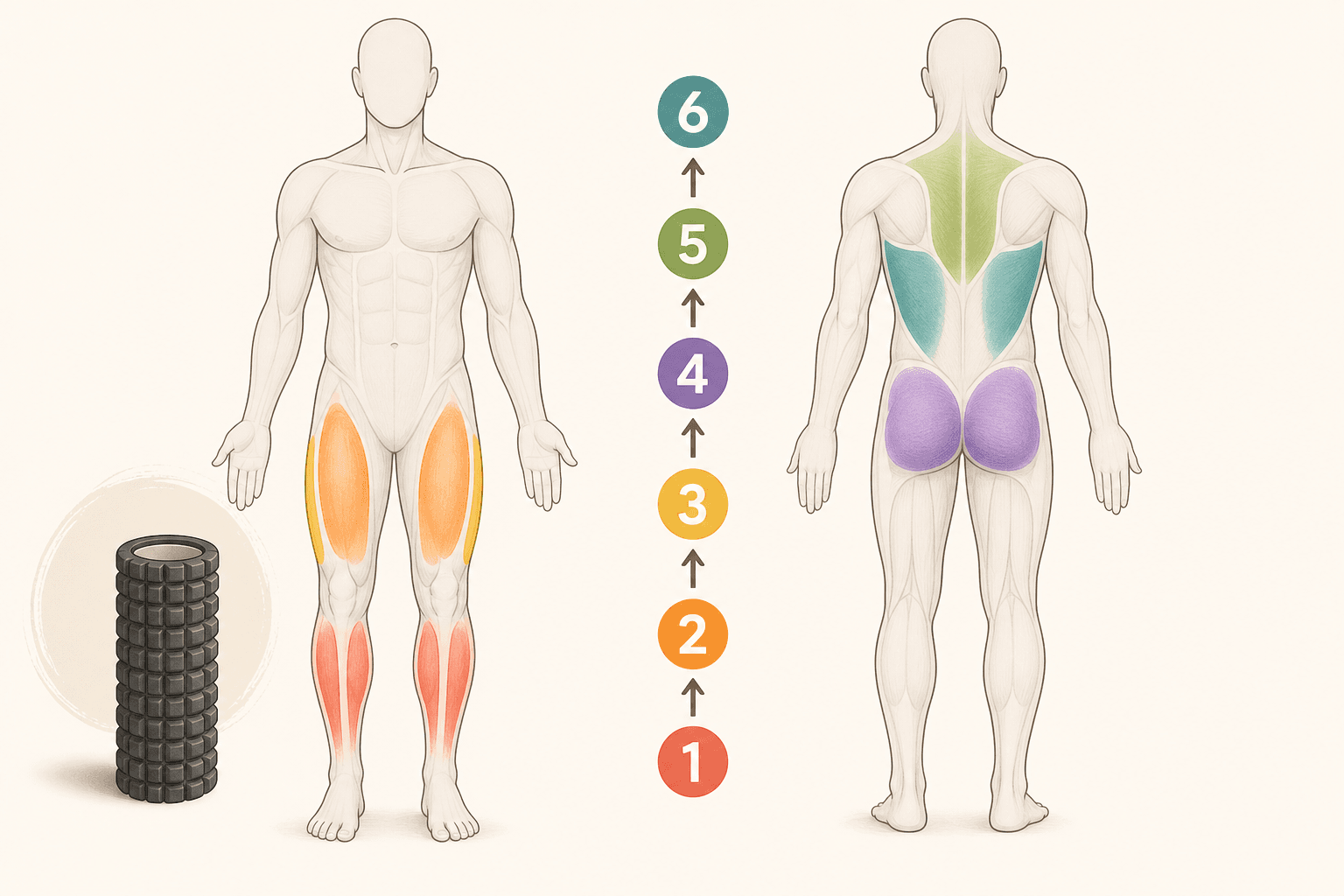
| # | Muscle Group | Starting Position | Movement Cue | Duration | Pressure Tip |
|---|---|---|---|---|---|
| 1 | Calves | Sit on the floor, legs extended, roller under one calf. Support yourself on your hands. | Roll from just above the ankle to just below the back of the knee. Rotate the leg slightly inward and outward to cover the full calf. | 60–90 sec per leg | Cross one ankle over the other to increase pressure if the standard position feels too light. |
| 2 | Quads | Lie face down, roller under the front of one thigh, just above the knee. | Roll slowly up toward the hip crease. Avoid rolling directly on the knee joint. | 60–90 sec per leg | Shift your weight slightly to one side to target the inner or outer quad. |
| 3 | IT Band / Outer Thigh | Lie on your side, roller under the outer thigh, just above the knee. | Roll from above the knee toward the hip, stopping at tender spots for 20–30 seconds. | 60–90 sec per side | The IT band is connective tissue, not a muscle — it tends to be very sensitive. Use a lighter load by keeping more weight on your supporting hand and foot. |
| 4 | Glutes | Sit on the roller with one ankle crossed over the opposite knee (figure-4 position). Lean toward the side you're rolling. | Shift your weight slowly to find tender spots in the gluteal area. Hold for 20–30 seconds, then move slightly and repeat. | 60–90 sec per side | This position also targets the piriformis, a deep glute muscle. If your lower back is tight, this is the correct alternative to direct lumbar rolling. |
| 5 | Upper Back | Sit in front of the roller, lean back so it sits across your mid-back. Support your head with your hands. | Roll from the mid-back up to a few inches below the neck. Do not roll the neck or the lower back. | 60–90 sec | Pause at the mid-back and upper back separately rather than rolling through continuously. |
| 6 | Lats | Lie on your side at a 45-degree angle, roller under one lat (the side of your back, below the armpit). | Roll from the armpit down toward the mid-torso. Keep the arm extended overhead for a better stretch. | 60–90 sec per side | If this position is uncomfortable, reduce the angle so less body weight loads onto the roller. |
When to Foam Roll: Timing Your Sessions
Foam rolling is not a single interchangeable activity you do whenever you remember. The timing of your session changes what you're trying to accomplish — and to some extent, how you should approach it.
| Timing | Duration | Pressure Level | Goal | Notes |
|---|---|---|---|---|
| Pre-workout | 3–5 minutes | Light to moderate | Warm tissue, increase range of motion, prime neuromuscular activation | Focus on the muscle groups you'll be using in the workout. Lighter pressure than post-workout rolling — you want to activate tissue, not fatigue it before you train. |
| Post-workout | 5–10 minutes | Moderate to deeper | Aid recovery, reduce soreness in the 24–48 hour window | This is where the strongest evidence for DOMS reduction applies. Roll the muscles you just worked. You can go slightly deeper here because the tissue is already warm. |
| Rest days | 10 minutes (full routine) | Moderate | Full-body maintenance, address accumulated tension | Use the complete 6-area sequence above. Rest-day rolling keeps tissue from stiffening between sessions and is the foundation of consistent recovery. |
Cleveland Clinic exercise specialist Ben Kuharik notes that pre-workout rolling "helps lengthen muscles so you don't compensate by using other muscle groups" — a particularly useful benefit for beginners who are still developing movement patterns.
Common Beginner Mistakes — and How to Fix Them
- Speed-rolling. Rolling fast feels productive but doesn't give the tissue time to respond. The fix: count to yourself. One inch per second is slower than it sounds — a full calf roll from ankle to knee should take roughly 10 to 12 seconds.
- Only rolling when you're already sore. Foam rolling works best as regular maintenance, not emergency treatment. By the time you're limping through DOMS, the window for the most effective intervention has already passed. Roll after every workout and on rest days, not just when you're desperate.
- Grinding one spot for minutes at a time. Holding pressure on a tender spot for longer than 30 seconds doesn't accelerate the release — it can actually cause bruising. Twenty to 30 seconds per spot is sufficient. Move on, come back if needed.
- Treating foam rolling as a substitute for stretching. These are complementary, not interchangeable. Research supports rolling first, then stretching — the sequence produces better flexibility gains than either practice alone. Use foam rolling to release tension in the tissue, then follow with static stretches to take advantage of that increased range of motion.
Choosing a Foam Roller for Home Use
You don't need to spend a lot or buy anything specialized to follow this routine. Three variables actually matter at the beginner level.
- Density: start with medium. A roller that's too soft provides no meaningful pressure — your body weight just compresses it flat. A roller that's too firm creates aversion; beginners often quit because it hurts too much before the tissue adapts. Medium density gives you enough resistance to feel the work without making every session unpleasant.
- Length: 18 to 24 inches covers everything. A standard full-length roller handles every muscle group in this routine. Shorter travel rollers are useful for packing but less stable when rolling larger areas like the upper back.
- Surface texture: smooth or lightly textured. Heavily ridged or knobbed rollers are more aggressive — they're useful for targeted trigger-point work but can be overwhelming for beginners whose tissue isn't yet accustomed to the pressure. Start smooth, upgrade later if you want more intensity.
One material note worth knowing: closed-cell foam holds its shape over time. Cheap open-cell foam compresses within weeks of regular use, at which point it's providing very little actual pressure. If a roller feels noticeably softer after a month, it's likely open-cell foam that has broken down.
Skip vibrating rollers and app-connected models for now. There's no meaningful evidence that vibration adds recovery benefit for beginners, and the added cost isn't justified at this stage. A basic medium-density roller is all this routine requires.
Frequently Asked Questions
- Can I foam roll every day? Generally yes — daily foam rolling is safe for most people and supports consistent recovery. A 10-minute full-body session on rest days and shorter targeted sessions around workouts is a reasonable approach. If you have an existing injury or pain condition, check with a physiotherapist before making foam rolling a daily habit.
- Why does it hurt so much at first? Tight, underused tissue is sensitive to pressure — the first one to two weeks are typically the most uncomfortable. As you roll consistently, the tissue adapts and the same pressure that felt sharp initially becomes manageable. This is normal. If you're experiencing sharp, localized, or joint-based pain rather than general muscular discomfort, stop and consult a healthcare provider.
- How long until it feels better? Most beginners notice a difference in how their muscles feel within two to three sessions. Meaningful improvements in range of motion and post-workout soreness typically appear within two to three weeks of consistent practice.
- Do I need a fancy roller? No. A basic medium-density, smooth-surface roller in the $20–$35 range handles everything in this routine. The technique matters far more than the equipment.
Comments
Join the discussion with an anonymous comment.