
Is the Whoop Fitness Tracker Worth It for Home Gym Recovery? A Data-Driven Review (2026)
Wondering if the Whoop 5.0's subscription is worth it for home gym recovery? This data-driven review breaks down the concrete sleep, HRV, and recovery insights you actually get, and helps you decide whether you're the type of athlete who'll benefit — or if you'd be better off with a cheaper alternative like the Fitbit Charge 6.
The $239 Question
That’s the first question I hear when people ask about Whoop: a fitness tracker that costs $239 a year, with no upfront hardware but a recurring bill that never ends. At the Peak tier, that’s $20 a month. Compare it to a Fitbit Charge 6 ($160 one-time) plus two years of Fitbit Premium ($10/month), and over two years the Fitbit runs $280, the Whoop $478. The difference is nearly $200.
I have tested enough wearable subscriptions to know most claim to change your health but end up as a notifications device on your wrist. Whoop is different — not because it is perfect, but because it forces you to pick a side. Either you are the kind of athlete who will actually act on recovery data, or you are not. And the answer to “worth it?” depends entirely on which side you fall on.
What the Extra $198 Buys
Whoop sells three tiers: One ($199/year), Peak ($239/year), and Life ($359/year). Hardware is included in every tier — the Whoop 5.0 band, a spare battery, and a charging case. The Peak tier gives you three features no mainstream competitor fully replicates.
AI Coach with Memory
The WHOOP Coach uses ChatGPT as a conversational layer with memory of past conversations. You can ask why your recovery dropped, and it remembers your sleep log, strain history, and journal entries from previous days. This is not a chatbot that reads a spec sheet; it is a coach that tracks your personal trends. The caveat: it is a text interface. You have to open the app and type a question after every workout. I have done it for three weeks, and the novelty wears off fast if training is not already a reflective habit.
Healthspan and Physiological Age
Whoop's Healthspan feature calculates a “Whoop Age” and pace of aging from nine biomarkers including VO2 max, sleep consistency, and time in heart rate zones. No other fitness tracker gives you a trend line on biological aging. For a home gym athlete focused on long-term health, that is a powerful motivator. For someone who just wants to know if they slept enough, it is overkill.
Strength Trainer with Velocity-Based Strain
The Strength Trainer uses velocity-based training principles to model muscular strain during strength workouts — a feature unique among mainstream wearables. It estimates how much your muscles have been stressed based on rep speed and load, then feeds that into your recovery score. For strength athletes who track progressive overload, this is gold. For a casual dumbbell user doing three sets of bicep curls, it does not add much.
The Accuracy That Matters
Whoop marketing quotes 99.7% heart rate accuracy. That number comes from a study funded by the Australian Institute of Sport, which measured Whoop against an electrocardiogram under controlled conditions. Impressive — but controlled conditions do not include burpees, kettlebell swings, or a CrossFit WOD. In a real-world test on a CrossFit workout, Whoop's wrist readings were within 5 BPM of a chest strap only 58% of the time. That is not a lab error; it is a fundamental optical-sensor limitation during high-movement activities.
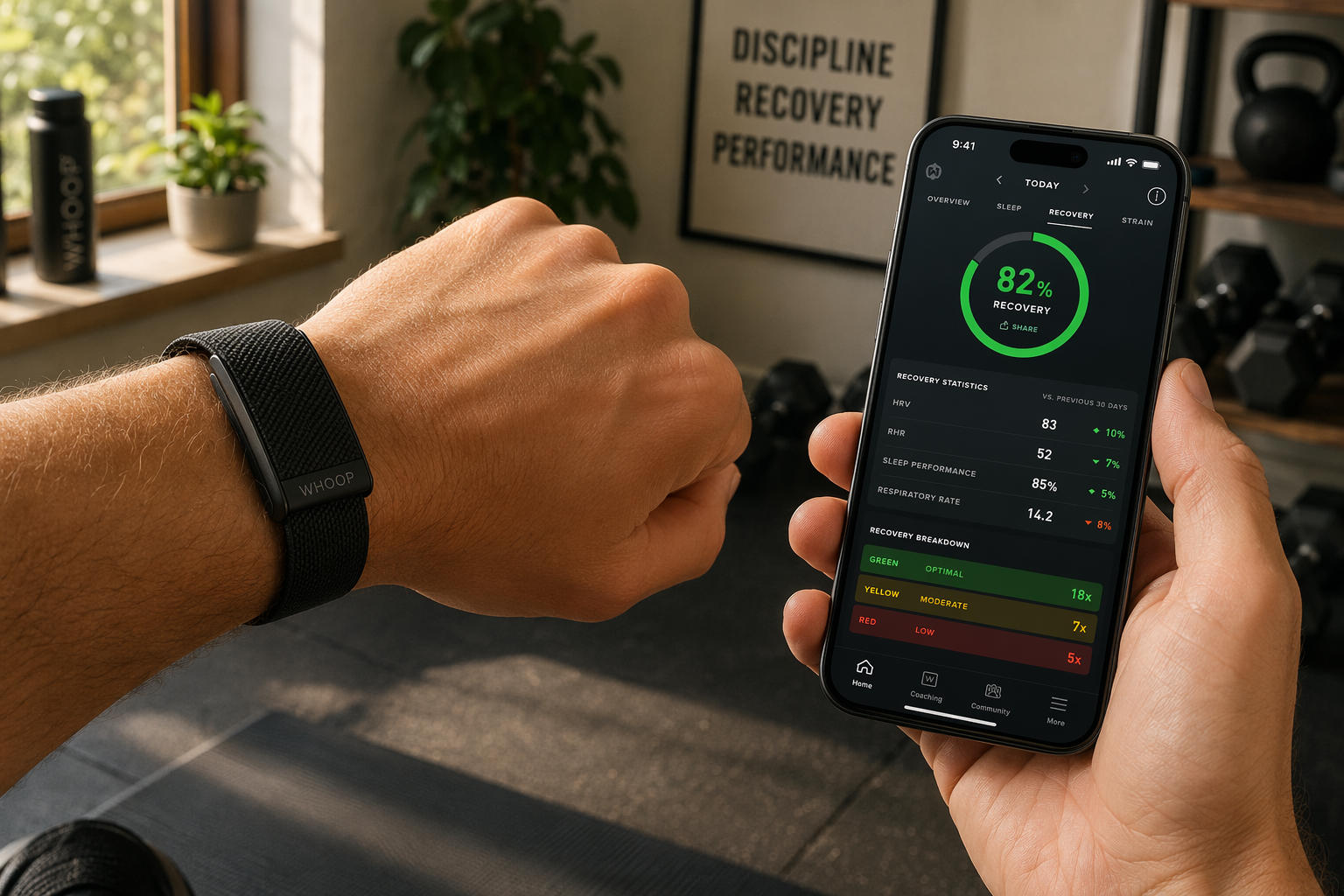
The fix is a bicep band. With the sensor placed on the upper arm, correlation with a chest strap reaches ~0.98. But that is an extra purchase and a reminder that Whoop's true strength is not workout HR — it is recovery. The recovery score is derived from HRV measured during the last phase of deep sleep, plus resting heart rate and sleep performance. That part is accurate and stable. The key takeaway: Whoop is a recovery tracker first and a workout tracker second.
Do You Actually Wear It Every Day?
A peer-reviewed study published in PMC (conducted by Whoop employees) followed 11,914 participants and found that daily wearers had a 3.769 bpm lower resting heart rate, 37 minutes more sleep, and 89.75 additional minutes of weekly activity compared to those who wore the band less than five days a week. Those are real benefits — but they are tied to consistency of use, not to the device's features. The tracker cannot change your behavior if you take it off after two weeks.
This is where the subscription starts to feel like a commitment. You are paying $20 a month for a tool that only works if you engage with it daily. The people who get the most out of Whoop are the ones who check their recovery before deciding whether to push hard or take it easy. If you train by how you feel and do not want to be told to back off, the subscription will feel like a nagging bill.
Two-Year Cost Side by Side
| Option | Upfront cost | Yearly subscription | Total over 2 years |
|---|---|---|---|
| Whoop Peak (subscription + hardware) | $0 | $239 | $478 |
| Fitbit Charge 6 + Fitbit Premium | $160 | $120 (Premium) | $280 |
| Oura Ring 4 + Membership | $299 | $72 (membership) | $443 |
The difference is plain: $198 more for Whoop over two years. For that you get AI Coach with memory, Healthspan, Strength Trainer, a battery that lasts 16.5 days (PCMag testing), a screenless design, and journal correlations that help you identify habits affecting your recovery. Whether those are worth $198 hinges on one question: will you actually use them?
Who Should Buy (and Who Shouldn’t)
If you are nodding yes to these, the Whoop 5.0 is genuinely best-in-class:
- You train by readiness — you adjust intensity based on recovery, not just the plan.
- You log strength workouts and want velocity-based strain estimates.
- You are willing to wear a bicep band during high-intensity sessions for accurate HR.
- You want to connect your sleep and strain data to long-term health metrics like physiological age.
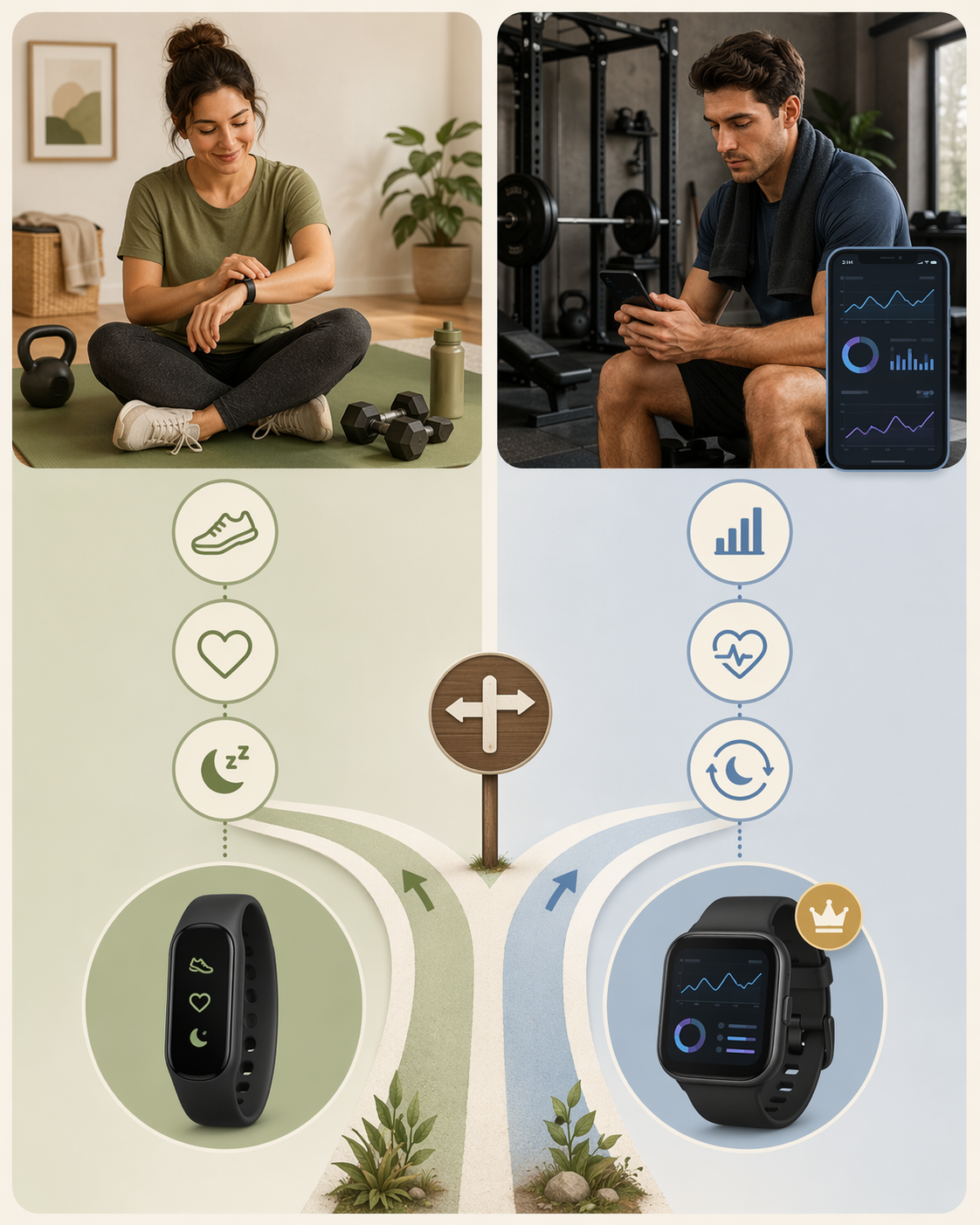
If you hesitate at any of those points, you are likely a casual home gym user who would be better served by a Fitbit Charge 6 or an Oura Ring. They cost less, require no subscription (or a cheaper one), and deliver adequate sleep and activity tracking without demanding daily data engagement. For a broader recovery-focused buying decision, see our guide to the best fitness tracker for recovery.
Verdict: Two Paths
The Whoop 5.0 is worth it — if you are the kind of athlete who will actually use its insights. For CrossFit, HYROX, strength athletes, and anyone who trains by readiness — who looks at recovery data before deciding whether today is a green-light or yellow-light day — the subscription cost is justified by the depth of the metrics and the unique AI features.
For everyone else — casual home gym users who follow a set routine, care about steps, and want a no-fuss tracker — a Fitbit Charge 6 or an Oura Ring delivers adequate value at lower cost. The Whoop subscription would be money you spent on a tool you do not fully use.
The $239 question does not have a universal answer. But if you finished this article and already know which path you are on, you had your answer before you started reading.
This is general fitness education, not medical advice. For diagnosis or treatment of pain or injury, consult a qualified clinician.
Pick your next session
Browse all routines to find an appropriately-spaced next session.
Spot something off?
This content sits adjacent to health guidance — tell us if a citation or figure needs a correction.