
Best Fitness Tracker for Home Gym Workouts: A Compatibility Guide for Strength, HIIT, Peloton & Treadmill
Most fitness tracker reviews focus on outdoor running and step counting. This guide evaluates trackers based on what actually matters for home gym users: Bluetooth/ANT+ HR broadcasting to gym equipment, automatic rep counting for strength training, screenless safety around weights, and app integration with Peloton, Zwift, and Apple Fitness+.
I have bought and returned three fitness trackers that promised gym compatibility. The first one paired with my Peloton for about ten seconds. The second could not count a single rep of a deadlift. The third had a screen that I spent half the workout trying not to scratch against the barbell. Every single one of those purchases was driven by reviews that focused on outdoor running, step counting, and sleep quality — none of which helped me decide whether the thing would actually work with my home gym.
If you lift weights, ride a Peloton, or do HIIT on a home treadmill, most fitness tracker reviews are not just incomplete — they are misleading. They are written for people who run outside. This guide is for the other kind of buyer. If you mainly walk or run outdoors, stop reading. For everyone else who has a home gym and wants a tracker that actually connects to your equipment, counts your reps, and survives a workout, here is what I found after testing the contenders on the things that matter.
Why GPS reviews are useless for your home gym
The criteria that dominate the typical review — GPS accuracy, step counting, outdoor running dynamics — are nearly irrelevant when you train indoors. Your Peloton already logs distance and cadence. Your treadmill knows how far you ran. Your barbell does not care how many steps you took. What you actually need are four things:
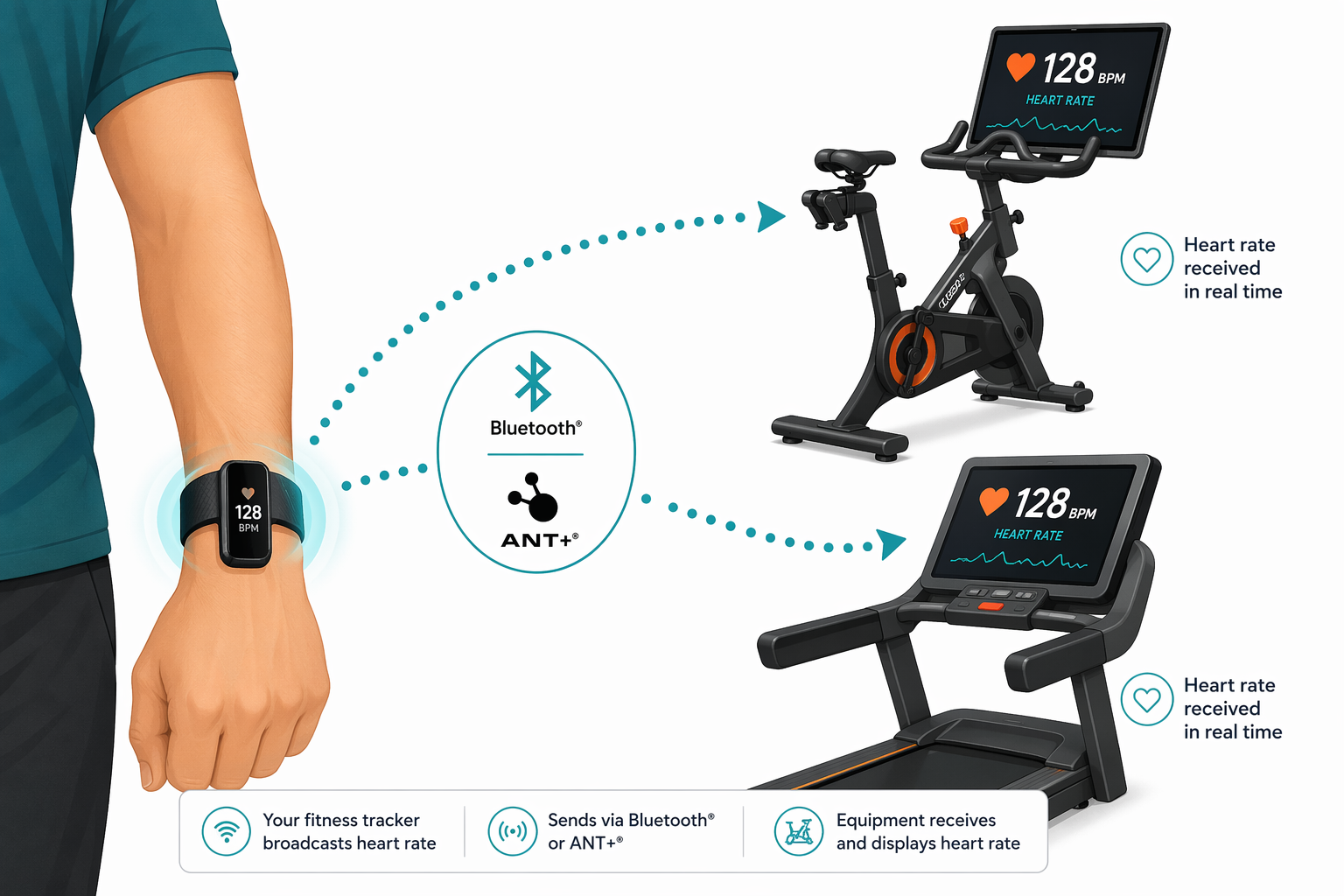
- Heart rate broadcasting to your gym equipment via Bluetooth or ANT+ — the specific protocol matters
- Automatic rep counting for strength training that actually works across multiple exercises, not just squats
- App integration with the platforms you already use — Peloton, Strava, Zwift, Apple Fitness+ — without manual file exports
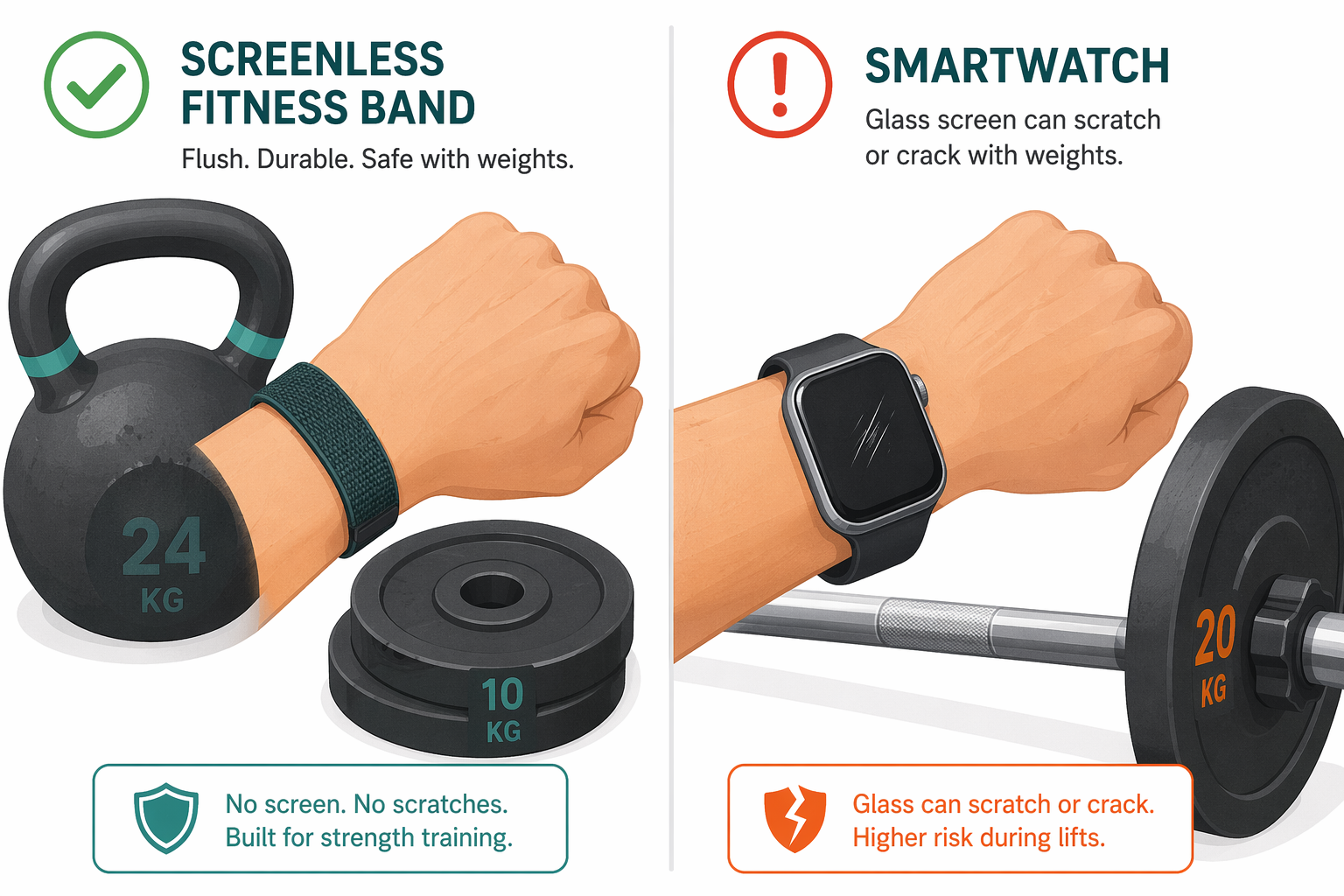
- A form factor that does not get scuffed or broken when you handle dumbbells, kettlebells, or a barbell
I will go through each of these in the context of the trackers I tested. But first, a quick warning about wearing a smartwatch during weightlifting.
The four dimensions that separate a good home-gym tracker from a bad one
Once you stop caring about GPS and step count, the real evaluation starts. Here is what I looked at on every device.
HR broadcasting: Bluetooth vs. ANT+
This is the single most important technical detail for home gym users. Your tracker needs to send your heart rate to the machine's display so you can see it in real time. There are two protocols: Bluetooth Smart and ANT+. Most modern home gym equipment — Peloton, NordicTrack, Life Fitness, Tonal — supports one or both. But the Fitbit Charge 6 broadcasts HR over Bluetooth and connects to Peloton bikes and NordicTrack treadmills. But it does not have ANT+. That is a real limitation if you own older machines that rely on ANT+ for HR signals. Garmin watches, on the other hand, typically support both Bluetooth and ANT+ — the Forerunner 165 can connect to gym equipment for real-time HR display and offers automatic rep tracking. I want to know exactly which machines are compatible, not just a vague claim. Garmin's compatibility lists are detailed — you can check their site for your specific model.
Rep counting for strength training
Automatic rep counting is one of those features that sounds great on paper and then fails on your first set of rows. The best implementation I have seen is on the Whoop 5.0. Its Strength Trainer lets you build custom workouts with exercises, supersets, and intervals, and it tracks muscular load alongside cardiovascular strain using the accelerometer and gyroscope. That is unique among all trackers right now. But there is a catch: Whoop requires a subscription, and Strength Trainer may be locked behind the more expensive Life tier ($359/year vs. Peak at $239/year). I have written more about those tiers here. Garmin's auto rep tracking is solid for basic exercises — bench press, squat, deadlift — but it is less reliable for complex movements like cleans or snatches. The Apple Watch, when paired with apps like Strong or Gymaholic, offers competing strength tracking with real-time logging and even 3D avatars showing form. It is not automatic, but the manual logging is fast enough that I stopped minding.
App integration: the friction point no one talks about
I want my tracker to talk to my apps without me exporting files or fiddling with third-party sync services. Peloton, Strava, and Zwift are the big ones. Fitbit syncs natively with Peloton and Strava. Garmin Connect pushes to Strava automatically. Apple Health shares data with most major platforms. Whoop's integration is solid for Strava and Peloton but less universal. The real difference is in the small things: does the tracker show your Peloton workout in its own app? Can it pull in an outdoor run recorded by your watch? The ecosystem comparison between Fitbit, Garmin, and Apple Watch is worth reading if you are torn between those three.
Form factor: screenless safety around weights
I scratched a nice watch face on a kettlebell handle. That is not a theoretical risk — it happens. Screenless trackers like the Whoop band, the Polar Verity Sense, and the Fitbit Air avoid the issue entirely because there is no glass to hit. The trade-off is that you lose the convenience of a display for checking time, notifications, or workout stats at a glance. For me, the peace of mind during heavy lifting is worth it. If you wear an Apple Watch while lifting, a screen protector is mandatory.
How the leading trackers actually performed in my home gym
I put each device through my standard home gym week: three strength sessions, two Peloton rides, one treadmill run, and one HIIT circuit. Here is what stood out.
Whoop 5.0
Whoop is the best tracker for strength training, period. The Strength Trainer feature lets you build a workout with exercises, sets, reps, and rest times, and then it tracks everything automatically. It measures muscular load and cardiovascular strain separately, which is valuable feedback for programming. The screenless band is safe around all equipment. But the subscription cost is steep: $239/year for Peak, $359/year for Life (which unlocks Strength Trainer fully). That ongoing cost changes the value equation. Check my breakdown of Whoop membership tiers for details. Whoop also does not have a built-in display, so you cannot see your heart rate during a workout unless you glance at the phone app. That is a small annoyance if you are used to checking your wrist.
Fitbit Charge 6
The Charge 6 is the best option if you primarily want heart rate on your Peloton or NordicTrack screen. It pairs via Bluetooth and shows your HR in real time. The rep counting is basic — it works for step-based exercises like lunges and squats but is unreliable for free-weight lifts. No ANT+ means it will not connect to older gym equipment that relies on that protocol. At $99 (2026 pricing), it is affordable, but remember the Fitbit Premium subscription if you want deeper analytics. For a home gym user who mainly uses connected cardio machines and does light strength work, it is a solid pick. For serious lifters, it falls short.
Garmin Vivoactive 6 / Forerunner 165
Garmin is the most versatile option for a mixed home gym. The Vivoactive 6 and Forerunner 165 both support ANT+ and Bluetooth, so they connect to virtually any gym equipment. The auto rep tracking works well for common lifts, and Garmin's strength training profiles classify your sets and rest times automatically. The battery life is exceptional — days to weeks, depending on GPS use. The downside is that Garmin's app is feature-rich but not as intuitive as Fitbit's or Apple's. If you want a tracker that does everything well, Garmin is the strongest all-arounder. My use-case-based Garmin buying guide can help you pick the right model.
Apple Watch (Series 9 or newer)
The Apple Watch is the best all-around smartwatch, but it is not the best home gym tracker. The app ecosystem is the strongest — Strong, Gymaholic, Hevy, and others provide excellent workout logging with real-time rep tracking and 3D form demonstrations. However, it lacks ANT+ support, so it cannot broadcast HR to older gym equipment. The display is also a scratch risk during lifting. Apple Health syncs well with Peloton and Strava, but the watch itself is not screenless. If you are in the Apple ecosystem and want a multi-use device (notifications, calls, health tracking), it is a decent choice, but you will need a screen protector and accept the connectivity limitations.
Quick reference: Home-gym compatibility table
Here is how the main contenders compare on the dimensions that actually matter for a home gym. Rows are sorted by how I would rank them for a mixed strength-plus-cardio home gym setup.
| Tracker | HR Broadcast | Rep Counting | App Integration | Screenless Option | Battery Life | Starting Price |
|---|---|---|---|---|---|---|
| Whoop 5.0 | Bluetooth only | Best (Strength Trainer, custom workouts) | Strava, Peloton (good) | Yes (band) | 4–5 days | $239/yr (Peak) |
| Garmin Vivoactive 6 | Bluetooth + ANT+ | Good (auto for basic lifts) | Strava, Peloton, Zwift (excellent Garmin Connect) | No (watch) | 14 days | $229 |
| Garmin Forerunner 165 | Bluetooth + ANT+ | Good (same as Vivoactive) | Same as above | No (watch) | 11 days (GPS off) | $249 |
| Fitbit Charge 6 | Bluetooth only (no ANT+) | Basic (step-based exercises) | Peloton, Strava (good) | No (band with small screen) | 7 days | $99 |
| Apple Watch SE 3 | Bluetooth only (no ANT+) | Manual via Strong/Gymaholic (very good) | Excellent (Apple Health sync) | No (watch, scratch risk) | 18 hours | $249 |
| Polar Verity Sense | Bluetooth + ANT+ | N/A (no rep tracking) | Basic (HR only to compatible apps) | Yes (arm band) | 30 hours (HR mode) | $80 |
Which tracker should you buy for your home gym?
There is no single best tracker. The right choice depends on the equipment you own and the training you do. Here is my honest take:
- For Peloton and NordicTrack owners who want HR on screen and do little strength work: Fitbit Charge 6. It is cheap, works over Bluetooth, and syncs natively. Just know you will not get good rep counting.
- For serious strength training with custom workouts: Whoop 5.0, despite the subscription. The Strength Trainer is unique, and the screenless band is a real advantage around weights.
- For a mixed home gym (cardio + strength + HIIT) with varied equipment: Garmin Vivoactive 6 or Forerunner 165. The ANT+ support gives you the widest compatibility, and the rep tracking is good enough for most lifters.
- For Apple users who also want a smartwatch: Apple Watch + Strong app + a screen protector. It is fine for basic tracking, but you lose ANT+ and risk scratches.
- For budget-conscious buyers who just want HR on equipment: Polar Verity Sense. It is an arm band, no rep tracking, but excellent HR broadcasting at a low price.
If you are still tinkering with your home gym layout, the best home gym for small spaces guide pairs naturally with your tracker decision — choose your equipment, then pick the tracker that connects to it.
The bottom line: stop using running reviews for your home gym
The next time you read a fitness tracker review that leads with GPS accuracy and step count, skip it. Those metrics do not apply to a home gym. What matters is whether the tracker can see your Peloton, count your reps, and survive your barbell. Whoop and Garmin lead for strength training. Fitbit is the best for machine connectivity. Apple Watch is the best smartwatch that happens to track workouts, but it is not the best home gym tracker. Pick the one that matches your equipment, not the one that wins a step-counting award.
This result comes from one real apartment under the stated conditions — it is a strong signal, not a guarantee your space will measure identically.
Builds this evidence supports
No build currently links to this specific test. Browse all builds with a matching tag.
Spot something off?
If this result didn't match your own space, let us know — floor-damage and noise claims carry real deposit-risk consequences if we get them wrong.