
Best Home Gym for Small Spaces: A Space-Mapped Equipment Guide
Think your apartment is too small for a home gym? The right compact equipment—foldable racks, smart gyms, and adjustable dumbbells—can deliver a full-body workout in as little as 80 square feet. This guide maps gear choices to three space profiles (under 100 sq ft, 100–150 sq ft, and 150+ sq ft) with product specs, ceiling height tips, and noise-control advice.
The Real Barrier: 80 Square Feet
Homeowners are 43% likely to own home gym equipment. Renters? 31%. That 12-point gap isn’t about money or willpower – it tracks square footage. The CivicScience data, cited by Fitness Avenue, shows the real barrier is the space to put the equipment.
But the counterpoint is real: a functional single-machine home gym fits in as little as 80 square feet. The Fitness Outlet's buying guide puts a complete cardio-plus-strength setup at 120 to 150 square feet – smaller than a parking space. The problem isn’t the room you have; it’s choosing equipment that matches it. I’ve been through the drill myself – measuring a corner, checking studs, wondering if the landlord will approve a bolt-in rack. Most guides skip those details. This one won’t.
Before you look at any product, measure your available floor area – not the whole room, the patch you’re willing to give up permanently. Then pick a profile:
- Under 100 sq ft: a corner of a living room or bedroom. Think foldable racks, compact smart gyms, adjustable dumbbells with a bench that stows upright.
- 100–150 sq ft: a spare bedroom or large den. Room for a functional trainer or multi-station machine plus a small cardio piece.
- 150+ sq ft: garage or finished basement. Full power rack, separate cable machine, maybe a treadmill. But ceiling height still matters.
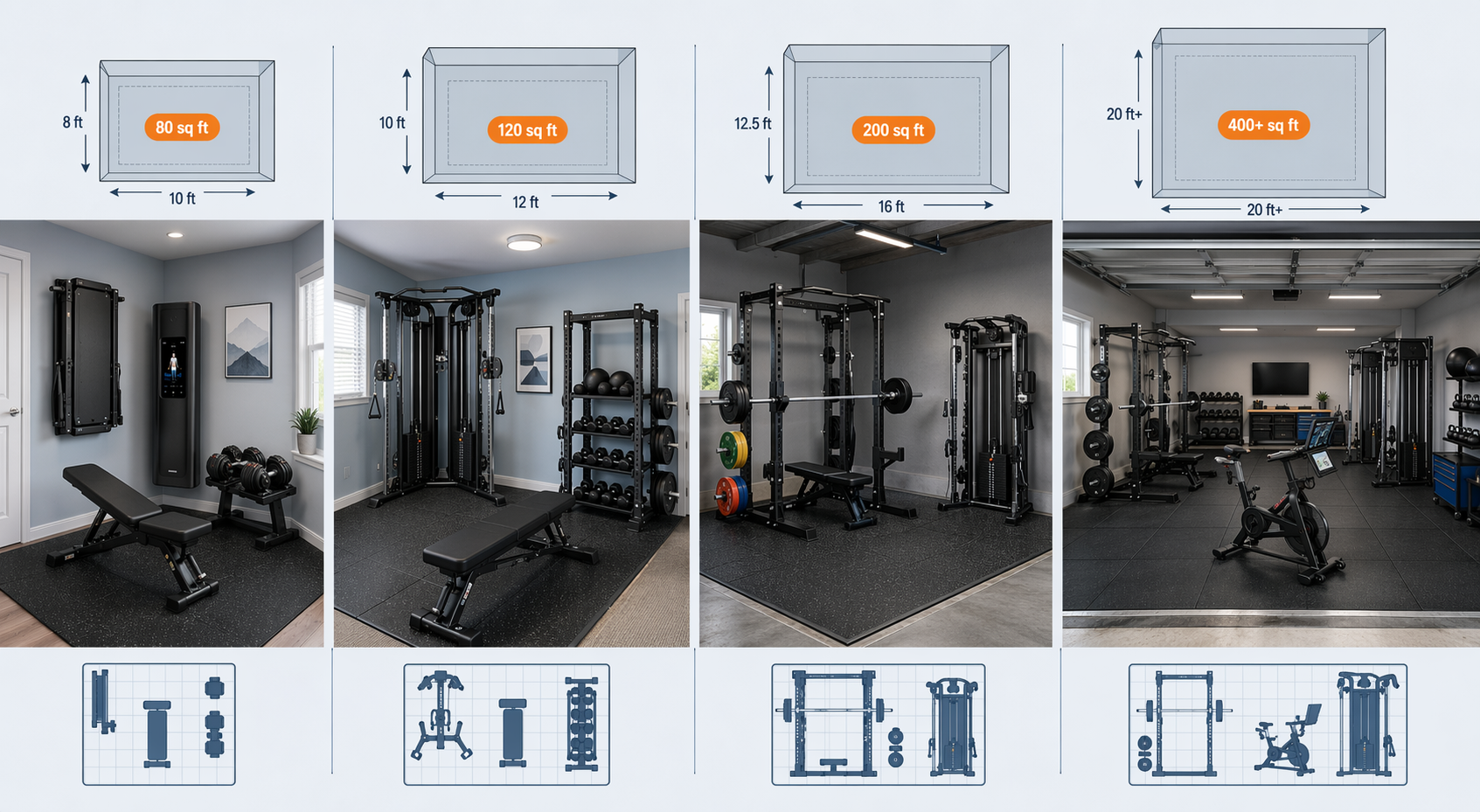
Under 100 Sq Ft: Foldable Racks and Smart Gyms
This tier demands the hardest decisions. You can have a full-body setup, but you cannot have everything. Pick your compromise: wall-mounted foldability, a slim smart gym, or a dumbbell-and-bench combo that disappears after use.
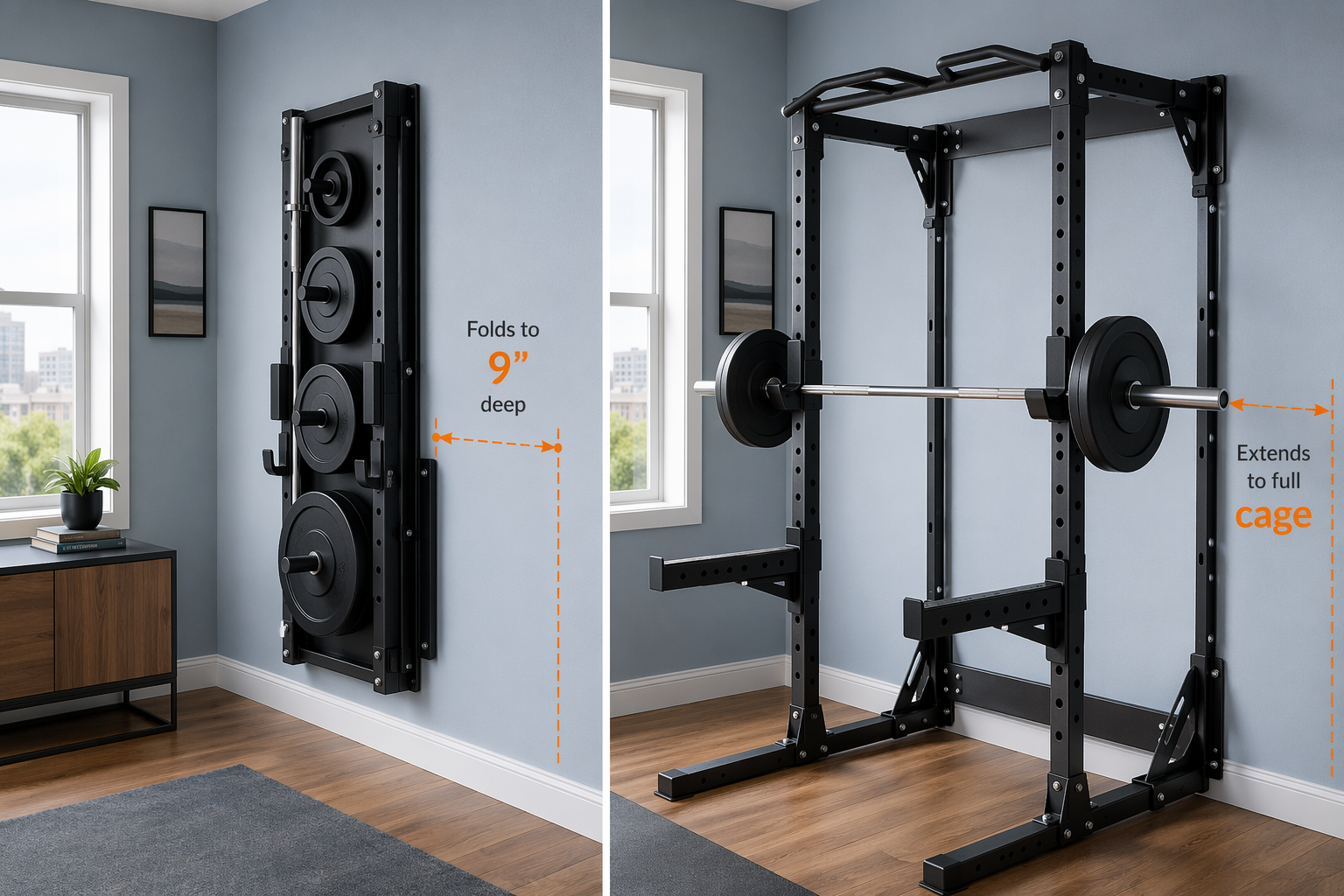
The PRx Profile PRO is the gold standard for renters who can drill into studs. Folded depth: 9 inches. Unfolded: 29.25 inches. That’s less than a standard bookshelf. Garage Gym Reviews measured those dimensions. It handles barbell work, pull-ups, and can hold thousands of pounds. The catch: you need a wall with studs at the right spacing and permission to bolt it in. If you can’t mount, skip this.
If drilling into walls isn’t an option, the Speediance Gym Monster becomes the better fit. Its unfolded footprint is 49.21" x 28.34" – about the size of a small desk. Folded, it shrinks to 14.96" x 28.34". Same source. It lives on the floor, needs no mounting, and runs on a display screen for guided training. But its max resistance is 250 lbs – enough for a beginner to intermediate lifter, but not for someone deadlifting 300+.
The Tonal 2 takes a different approach: wall-mounted, only 5.25 inches deep, 50.9 inches tall. It uses digital resistance up to 250 lbs. For a sub-100-sq-ft space where every inch counts, it’s hard to beat. CNET's review confirms the dimensions and resistance. But the same mounting caveat applies – and you need a monthly subscription for full use.
For the truly compact, an adjustable dumbbell set and a folding bench can occupy less than 3 square feet total. REP Fitness's QuickDraw cradle takes 1.2 sq ft; their Nighthawk bench stows upright at 1.8 sq ft. That leaves room for a yoga mat for bodyweight work. But you lose everything that a rack or smart gym offers – pull-ups, cable pulls, heavy squats.
100–150 Sq Ft and Beyond: More Room, Same Ceiling Problem
A spare bedroom or large den gives you room for a dedicated functional trainer. The Bells of Steel Cable Tower With Weight Stack has a footprint of 31" D x 28.5" W x 80.75" H. Garage Gym Reviews measured that. It’s about the size of a narrow reach-in closet. Dual weight stacks up to 200 lbs each, cable crossovers, pressing, rowing – far more variety than a smart gym. But 80.75 inches of height is a dealbreaker for rooms with standard 8-ft ceilings. The Freak Athlete Hyper Pro stores vertically at 22" x 22" x 60" and uses resistance bands – less versatile, but it fits anywhere. Multi-station machines like the Major Fitness B17 combine a functional trainer, bench press, and leg press in one unit, but they occupy a fixed footprint closer to 12 square feet.
At this tier, you also have room for a compact treadmill or spin bike alongside the strength equipment. The full cardio-plus-strength setup The Fitness Outlet mentions – 120 to 150 sq ft – starts to feel realistic here.
If you have 150 square feet or more in a garage or basement, you don't need the same compact gear. A standard power rack (about 48" deep) plus a separate cable machine or functional trainer is viable. You can also fit a rower or bike alongside. But ceiling height remains the hidden constraint. Many garage ceilings are 7 to 8 feet – not the full 9 ft of a modern house. Overhead pressing, pull-ups, and tall cable towers require at least 8 ft, so verify before you buy. The PRx Profile PRO still works here, but a fixed rack is usually more stable and cheaper per pound.
Ceiling Height and Noise – The Hidden Constraints
The Fitness Outlet states a minimum of 7 to 8 feet for most equipment. Some machines need 8 ft or more. Let's be concrete:
- Tonal 2: 50.9" H – fine in any room.
- Speediance Gym Monster: 72.83" H – okay in 8-ft ceilings, tight in 7-ft.
- Bells of Steel Cable Tower: 80.75" H – will not fit under 8 ft.
- Power racks with pull-up bars typically need 90" of clearance for safe overhead work.
Renters worry about neighbors. They should. A dropped dumbbell on a second floor can sound like a wrecking ball. Wall-mounted racks transfer vibration through studs. Even cable pulls generate a thump from the weight stack.
The solution: rubber mats. A 6x8-ft mat adds about 48 sq ft of perceived floor footprint, but it's non-negotiable for protecting the subfloor and absorbing sound. For second-floor setups, consider smart gyms (quieter cable pulls) and avoid dropping weights entirely. I've linked the full flooring guide below for detailed recommendations on thickness, material, and installation.
The noise issue also favors certain equipment: cable machines with weight stacks are quieter than free-weight drops. Smart gyms with digital resistance are nearly silent. If you're in a ground-floor apartment or above a garage, the problem mostly goes away – but check the terms of your lease regarding 'gym equipment' and floor protection.
The Spec Table: Choose Your Setup by Square Foot
Below is every product discussed in this guide, organized by the space profile where it makes the most sense. The dimensions are from the sources cited in each section – verified against the actual review data.
| Product | Space Profile | Folded Dimensions | Unfolded Dimensions | Ceiling Height Needed | Wall Mount Required? | Max Resistance |
|---|---|---|---|---|---|---|
| PRx Profile PRO | Under 100 sq ft | 9" D | 29.25" D | 8 ft+ (for pull-ups) | Yes | 1,000+ lbs |
| Speediance Gym Monster | Under 100 sq ft | 14.96" x 28.34" | 49.21" x 28.34" | 7–8 ft | No | 250 lbs |
| Tonal 2 | Under 100 sq ft | n/a (fixed mount) | 21.5" x 5.25" | Any (50.9" H) | Yes | 250 lbs |
| Freak Athlete Hyper Pro | Under 100 sq ft | 22" x 22" x 60" | Same (vertical storage) | 5 ft | No | Band-dependent |
| Bells of Steel Cable Tower | 100–150 sq ft | n/a | 31" x 28.5" x 80.75" | 8 ft+ | No | 200 lbs per stack |
| REP QuickDraw + Nighthawk bench | Under 100 sq ft | Cradle 1.2 sq ft, bench 1.8 sq ft | Bench 9 sq ft flat | Any | No | Dumbbell-dependent |
Use the profile column to filter. If you're under 100 sq ft, your three best options are the PRx (if you can mount it), the Speediance (if you can't), or a dumbbell-and-bench combo. For 100–150 sq ft, the Cable Tower opens up significantly more exercise variety.
The Right Gear, Not More Space
The CivicScience gap between homeowners and renters is real, but it's not destiny. A carefully chosen setup – one that matches your square footage, ceiling height, and noise tolerance – can deliver a full-body workout in 80 square feet. The trade-offs are honest: no single piece of 'compact' gear works for every apartment. Wall mounting, resistance limits, and subscriptions are real constraints. But once you know your profile, the right choice becomes obvious.
Start by measuring your space. Pick a profile from this guide. Then choose from the spec table. You don't need a dedicated gym room – you need the gear that fits the room you already have.
This result comes from one real apartment under the stated conditions — it is a strong signal, not a guarantee your space will measure identically.
Builds this evidence supports
Cable Machine Alternatives That Save Space and Money
Compare the best cable machine alternatives for home gyms – from resistance bands and pulley systems to suspension trainers and compact digital units – and find the right option for your space and budget.
How to Choose a Compact Home Gym That Works for Your Space, Budget, and Noise Tolerance
This article provides a structured decision framework for apartment dwellers and small-space residents to match their specific floor footprint, noise sensitivity, and budget to the most suitable compact home gym strategy — whether that's an all-in-one machine, modular build, smart digital system, or band/bodyweight setup.
The Garage Gym Reality Check: What Equipment Actually Fits in a Single-Car Garage
Most garage gym guides assume a two-car space. This article uses real dimensions, real equipment footprints, and three layout templates to show what fits—and what doesn't—in a single-car garage (10x20 to 12x20 ft).
Spot something off?
If this result didn't match your own space, let us know — floor-damage and noise claims carry real deposit-risk consequences if we get them wrong.