
Best Home Gym Equipment for Beginners: The Phased Buying Guide (Start Under $1,000)
A complete step-by-step guide for absolute beginners who want to build a home gym without wasting money. Learn the minimal equipment you need to start (rack, barbell, plates, bench) for under $1,000 and how to expand in four logical phases as your training progresses.
Why Starting Small Beats Buying Everything at Once
The Tonal 2 costs $4,295 and charges another $59.95 a month. It is a beautiful machine. It is also the worst possible first purchase for a beginner home gym.
I have watched this pattern repeat: someone sees a sleek smart gym, imagines themselves training daily, and drops thousands before they have ever loaded a barbell alone. Three months later the machine is a $4,300 clothes rack. The habit never stuck, and the sunk cost barrier feels too high to sell and restart. That is the real hidden cost of bad buying advice — money wasted on gear that does not match how people actually train, or that arrives before the habit does.
The average home gym costs between $1,500 and $2,500, according to Garage Gym Reviews' 2026 survey. The average gym membership runs about $65 a month, per the Health & Fitness Association. So a $1,500 home gym breaks even in roughly two years against the membership. That math looks clean until you realize it assumes the beginner already owns a space and does not move. A renter in a small apartment may never break even on a power rack. The break-even benchmark is useful, but it is not a universal truth.
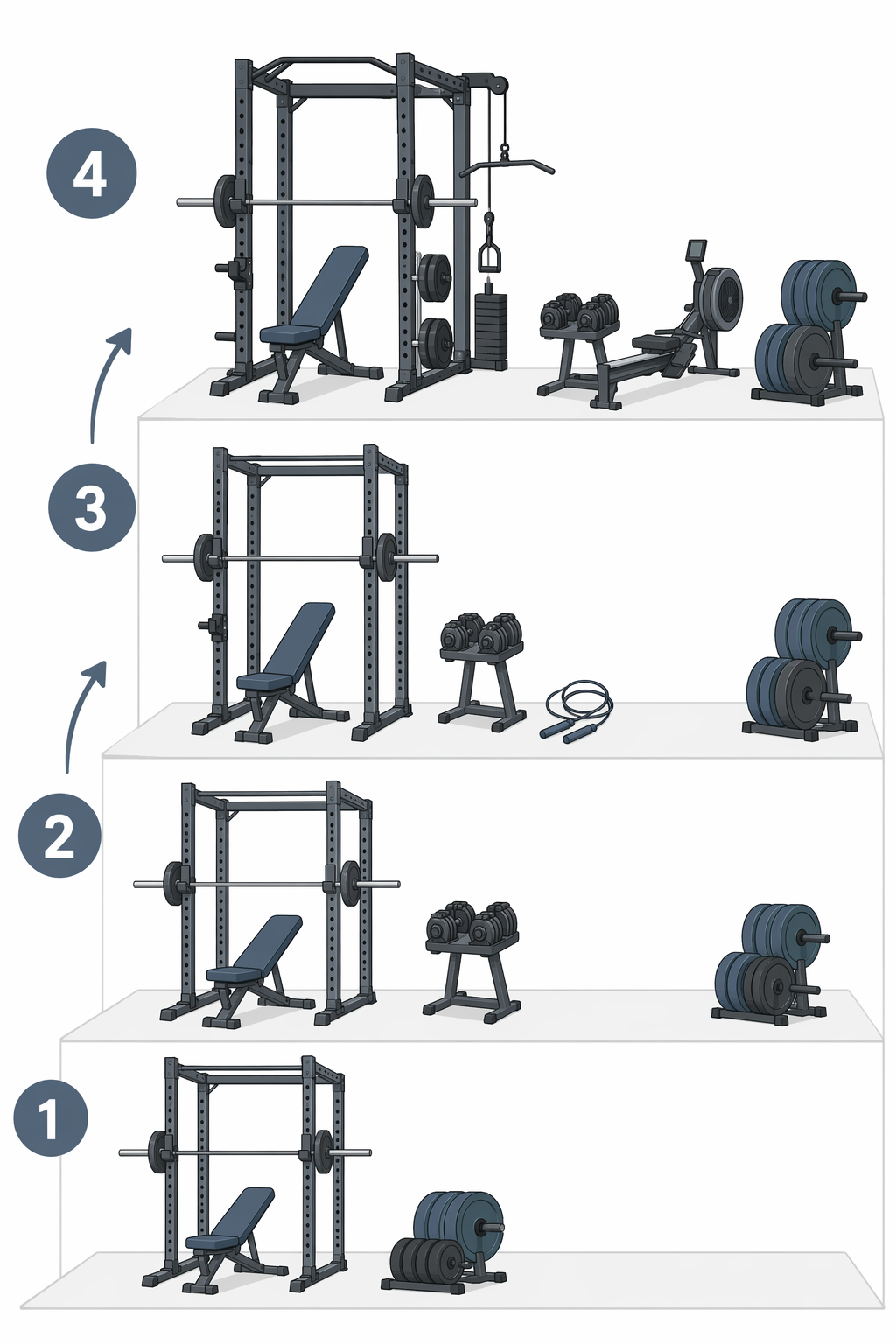
The point is not the exact dollar value. The point is that spending less upfront and expanding over time is both financially and psychologically wiser than buying a full gym all at once. The thesis of this guide is straightforward: start with a minimal viable setup of rack, barbell, plates, and bench — four items that cover over 80% of effective strength exercises — then expand in four logical phases as your training progresses. You will not outgrow this approach. You will outgrow the urge to buy everything on day one.
If you want a broader orientation first, read the broader home gym startup guide. This article is the specific, product-level build sequence for absolute beginners who want exact prices and a phased plan.
The Minimal Viable Setup: What You Actually Need (Under $1,000)
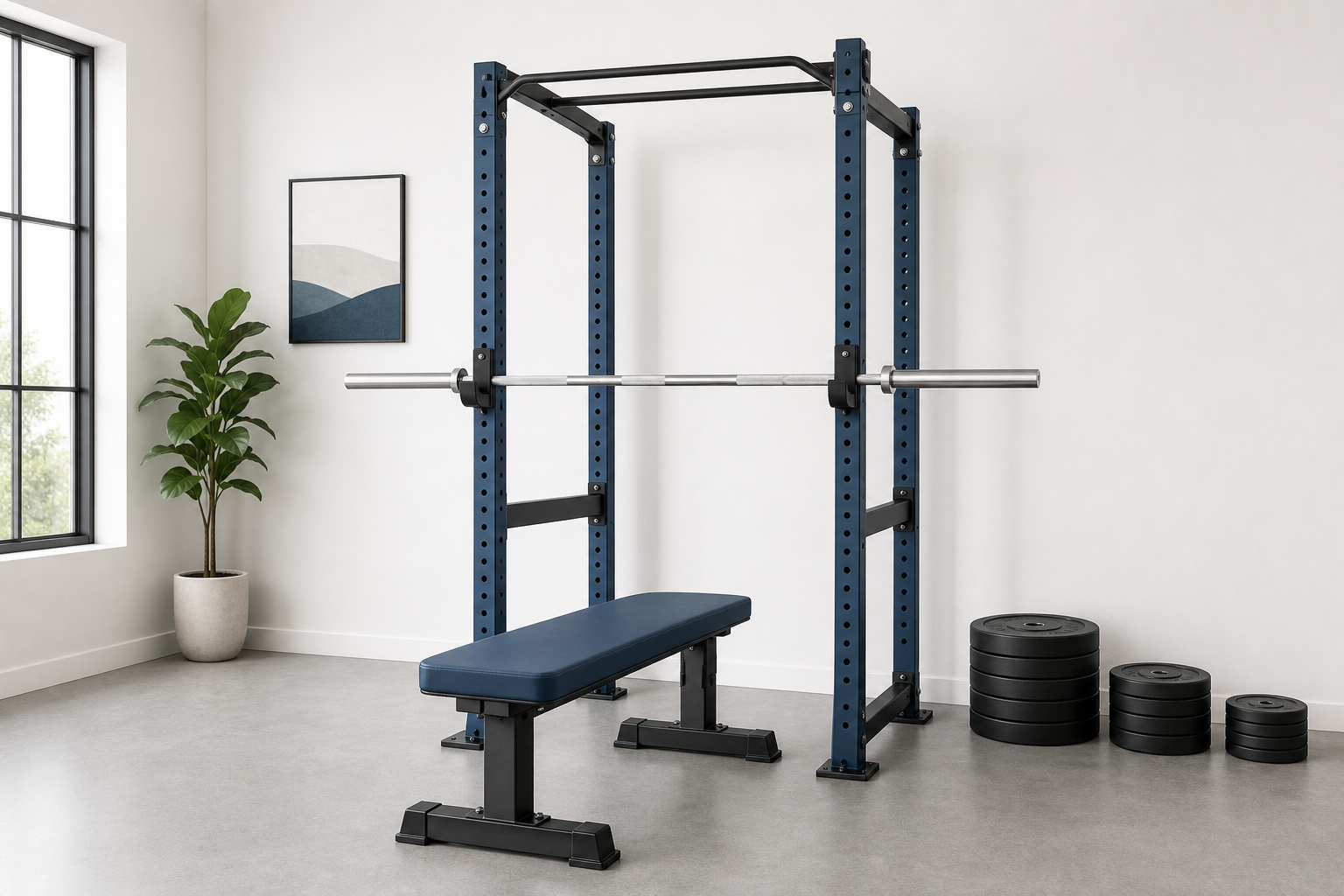
Four items are enough for years of progress: a power rack, a barbell, weight plates, and an adjustable bench. That is it. No cable machine, no dumbbells yet, no cardio. Here is a specific build under $1,000, using products tested and recommended by independent reviewers:
- REP PR-1100 Power Rack — $380. This rack has a 700-lb capacity and accepts attachments for future upgrades. For a beginner, the pin safety depth and stable footprint matter more than the price tag.
- Synergee Games Cerakote Barbell — $179.95. The knurl markings help with grip placement. It is a solid, mid-weight bar for someone learning the basic lifts.
- Fringe Sport Black Bumper Plates (160 lb set) — about $286 at $1.79 per pound. Bumpers allow you to drop deadlifts safely, and 160 lb is enough for a beginner's squat and deadlift for many months.
- Major Fitness Adjustable Bench — $219. The adjustment range (flat, incline, decline) lets you do presses, rows, and more. It is stable and easy to move.
Total: roughly $1,066. Slightly over the $1,000 target, but rounding-friendly. With this setup you can squat, bench, deadlift, overhead press, row, and add countless variations. That covers the vast majority of strength training movements.
What If You Are Not Sure You Will Stick With It?
The $1,000 entry point may still feel too high for someone who has never trained and is not convinced they will keep going. I get that. A rack and barbell take more motivation to start a workout than a screen that says "press play." For the truly uncertain, there is a cheaper alternative that still respects the phased philosophy:
- Synergee Games Barbell — $179.95
- Bumper plates, say 100 lb set — roughly $179 (smaller set, about $1.79/lb)
- A floor mat (horse stall mat from Tractor Supply, about $50) or a simple deadlift platform pad
- No rack. You do floor presses, deadlifts, rows, and overhead press variations (seated or standing without a rack).
Total: under $450. It is less convenient — you cannot squat or bench heavy alone without spotter arms — but it preserves the core principle: start small, build the habit, then upgrade. If you outgrow this setup in three months, the rack you buy next will feel like a luxury you earned, not a gamble you took.
Phase 2: Add Variety Without Overloading Your Wallet
After a few months of consistent training, you want accessory work: lateral raises, bicep curls, lunges with lighter weight. Adjustable dumbbells are the space-smart answer. The REP QuickDraw Adjustable Dumbbells start at $335.99 and replace a dozen pairs of fixed dumbbells. That is a good deal for someone with a small floor and a growing collection.
But if you only need weights from 10 to 30 lb for a few exercises, buying fixed hex dumbbells at roughly $1 per pound (CAP Cast Iron Hex Dumbbells, for example) costs less than $30 total for three pairs. The QuickDraws become worthwhile only when you truly need the range from 10 to 40 lb. Do not let the "replaces 12 pairs" marketing push you into spending before you need it.
Add a jump rope — the WOD Nation Double Under Speed Jump Rope costs $18.99 — for quick conditioning. That is Phase 2 done: about $355 if you go adjustable, or much less if you only need a few fixed dumbbells.
Phase 3: Adding Cardio — When and What to Choose
Cardio at home is easier to justify after you already have a solid strength habit. You can walk outside for zero cost. But if you want a dedicated machine, the decision comes down to budget and preference:
- Budget option: Sunny Health & Fitness Indoor Cycle Bike SF-B1002 — $254.34. Basic, reliable, does the job. Good for steady-state cardio.
- Best value: Concept2 RowErg — $990. It is a gold standard, stores upright, and weighs 57 lb. It gives you both cardio and a back workout. It is expensive, but its resale value is high and it will outlast every other machine in your gym.
My recommendation: do not buy cardio equipment until you have been strength training consistently for at least three months. By then you will know whether you prefer biking, rowing, or simply jogging. A forced cardio purchase on day one often becomes the $900 rower that gets used twice.
Phase 4: Upgrades Are Luxuries, Not Necessities
After a year or more of training, you might want a bigger rack, a cable system, or even a smart gym. That is fine — but none of these are needed for progress. They are upgrades, not foundations.
- REP PR-4000 Power Rack — starts around $950. More capacity, more attachments, more room.
- REP Ares 2.0 Functional Trainer — $2,999. Adds cable pulley exercises, but costs more than the entire Phase 1 build.
- Tonal 2 — $4,295 + $59.95/month subscription. The exact kind of upfront overbuying this guide warns against. Smart gyms are Phase 4 at the very earliest, and only if you value the screen-led training experience over raw strength work.
A more practical Phase 4 upgrade is a simple cable attachment like the Bells of Steel Cable Tower ($434.99) — it adds lat pulldowns and tricep pushdowns without a $3,000 investment.
What Beginners Should NOT Buy First
This section is where the article earns its credibility. Here are the specific traps that waste money and stall progress:
- Fixed dumbbell sets. A full set from 5 to 50 lb can cost $500–$800 and take up an entire shelf. You will outgrow most of them within months. Start with adjustable dumbbells or just a few pairs in the range you actually need.
- Cable machines without a rack. A standalone cable tower is attractive, but it does not let you squat, deadlift, or bench heavy. You need a rack first. The Bowflex Xtreme 2 SE Home Gym ($1,499) is an all-in-one that looks versatile but restricts your exercise selection and cannot be upgraded.
- Premium cardio before strength basics. A Peloton Cross Training Bike+ costs $2,695. That money could buy a complete Phase 1 strength setup plus a cheap bike. Cardio builds endurance, but strength builds the metabolic engine that makes cardio more effective.
- All-in-one home gyms. Machines like the Bowflex Xtreme 2 SE or the Speediance Gym Monster ($3,199) claim to replace everything. In reality they are neither a great rack nor a great cable machine. You are paying extra for the convenience of not buying multiple pieces — but you sacrifice exercise quality and upgradeability.
- Smart gyms with subscriptions. Tonal, Mirror, Tempo — all require ongoing fees. A beginner who is not sure they will train long-term should not lock into a subscription. The monthly cost piles up even when the machine sits unused.
For a more detailed breakdown of what to buy and what to skip, see the Garage Gym Equipment Priority Tier List. That guide ranks equipment by necessity rather than by price, and it helped shape the thinking behind this phased approach.
Your Move: Start With the Minimal Viable Setup and Grow From There
The pattern is simple: buy a rack, barbell, plates, and bench. Train for three to six months. Then decide whether you need adjustable dumbbells, a rower, or nothing at all. Most upgrades in phases 2–4 are optional luxuries. The only thing you truly need is the willingness to start with less.
If you already own the Phase 1 setup and are looking for the next level, the Complete Garage Gym Equipment Checklist dives into garage-specific considerations and full builds. But for now, start smaller than you think you need. The habit will grow, and the equipment can grow with it.
Starting small is not a compromise. It is the honest path.
This result comes from one real apartment under the stated conditions — it is a strong signal, not a guarantee your space will measure identically.
Builds this evidence supports
Cable Machine Alternatives That Save Space and Money
Compare the best cable machine alternatives for home gyms – from resistance bands and pulley systems to suspension trainers and compact digital units – and find the right option for your space and budget.
How to Choose a Compact Home Gym That Works for Your Space, Budget, and Noise Tolerance
This article provides a structured decision framework for apartment dwellers and small-space residents to match their specific floor footprint, noise sensitivity, and budget to the most suitable compact home gym strategy — whether that's an all-in-one machine, modular build, smart digital system, or band/bodyweight setup.
The Garage Gym Reality Check: What Equipment Actually Fits in a Single-Car Garage
Most garage gym guides assume a two-car space. This article uses real dimensions, real equipment footprints, and three layout templates to show what fits—and what doesn't—in a single-car garage (10x20 to 12x20 ft).
Spot something off?
If this result didn't match your own space, let us know — floor-damage and noise claims carry real deposit-risk consequences if we get them wrong.