
Home Gym Flooring for Small Spaces and Apartments: A Renter’s Decision Guide
A practical guide for apartment dwellers and small-space owners who need flooring that protects deposits, muffles noise, and requires no permanent installation. Covers material trade-offs, thickness minimums, and adhesive-free setups.
- Space type
- apartment
Items included: —
You want a real home gym in your apartment — not just a yoga mat in the corner. But every flooring guide online is written for garages and basements, places where noise and moving out are afterthoughts. The question that matters for a renter is different: what kind of flooring can you put down that won't get you evicted, won't eat your security deposit, and can be picked up and carried out in one afternoon?
What Your Landlord Actually Cares About
Garage gym advice assumes you own the concrete slab above you. Apartments add three constraints that those guides ignore:
- Noise transfer to the unit below. Every footstep, every dumbbell set-down, every thud travels through the floor joists. Your downstairs neighbor does not care that you are getting fit.
- Floor protection. That security deposit covers the hardwood or laminate you are about to cover. Any adhesive, any scratches, any permanent marks — that is a deduction.
- Portability. You will move. Maybe in a year, maybe in three. The flooring has to come up clean, no trace, no damage.
Every material decision from here on gets judged against those three filters. If it fails one, it is not the right floor for your apartment.
The Noise Test – Why Rubber Wins
Most people assume thicker flooring means quieter. That is not how it works. There is airborne noise — sound that travels through the air — and impact noise, which travels through the structure. When you set down a 30‑pound dumbbell, the thud is impact noise. The flooring absorbs that vibration before it reaches the subfloor and transmits through the joists.
A 2025 study tested eight types of rubber gym flooring and confirmed that rubber reduces impact noise measurably. EVA foam tiles, on the other hand, compress but do not absorb vibration. They transmit the shock straight through. A 6mm foam mat might as well not be there for the person below you when you set down a weight.
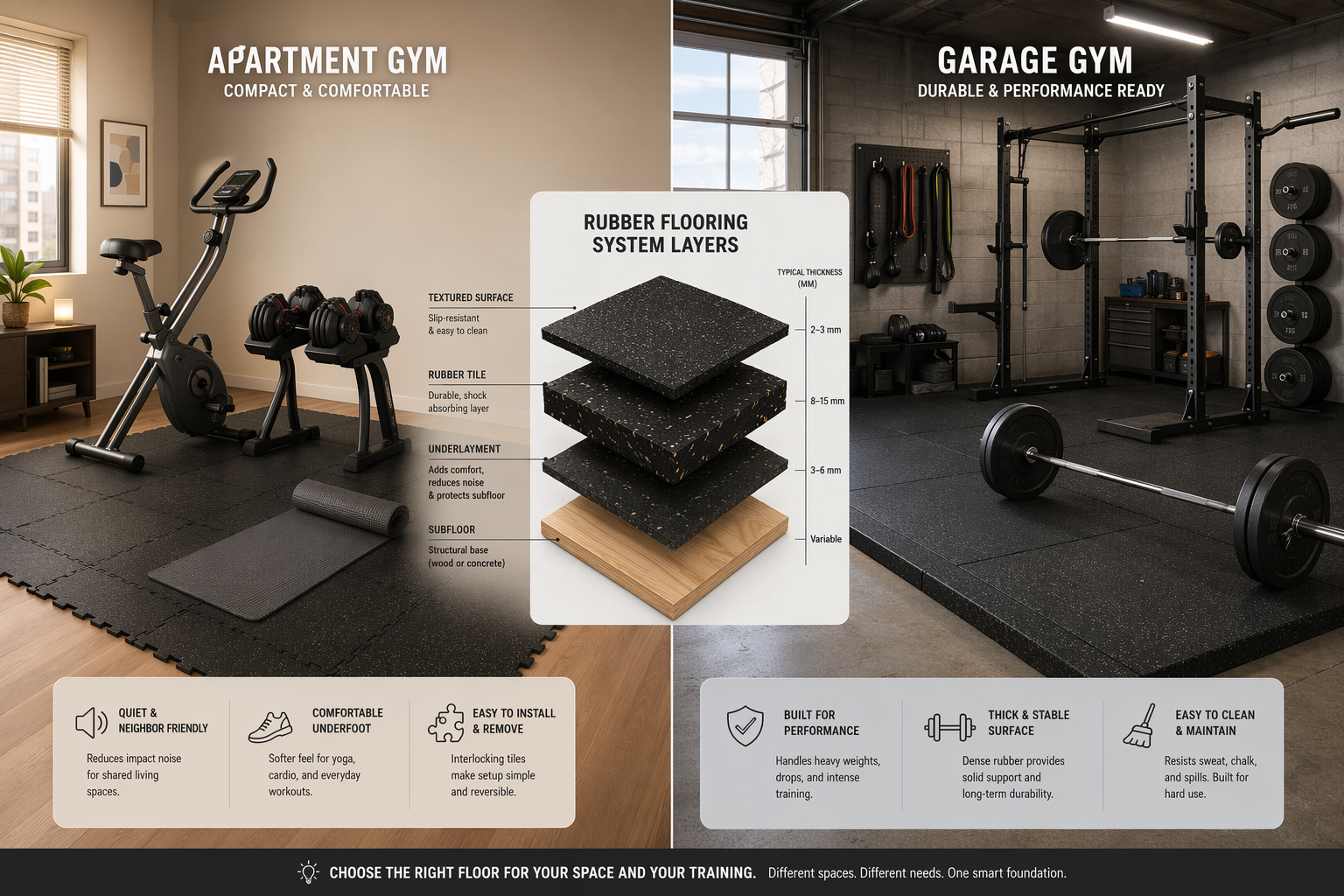
Rubber's density is what does the work. For upstairs apartments, the advice from Iron Company is clear: use 3/8″–1/2″ rubber over an acoustic underlayment. The rubber alone helps; the underlayment cuts the impact noise that travels through the joists. Without it, your neighbor still hears every rep.
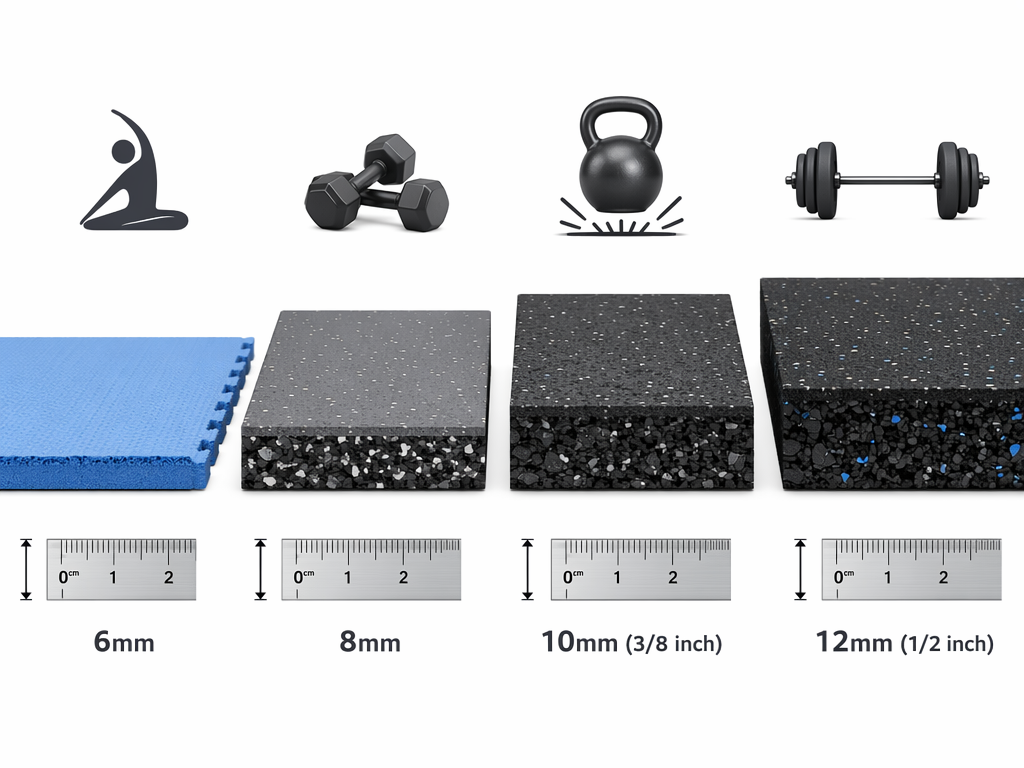
Thickness depends on what you do. For bodyweight and dumbbells up to 30–40 lbs — the realistic apartment workout — 8mm rubber is the starting point. That handles occasional set‑downs without transmitting a thud. Garage Gym Reviews calls 8mm the most common thickness for general fitness training. If you ever let go of a kettlebell or drop a dumbbell from standing height, go to 3/8″ (10mm) — the same source says 3/8″ is sufficient for strength training with occasional drops. 1/2″ (12mm) is only needed for barbell drops; most apartment dwellers do not need it. But remember: thickness alone does not fix impact noise. Even a 1/2″ rubber tile on bare subfloor still transmits vibration. Pair it with an acoustic underlayment if you are above the ground floor.
Three Options, One That Actually Works for Renters
The market offers three choices for a home gym floor: EVA foam tiles, interlocking rubber tiles, and horse stall mats. Here is how they stack up against the three renter constraints.
| Material | Price per sq ft | Noise isolation | Floor protection | Portability | Verdict for apartments |
|---|---|---|---|---|---|
| EVA foam tiles | $1.04–$1.50 | Poor | Fair – compresses under weight | Easy – lightweight | Yoga and bodyweight only; fails noise and durability |
| Interlocking rubber tiles | $5–$10 | Good | Excellent – dense, non‑marking | Excellent – tool‑free, no adhesive | Best all‑around for renters |
| Horse stall mats | ~$2.38 | Good | Good – but may mark hardwood | Terrible – 100+ lbs each, off‑gassing | Wrong for apartments – see below |
The foam tile numbers look tempting — ProsourceFit tiles come in at $1.12 per square foot. That price buys you quick compression under any real weight and minimal noise isolation. For yoga or push-ups, fine. For anything involving dumbbells, your neighbor will hear it and your floor will show permanent dents within months. Do not let the low per‑foot figure stand without that consequence. Living.Fit puts it plainly: rubber lasts decades under heavy equipment; foam compresses faster and degrades. That is the real cost of cheap foam.
Interlocking rubber tiles hit all three constraints. They are dense enough to absorb impact, they do not need adhesive (your deposit stays safe), and they come apart and move with you. Iron Company notes they have finished edges and allow single‑tile replacement — useful if a tile gets damaged during a move. The premium price ($5–$10 per square foot) is the only real downside, but for a small space the total material cost is manageable.
Horse stall mats are the darling of garage gyms. At around $2.38 per square foot from Tractor Supply, they are thick, durable, and cheap. But for an apartment, they are a trap. Each mat weighs about 100 pounds. I know because I carried one up two flights of stairs once. I will not do that again. Beyond the weight, they off‑gas a strong rubber smell that can linger for weeks. The uneven edges never fit together tightly, leaving gaps that collect dust. And if you lay them directly on hardwood, the black rubber can leave a mark that a landlord will notice at move‑out. Garage Gym Reviews and Iron Company both warn about the odor, weight, and edge fit issues. A mat you cannot carry alone, that smells for weeks, and leaves a black mark on your floor is simply the wrong product for anyone with a security deposit and a second‑floor apartment.
How to Install Without Losing Your Deposit
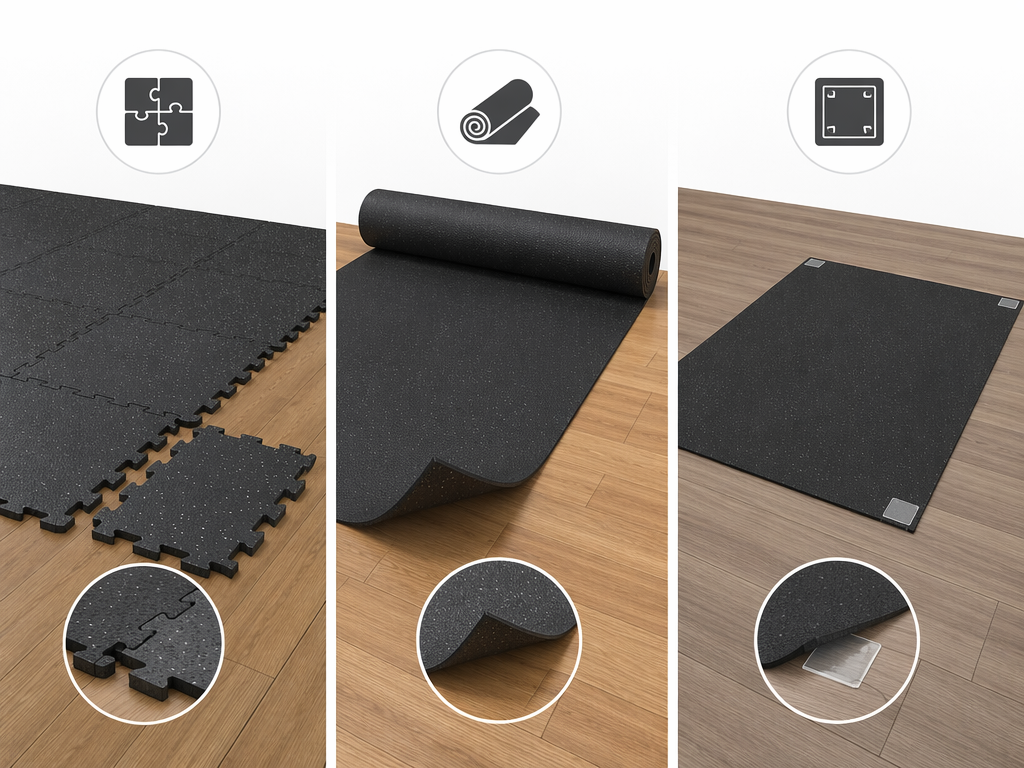
The installation method matters as much as the material. No adhesive, no screws, no permanent modifications. Three approaches work for renters:
- Interlocking system (puzzle edges). Most rubber tiles use this. No tools, no glue. If a tile gets damaged, you pull it out and replace it. Ideal for irregular room layouts.
- Loose‑lay. For full rubber sheets, just roll them out. The weight of the material and equipment holds them in place. Best under large equipment like a treadmill or elliptical.
- Double‑sided tape at seams. For foam tiles or thinner rubber, a few strips along the edges keep them from shifting. The tape comes off clean without residue.
A smart approach is the zone method: use a thin rubber mat under your stationary bike or treadmill (protects the floor, quiet enough), then a thicker interlocking tile area where you stand and set down dumbbells. That way you only buy the expensive material where you actually need it.
What You Should Actually Buy
For an apartment gym, interlocking rubber tiles are the clear winner. They pass all three renter constraints: they isolate noise well enough to keep the peace, they protect the floor without adhesive, and they come apart and move with you. Yes, they cost $5–$10 per square foot — but for a 6'x6' workout area, that is $180–$360. Less than a month's rent in many cities, and a fraction of what you would lose to a damaged deposit or a neighbor complaint.
If your budget is under $30 total and all you do is yoga and stretching, the AmazonBasics EVA foam tiles at ~$1.04 per square foot will work — but you need to understand what you are not getting: no noise isolation, no durability under weight, no protection against a dropped dumbbell.
The decision is simple: if you might move, or if you have a security deposit on the line, buy interlocking rubber tiles. They check all three constraints without a permanent commitment. Everything else is a compromise you should only make if you fully understand what you are trading away.
Some links on this page are affiliate links — they may earn us a commission at no extra cost to you. Our tier and tests are decided before we ever check which links pay; see our full affiliate disclosure.
Spot something off?
Noise and floor-damage claims carry real deposit-risk consequences if we get them wrong — tell us if your experience with this build didn't match what's above.